

I’ve already posted quite a few times this year on the discourse surrounding data centres, including earlier this week where I wrote a post that highlighted the many economic benefits coming from data centres.
But in spite of my best efforts, and those of others including Andy Masley, and Noah Smith, data centres have become extremely unpopular with the American public:
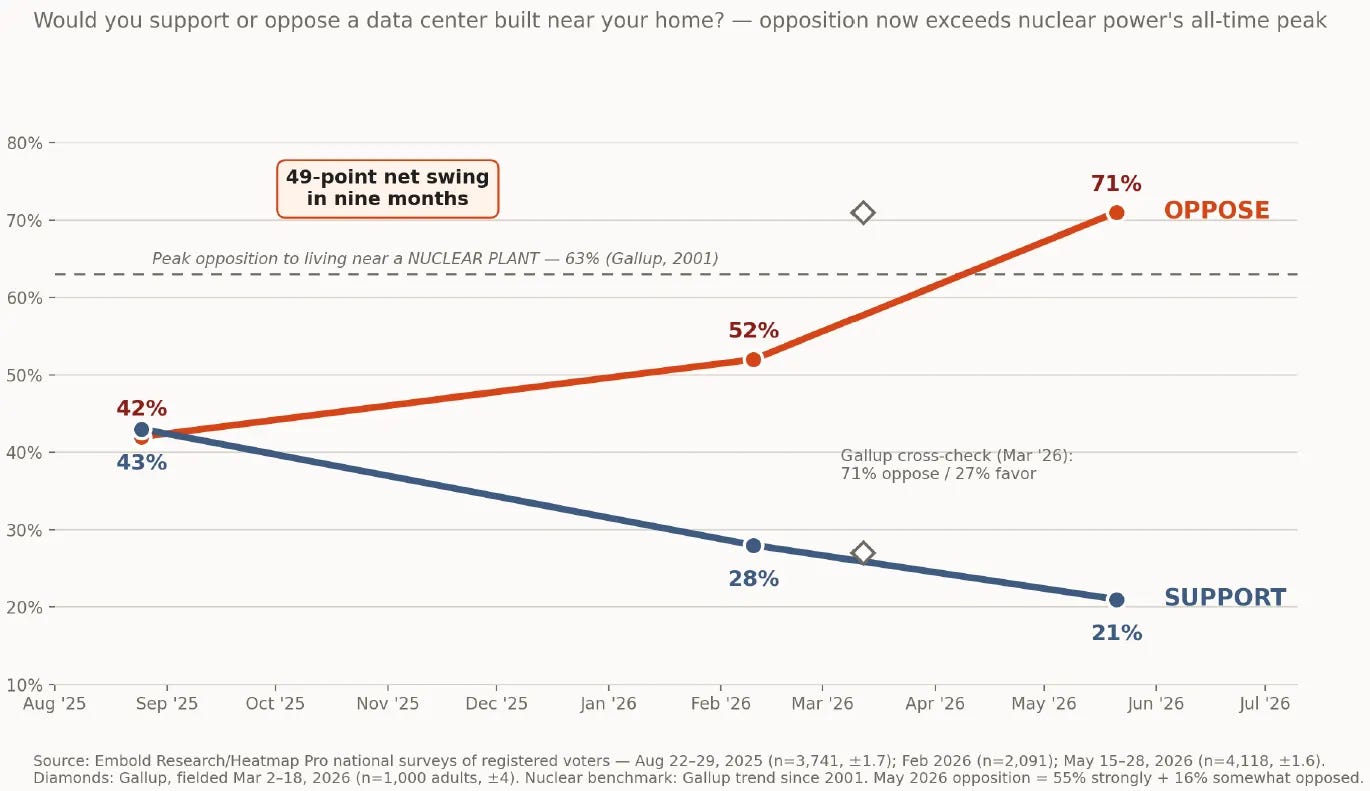
Multiple states are introducing measures to limit data centres:

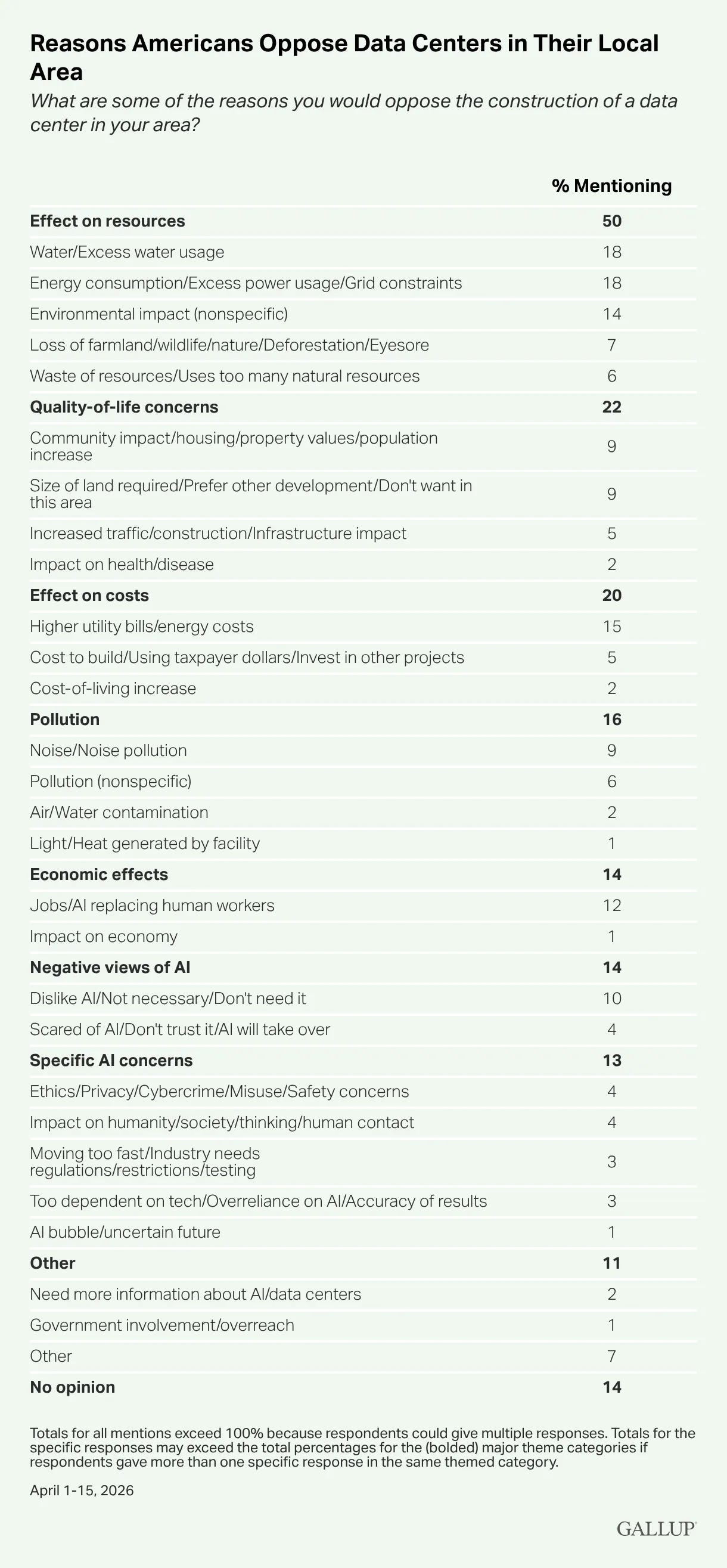
The public’s concerns are many and varied, but mostly are focused on resources and to a lesser extent “quality of life concerns” and costs:
What seems to be brewing is a new Luddite movement. As I wrote in February:
The new Luddite movement today, like the old Luddite movement is reacting to a new technology, and the waves of social change that are rippling around it. It’s a coalition: some artists, some union people, a few researchers, and many ordinary users, all reacting to the same mood—that the rollout of AI is severely disrupting society, or at least that it has the potential to do so.
Fear of AI is exploding. The Atlantic—who I have previously written for—published this piece in June:
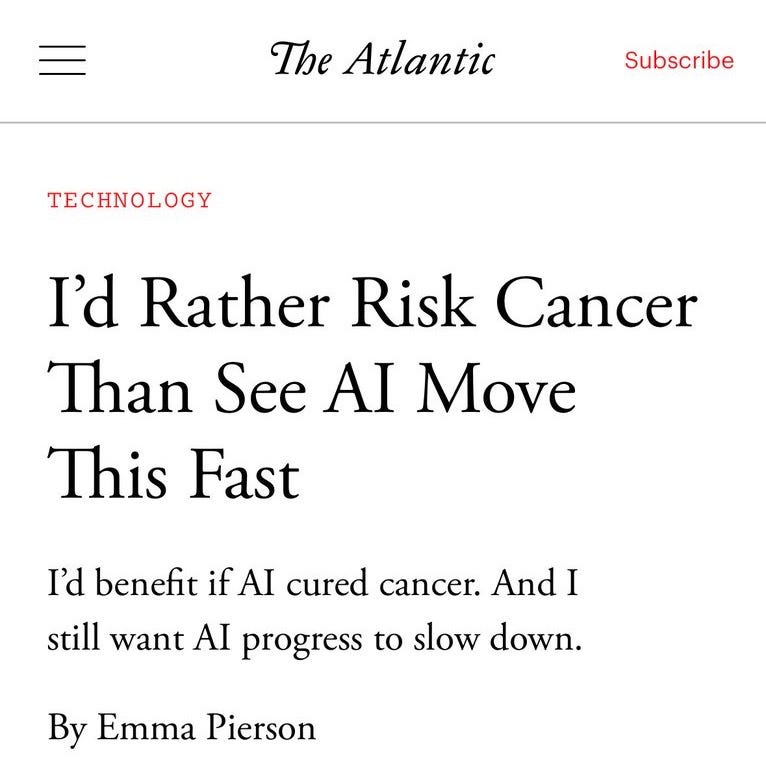
The author—who is a computer science professor at UC Berkeley, so by no means non-technical—is so concerned about the development of AI that she thinks that even if it cured cancer it is still necessary to slow down the development of it. Why? Well, she is concerned about “mass unemployment, skyrocketing inequality, repressive surveillance, and autonomous warfare.”
She also worries about the danger of AI replacing humans in fields like writing and therapy. She writes:
“I will be heartbroken when a chatbot can extract my innermost feelings and, having gorged itself on the words of a million artists, regurgitate Fitzgerald-worthy prose I cannot match. For me, writing is a process bound up in self-discovery and human connection. My sister suggested the idea for this essay; my wife, seeing me suddenly and deeply sad as I reflected on it, touched my cheek, offering a comfort that no AI therapist could.”
I think all of these things are valid concerns.
But the reality is that the race for artificial superintelligence is going to be won soon. The question is: who is going to win it?
If Americans slow down the development of AI, and China doesn’t, then China will have a huge advantage in repressive surveillance and autonomous warfare. There will still be repressive surveillance and autonomous warfare, of course. And America—and the West—will now be on the back foot against someone else’s AI-powered advantage.
As for inequality and mass unemployment, well, those are human problems. Governments have tools to deal with those things, such as via universal basic income, or a job guarantee system where the government (perhaps aided by companies that have benefited from AI) could directly employ unemployed people.
But what I really think is that the Lump of Labour Fallacy is still a fallacy. I suspect that the acceleration of AI will actually create a lot of jobs. This is because AI is a force multiplier. If I have a hundred robots who can help me to produce things, then I can produce a lot more than I can by myself.
The question of whether a person can work like that is their resources to do so, or if they are lacking in resources, then it depends on whether or not they can get credit.
Human wants are essentially unquenchable. They don’t settle after a certain amount of consumption. They are expansive. Once we come to rule over and dominate our surroundings, our ambition moves to the next horizon.
We see this already today: very rich people like Elon Musk and Jeff Bezos want to leave Earth, and colonise outer-space.
The Star Trek series (which I love) has a tagline of: “Space: the Final Frontier”.
But of course, space is not one frontier. It’s a series of frontiers: each bigger than the last. Leaving Earth and building infrastructure in orbit and on the Moon is one frontier. Going to Mars and terraforming and building there is another frontier. Conquering the Moons of Jupiter and Saturn is another. So it conquering the Kuiper Belt, and Oort Cloud. And then beyond that there are billions of stars in our galaxy, and billions of galaxies in the observable universe. And there may well be more universes and frontiers even beyond our own universe.

AI-powered automated robotics will be the fuel for this crusade.
Another frontier, of course, is human longevity and curing all diseases. There are already biologically immortal creatures in nature. These include certain jellfyish and flatworms:

There are plenty of avenues already being pursued towards longevity escape velocity, and regenerative medicine that could allow humans to effectively live forever (so long as they don’t die in an accident or other such freak event). Using AI to provide personalised medicine is one of these.
So here’s my theory: public anger at data centres, AI, robotics, drones, regenerative medicine, and space exploration may continue to rise.
But at the end of the day, technology is very hard to stop. Large corporations are powerful. People like Elon Musk and Jeff Bezos aren’t just going to stop their advances.
And at some point the benefits of all of this technological growth will become undeniable. Because these technologies will massively help people in huge numbers of ways.
As I wrote earlier this month:
The washing machine became beloved (or at least well-appreciated) because it greatly reduced hours of hard labour. For context, washing clothes by hand is both time consuming and also tremendously labour-intensive and tough on a person’s hands. The dishwasher became popular in much the same way. Less drudgery. Less labour. More free time. People like that.
Household robotics can also give us less drudgery. And more free time.
Few people dream of spending their Saturday clearing hair from a drain, or scrubbing their kitchen floor. Most people, I wager, would prefer a robot to do that, if the robot can do it consistently and safely. Most people, I wager, would appreciate a robot that cleans the streets, and picks up trash.
Public resistance could ease when AI delivers visible benefits in the physical world.
No posts
Comments
Nothing yet. Say the first thing.
Sign in to join the conversation.