

I think many people remember where they were when Usain Bolt ran the 100m in 9.58 seconds in Berlin in 2009.
I don’t quite remember where I was, but I remember watching the race.
It was a momentous performance that made waves far beyond the sphere of athletics.
Bolt didn’t even dip on the line. He didn’t even seem to be running flat out. Many people believed that he could run faster even than 9.58.
But he never did, in the end.
9.58 seconds is still the world record for a human today.
But for a humanoid robot?
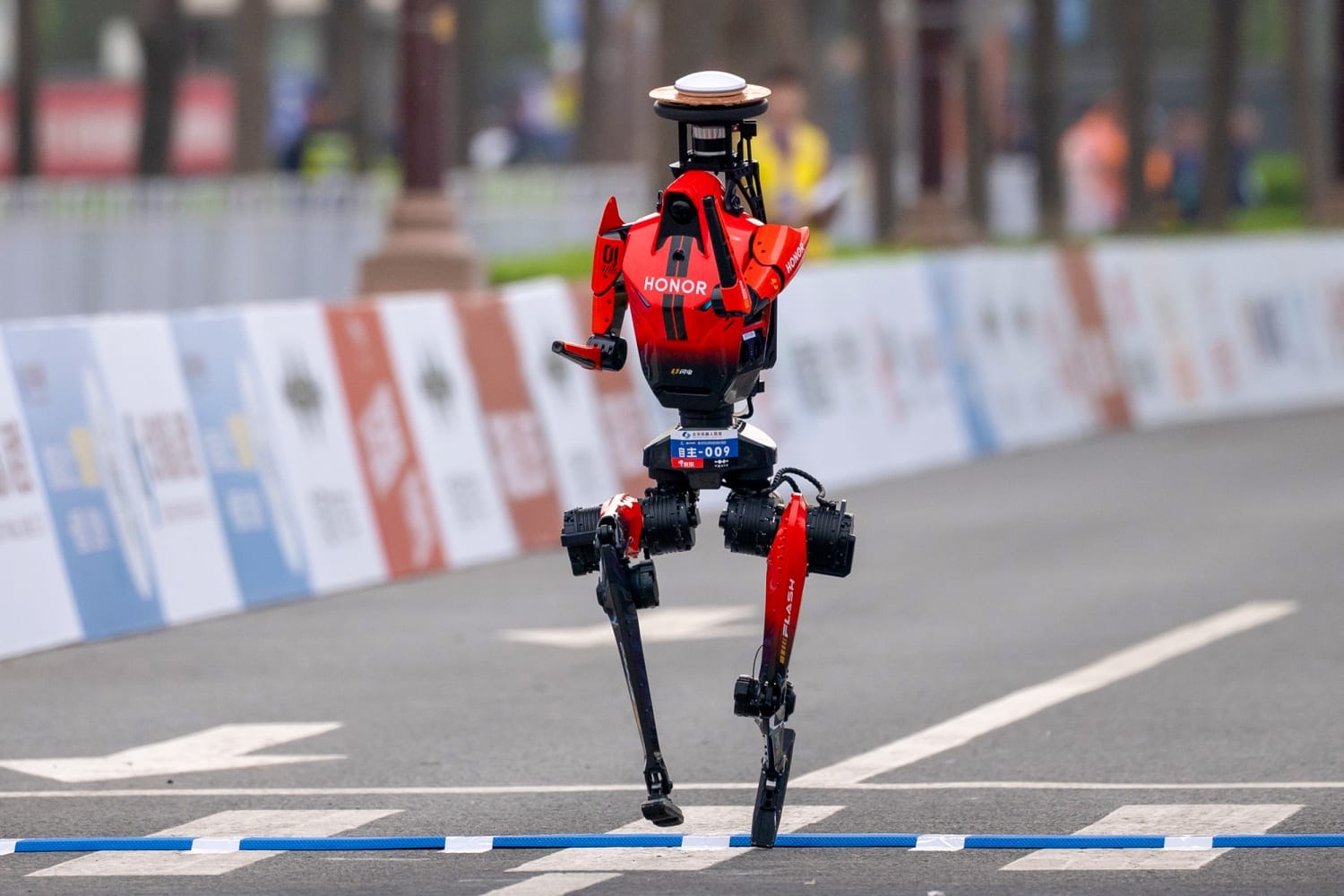
No, a humanoid robot can run faster. Today, one ran the 100m in 9.32 seconds.

Trung Phan@TrungTPhan
Chinese humanoid robot by smartphone maker Honor (“Lightning”) ran 100m in 9.32 seconds (Usain Bolt’s record is 9.58 seconds). Perhaps more impressively: it crashed into a safety wall without having its waist implode with sparks flying off.
3:19 PM · Aug 22, 2026 · 828K Views
318 Replies · 403 Reposts · 2.77K Likes
I don’t want to downplay the greatness of Bolt’s achievement, but in a sense having a humanoid robot running faster than the fastest human is an even more momentous achievement.
Bolt’s run was the culmination of a lifetime of preparation: training, nutrition, planning, tactics, strategy.

This machine, meanwhile, is the culmination of millennia of human scientific and technological progress.
Of course, humans invented much faster machines long ago, like cars and planes.
So for a machine, this machine still isn’t that fast.
And, yes, there are much faster animals. Cheetahs, horses, lions, ostriches, and even dogs (specifically, greyhounds) have all run the 100m faster than Bolt, too.

But a humanoid robot is a different proposition altogether. We are reaching a new stage of technological industry, where humanoid robots become commonplace. They are going to take on a vast number of different roles in human society.
Like with artificial intelligence, I view robots as a tool and as a force multiplier. Their job is not to replace humans. (And it was actually very naive for some within the AI industry to try and claim that AI could replace humans). Their real role is to augment what humans can already do, and to take over tasks that human beings find too difficult or punishing.
Nobody wants to swim through a sewer to unclog it, for example. Nobody wants to face life-threatening radiation in somewhere like Chernobyl. Very few people enjoy tedious and repetitious tasks like scrubbing the floor, hauling boxes, or sorting recyclables.
Robots can do all of that—and humans can direct them, and reap the rewards.
Automation is going to change the world. Human labour is not going to be a limiting factor in what can be produced anymore.
This is going to unleash a whirlwind of productivity, and industry.
A single person with 50 programmable machines to assist him or her can produce a lot more than an individual without those machines.
The fact that these robots will all very soon be able to run faster than Bolt is symbolically significant. But for most things that robots will do, they won’t need to run that fast.
At the same event, another robot also obliterated the human record for the high jump:

智东西China AI News@Chinazhidx
🚨A humanoid robot just beats human at the high jump TienKung cleared 2.8843 meters in the standing high jump — surpassing the 2.45-meter best mark recorded by human men #WorldHumanoidRobotGames

智东西China AI News @Chinazhidx
🚨The humanoid robot sports games just wrapped up a fully autonomous 7v7 soccer match. Booster Evolution won 3-1 on penalties against Booster Acceleration After scoring, one robot even waved to celebrate with its teammates🤖⚽️ Both teams are from @boosterobotics #RobotSoccer
12:34 PM · Aug 22, 2026 · 45.1K Views
8 Replies · 78 Reposts · 525 Likes
For future generations, the fact that humanoid robots can outrun and out-jump us will probably seem pretty mundane.
But I suspect nobody will care very much about that.
It won’t be any kind of competition.
Because, as I said, robots are a tool. They’re not our competitor. They do work for us.
If anything—if running so fast is so tremendously important—we can adapt these technologies to build exo-skeletons for humans.
No posts
Comments
Nothing yet. Say the first thing.
Sign in to join the conversation.