
We live in a former factory building, alongside a canal. Back in the 19th Century, when the canal was used for transport, old photos show the banks trimmed down to the dirt and hardly a tree growing there.
But in the 20th Century, when the factory closed and the canal became an industrial relic, successive owners let nature take its course. By the time we moved in, the soil had rewilded into a hoary mat of mile-a-minute, ivy, garlic mustard, and a million other invasives.
It’s been a pet project of mine to replace the hoary mat with a tidier garden of (mostly) native, non-invasive plants. The challenges I’ve encountered have been annoying and intimidating, yet also instructive. From weeds to wildlife, my outdoor enemies have taught me not only about gardening, but life.
All weeds are a nuisance to any gardener but the one that really sticks in my craw is Canadian Goldenrod, that shaggy yellow bloomer. Some find it attractive, but to me, its flop-topped habit is the botanical version of a dorky 80’s Flock-of-Seagulls haircut. Technically, it’s not a weed but a North American native. And technically, it’s not invasive but what experts like to call a “vigorous spreader.”
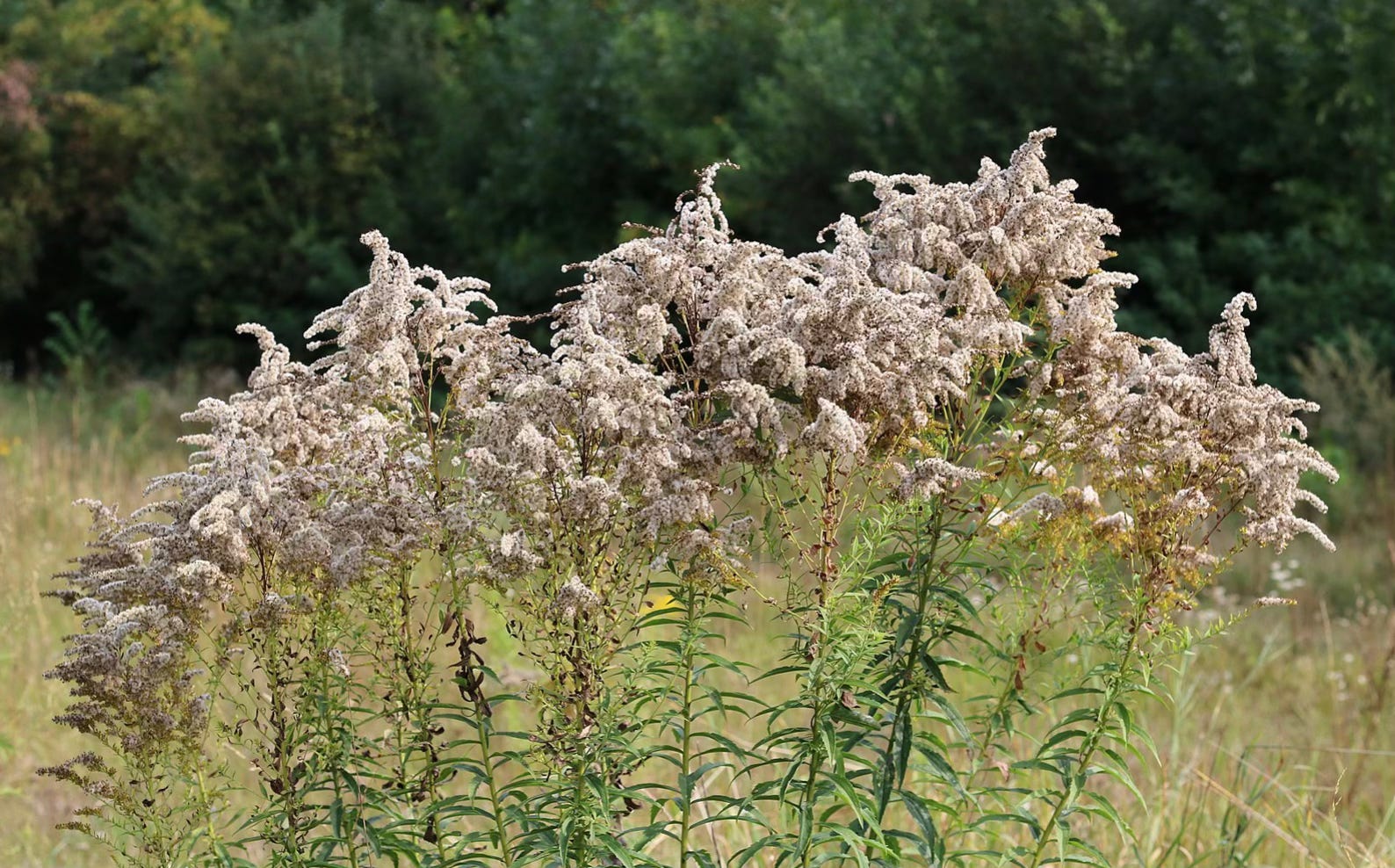
Well, here’s my “lived experience”: When you want to clear a patch for whatever reason (sheer aesthetics, in my case), whatever happens to be growing there is an invasive weed. This is doubly so when what’s growing there is Canadian Goldenrod.
Other weeds have the courtesy to unroot with one single-handed tug. But Canadian Goldenrod, like the odious dandelion, is a stubborn mofo that needs to be dug out. What makes this task a bear is that — unlike the dandelion with its lone taproot — goldenrod has rhizomes, underground stems that send out roots and shoots horizontally, like a web. In digging it out, you inevitably sever some of the rhizomes and leave their stumps behind in the soil. These stumps don’t wither and die but rather, through the miracle of asexual reproduction, sprout new shoots and roots for the next generation of goldenrod.
I try to extract goldenrod like a dermatologist excising a melanoma: I dig deep and wide to make sure the stuff is out. But it’s never out. No matter how careful and thorough my weeding, I’ll miss one little node. And in a matter of weeks, that one little node will generate an entire fresh colony of goldenrod. I will always be clearing Canadian Goldenrod. It is maddening.
Yet after years of battling goldenrod, I have come to respect it not only as an enemy but as a teacher.
Canadian Goldenrod has an uncanny knack for survival. Storms occasionally flood the canal banks, washing away vegetation with shallower, wimpier roots. But goldenrod’s interlocking rhizomes act as a sturdy net, anchoring it to earth. Come what may, it’s not going anywhere.
This is the lesson of goldenrod, one we’d all do well to follow: To increase your odds of weathering what storms may pass, form networks. Ideally, roots should not only be deep but also wide and connected. Some roots will be thick and foundational, such as family, friends, and worship communities. Others will be thinner and more fragile — perhaps work colleagues, or the regulars at your gym.
But take it from rhizomes: small roots buttress large ones, and vice versa, for the good of the organism in the long-haul. It’s all the more reason to sign up for the group class you’re intimidated to take, or attend the party where you know barely anyone, or call the old friend you haven’t spoken to for years. Doing so may be a waste of time. But it may just as easily be a way to build the matrix of human connection that will ultimately sustain you.
I am seriously afraid of snakes. I have no rational reason for my phobia; it just is. Snakes are Boschian demons that slithered up from the underworld, just to terrorize me for sport.
So you can understand my reaction when I was climbing down to the canal bed to perform some weeding and this thing stopped me dead in my tracks:
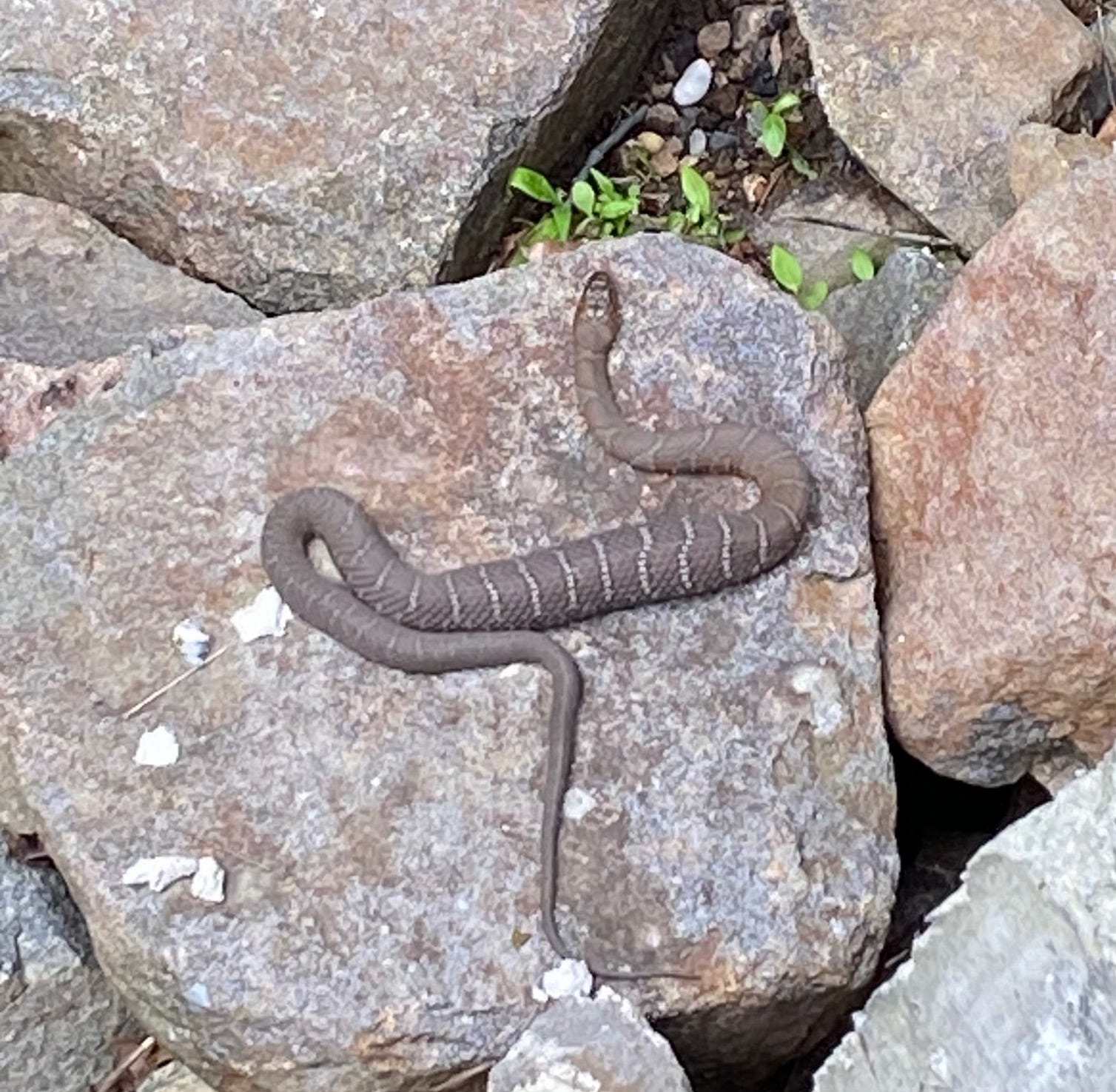
There it was, sunning itself on its perch above the water (snakes are things to me and hence genderless). Just an unholy, fleshy rope, with a bulge in the gut suggesting it had recently downed a frog. When it spied me, the whole 26 inches of it slid down the rocks and into the canal, where it swam off in a series of rippling, S-shaped curves. The internet tells me this is “lateral undulation”, and it is skin-crawling to watch.
I named it Hissyface. That snake might strike the fear of God in me, but I can give it a stupid name. So HAH!
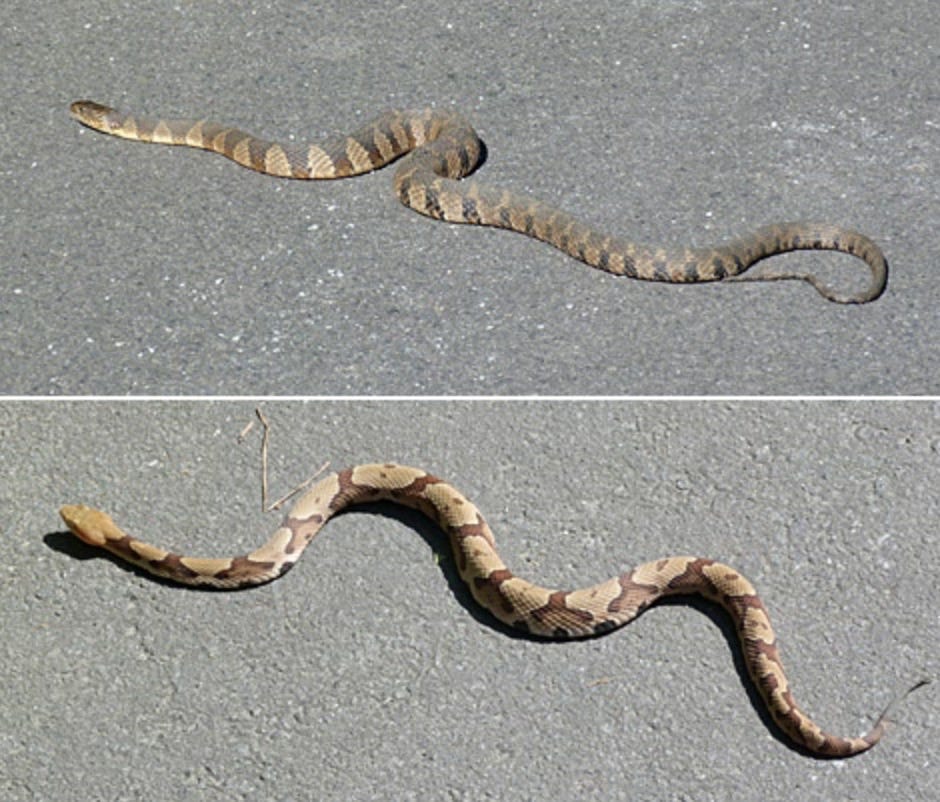
Initially I thought Hissyface was a copperhead, based on its color and the banded pattern of its scales — not to mention the fact that a copperhead recently struck a hiker in the hills above our place, sending him to the hospital for antivenom. I vowed I was never going near that part of the canal again and abandoned any plans to clear it of loosestrife (pretty, but invasive).
Now, you hawk-eyed herpetologists might laugh at my mistake, as it turns out Hissyface is a common Northern water snake — non-venomous, although they can get bitey when cornered. But can you blame me? As this side-by-side comparison photo shows, it’s not always easy to differentiate a copperhead from a water snake from a generous distance:
And this is where my nemesis Hissyface has some valuable wisdom to impart.
The Northern water snake is not a copperhead but it evolved to look like one to scare off potential predators. What’s more, when actually threatened, the water snake turbocharges the mimicry by flattening its head to resemble the spade-shaped head of a venomous snake. You can watch the transformation in this video (the kid miraculously goes unscathed despite subjecting the water snake to a goodly amount of tugging and prodding).
The lesson here is that it’s often advantageous to project strength you may not necessarily possess. In poker it’s called “bluffing”, but the water snake’s defensive behavior is not mere bluster. It primes its body and reptilian brain for action, for the rapid strike that may be necessary.
That’s excellent survival advice, even when the threat at hand isn’t existential but prosaic: say, publicly addressing a less-than-sympathetic audience, or having a face-to-face argument with the boss about that non-compete clause in your contract, or driving through a torrential storm while your kids are freaking out in the back seat and you’re secretly pretty panicked yourself.
In these instances, follow Hissyface’s lead and physically project strength with a straight spine, squared shoulders, and direct gaze. Your Mom was annoyingly right on this one: no slouching and make eye contact. By mimicking strength, you are priming your body and mind for action, funneling that cortisone spike so that it’s more likely you will do the necessary-but-unpleasant thing rather than fleeing for safety. And once you do the necessary-but-unpleasant thing, you will actually possess more power, even if it’s simply the bare knowledge that necessary-but-unpleasant things are eminently survivable.
These days Hissyface doesn’t deter me. If I see it sunning on its perch, I fake confidence and descend to the canal with calm, even steps, then get to work pulling that loosestrife. I keep one eye on Hissyface and we both give each other a wide berth. That snake still gives me the willies, but by pretending that it doesn’t, my willies are incrementally less willy. I’ll take that as a win.
We used to have a redbud tree, not far from the canal. When I planted the redbud it was a stick, not much wider than my thumb, with just a few bare, twiggy branches. But luckily, it leafed out and survived, growing eight foot tall and nearly as wide. In the spring it would burst into masses of pink blooms that turned into heart-shaped leaves come summer. Come fall, the leaves put on a brilliant display of color before they dropped. It loved that redbud. It was a pretty tree.
One morning in late March, when trees were just beginning to bud, I rose and took our dogs outside to do their business. As I groggily followed them along the canal bank, something seemed off. The universe seemed hinky, like there’d been a Disturbance in the Force.
Then I turned to find a pointy stump where my redbud had been. My beautiful tree now looked like the nub of a crudely shaved pencil. A thick mulch of wood chips encircled the stump, along with bits of chewed branches. Horrified, I scanned the canal for the culprit, but found only clues. Flattened grass where tree limbs had been towed to the water. Dainty paw prints in the mud, trailed by a flat groove that could only have been made by a dragging tail.
A beaver had taken my redbud. He had felled my favorite tree. And what’s more, he was just getting started.
From there on out, every morning was like waking up to a crime scene. The expensive Japanese maple with the lacy leaves? Lopped down to a quarter of its size. The young spruce tree with the silver-green needles? All its limbs sheared off, as if it had been run through the lumber mill. The junipers I’d just planted? Yanked out of the ground, leaving nothing but the holes.
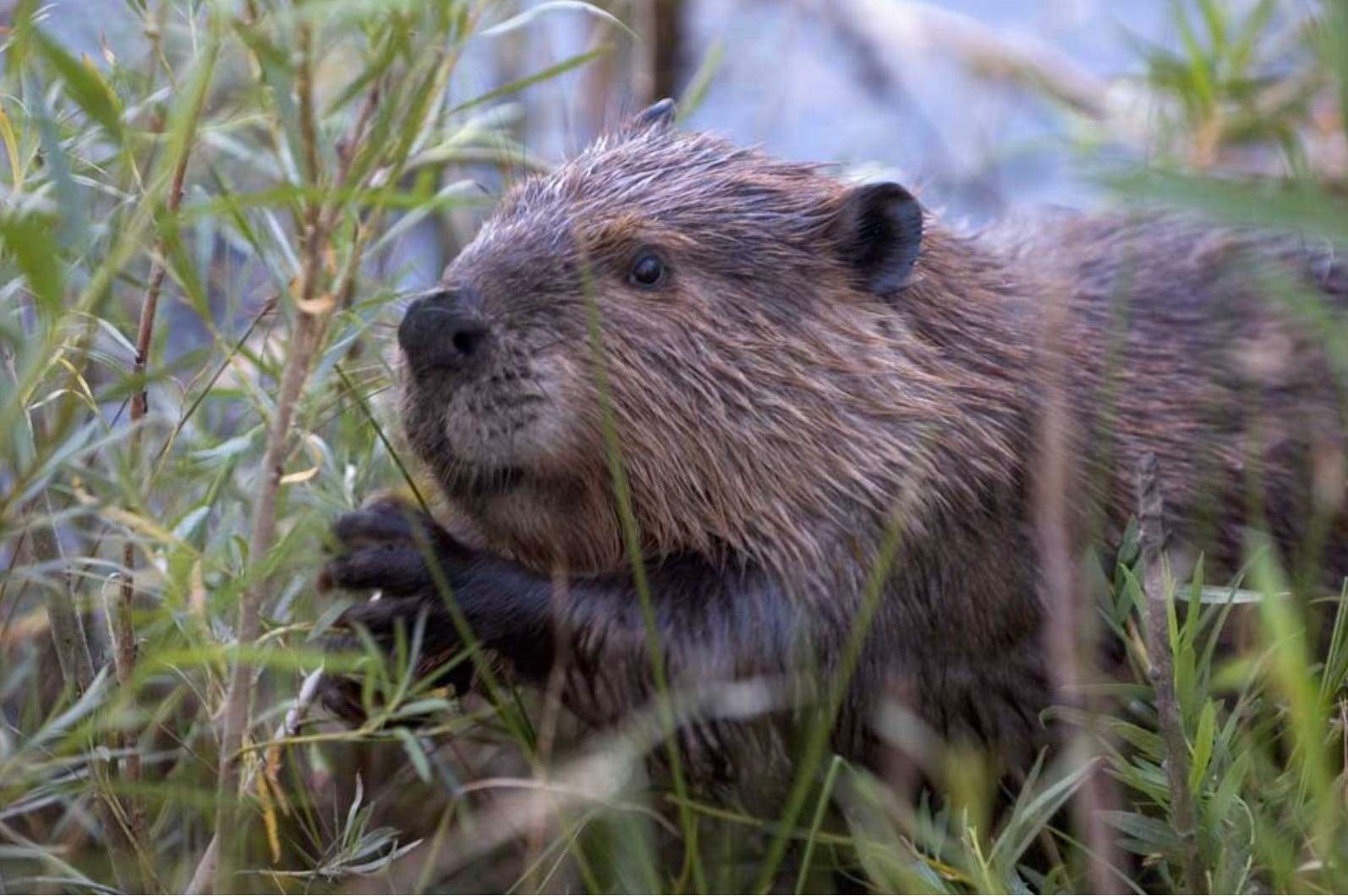
This beaver was unstoppable. Even worse, he had no fear. My husband and I were sitting outside on the canal one evening when said beaver casually waddled by us, as if we were just the low-paid employees keeping the buffet stocked for the VIP guests. He gave us one “zero-f***s-given” glance, then got to work munching down some stems. We named him “Chonker.”
At this point it was still early spring. Based on the trees and shrubs Chonker had taken out, I knew it was pointless to replace them with anything with a nice, fleshy bark he could eat, or nice, sturdy branches he could use for his dam. Speaking of dams, I never located Chonker’s, but I spied his lodge on the canal, about a quarter mile south of us. It was a muddy dome stacked with tree limbs, and when I squinted I was positive I spotted the remains of my redbud sticking out of the pile.
Chonker had worked hard building that lodge, that was certain. It was also certain that he hadn’t destroyed my landscaping out of malice. Beavers are gonna beave, after all. Besides, he was pretty cute, especially when you caught him on one of his evening swims:
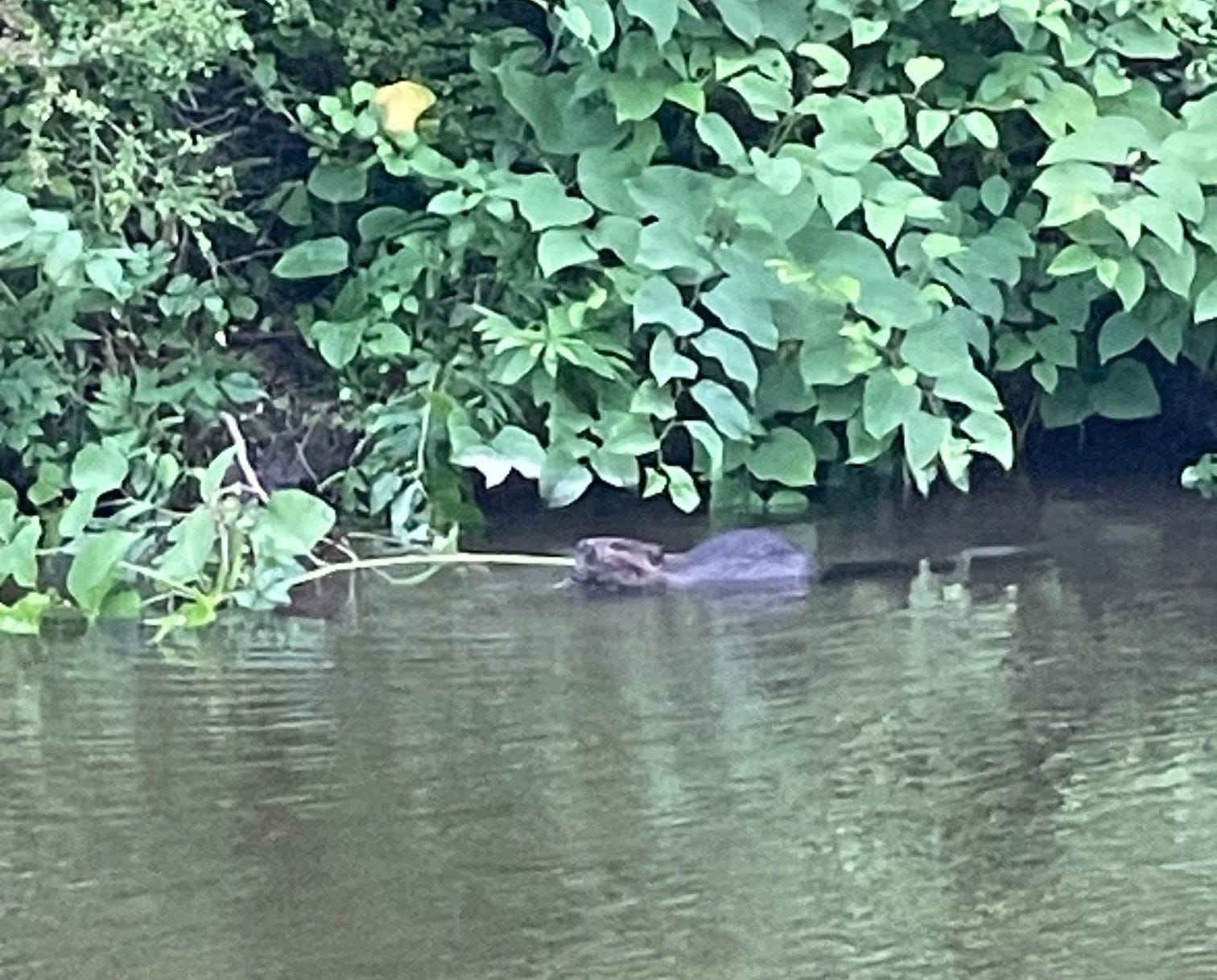
Fine, I thought to myself. Chonker and I can co-exist. I’ll just replace the trees and shrubs with perennials. No bark, no branches . . . no problem!
So I planted a bunch of yarrow and coneflower — tough perennials that bloom prettily, and pollinators to boot. They grew steadily through the spring then, due to a wetter-than-normal summer, really took off. The coneflower, in particular, brightened the canal banks with its big magenta heads.
But in August, when the rest of the landscape was starting to turn dry and crispy, Chonker returned in the night and ate all my babies. And when I say “ate all,” I mean he devoured every single yarrow and coneflower, down to the roots.
This was not supposed to happen. Trees and shrubs were fair game, but he was not supposed to touch my flowers. I clenched my fists and let out a scream to rival Shatner’s in Wrath of Kahn: CHONKERRRRR!
At this point — belatedly, unfortunately — I learned that beavers are “generalist” herbivores, which is a fancy way of saying they’ll eat the best plants available to them. In the spring, they can have their pick of the soft, chewy bark on new tree growth. But as the summer turns to fall, when bark hardens and vegetation dies, they are far less choosy. As this author puts it: “Any green leafy edible plant may fill the bill for a hungry beaver.”
This was a disappointing revelation, to put it mildly. Yet there’s a powerful insight in the beaver’s feeding habits.
So often we hold out for the ideal — the dream job, the dream house, the dream partner. To do otherwise is considered “settling” and an affront to our integrity. But perfect shouldn’t become the enemy of the good, or even the “pretty good.” In Chonker’s case, holding out for the ideal — say, some delicious fresh willow bark — means starving. For us, the consequences are far less dire, but they’re still there. Perhaps rejecting a sub-optimal job offer causes an unflattering employment gap to appear on your resume, one that hinders your search for the job you really want. Or breezing past someone on Hinge because you didn’t like one part of his profile, ignoring all the parts you do like, causes you to overlook someone who would be really great for you.
Be like Chonker: a flexible opportunist, willing to nibble on something outside your preferred choice or even comfort zone. Realize there are seasons to life, some abundant, some scarce. And that there’s no shame in “second best” if that’s what keeps you going.
But please, please, please, don’t eat my plants.
Thanks for reading! If you enjoyed this post, please feel free to share!
No posts
Comments
Nothing yet. Say the first thing.
Sign in to join the conversation.