
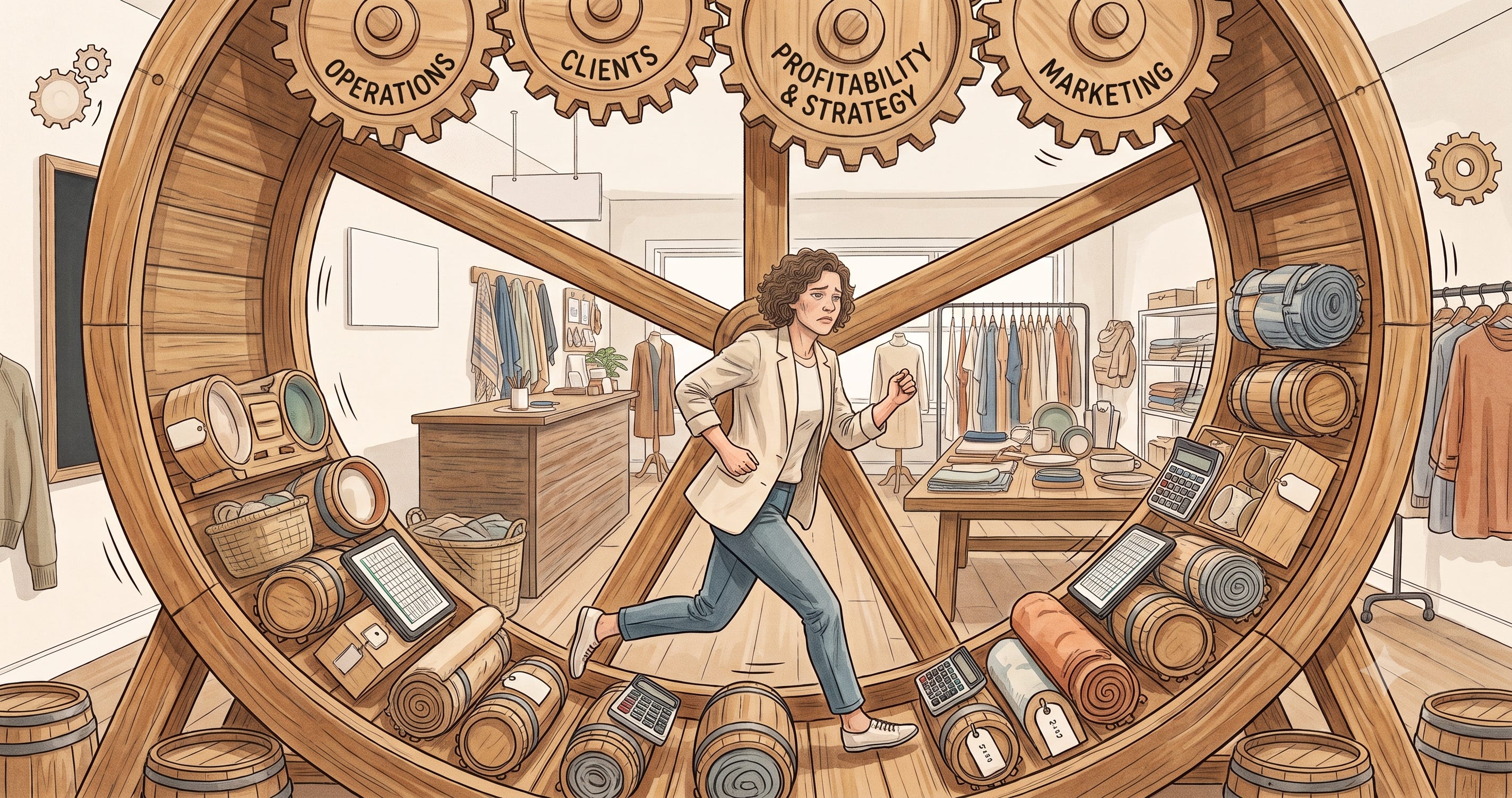
I want to tell you a story about a business owner who was doing everything right and still couldn’t get ahead.
She was signing clients consistently. Revenue was growing. The team was expanding. By every external measure, things were working.
And yet every month felt like a scramble. There were no flex funds. No breathing room. No sense that the pressure was lifting — in fact, the more she sold, the heavier things felt. More clients meant more overhead, more payroll, more responsibility, and somehow, never more peace.
That business owner was me.
The number I chose and why it was wrong
When I started The Profitability Project, I priced my services based on the hourly rate I’d earned at my day job.
It felt logical at the time. I (thought I) knew what my time was worth. I had a number, so I used it.
What I didn’t account for — and this is almost embarrassing to admit as a finance person — was overhead. The software subscriptions and the insurance and the time spent on admin and sales and the benefits I was no longer getting from an employer. The cost of building something, not just doing something.
I was charging what I’d been paid as an employee and trying to run a company on it.
So I ran faster. We signed more clients, we brought in more revenue, and we stayed exactly as stretched as we’d always been, because the problem wasn’t the volume. The problem was the price.
The Disneyland budget
The first conversation that changed everything wasn’t with a financial advisor or a business coach. It was with my sister — who is so far from a finance person she’s actually an expert in marketing.
She sat me down and made me do something I’d never actually done: build a budget from the life I wanted, not the one I was surviving.
She had me list every expense if I was paying myself and my team what we actually deserved. Benefits. Bonuses. Client gifts — the gifts I’d always wanted to send but quietly cut every time cash got tight. A team retreat, which had been a dream since the beginning. Christmas bonuses. All the little things I’d filed under “someday.”
She called it our Disneyland budget. Not a fantasy or some a greedy wish list — just the version of this business where we got to do the things we’d always said we would do when things settled down.
I was bringing in a fifth of what I needed to fund that budget.
It finally clicked: if I sold five times more, I’d have to hire five times the help, and we’d be worse off financially then we were then. I needed to have five times the revenue with the team I had today.
I could either work that team to the bone (more than I already was), or I could increase prices.
I’ll be honest: I’m still working up the courage to charge what that budget actually requires. But that conversation cracked something open. For the first time, I wasn’t looking at my prices in a vacuum. I was looking at them against something real — and the gap was impossible to ignore.
The ultimatum
The second conversation was less gentle.
A mentor of mine looked at my numbers, looked at my prices, and told me plainly: if I didn’t raise them, I was going to go out of business.
Then she told me to triple them.
I did not triple them because I am a human who cannot take her own advice.
But I did finally raise them — more than I was comfortable with, more than felt safe, more than the scared version of me thought was justified.
And something happened that I did not expect.
We sold more clients than we ever had before.
The clients who said no? They were going to say no anyway — and they weren’t the clients who were going to value what we did. The clients who said yes did so without flinching, because the price we were charging finally matched the service we were actually delivering.
Turns out, the people weren’t saying no because I was too expensive.
That was entirely in my head.
What the hamster wheel is actually telling you
If you’re in the version of this story I was in — growing, busy, signing clients, and still feeling like you’re barely keeping up — I want you to hear this:
The hamster wheel is not a hustle problem. It’s a pricing problem.
You can run faster. You can sign more clients. You can grind through another quarter with your head down and your fingers crossed.
Or you can look at the number on your invoice and ask yourself honestly: is this built for the business I want, or the business I’m afraid to want?
Your sister might be the one to ask. Your mentor might be the one to push you. But the conversation has to happen — because the wheel doesn’t stop on its own.
Next essay: the tactical one. How to actually know if you’re underpriced, what to look at, and what to do about it.
The Profitability Project helps small business owners stop guessing and start knowing — bookkeeping, tax, payroll, fractional CFO, and everything in between. Not your dad’s CPA.
No posts
Comments
Nothing yet. Say the first thing.
Sign in to join the conversation.