
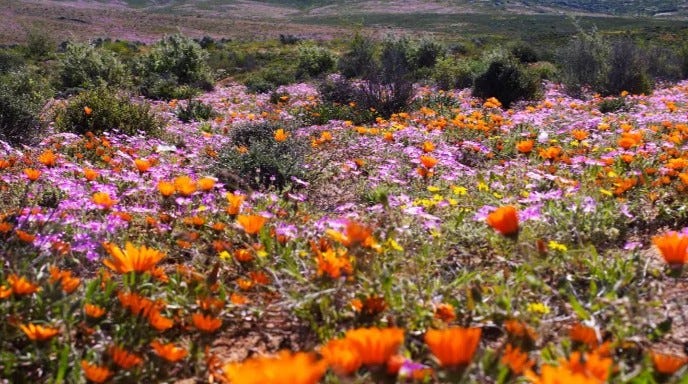
“African daisies” are daisies from Africa, of course. But not all the daisy-like flowering plants of Africa are called such. Only a few have acquired that common name.
I suppose pretty much any daisy-like flower can be called a “daisy” and if it’s from Africa, why not “African daisy?” In the most common (defined as being widespread among the gardening community) “common name” sense, the term “African daisy” encompasses particular species within several related genera, most notably Arctotis, Dimorphotheca, Gazania, Gerbera, Osteospermum, and Ursinia. It also includes an uncommon very un-daisy-like plant, Lonas annua. These genera are in the family Asteraceae (formerly Compositae).
In their native South Africa (except for Lonas), many of the species that we call “African daisies” are called “marigolds,” although the Afrikaner translation of such is varied.
The common names I’ve included with each species description here are everything BESIDES the “African Daisy” moniker. I’ve also had some fun adding the Afrikaans name for each species, because all but one of these entries is, as just noted, native to South Africa. Afrikaans is the fusion language that evolved during the deadly period of colonialism; it is now one of twelve official languages of the Republic of South Africa and is the most used for the common names of plants there.
Something that wasn’t so fun: while looking for translations of the Afrikaans names, I was often confused by very different translations of a word. “Gous,” for instance, might be gold/golden, goose, gooseberry, gorse, gourd, gown, horn, pod, rooster, or thistle. If somebody has further info on this, I’d be grateful if you can share.
Another particularly enigmatic Afrikaans word was “bietou,” which literally translates, now, to “beetroot.” Originally, and I suppose now by those who know, it is the Khoisan name for any daisy-family shrub.
The name “marigold” also comes into play here. It’s a leftover word from the English who first applied that common name (from “Mary’s gold”) to Calendula as early as the 1200s in Britain (the plant is originally from parts of southern Europe, the eastern Mediterranean, and adjacent arid or semi-arid areas). They would bring the word to South Africa during their colonization sometime between 1795 and 1806, applying it to just about any gold-colored daisy they found. [An aside: “marigold” was also applied to another golden-flowered species of plants that came to Britain from Mexico around 1573. This would be Tagetes patula, which would take on the full common name of “French marigold.” But not from France. The larger species, Tagetes erecta, would be named “African marigold.” But not from Africa.]
.
African daisies are an increasingly popular group of garden plants. What once started as “Southern California specialties,” these plants can now be found in every nursery in the country, plus Canada and the UK. Southern (and a good portion of the rest of) California has a Mediterranean climate, the same climate type as South Africa, where all of these species (except for Lonas annua) are found.
Other Mediterranean climate countries do, of course, have these plants in their gardens. Australia, with good portions of its country being Mediterranean, and parts of New Zealand put all of them into gardens many years ago and the plants were so happy there, they escaped and are now considered “Invasive.” Somewhat the same in California and a little bit in New Mexico and Arizona. It’s probably the same in other distinctly Mediterranean countries.
Outside of the Med climates, gardeners find them immodestly colorful and valuable as summer bedding and container plants. All of the species here, even the perennials and subshrubs), are almost always grown as annuals in colder zones (about USDA Zones 8 or 9 and colder).
Within the Med climates, most are grown as perennials (some are technically “subshrubs”) in the ground, particularly in the larger landscape where they became popular for “xeriscaping” (a term I’m uncomfortable with because of its common interpretation in gardens: sweeps of rock and pavement with plops of stark desert-approximating plants). With this mini-rant on xeriscaping aside, I suspect African daisies, with their built-in heat and drought tolerances, will become a larger part of popular horticulture for the next many drier years. Breeders, start your engines.
Their essential garden needs include all-day sun and a light soil (sandy, rocky is great*). They are happy with or at least happily tolerant of dry summer weather. Some are tolerant of occasional summer water. Too much rain, even and maybe especially during winter, leads to root rot. Where soils aren’t so light, plant on slopes. [* Gerbera is the one exception, preferring a richer loam.]
If you’ve never noticed, daisies, of almost every kind, need sunshine. Composite flowers, as a whole, tend to close in the late afternoon and night or in dull weather. This is called “nyctinasty,” and is a behavior found in a few other flowers. Fortunately, there are numerous cultivars that have been developed for garden use that stay open for longer.
Most do well in the salty air of coastal gardens (even in somewhat salty soil).
Although African daisies require no fertilization in the ground, they will need light feedings if planted in a “soil mix” in pots.
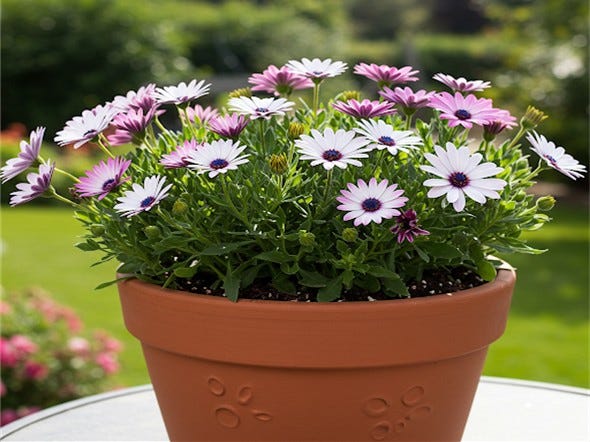
The annual types, especially those that are most often sown as with “wildflowers,” prefer to be sown direct, that is, their seed is put into the ground in the beginning; they dislike root disturbance, so it’s advisable to not sow seeds indoors in pots or trays. Most of these annuals can be grown almost anywhere, as fall-sown in Zones 8 (maybe 7) through 11 and as early spring sown in 5 (maybe 4?) through 7/8.
The perennials and subshrubs are quite suitable for propagation by cuttings.
Perennial species grown in containers will need infrequent, light applications of preferably organic fertilizer in time. They will also require regular watering; they are not so drought-tolerant in such limited space. Do check for moisture before watering, though; roots are more susceptible to rotting in containers.
Root rot is probably their number one issue. And root rot is caused, in most cases, by one thing: gardeners who water too frequently. Then there’s too much rain.
.
Some botanists still consider a few species of Arctotis as part of the genus Venidium. The consensus is that the name Venidium is no longer used as a separate genus in modern botanical classification. It does, however, remain in use in some horticultural contexts for certain cultivated forms.
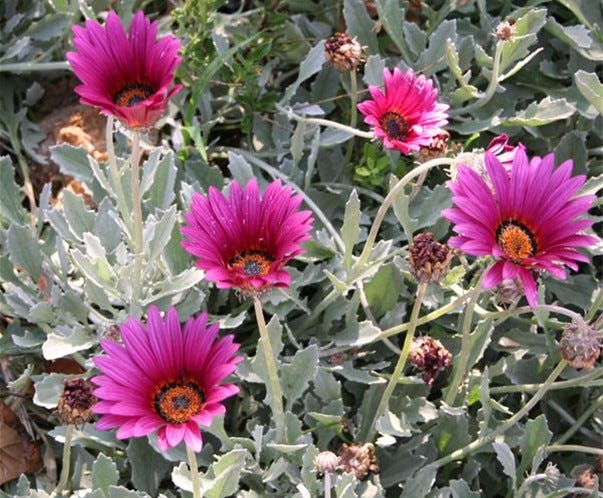
Arctotis acaulis — FLAT AFRICAN DAISY; Afrikaans: renostergousblom (literally “rhino horn flower” but more fittingly “rhinoceros hornbill,” a bird), tonteldoekblom (“touch-me-not flower”), as well as colloquially renoster arctotis (“rhinoceros arctotis”), renoster marigold (“rhinoceros marigold”).
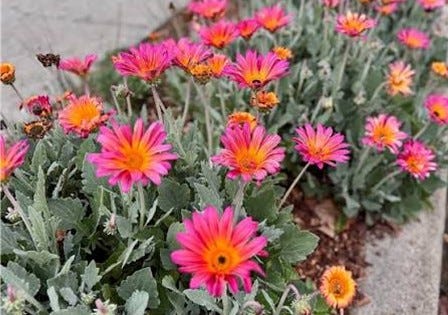
It’s a stemless (flower stalks notwithstanding) perennial with vibrant, large daisy-like flowers and low-to-the-ground clumping but spreading foliage. Leaves are a velvety gray-green or blue-green, depending on your sense of color. It grows to about a foot tall in bloom and up to 3 feet or more in spread. It has a specialized, almost-woody tuberous rootstock underground that gets it through the driest of times with virtually no supplemental water. Its large flowers are variable in color; they can be bright yellow, orange, salmon, cream, or, usually, shades of pink, red, magenta, and purplish; all with dark centers (sometimes looking yellowish because of the sex things) and a black or yellow band at the base of the ray florets. They bloom spring, summer, and fall with some deadheading.
They are superb evergreen groundcovers for light, gritty, or rocky soils in Zones 9 to 12 where summers are dry or at least dryish.
Cultivars: ‘Big Magenta’ (bright magenta), ‘Big Red’ (purplish-red with orange ring), ‘Torch Purple’ (amethyst).
.
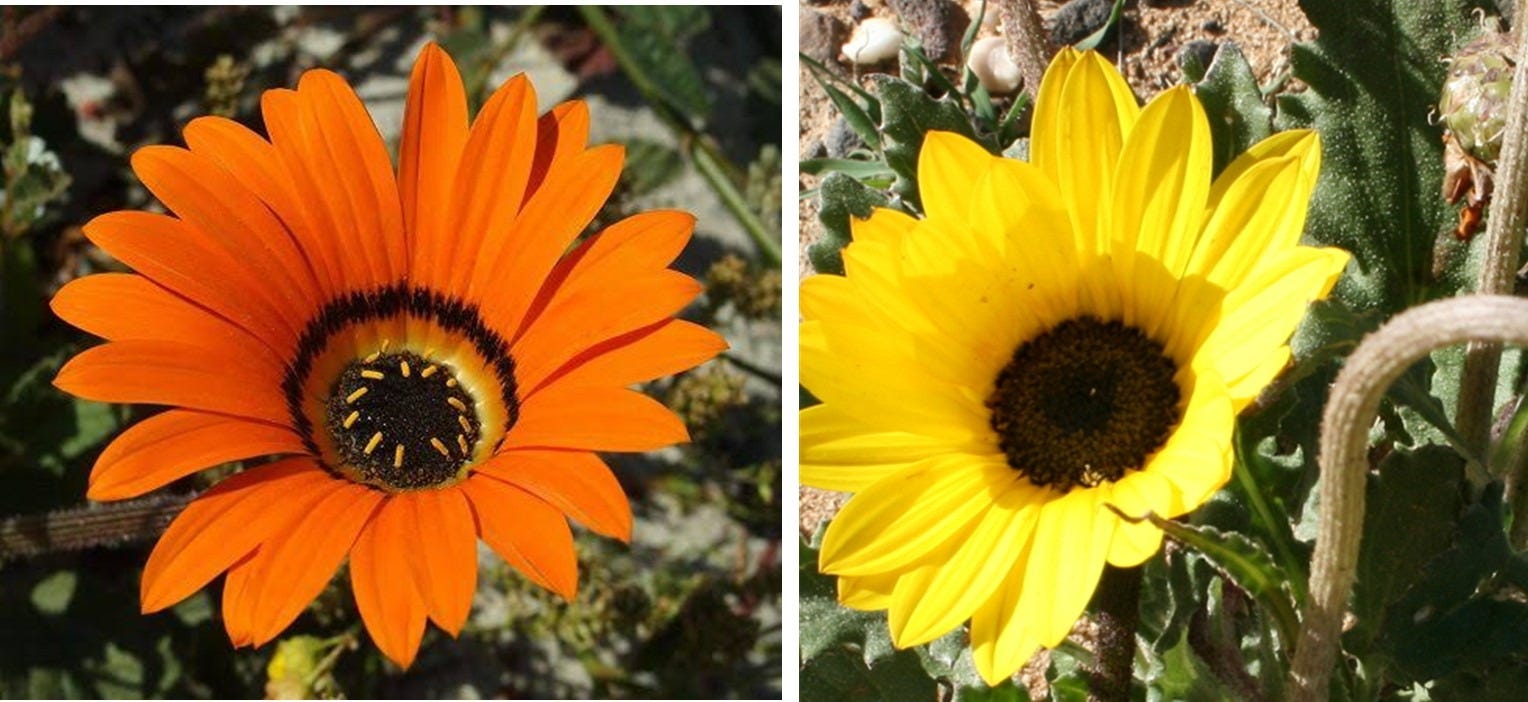
Arctotis breviscapa — SANDVELD AFRICAN DAISY; Afrikaans: Sandveld gousblom (“Sandveld golden blossom;” Sandveld refers to the coastal lowland region in the Western Cape from where many Med-type plants come and known for it’s stunning “springtime” wild flower show).
This species is an annual, sometimes used in “wildflower” mixes, albeit not native to most of the areas where such is used. It grows 6 to 12 inches high and bears brown-centered orange and/or yellow flowers featuring dark purple or black central discs, in spring (in cold zones, sow as early in spring as possible; in mild zones, sow in fall).
.
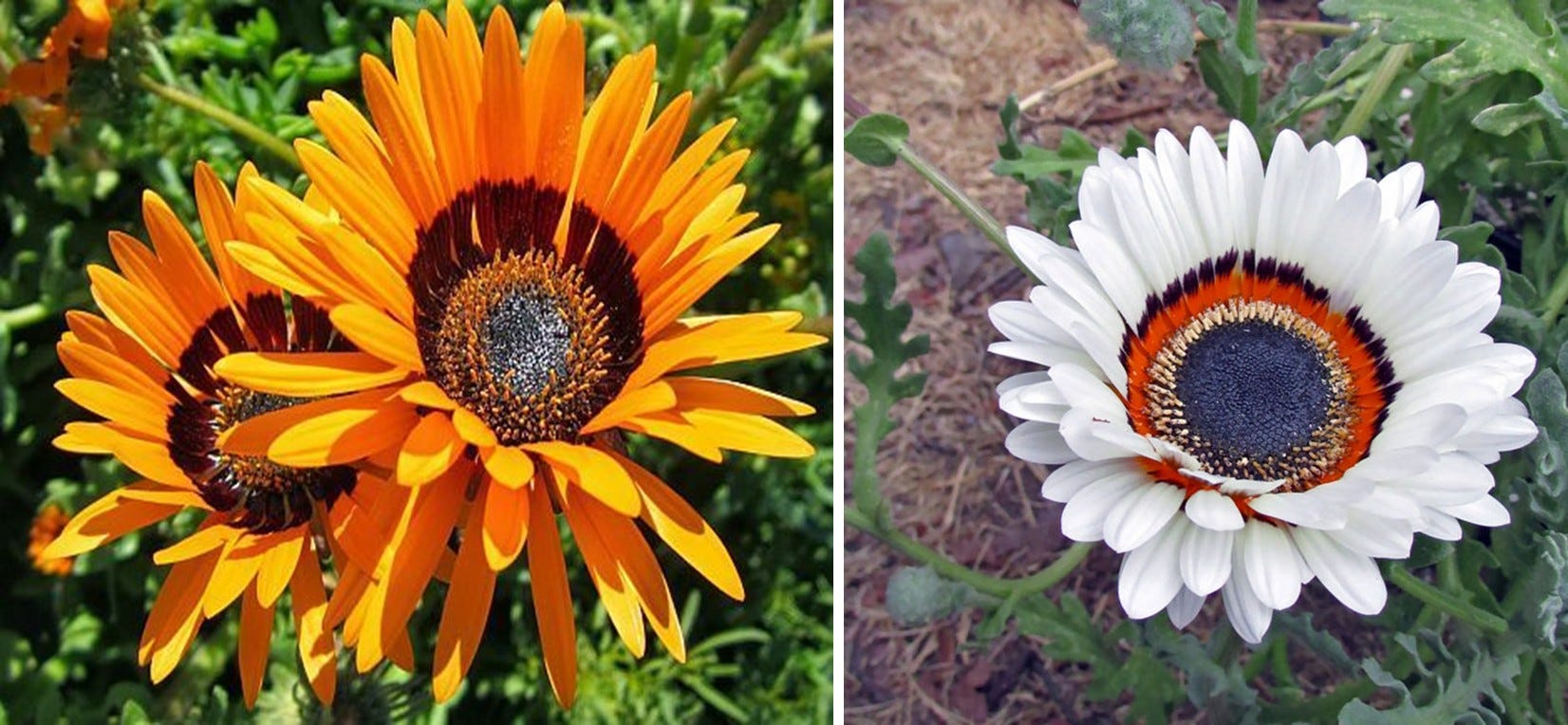
Arctotis fastuosa — MONARCH-OF-THE-VELD; Afrikaans: bittergousblom (“bitter gooseberry bloom”), Namakwagousblom/Namakwalandse gousblom (“Namaqualand golden flower”).
It is an annual that grows to about 1 foot tall but can get up to 3 feet tall in the right situation. It produces a basal rosette, from which grows several flower stalks, each with a flower that is 4 inches across. The ray florets (“petals”) can be orange or white with purple, yellow, or orange bases, and the disc florets at the center can be brown, purple, or black.
The typical orange-flowered type may still be sold under an old synonym, Venidium aureum. A. f. alba is white and is usually sold as ‘Zulu Prince’, a striking selection with white ray florets that are marked with orange basal splashes that are tipped with chocolate. ‘Zulu Prince’ is almost always sold under its old botanical name, Venidium fastuosum.
This species has naturalized in disturbed areas of southern California.
.
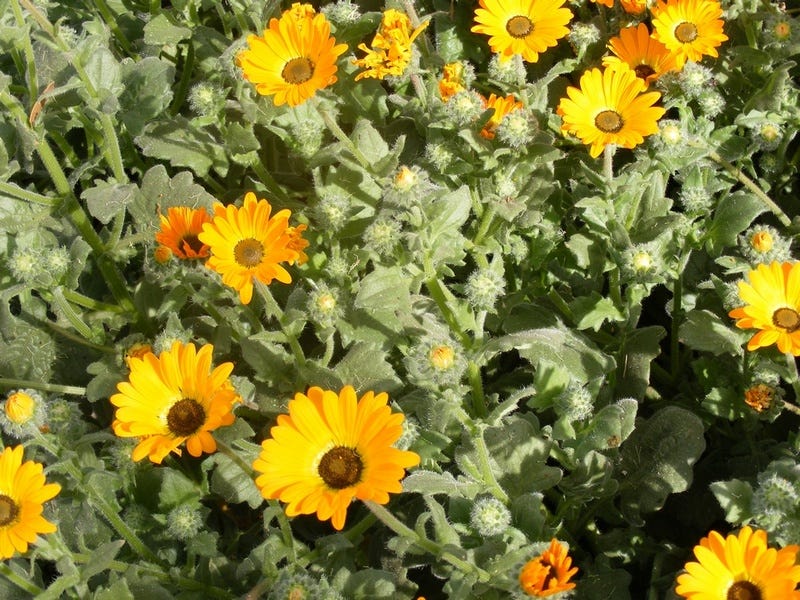
Arctotis hirsuta — NAMAQUA MARIGOLD; Afrikaans: gousblom (“gorse flower” or, in Afrikaner common parlance, “marigold”).
It is an annual, almost succulent, plant that reaches up to 18 inches high. The flowers are orange, yellow, or cream-colored and the multiple flower heads are each about 1 ½ inch across.
.
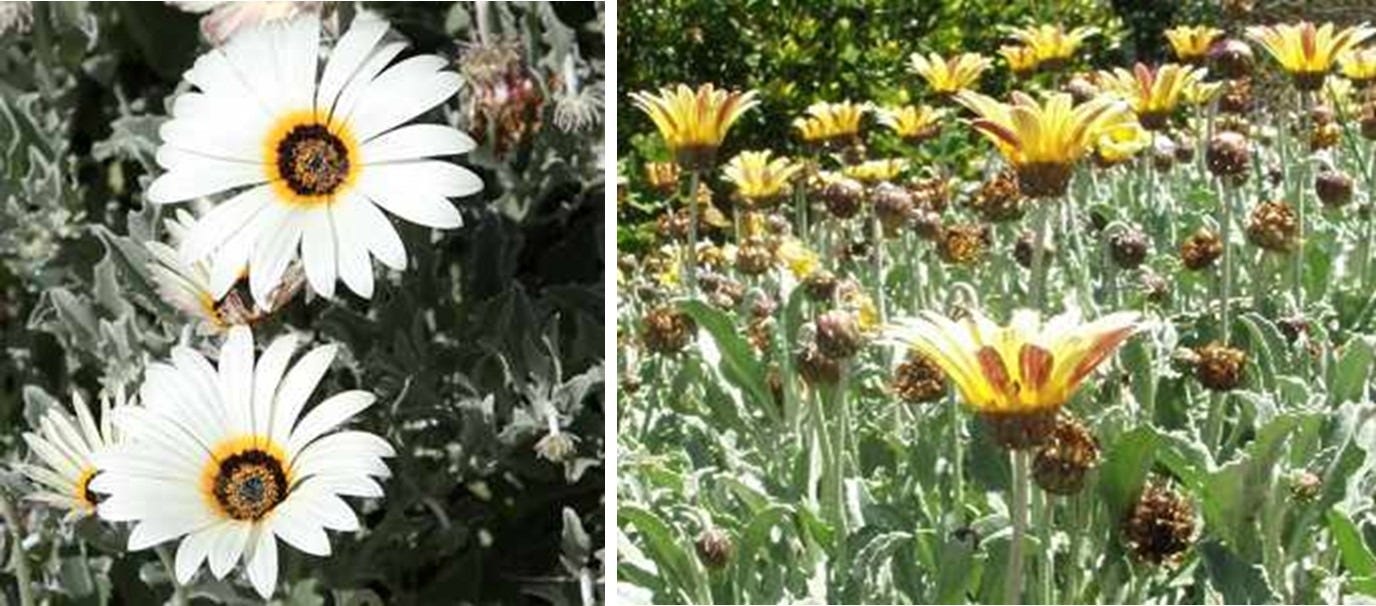
Arctotis stoechadifolia — WHITE ARCTOTIS, CREAM AFRICAN DAISY, COAST ARCTOTIS, SILVER ARCTOTIS, TRAILING ARCTOTIS; Afrikaans: kusgousblom (“kiss gown flower”), bittergousblom (“bitter gourd flower”), witgousblom (“white goose flower” or “white marigold”).
This is a 1-foot-tall spreading perennial, almost subshrub, that forms a stunning silver-gray carpet capable of covering an area of about 4-feet wide. The base of the plant becomes a bit woody with age. The leaves are long, narrow, and toothed. The ray flowers are light yellow at their bases, fading to creamy white at their tips, and marked with red/maroon on the undersides; the central disc is black. They flower from spring to summer.
The names Arctotis stoechadifolia and Arctotis venusta, the next species in this list, have a long history of botanical confusion. Arctotis venusta (the common blue-eyed African daisy grown worldwide in gardens) has been historically mislabeled and sold under the name A. stoechadifolia or A. grandis, but taxonomists separate them as distinct species. A. venusta is common and widespread in South Africa while A stoechadifolia is a rare plant in the wild. Nearly all commercial seeds, nursery plants, and garden center choices labeled as “stoechadifolia” or “grandis” are actually Arctotis venusta or its hybrid derivatives. True Arctotis stoechadifolia is rarely, if ever, found in general horticulture. In other words, be careful where you get your seed.
.
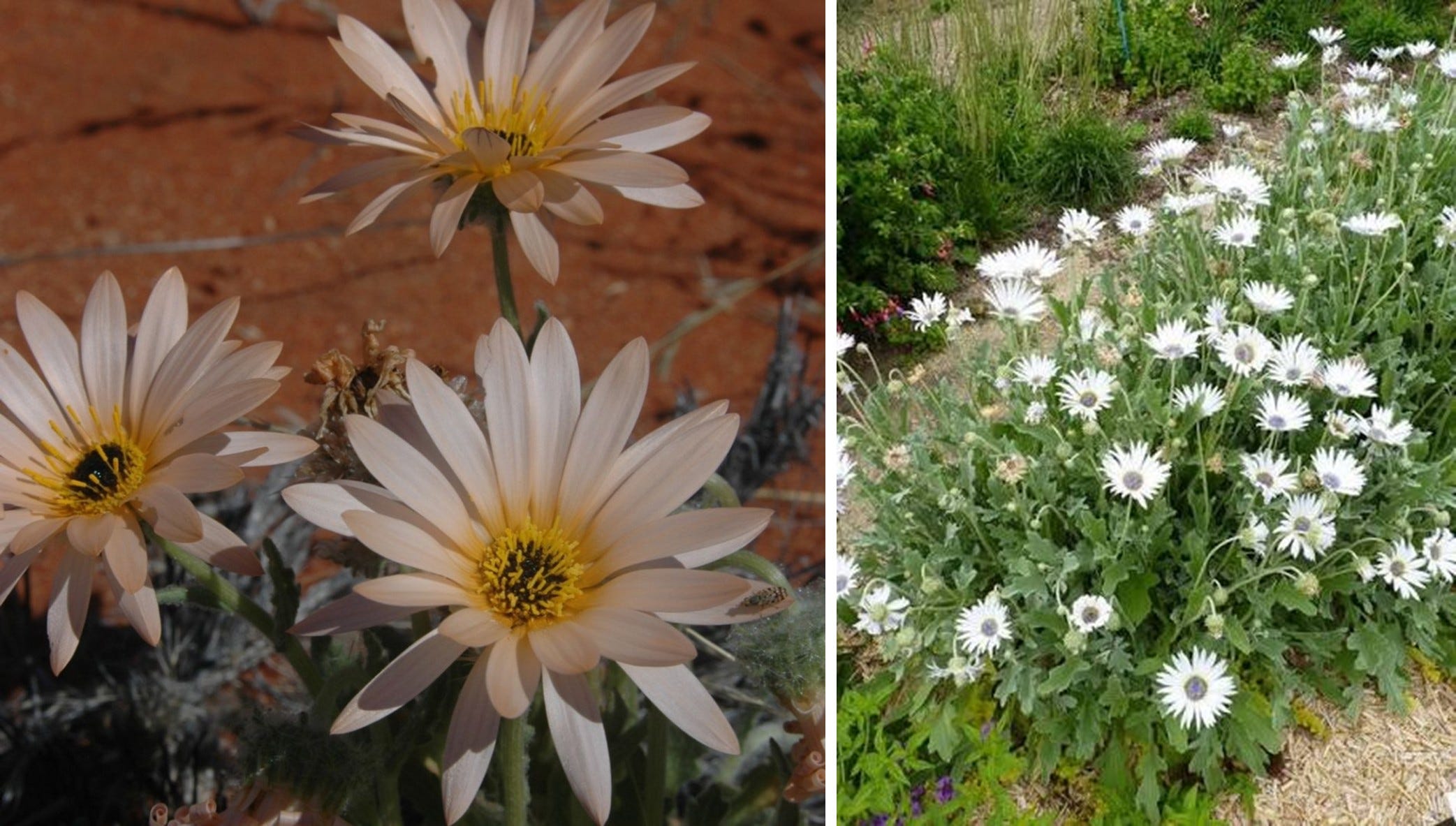
Arctotis venusta — SILVER ARCTOTIS, BLUE-EYED AFRICAN DAISY, Afrikaans: kusgousblom (“kiss gown flower”).
A. venusta is a strong-growing perennial with silvery, violin-shaped, heavily lobed leaves. The flowers are composed of creamy-white to pink or bronze ray florets with lavender to reddish undersides and centers filled with purple disc florets. This plant is grown as a groundcover, especially on slopes, and is adaptable to a wide variety of conditions.
As mentioned above, this species and the similar A. stoechadifolia are sometimes considered to be the same species.
A. venusta is the widely cultivated one. It has become naturalized in parts of the United States (California, Arizona, South Carolina), as well as in Australia, and Central and South America; in some of these areas, it is a designated “Noxious Weed.”
Some of these are evergreen groundcovers in Zones 9 through 11. Others, although they may survive the winter in these zones, rarely bloom well after their first year.
Most Arctotis sold at nurseries are hybrids of the various Arctotis species. These include: ‘Big Gold’ (golden-orange); ‘Flame’ (medium orange highlighted with yellow), ‘Large Marge’ (bright yellow, semi-trailing), ‘Pink Sugar’ (deep salmon pink), ‘Pumpkin Pie’ (deep pumpkin red-orange), ‘Sunset’ (scarlet orange), ‘Sunspot Orange’ (tangerine orange tinted yellow), and ‘Wine’ (rosé blush pink). If these hybrids go to seed (uncommon) and that seed germinates (rare), they usually revert to orange.
.
“Treasure Flowers,” which just may be their most common “common name” today, are becoming quite popular, especially in their many hybrid forms. They are, as with every other “African daisy,” colorful, easy to grow, and problem-free. More than that, they are neat and sturdy plants.
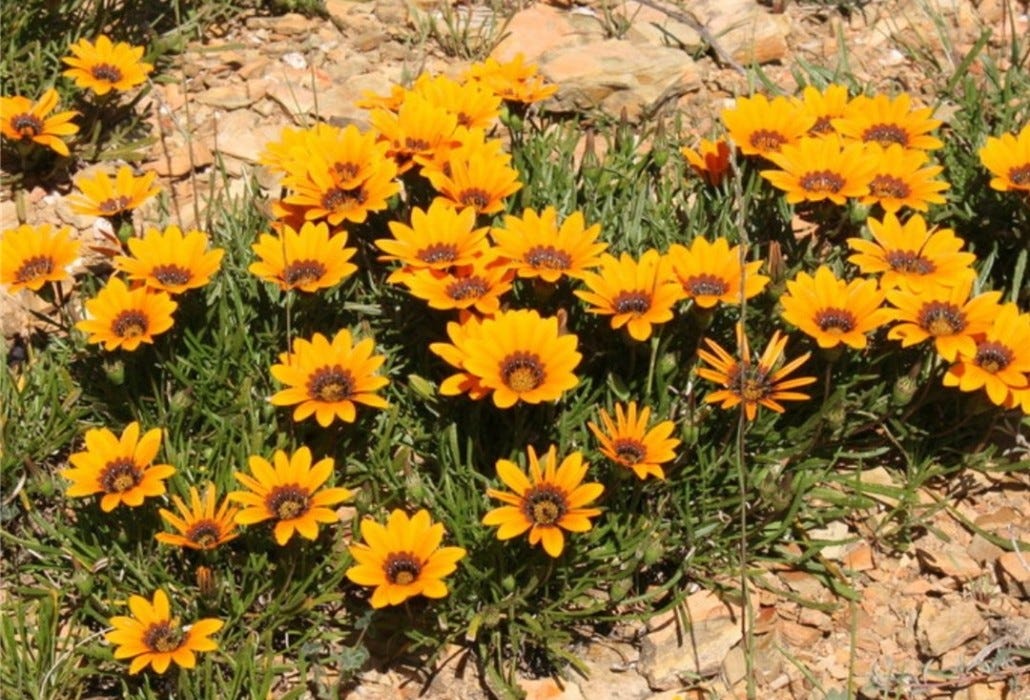
Gazania krebsiana (Gazania pavonia) — TERRACOTTA GAZANIA, COMMON GAZANIA; Afrikaans: gousblom (“thistle flower”), botterblom (“buttercup flower”), rooi gazania (“red gazania”).
This “common” gazania, albeit not as common as the other two species here and certainly not as common as the popular hybrids, is a ground-hugging herbaceous perennial that grows from a fairly woody rootstock. Leaves are generally olive-green with a white velvet on the undersides. The natural variety G. k. var. tomentosa bears those woolly, light-reflective leaf hairs on both sides.
It begins to flower in early spring, with a profusion of white to buttercup-yellow flowers, some forms having dark spots at the base of each ray floret. It’s not the longest of bloomers, though, lasting for but a few weeks after good rains.
Gazania krebsiana is very similar to a number of other Gazania species, including the ones here. As with many taxonomic “complexes,” where to draw the line between such similar species is tricky, leaving home gardeners and even good horticulturists frequently confused in practice (mislabeling and mis-describing are common).
.
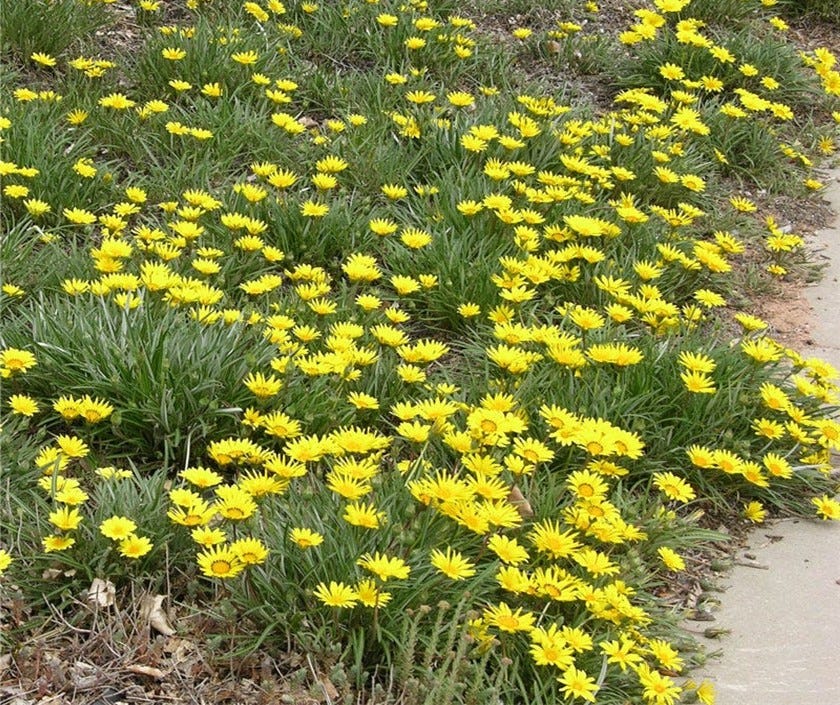
Gazania linearis — TREASURE FLOWER, TUFTED GAZANIA; Afrikaans: botterblom (“buttercup flower”), gansblom (“gooseflower,” “ox-eye daisy”), gousblom (“goldflower,” “marigold”).
This species is a clumping, mounding perennial. The leaves are usually linear in shape, hence the specific epithet, and are dull green above, white woolly/tomentose beneath. Its flowers are bright golden-yellow, subtly gradated to a slightly darker zone near the center.
Gazania linearis is very similar to other species. The differences in gross characteristics is oh-so-subtle, requiring very close inspection to view the minute technical variances.
It has been become invasive (or simply called a “weed”) in California and New Mexico in the United States, as well as in Australia and New Zealand.
One cultivar, ‘Colorado Gold’, is surprisingly hardy (to Zone 5), hence why it’s popular among north-climate gardeners.
.
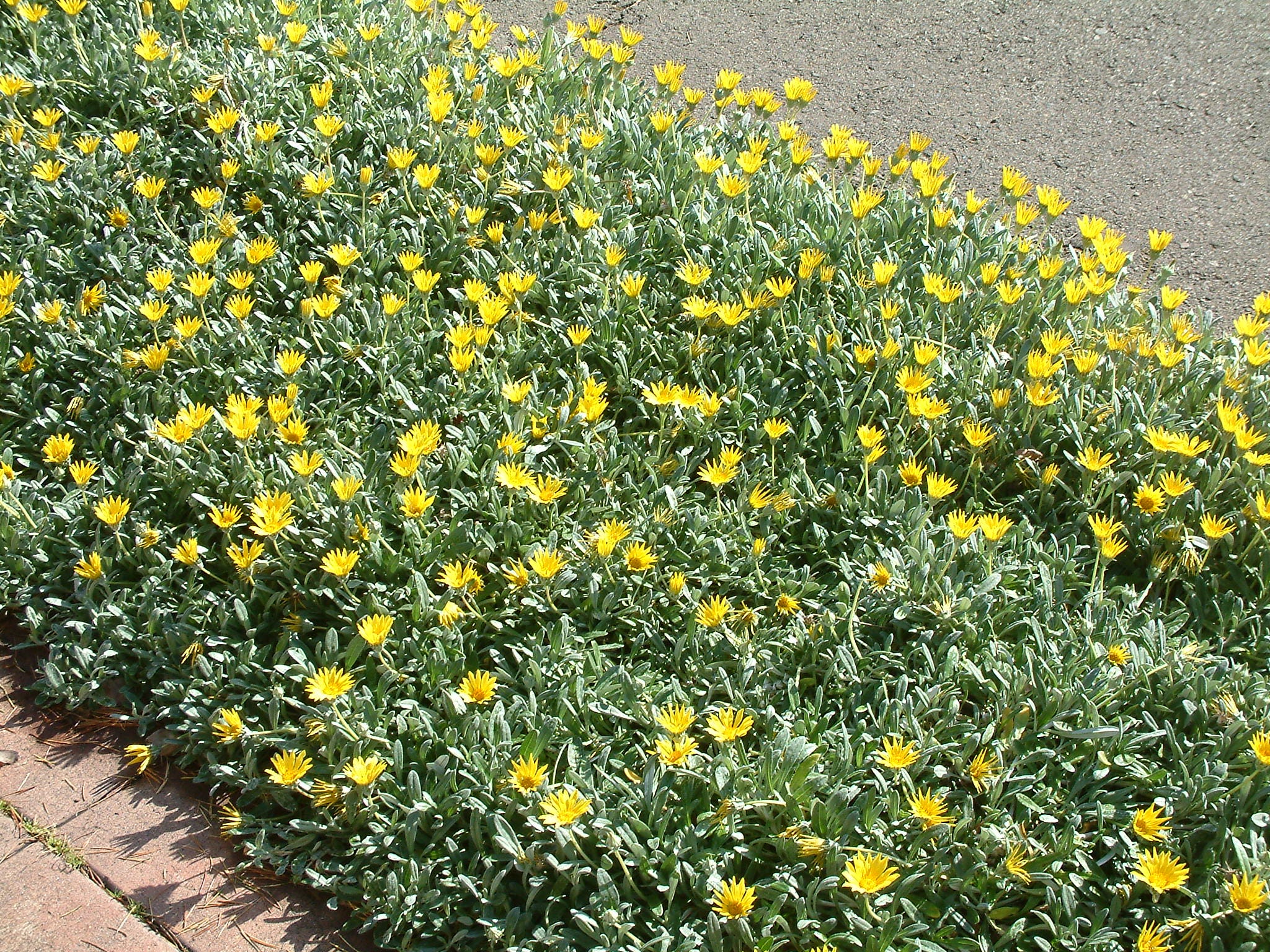
Gazania rigens (G. splendens) — TREASURE FLOWER, TRAILING GAZANIA (one variety), CAPE DAISY, GAZANIA; Afrikaans: bokbaaivygie (“Bok Bay fig” = “Bok Bay ice plant”).
A spreading, low-growing, half-hardy perennial with a fast growth rate. Grows to about 20 inches tall and wide, with blue-grey foliage and brilliant yellow to, more commonly, orange-yellow flowers with each ray displaying a dark ‘beauty spot’ near the center disc. The flower show starts in mid- or late spring (with the largest and most numerous flowers) and continues into autumn.
Possibly the most commonly grown natural variety is Gazania rigens var. leucolaena, the trailing gazania. It is almost always used as a groundcover, planted en masse to cover large areas especially slopes. Cultivars of this variety include ‘Sunburst’, ‘Sunglow’, and ‘Sunrise Yellow’’ and the old standbys ‘Burgundy’, ‘Copper King’, ‘Fiesta Red’, ‘Goldrush’, and ‘Moonglow’. These have become harder to find, having been supplanted by interspecific mounding hybrids (not efficient groundcovers). G. rigens ‘Variegata’ sports thin white stripes on the leaf edges; colorful even when not in bloom.
G. rigens var. leucolaena. Grey-white leaves, bright yellow flowers, typically without any eye-spots. The trailing variety and parent of most trailing types.
G. rigens var. rigens. Larger flower heads with yellow or orange rays, each with a basal eye-spot. This is not a natural variety; it is strictly a cultivated selection.
G. rigens var. uniflora (once sold as Gazania uniflora). Mounding. Flower heads are yellow, typically without any basal eye-spots.
Most modern garden cultivars and seed strains originate from repeated crosses and backcrosses among a few key wild species, including the three above as well as a fourth species not in the trade as itself:
Gazania krebsiana contributes to flower colors with a vast range of warm earthy tones, including bronze, terracotta, copper, and deep red-brown shades.
Gazania krebsiana var. tomentosa is often used for even more color variations and the woolly, light-reflective leaf hairs (silveriness).
Gazania linearis lends a more upright, clumping growth habit, darker green linear foliage, and strong cold/frost tolerance.
Gazania pectinata (not detailed above) is added to the mix for increasing petal width, flower size, and color intensity.
Gazania rigens (syn. Gazania splendens) promotes a more spreading or trailing habits, glossy or woolly leaves with silver undersides, and intense red, orange, and yellow flowers.
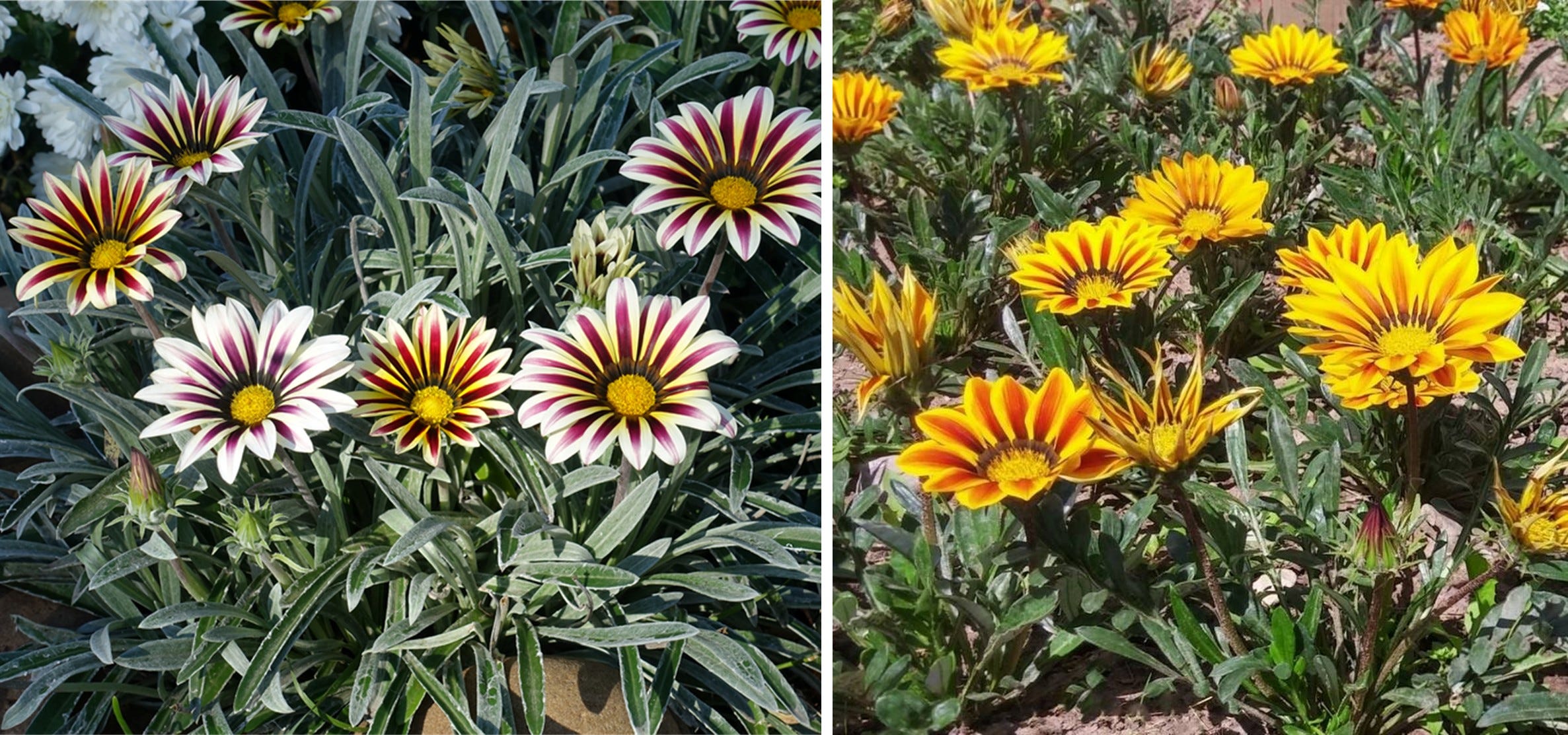
‘Aztec’, ‘Aztec Queen’ has a trailing and spreading habit and a marvelous color combination: the central disk is yellow and the rays are a creamy pink, each with a gradated maroon stripe.
“Kiss,” and “Daybreak” strains have been bred for uniform clumping, larger flower diameters, and a vast spectrum of vibrant colors.
‘Big Kiss Yellow Flame’ reaches about a foot high. The “Big” part is the flower head at almost 5 inches across. Not a very long blooming season, though, only from mid-spring to mid-summer.
The ray flowers are golden yellow with a gradated maroon-red stripe, and the center (disc flowers) is yellow ringed with mahogany brown that weeps into the maroon-red stripes.
‘Big Kiss White Flame’ is as above but light creamy off-white rays with brilliant stripes of gradated rose red.
‘Cookei’ has possibly the most eye-catching blooms: yellow center thinly ringed with chocolate, then a wide band of blue-olive-green, then the rays of rusty, fiery orange.
‘Chansonette’ - A spreading variety that has dark, deep green foliage. 4-inch flowers in tones of yellow, orange, pink, scarlet, and red all with a central dark zone.
‘Christopher Lloyd’ has pink petals, yellow center, and a bright green band.
“Harlequin Hybrids” and “New Day” are large-flowered clumping types and sold as mixed plants or as seed labeled “mixed colors.”
‘Moonglow’ is a double-flowered bright yellow; blooms stay open at night.
‘New Day Rose Stripe’ is selected from the New Day mix and feature a deep yellow disk and sharply gradated rose stripes on off-white petals.
“Sunbathers Series” include ‘Nahui’ (deep golden orange; frilly anemone-form), ‘Otomi’ (lilac purple; frilly anemone-form), ‘Tikal’ (gold with orange stripes [a la circus tent]; frilly center), and ‘Totonaca’ (mostly gold with fiery-orange flames at the insides of the boat-shaped ray flowers; anemone-form (central pom-pom) to semi-double,
“Sunshine Hybrids” are some of the most widely available seed-grown garden strains.
“Talent Series” are of the compact spreading type that rise to about 8 inches and have muted bluish-grey foliage. It bears flowers in a wide range of colors, including pink and rose.
‘Tiger Stripes’ is a clumping type with rich, deep green foliage. The large flowers are bright yellow with a thick rust-orange stripe on each petal.
In Australia, where gazanias have become invasive, breeders have developed sterile forms, including:
‘Double Gold’™ (anemone-form to fully double) golden-yellow flowers year-round and sets no seed or pollen, preventing cross-pollination with wild weeds.
‘Montezuma’ has distinctively striped, large flowers in earthy tones of orange and brown. Frilly (almost anemone-form) center.
‘Sunset Jane’ has large, honey colored, fully double blooms over grey-green foliage.
.
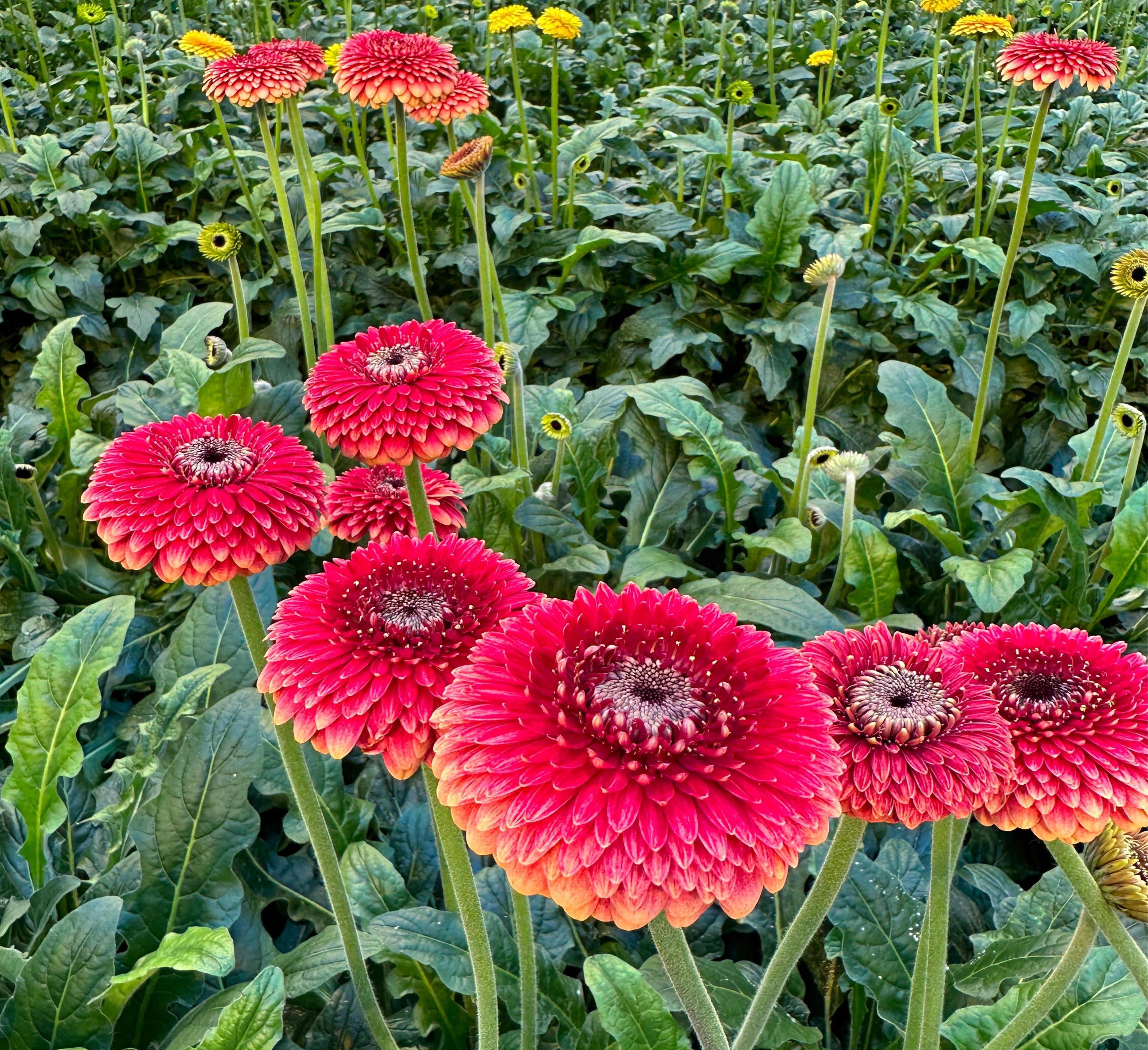
Gerbera jamesonii — BARBERTON DAISY, GERBER DAISY, TRANSVAAL DAISY; Afrikaans: rooigousblom (“red rooster flower”).
This is a mounding perennial with flower stalks up to 2 ½ feet tall. The spectacular flower heads — the daisies — range from 3 to 5 inches across. With recent hybridization, the flower color spectrum now includes near red, orange-red, orange shades, yellow, white, and pink. The number of flower forms, too, has dramatically increased in just a couple of decades, now including the traditional single form, as well as doubles, pom-pom, semi-double, anemone-form, spider, super frilly, and mini. These flowers are naturally produced from September to December but greenhouse-grown plants are available in bloom pretty much year-round.
Gerberas like a richer soil than the rest of the African daisies.
These originated from the cross of Gerbera jamesonii (most commonly orange) and Gerbera viridifolia (cream, mauve, or purple daisies). Thousands of cultivars exist; most sold at retail centers are unnamed, mostly seed-grown types; popular, named cultivars include (just a few of the many): ‘Pink Elegance’, ‘Piton’, ‘Primrose’, ‘Rosalin’, ‘Sangria’, ‘Savannah’, ‘Sazou’, ‘Tropic Blend’, and ‘Winter Queen’. These named forms are propagated by tissue culture and are the cultivars used mostly in the cut flower trade.
.
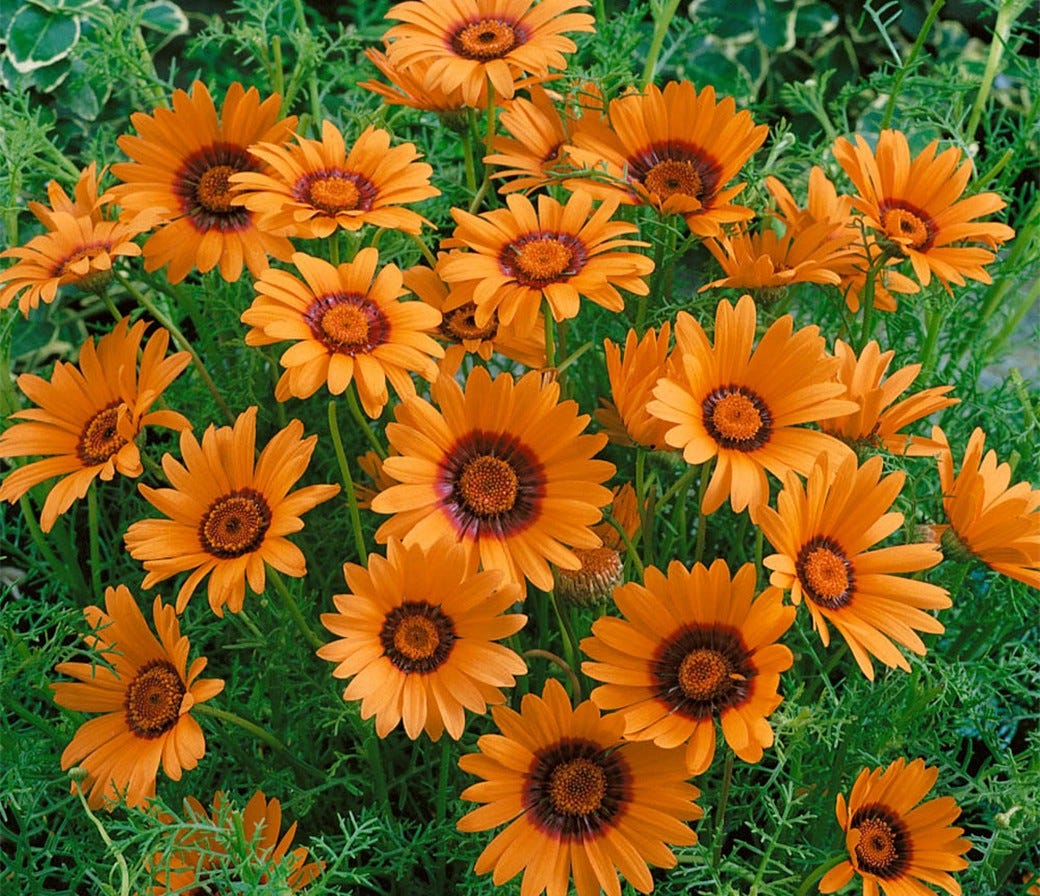
Ursinia anthemoides — CAPE MARIGOLD, DILL-LEAF URSINIA, MOUNTAIN MARIGOLD, NAMAQUA DAISY, PARACHUTE DAISY, SOLAR FIRE, SOUTH AFRICAN MARIGOLD; Afrikaans: bergmagriet (“mountain daisy”).
An annual, from 6 inches to 1 foot high. Flower color ranges from pastel yellow to soft orange. Blooms spring and summer. Very easy.
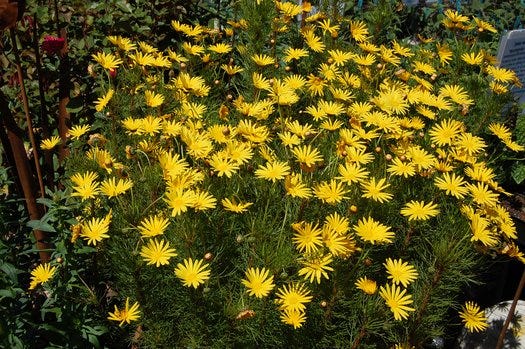
Ursinia nudicaulis — LITTLE DAISY, LONGSTALK PARASEED; Afrikaans: bergmagriet (“mountain daisy”), berggousblom (“mountain marigold,” “mountain golden flower”).
Neither annual nor perennial, this “African Daisy” is a deciduous shrub growing 3 to 4 feet high and just as wide. Foliage is feathery and bright emerald green. In spring, summer, and often into fall, it puts out scads of bright yellow, 2-inch flowers. Hardy in Zones 8 (maybe 7) to 10.
.
The one species in this genus is the odd-man-out “African Daisy.” I’m not sure why it’s even called a “daisy;” it’s flowers/flower heads don’t look anything like what we know as a daisy. Technically, though, it has all the right parts, in the right places, to be included in the Asteraceae (the “daisy” family). Moreover, it’s in the Tribe (just above Genus) called Anthemideae (the “chamomile” tribe), making it kissing cousin to marguerite daisy, ox-eye daisy, Shasta daisy, chrysanthemums (which are daisies if you didn’t know), chamomiles, tansies, and almost every popular annual daisy.
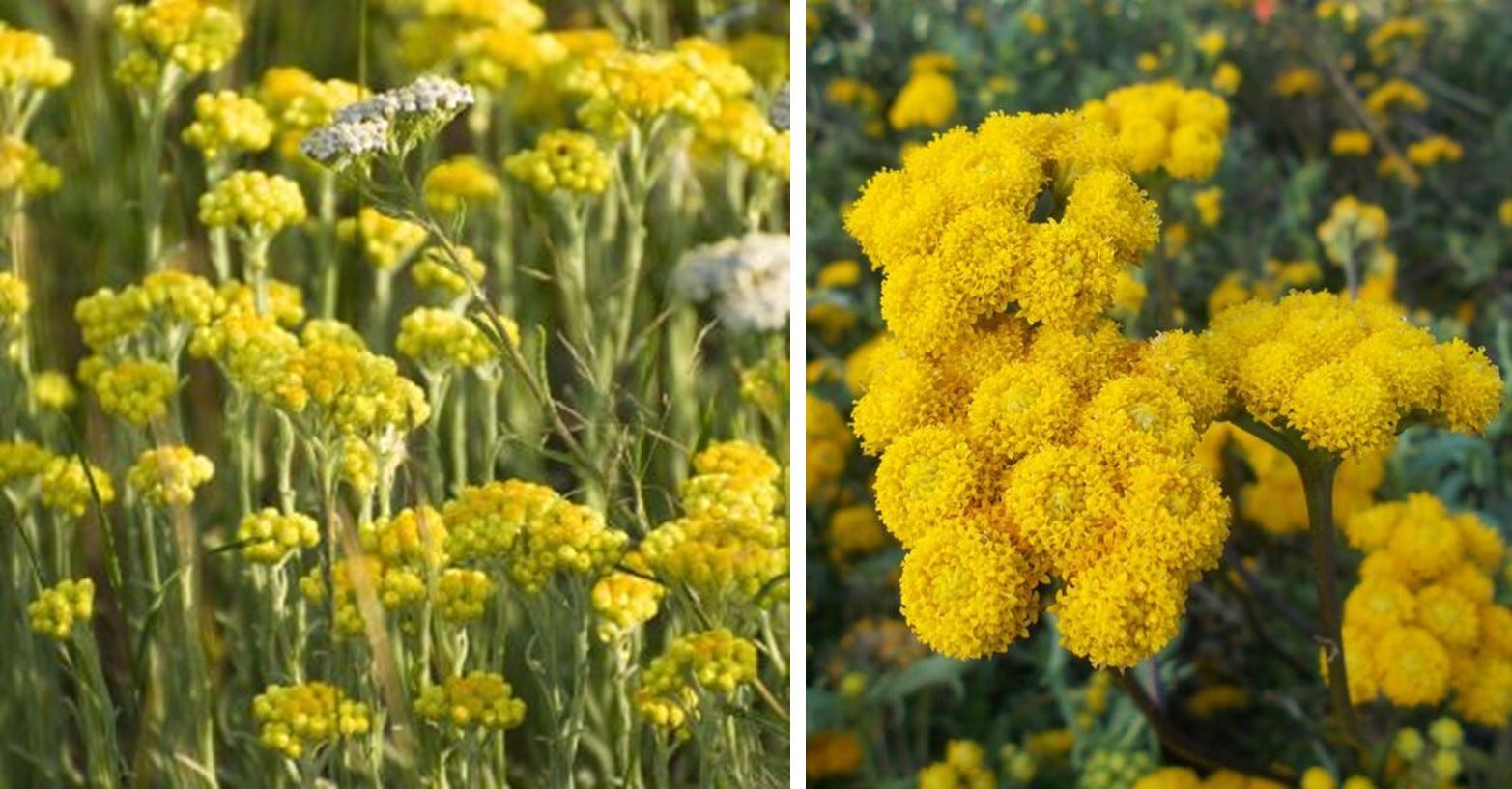
Lonas annua — besides being known as AFRICAN DAISY, it goes by GOLDEN AGERATUM, YELLOW AGERATUM, YELLOW LIVER BALM, and, simply, LONAS.
In Lonas, there are no conspicuous ray flowers, the flower type that just about every gardener calls “petals.” Every “daisy,” as we know them, has these eye-catching ray flowers; it’s what you yank off while pleading the question “she/he loves me, she/he loves me not.” But not this guy and yet we call it a daisy. Or at least somebody does.
The plant instead produces barely distinguishable flanges from a clump of a few disk flowers, all stuffed together in small, roundish, button-shaped flower heads, and several of these flower heads are arranged in a ½- to 1-inch dome-shaped cluster at the top of a long stem. Kinda like yarrow or tansy but more steroidy.
Nonetheless, this “African daisy” puts on a long flower show from late spring to autumn, with near continuous flowering in warm conditions. The bright yellow flowers are outstanding for cutting fresh and even retain their color, albeit changing to a more golden hue, well when dried.
In addition to not being an actual “daisy,” as with all the others, this species is not from South Africa. It’s native to the northern African countries of Algeria, Morocco, and Tunisia, as well as to Italy, France, and, surprisingly, non-Mediterranean Germany.
It’s a half-hardy to hardy annual that grows 1- to 2-feet high. It can reseed itself in mild climates.
The variety ‘Goldrush’ has more compact inflorescences.
.
Finally, there are these last two genera, Dimorphotheca and Osteospermum. I wouldn’t feel too far off if I said these represent at least 75 percent of retail sales of “African Daisy” in the U.S. outside of California. And just as much in the U.K.
These two genera have been botanically confused over many years. Most species that were in the genus Osteospermum, at least as far as horticulture goes, have been dumped into Dimorphotheca. Several species are still properly Osteospermum but none of them are found in garden centers/nurseries nor even from specialists.
Botanists once considered Dimorphotheca the home for the species with an annual habit, while Osteospermum was the place for perennial and woody species. But that all shifted with major taxonomic studies in 1994 and through 2018. The genus Dimorphotheca now includes popular species such as Dimorphotheca (formerly Osteospermum) ecklonis (Cape marguerite) and Dimorphotheca (formerly Osteospermum) fruticosa (trailing African daisy), both perennial/subshrub species.
And yet, every version of these African daisies — whether purple, violet, orange, yellow, or any of the exotic shades and blends in-between — is still sold as “Osteospermum.” “Osteospermum” probably now rates higher than “African daisy” as the common name.
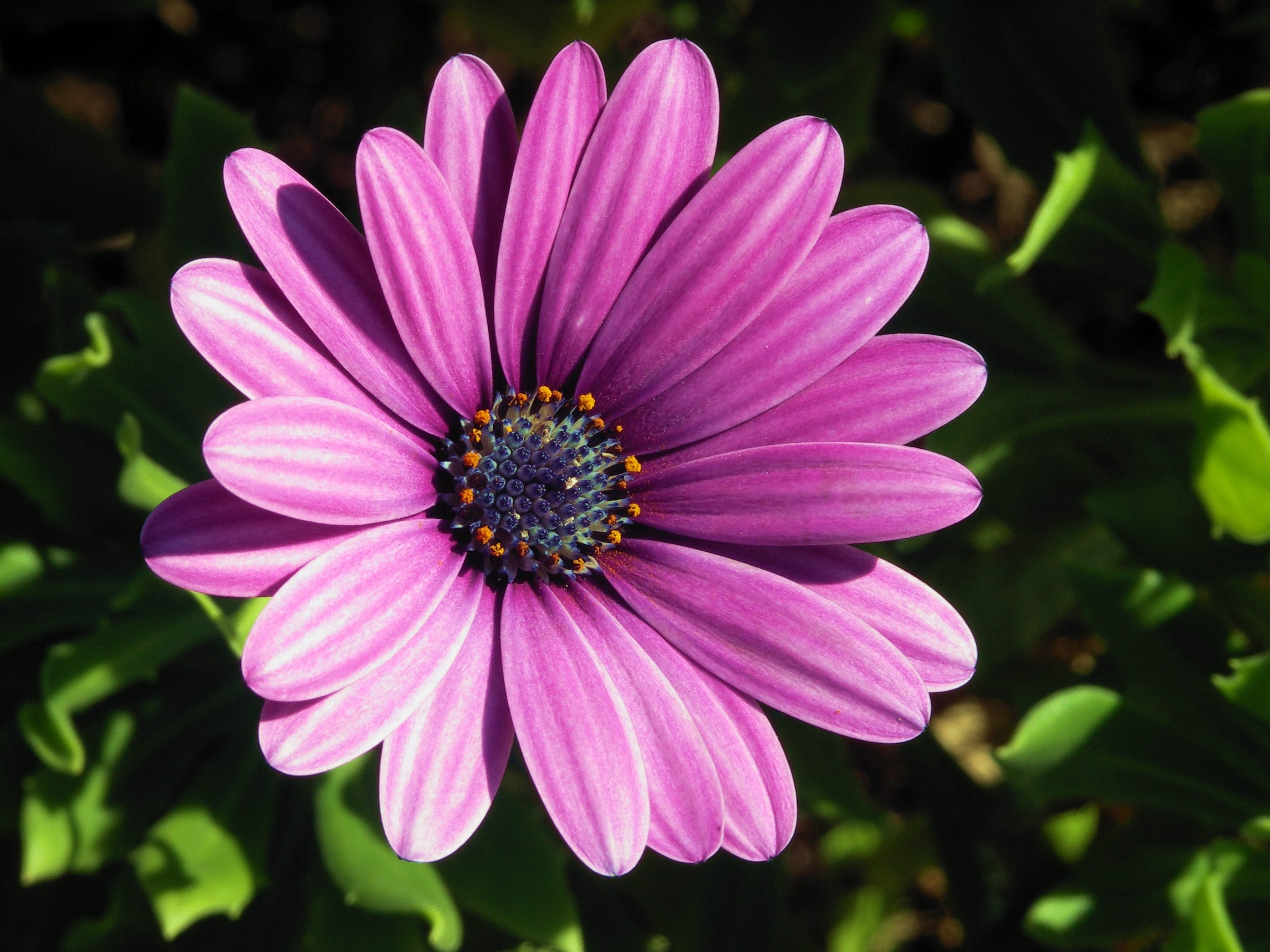
Dimorphotheca barberae (once Osteospermum barberae and also thought to be the same as O. jucunda) —CAPE MARIGOLD, EASTERN CAPE RAIN DAISY, PINK DAISY BUSH, RED-STAR DAISY; Afrikaans: bergbietou (“mountain beetroot”), bloubietou (“blue beetroot”).
This is an evergreen or semi-evergreen perennial, almost subshrub (in Zones 8 to 10). It has scented foliage and grows to 10 inches high and 18 inches wide. Silvery-pink daisies are produced though spring and summer.
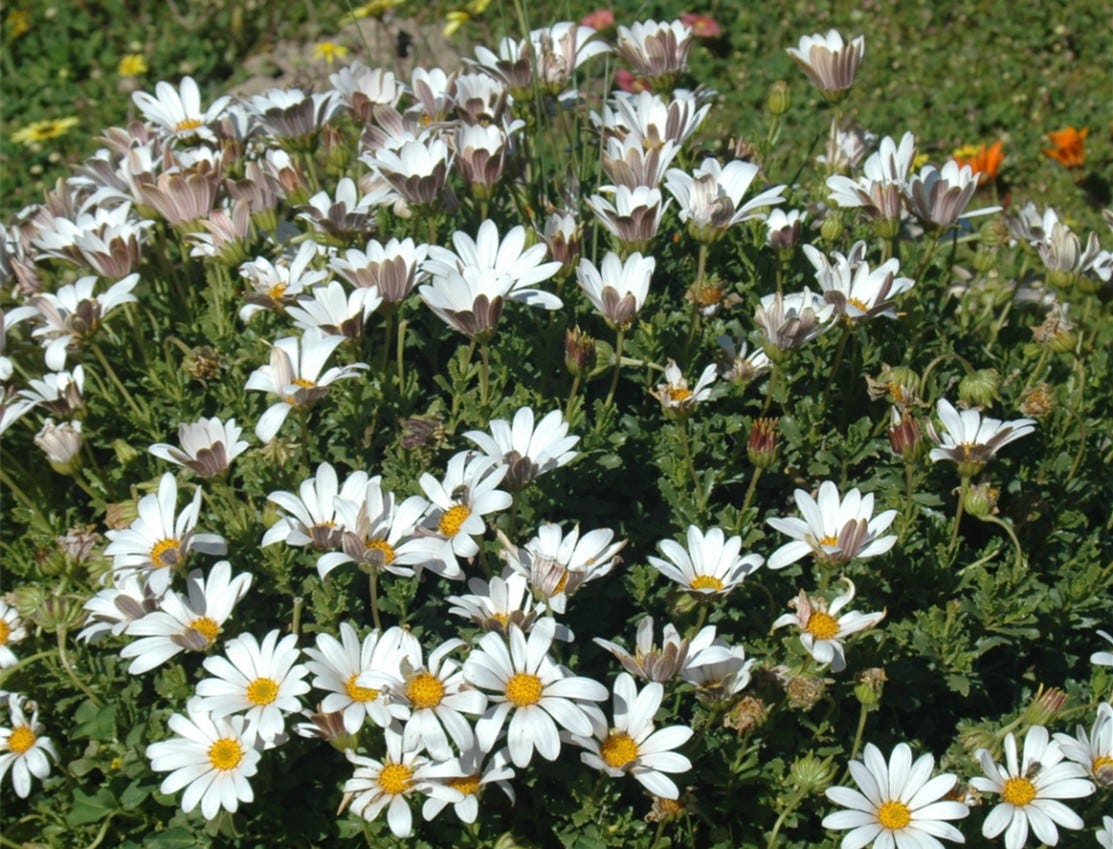
Dimorphotheca cuneata — BRIDE’S BOUQUET, RAIN FLOWER, STICKY RAIN DAISY, WHITE BIETOU; Afrikaans: bergbietou (“mountain beetroot”), bosmargriet (“wild daisy”), gousblom (“golden flower”), grootbietou (“big beetroot”), Karoobietou (“Karoo beetroot”), makbietou (“tame beetroot;” this might also be a colloquialism for “lazy person”), reënblom (“rain flower”), struikdimorphotheca (“shrub dimorphotheca”), weerprofeet (“weather prophet”), witbietou (“white beetroot”), witgousblom (“white and gold flower”).
This multi-named beauty is a subshrub (woody-ish perennial) in its natural habitat. It’s mounding to 1 ½ to 2 feet high. The leaves are strongly scented (although not necessarily pleasantly) when crushed.
It’s sparingly naturalized in Arizona.
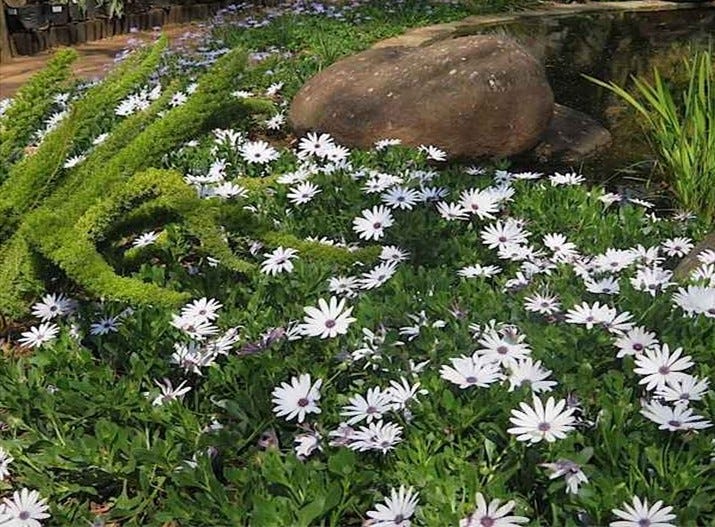
Dimorphotheca ecklonis (Osteospermum ecklonis) — BLUE-AND-WHITE DAISY BUSH, CAPE MARGUERITE, STAR OF THE VELDT, SUNDAYS RIVER DAISY, VAN STADEN’S RIVER DAISY, WHITE DAISY BUSH; Afrikaans: jakkalsbos (“jackal bush”), kaapse magriet (“Cape daisy/marguerite”), sondagsrivier madeliefie (“Sundays river daisy”), vanstadensrivier madeliefie (“van Staden’s river daisy”).
An evergreen perennial/subshrub that is grown as a groundcover and can get up to 3 feet tall if and when unclipped/unmowed. It bears flowers composed of ray florets that are white above and reddish blue below and a dark blue/purple center. The peak flowering period is in spring, although some flowers will last through summer.
This plant contains hydrocyanic acid, which makes it poisonous to livestock and pets.
The cultivar ‘Lavender Mist’ is white, aging to soft pale purple. ‘Silver Sparkler’ has striking silver-sheened white flowers with deep indigo-blue centers and creamy-edged variegated foliage.
The species is an invasive plant in parts of Australia.
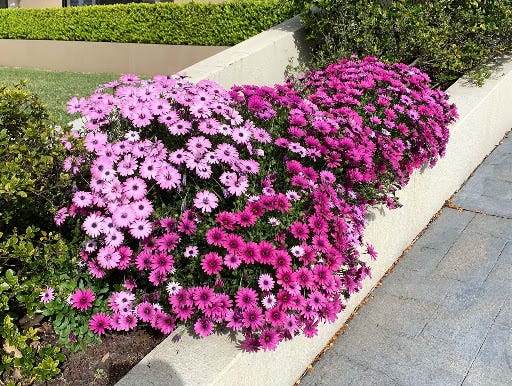
Dimorphotheca fruticosa (Osteospermum fruticosum) — TRAILING AFRICAN DAISY, SHRUBBY DAISYBUSH, “FREEWAY DAISY” (because it was once an almost ubiquitous eyecatcher in the highway landscapes of California); Afrikaans: rankmagriet (“creeping marguerite,” “trailing daisy”), rankbietou (“creeping beetroot”).
It is a fast growing, ground hugging, sprawling to prostrate perennial with semi-succulent leaves. Only 12 inches high but up to 4 feet wide. Flowers can be bright white, pink, purple, or rose-purple on the upper side, and with a reverse side that is blue, violet, mauve, or deep rose. The flower center is a contrasting dark blue, purple, or reddish-purple. Blooms intermittently all year where hardy (Zones 9 to 11). It can be mowed down if/when it gets ragged looking.
Weedy in New Zealand.
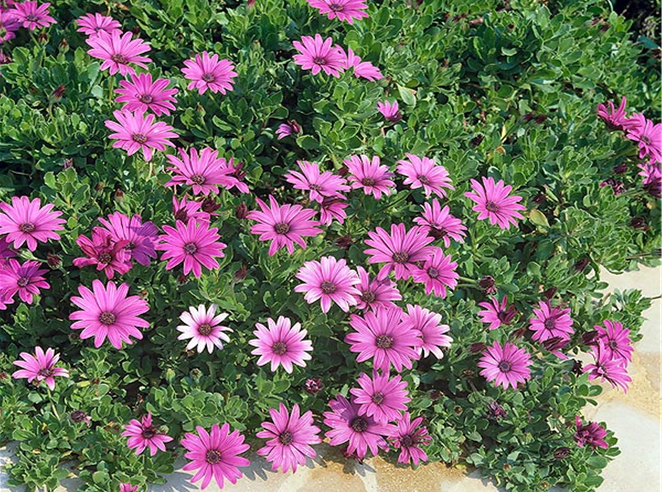
Dimorphotheca jucunda (Osteospermum jucundum) — DELIGHTFUL AFRICAN DAISY, TRAILING PINK DAISY, TRAILING MAUVE DAISY; Afrikaans: bergbietou (“mountain beetroot”), bloubietou (“blue beetroot”); Zulu: umasigcolo nkonekazi,(“we are poor women”), u-mesigcolo-nkonekazi ( “the maid”).
This is a perennial (not-quite-subshrub) that grows from a husky underground stem. The above-ground stems are erect or sprawling, with rooting stems up to 3 feet long. The ray florets are magenta-pink or purple above, orange or coppery below. The center disc florets are dark purple or yellow tipped blackish.
The white-flowered ‘White Moon’ is a variant with flowers pure white above and almost pure white beneath. O. jucunda var. compactum ‘Purple Mountain’ is bright purple and seems to be much hardier than the species which makes it even more useful for spring-summer-fall growing in short summer areas. ‘Blackthorn Seedling’ is purple-pink and floriferous. ‘Langtrees’ is white with dark center, also floriferous. These older selections have mostly been supplanted by the newer hybrids.
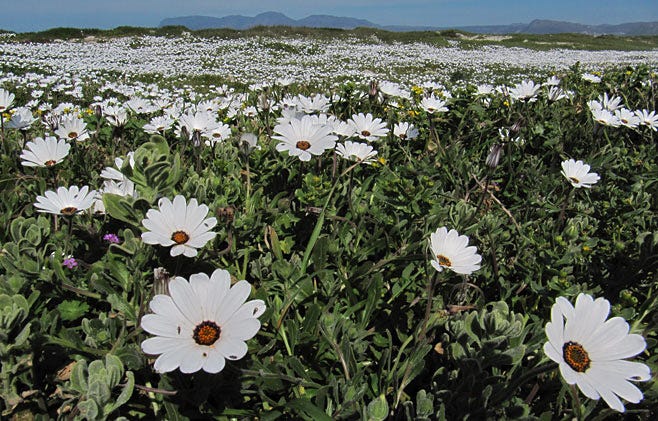
Dimorphotheca pluvialis — WHITE AFRICAN DAISY, CAPE MARIGOLD, WEATHER PROPHET, CAPE RAIN-DAISY, OX-EYE DAISY, CAPE DAISY, RAIN DAISY. Afrikaans: witbotterblom (white buttercup), reënblommetjie (rain daisy), witmargriet (white marigold).
A commonly sown annual up to 16 inches tall. Ray flowers are white to yellowish, sometimes with blue or purple markings. Disc flowers are usually white to yellowish with purple tips. ‘Glistening White’ is a dwarf form with slightly larger flowers in near-pure white.
The species and the white form are often used in California/Southwest “wildflower” seed mixes, albeit not native.
Sparsely naturalized in scattered locations throughout California.
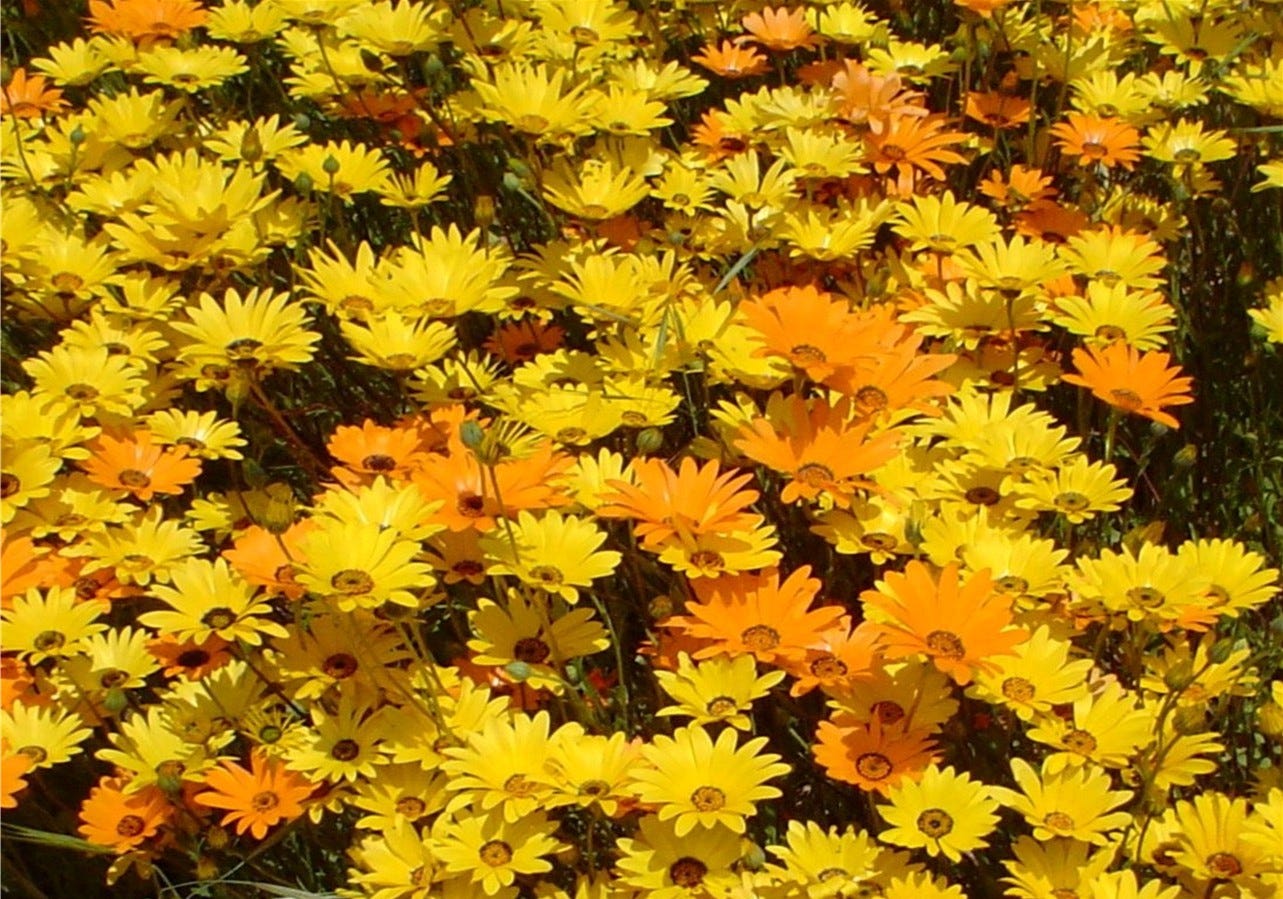
Dimorphotheca sinuata (labeled as Dimorphotheca aurantiaca in the trade) — GLANDULAR CAPE MARIGOLD, NAMAQUALAND DAISY, ORANGE NAMAQUALAND DAISY; Afrikaans: gousblom (“gold flower”), jakkalsblom (jackal flower), jakkalsbloubossie (jackal bluebush), and namakwalandse madeliefie (Namaqualand daisy).
An annual sometimes exceeding 12 inches in height. Flower heads are generally yellow or orange with purple markings. It flowers early in spring.
A common species in “wild flower” mixes (although not native to any parts the U.S.). Naturalized in California and Arizona.
.
There are no more plants in the genus Osteospermum left in the horticulture trade. No more sold at nurseries and none are available from specialty mail-order companies. As mentioned earlier, virtually every plant sold as such has been taxonomically reclassified as Dimorphotheca.
Here’s what used to be Osteospermum:
Osteospermum barberae is now Dimorphotheca barberae
Osteospermum ecklonis is now Dimorphotheca ecklonis
Osteospermum fruticosum is now Dimorphotheca fruticosa
Osteospermum jucundum is now Dimorphotheca jucunda
What’s left in the genus Osteospermum are woody subshrubs/shrublets, true shrubs, and at least one tree. Some have become invasive in Australia and New Zealand. None are used now in common horticulture. Yet, several widely cultivated species and hybrids continue to be sold, grown, and referred to as “Osteospermum.”
There is one actual Osteospermum species, O. grandiflorum, although not sold as itself, that sneaks in to help give us a wide array of interspecific hybrids.
This is where the action is in retail sales. This is an ever-increasing, constantly changing group of plants in an amazing array of flower colors and flower forms. They are regularly sold interchangeably under Osteospermum and Dimorphotheca names (because they don’t know or because they know that the taxonomy has been swinging back and forth for years?) As a horticultural group, they are, as already said, called “Osteospermum” by home gardeners.
Most widely sold cultivars, almost always grown as annuals, are hybrids of Dimorphotheca jucunda, D. ecklonis, and Osteospermum grandiflorum and are generally hardy to 30°F. If hardy, they can be grown as perennials (mostly evergreen) or as subshrubs. Some newer hybrids include annual species such as Dimorphotheca pluvialis and Dimorphotheca sinuata (the orange and yellow colors).
The last osteo still hanging around in one respect, O. grandiflorum, is included in breeding work for its hardiness, shrubby perennial traits, and flower colors. Breeders also value one particular trait that it instills: sterility. The progeny of such crosses do not come true from seed and require vegetative propagation via stem cuttings.
Among the many hybrid cultivars: ‘Acapulco’ (bright yellow, white inner ring), ‘Apricot’ (pastel apricot), ‘Blue-eyed Beauty’ (canary yellow with deep violet blue eye), ‘Buttermilk’ (mostly white, gradating to creamy yellow), ‘Chris Brickell’ (medium-dark center, white inner ring gradating to soft violet pink), ‘4D Berry White’ (white, anemone-form center is purple), ‘4D Blue Ice’ (white, anemone-form center is lilac blue), ‘‘4D Violet Ice’ (violet purple, frilly center disc and white to icy-blue rays), Giles Gilbey’ (spoon flowers, pastel lavender), ‘Ice White’ (classic sparkling white with deep purple center), ‘Lady Leitrim’ (starting white and aging to lilac-purple edges, purple center), ‘Lemon Symphony’ (true lemon-yellow with a contrasting dark center), ‘Lilac Spoon’ (spoon flower with wider rays than usual, perfectly lilac), ‘Mango Punch’ (golden-orange at the base transitioning to vibrant coral at the tip, ‘Mara’ (three tone — apricot, pink, and purple rays on yellow to green centers), ‘Marbella’ (rich earthy orange fading to cream-yellow at center), ‘Margarita Pink Flare’ (very compact plant, white gradating to pink tips), ‘Nairobi Purple’ (classic magenta-purple), ‘Pink Beauty’ (palest pink gradating to lilac pink at tips), ‘Pink Whirls’ (extreme spoon flower, deep lavender pink), ‘Serenity’ (hard-to-describe dusty lavender), ‘Sideshow Pink Symphony’ (vivid pink rays fading to white near the eye and a rich chocolate-brown center), ‘Spider Purple’ (extreme spidery spoon flowers, deep purple), ‘Springstar Yellow’ (golden yellow rays subtly becoming violet toward center), ‘Starry Eyes’ (white rays with a striking midnight-blue center disc and fine dark veining on each ray), ‘Sunset Glow’ (yellow base, inner ring mahogany, ray tips mahogany), ‘Sunshine Beauty’ (vibrant orange edges fading into yellow inner ring), ‘Volta’ (ray florets curve backwards, deep violet-blue with near-black centers), ‘White Pim’ (almost shrubby, classic white), ‘White Spoon’ (spoon flowers, very white), ‘Whirlygig’ (spoon flowers, white with purple bottoms), ‘Zulu’ (semi-double blooms, rich plum-purple, developed specifically for hanging baskets).
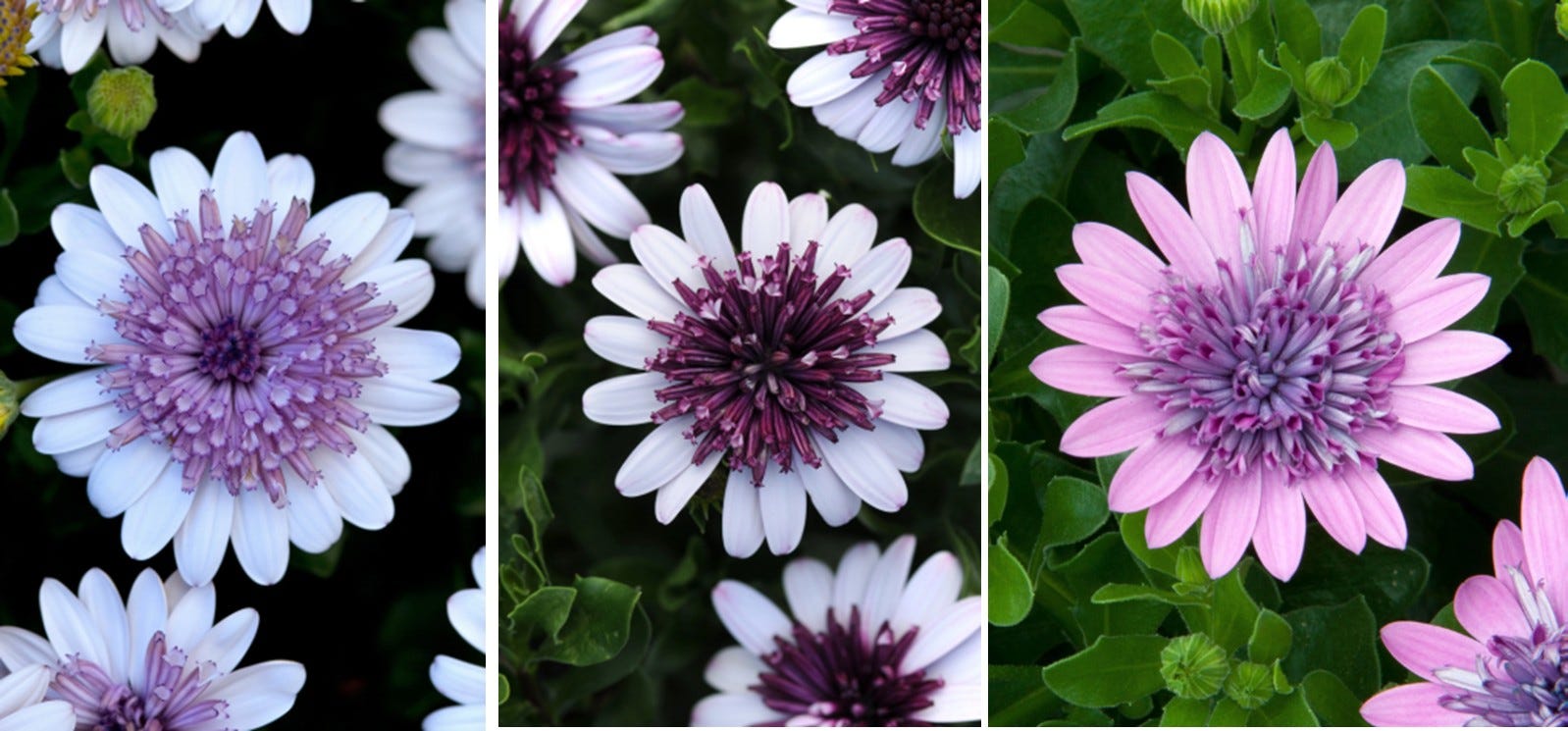
This is a good sampling but only a sampling. The listing above started as a much longer list. In editing my own original list (which I started many years ago), I soon found that many cultivars are no longer available or are available at discount retailers and without full labeling. But such shrinkage has been more than offset by a mad rush by breeders to jump on this trend. The industry has found a very important new plant for the retail market. Not only colorful and easy, they are some of the best plants for the coming hotter, drier gardening climate. That’s why new cultivars, by the dozens, appear every year.
.
It’s safe to say that every major nursery in the U.S. offers at least some African daisy species as above and certainly a dozen or more of the hybrids. California is where almost everything here can be found but they’ve become an important commodity everywhere else.
If you’ve become passionate about African daisies, you might want to look into Silverhill Seeds. They are THE specialist in South African native flower seed and their seed selection is out of this world (for unusual plant collectors). Before you look into it, this is their introductory shipping policy: “Please ensure you have checked your import conditions and postage requirements. Please note there is a delay at US Customs due to the new tariff charges and the removal of minimum threshold.”
.
.
© Copyright Joe Seals, 2026
No posts
Comments
Nothing yet. Say the first thing.
Sign in to join the conversation.