
A question keeps coming up in my conversations with campus leaders, whether I’m talking with a CIO, a provost’s office, or a system-level committee: “We know our people need to build their AI skills. But what does that actually mean, and where do we start?”
It’s a fair question. Most institutions have moved past the initial wave of AI curiosity. They’ve piloted tools, drafted guidelines, and stood up task forces. What many still lack is a shared definition of what AI proficiency looks like across the institution, and a practical way to build it without adding another burden to people who are already stretched thin.
Two observations from my own work kept pointing me to this gap. First, I see frameworks, plenty of them, but without details on how they could be operationalized. A model on a slide is not a program. Second, I see AI programs popping up all over campuses, but it’s often unclear what their intended outcomes are, whether they’re cohesive with one another, and how these efforts tie to the principles of responsible AI and align with the campus mission.
These observations led me to this framework. I built CampusAILiteracy.com to connect the two halves that usually go missing: a proficiency model specific enough to act on, and a way to design programs that are intentional, coherent, and anchored in responsible AI and institutional mission. It’s part of the larger Campus AI Framework, sitting within Pillar 5: Engagement & Collaboration.
The cost of not defining it
Fragmentation isn’t a tidiness problem. It has a price, and institutions pay it in three ways.
They pay it in redundant investment: three units buying three overlapping licenses and building three versions of the same intro workshop, because no one shared a baseline. They pay it in uneven risk: one office using AI in a high-stakes way, such as admissions screening or student advising, without realizing it has crossed into territory that demands more scrutiny, while another office avoids AI entirely out of vague fear. And they pay it in missed leverage: with no common floor, nothing scales, because every new effort starts from zero.
Picture three units adopting AI in the same term, each with its own assumptions about acceptable use. One treats student data as fair game for any tool; another won’t touch it. Students get wildly different experiences depending on which door they walk through, and when the audit or the board question comes, no one can say what the institution’s actual posture is. That isn’t a hypothetical failure. It’s the default outcome when proficiency is left undefined.
One organizing idea
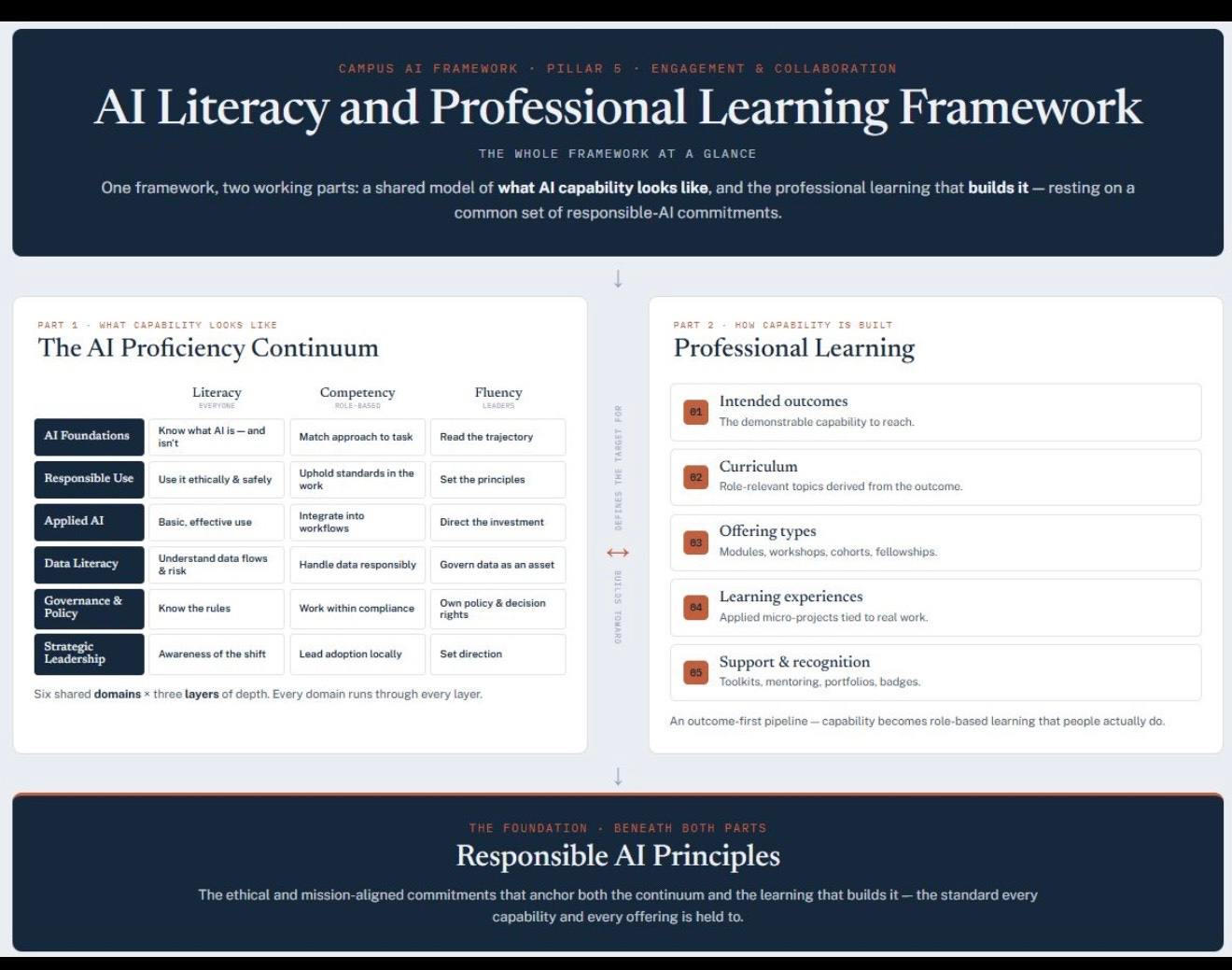
The site flows from a single idea: an institution should define what AI proficiency means once, in one shared model that every unit works from, rather than letting each department write its own competing definition. That shared model becomes a common language, and proficiency gets built through role-based learning that rests on responsible-AI principles.
When a provost, a financial analyst, a faculty developer, and a systems administrator can all point to the same model and see themselves in it, this work stops being a scattered set of trainings and becomes an institutional practice.
The AI Proficiency Continuum
The core of the site is the AI Proficiency Continuum. Two axes define it.
The first axis is depth, expressed in three layers. Literacy is for everyone: a shared baseline understanding of what AI is, what it can and cannot do, and how to engage with it responsibly. Competency is by role, the ability to apply AI effectively in the actual tasks of one’s own work, which looks different for a financial analyst than for a faculty developer. Fluency is for institutional leaders, and it’s where the stakes turn strategic: the judgment to prioritize AI investment, weigh reputational and academic-integrity risk, anticipate workforce implications, and lead pedagogy shifts rather than react to them. A leader doesn’t need to operate the tools, but they do need the judgment to make sound calls about them. Not everyone needs the same depth, and pretending otherwise is how institutions end up with training that’s too shallow for some and overwhelming for others.
The second axis is breadth: six shared domains that run through every layer, from the foundational to the strategic. They span AI Foundations, Responsible Use, and Applied AI; Data Literacy for AI; and AI Governance & Policy and Strategic AI Leadership. Everyone works across all six. What shifts between layers is the emphasis, not the territory.
Where the layers and domains intersect, you get the capability matrix, a map of what each domain looks like at each depth for any role. That matrix is the common language.
From the model to professional learning
Naming what proficiency looks like is only half the work. The site also lays out how to build it: an outcome-first professional learning pipeline that moves from intended outcomes to curriculum, to offerings, to experiences, and finally to recognition. Start with what people should be able to do, then work backward to how they’ll learn it.
The site follows a System, Campus, Program spine, moving from broadest to most specific. At the system level, it addresses the question every multi-campus system wrestles with: what to run centrally versus what to leave to each campus. At the campus level, it covers maturity assessment, where to begin, a phased roadmap, cost, governance, and team. At the program level, it walks through how to stand up a single offering, the formats available, and how to measure impact. There’s also a working process for running an engagement, with self-assessment tools, stakeholder mapping, and reusable templates.
Where this sits in the bigger picture
It helps to see how the pieces of AI transformation relate. Governance defines the guardrails. Architecture enables what’s technically possible. But neither one works in practice unless people across the institution have the understanding and skill to act on them. Literacy is the human layer that determines whether governance and architecture actually hold.
That’s why this lives in Pillar 5 of the Campus AI Framework. Governance and IT architecture are their own pillars, and they matter. This is the part that decides whether any of it translates into how people actually work.
What it is, and what it isn’t
I want to be direct about the boundaries, because they matter.
This is not tool training. It names what people should be able to do, not how to operate a specific product. It is not a mandate or a compliance regime; participation is voluntary and meant to be adapted to each institution. It is not a finished curriculum; the offerings and topics are illustrative, to be built locally. And it is not a governance or IT-architecture framework; those are separate pillars of the Campus AI Framework.
What it is: a starting point, meant to be adapted to each institution’s context. Consider one external signal. The EU AI Act includes an explicit AI literacy requirement, obligating organizations that provide or deploy AI systems, higher education included, to ensure their staff have a sufficient level of AI literacy. What this site treats as good institutional practice is, in some jurisdictions, already a legal expectation. And I don’t expect the EU to remain the exception. I expect more legislation, local and global, to require AI literacy, and I expect accreditation agencies to follow. Institutions that build proficiency now will be ready. Those that wait will be reacting.
Why this matters to me
If you’ve followed my writing, you know where I land on this: the hardest part of AI transformation isn’t the technology. It’s the people. Institutions can procure tools and write policies, but transformation happens when people across every role, from the front counter to the cabinet, have the confidence and skill to use AI well in service of the mission.
That work starts with a shared language. You can’t build proficiency you haven’t defined, and you can’t scale it if everyone defines it differently.
Explore it at campusailiteracy.com, start with The Framework section to learn the model, then jump to the level where you work.
And if you’re doing similar work at your institution or system, I’d welcome the conversation. This is a working reference, and it will get better with input from people doing the work.
Comments
Nothing yet. Say the first thing.
Sign in to join the conversation.