
In just a few days, I will be heading to the Land of Zdarsky and Wolverine. Yes, it’s a land of many contradictions.
This is my second trip to Canada in less than four months. You’d think the entire country would be yelling, “No mas!”
Maybe it is?
I’m still going anyway, so prepare yourself, Toronto!
IMPORTANT: I WILL BE THERE THURSDAY AND FRIDAY ONLY!
Here are my signing times. All are subject to change:
THURSDAY, AUGUST 27
Booth CP58
5:00–8:00 PM
FRIDAY, AUGUST 28
Booth CP58
11:00 AM–2:00 PM
4:00–6:30 PM
I’ll also be on a panel Friday at 2:30 PM in Room 701. The room isn’t confirmed yet, so double-check closer to the event in case it changes.
Moving on.
In our last installment, I told you we’d finish with the divorce. Here it is, and like most divorces, the evidence was hiding in the paperwork.
Pull out Amazing Spider-Man #30, November 1965, and read the credit box.
Wait, never mind. I’ll do it for you.
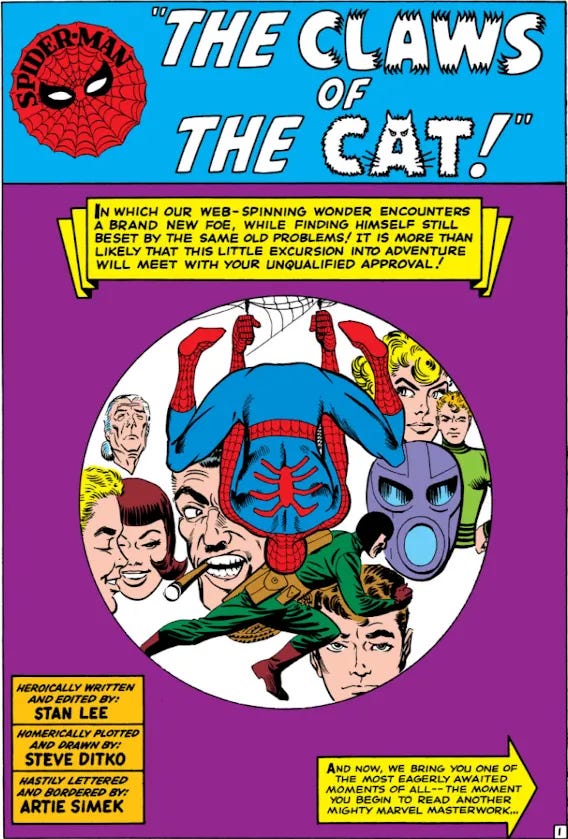
“Written and edited by Stan Lee. Plotted and drawn by Steve Ditko.”
Now, for the record, issue 30 isn’t where that credit first appeared. Marvel had started acknowledging Steve’s plotting back in issue 25, and on arrival it read like recognition.
It was. Steve had earned it a hundred times over.
So why am I focusing on issue 30 instead of 25?
Because by 30, you can see what that credit actually meant.
These were two men doing two separate jobs in two separate rooms. Steve plotted alone. The pages went to Stan. Stan wrote what he saw.
By this point, the two men weren’t speaking at all.
Sound familiar? Two guys who parted ways certain they’d agreed on the story, except now there was no ride home, no back and forth over the road noise, no third option invented in the space between them.
And in issue 30, you can watch what that looks like in print.
Ditko drew a gang of uniformed, high-tech crooks hijacking a shipment of uranium. Everything about them is engineered as a setup: these are the foot soldiers of the Master Planner, the villain of the three-issue masterpiece Ditko was building next, which Stan had no clue he was building to.
Stan looked at those pages, and, with nobody to ask and apparently no interest in asking, scripted them as the hired muscle of the Cat, the small-time burglar starring in that particular issue.
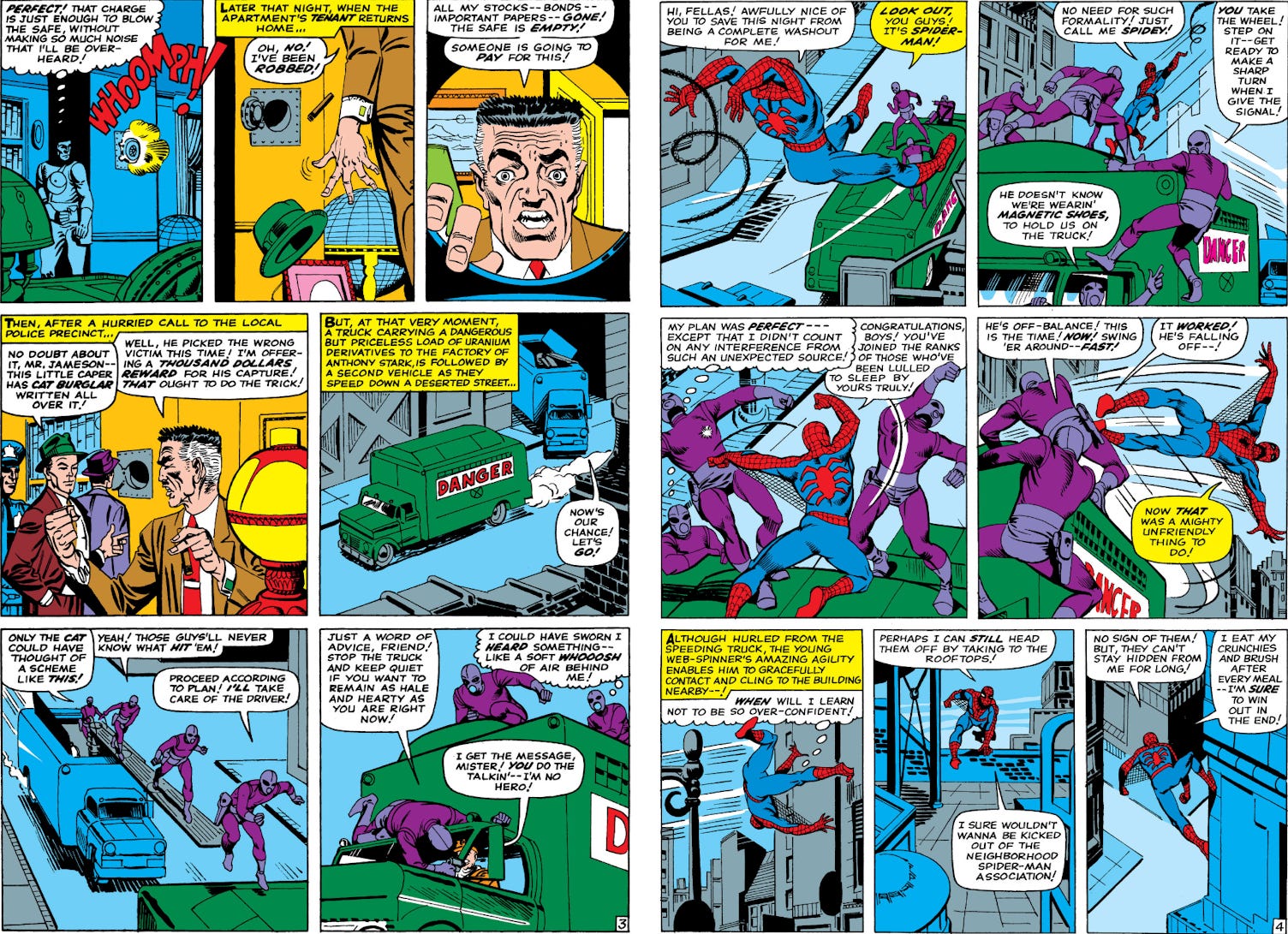
This is what it looks like when the artist is drawing one story while the writer is writing another.
And nobody ever fixed it.
Issue 31 hit the stands, the same gang showed up working for the Master Planner, and not one caption looked back. Eventually a confused reader wrote in, and Stan joked it off in the letters page of 34.
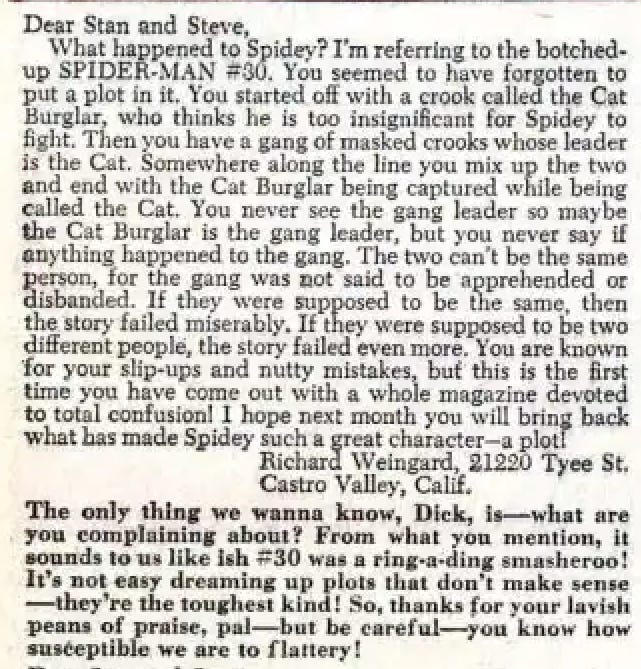
Have to give Stan credit. He didn’t have to run that letter. But that’s what I loved about the man: he’d always find a way to show you how the sausage was made, even when the sausage was his.
That came out wrong, but you know what I mean.
One caveat, because I’ve been careful with this story since we started it, and I’m not stopping now: Ditko never publicly explained his intent for those specific panels. The inference comes from the pages themselves and from Marvel’s own correction.
Marvel didn’t formally own the error until 1984, when a reprint of the story in Marvel Tales #169 ran an editor’s note admitting the script “should have said” the gang worked for the Master Planner.
Nineteen years to acknowledge it.
Mommy and daddy were arguing openly for all the world to see, and twelve cents was the price of admission.
The final movement of our lesson on the two languages. First, what the languages are. Then, the marriage. Now, how it ends.
You can see the split coming in the character himself.
Over Ditko’s last two years, Peter Parker tightens. He grows more isolated, more judgmental, more certain of his own compass. He resents the people around him. He refuses to join the campus protesters. He stops needing to be liked.
That was Steve’s Peter, and it tracked with everything Steve believed: responsibility, self-reliance, the individual against the crowd.
Stan wanted the other Peter. Connected, romantic, contemporary. A kid finally getting invited to the party.
Then Ditko left with issue 38, and here’s the thing about watching an era end: the next era tells you a hell of a lot about the last one.
Under John Romita, Peter gets handsomer almost immediately. His social life expands. Gwen Stacy moves to center stage. Mary Jane finally walks through the door in full glamour mode with the most famous entrance line in comics.
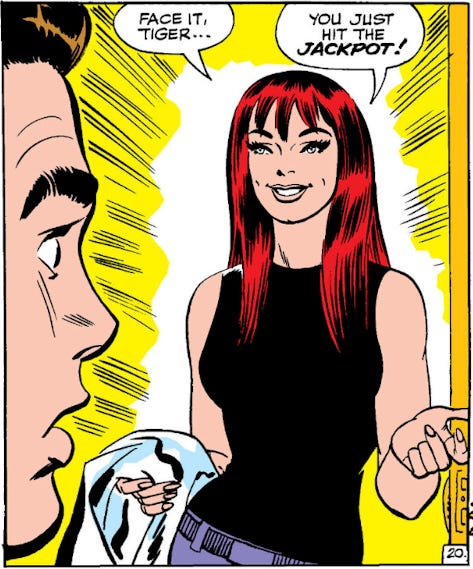
The book got warmer, sexier, more soap opera. It became, almost overnight, the comic Stan had been describing all along.
I don’t think that was accidental.
The post-Ditko Peter Parker is Stan’s Peter. And once you see him, you realize just how different Stan and Steve’s versions of that character had become.
Earlier in this series, I told you what the Marvel Method gives you: an artist with full storytelling authority, telling the story instead of illustrating it.
What I didn’t tell you was the price tag.
When the artist is plotting the story, authorship gets harder to divide cleanly. Sixty years later, we’re still arguing about who created what. That’s not a footnote to the Marvel Method.
That’s the bill.
The method didn’t divide the work. It divided the authorship.
Every credit box in this lesson is two men trying to describe a marriage in six words.
“Written and edited by. Plotted and drawn by.”
Marvel kept fiddling with the wording because nobody could ever settle what was true underneath it.
And while we’re reading credit boxes: in 1965, Marvel didn’t print colorist credits at all. Stan Goldberg colored practically the entire line, and his name appears nowhere in those comics. A third of what you love about a sixties Marvel page belongs to a man the page never mentions.
I broke into this business as a colorist.
Just sayin’.
Nobody tells you this when you take the Editor-in-Chief job, so I’ll tell you: a chunk of it is herding cats, another chunk is marriage counseling.
For eleven years, writer-artist teams came through my office in every condition. Honeymooners. Bickerers. Couples already sleeping in separate studios.
And the failures never once surprised me, because it’s always the same death.
The fight leaves the page.
In Lesson 24, I told you a working collaboration is shared custody of the reader. Every argument Stan and Steve had in the good years was an argument about what the reader would find more compelling and surprising: is an otherworldly or cosmic entity right for this world, is May’s death right for this kid.
That’s something I learned sitting in that chair. I never worried much when a writer and artist were arguing. At least they were still talking. What worried me was when they stopped.
Because once they stop arguing with each other, they start arguing through the work.
Look at ASM 30.
There’s an artist protecting his story from his writer, a writer captioning around his artist, and a reader left to figure out why the words and pictures don’t match.
Yelling is what the marriage sounded like. The divorce is the silence.
Remember John Romita’s story from the Cadillac? By issue 30, the two monologues weren’t even masquerading anymore.
When the conversation stops, the work doesn’t stop. That’s the cruel part.
The book kept shipping. It even stayed brilliant, right to the end, because both men were geniuses operating at the height of their powers in separate rooms.
But the third option, the thing neither man walked in with, the Bennett Brant instead of the dead Betty?
That never happened again.
The marriage made things neither man could make.
The divorce just made comics.
Something more hopeful. I promise.
The next lesson is about what happens when craft actually works: nobody notices it. Fans defend characters like they’re family. Stories outlive the people who made them. The creator pulls off the ultimate magic trick and disappears entirely.
We’ve just spent three installments watching two men who couldn’t disappear into one voice.
Next time: what it looks like when creators can.
Thanks for reading.
You’re AMAZING!
JQ
Comments
Nothing yet. Say the first thing.
Sign in to join the conversation.