
There’s something I forgot to mention. Last week's Part 23, The Two Languages, was the beginning of Act VI of this curriculum.
In my defense, I went back and checked, and I never announced Act V either. At this point, unannounced acts are less a mistake and more a house style.
So consider yourself officially caught up. You are in Act VI: Disappearance. And for everyone reading this series in order somewhere down the road, I went back and hung both banners on the online versions, Act V: Authority at Lesson 18, and Act VI at last week’s. The emails remain a monument to my consistency.
Now, back to the lesson.
Actually, one more thing, because last week’s Cadillac story has a postscript.
Marvel Vice President, Executive Editor, and resident historian Tom Brevoort read the last installment and had something to add to the Stan and Jack story, a different telling of the tale. John Romita Sr. told Tom the same commute story years before he told me, and it came with a detail that changes the picture.
As John told it to me, while Stan and Jack did talk back and forth, neither man was actually listening to the other—they were just pushing forward their own ideas. And so when they parted, both Stan and Jack felt that they’d agreed on the particulars of the story, but each one had a different story in mind. Then Jack went away and drew up his story, and after getting the pages in, Stan tried to dialogue it back into being his story. Apparently, this was a frequent difficulty they had, but John said that he saw it happening in real time—it was two monologues masquerading as a conversation.
Two monologues masquerading as a conversation.
That might be the best sentence about collaboration I’ve ever heard.
Same ride. Same two geniuses. The story got deeper because the man telling it was younger at the time, telling it to a different person.
File that away, because it’s the theme of this whole installment.
Hold on to that phrase, too.
We’re not done with it.
This is the second movement of our lesson on the two languages.
Last week, we talked about what the languages are.
This week, we’re talking about what happens when two people actually have to speak them to each other.
Now.
I promised you more Stan Lee and Steve Ditko, two men who built Spider-Man while disagreeing about practically everything.
That’s not me being colorful.
It’s sworn testimony.
In a 2010 deposition connected to the Kirby copyright case, John Romita Sr. put it under oath: Stan and Steve disagreed on almost everything. Cultural, social, historical, and, most important to this lesson, they disagreed on characters and stories.
And out of that marriage came the most human superhero ever made.
Open the file.
The disagreements are still there, preserved in the essays Ditko spent his later years writing about what happened in that room. That doesn’t make Ditko’s account any more accurate than Stan’s. Stan, for the most part, never answered Ditko’s version publicly. There could be several reasons why, but I don’t think any of us are in a position to do more than guess.
Here are three entries.
By Ditko’s account, Stan’s synopsis had a movie crew on location discovering an Egyptian-like sarcophagus. Inside was an ancient mythological demon called the Green Goblin.
“I rejected Stan’s idea,” Ditko wrote.
Ditko wanted Spider-Man’s villains to grow out of that world. Human beings making terrible choices. Criminals, scientists, inventors, and broken men who usually had more in common with Peter than either of them wanted to admit.
So he took the Goblin out of the sarcophagus and put a man behind the mask.
Given everything that came later, the distinction may seem almost quaint. Spider-Man has since encountered enough gods, demons and interdimensional beings to make Dante’s Inferno feel like a PTA meeting. But in those first years, Ditko was helping establish the rules before anyone started breaking them.
Then comes the version everybody knows.
Stan wanted the Goblin unmasked as Norman Osborn. Ditko wanted him to be a total stranger. That disagreement has often been cited as one of the things that drove Ditko off the book.
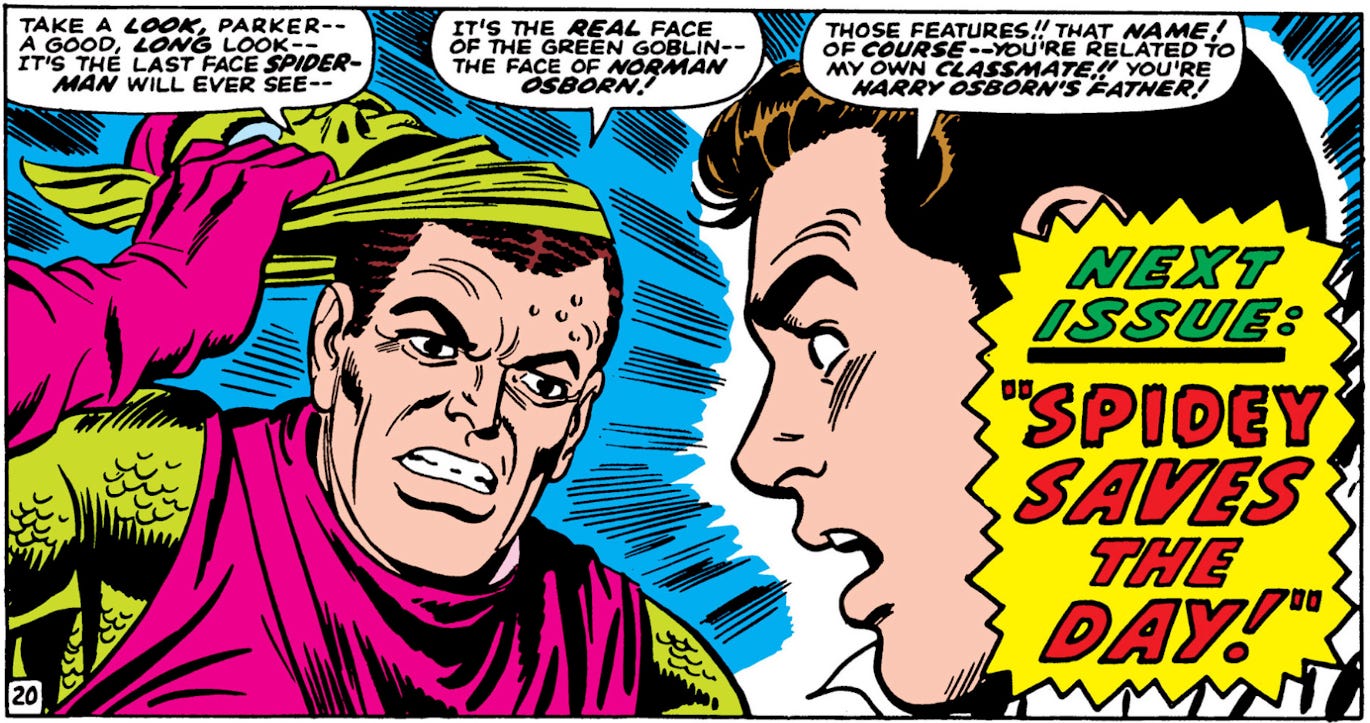
Stan told the story that way in 2011, and John Romita repeated a version he had heard secondhand from Stan.
Ditko said it never happened.
“I knew from Day One, from the first GG story, who the GG would be,” he wrote.
And the published pages make the argument more interesting.
An unnamed Osborn begins haunting the backgrounds of Jameson’s club in issue #23. Harry arrives in issue #31 with the same unmistakable wavy hair, visually linking the two before anyone says a word. Six issues later, in #37, the unnamed man finally gets a name: Norman Osborn, Harry’s father. As far as anyone can tell, no one noticed those background cameos for more than thirty years, until Ditko himself pointed readers back to the pages.
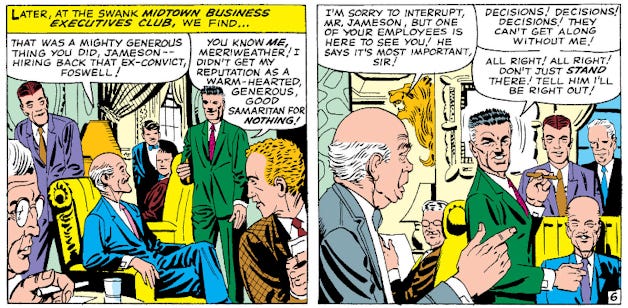
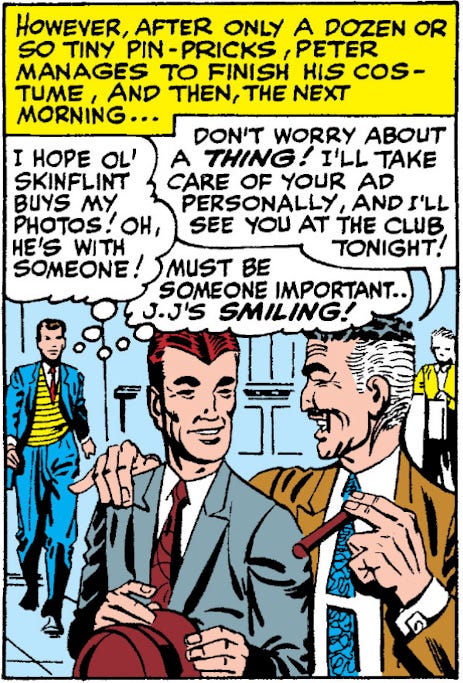
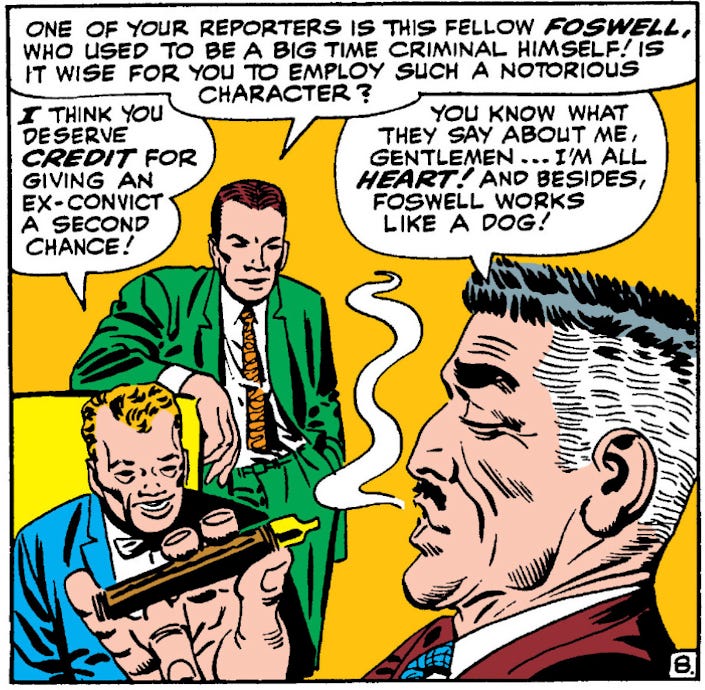
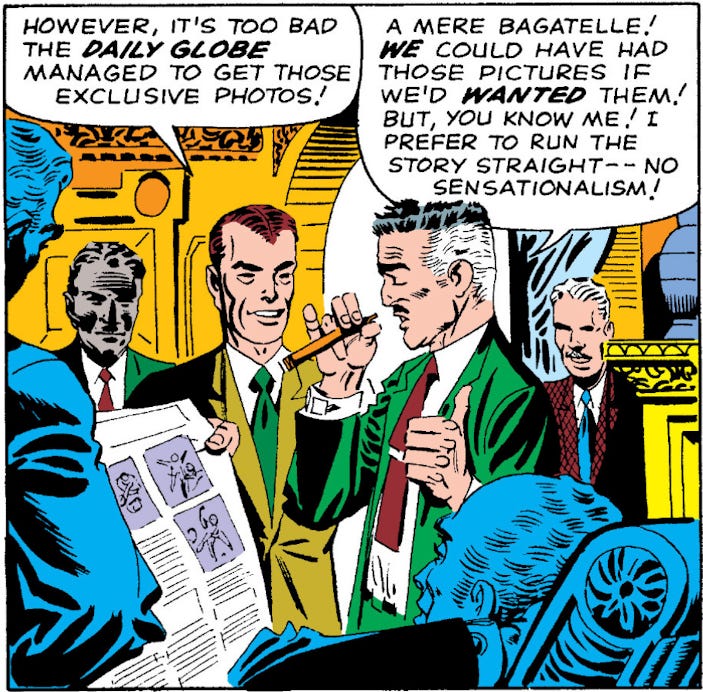
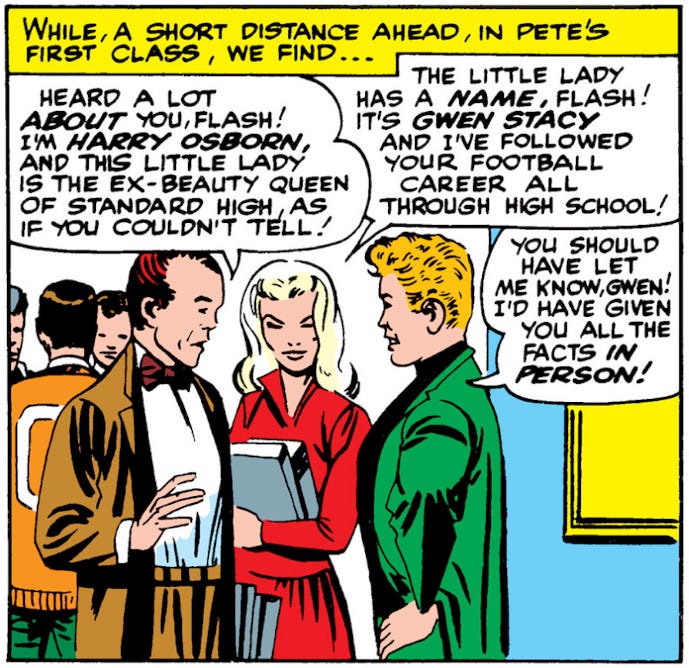
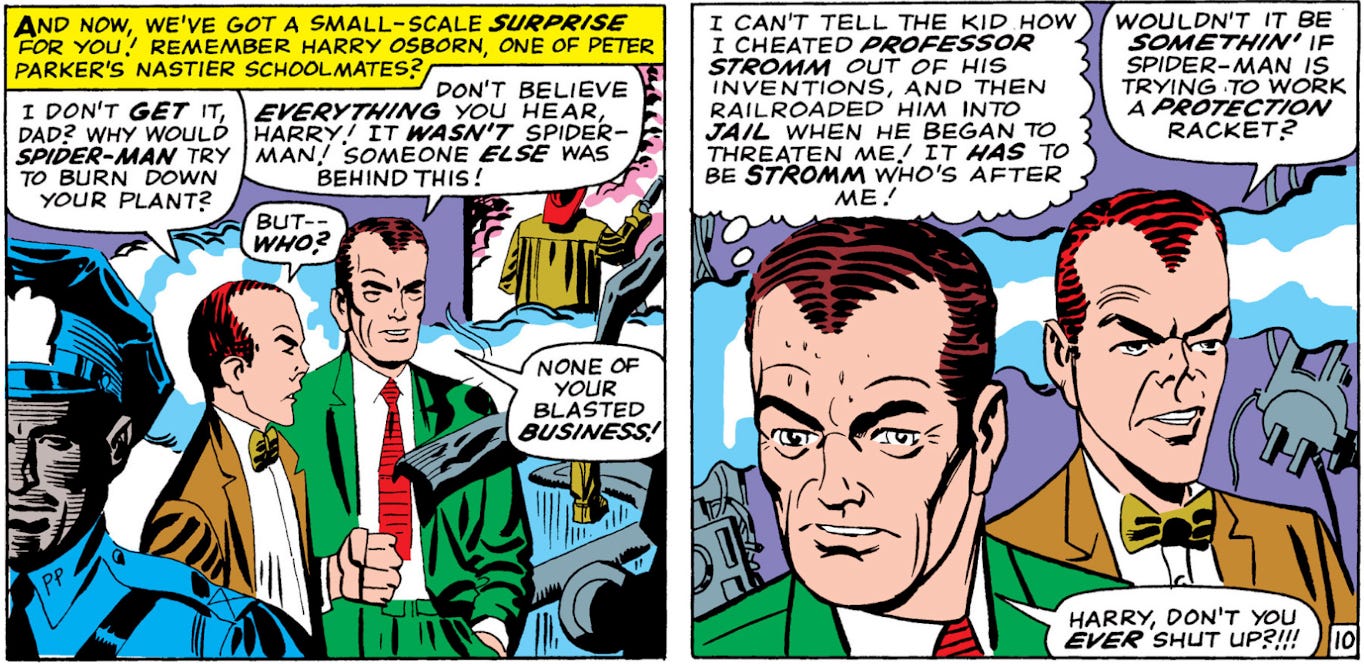
Stan complicated matters further. In 1995, he admitted he couldn’t remember whose idea Osborn had been. When he told the dispute story years later, he began by warning that he might be blending different characters and memories together.
Which is usually where comics history leaves you.
The legend is cleaner than the evidence.
Here’s where I part company with the legend.
Look at what the pages actually prove. And what they don’t.
What they prove is that Ditko built a recurring, unnamed man into Jameson’s circle with one distinctive, trackable feature.
That tightly ribbed widow’s peak hairstyle.
It’s a mystery device. It’s engineered so that when the reveal finally lands, whoever it lands on, the reader can flip back through a year’s worth of comics and realize he’d been hiding in plain sight all along.
Notice what that device requires.
Not a name.
It only requires that the same face reads as the same face, month after month.
That part of Ditko’s story doesn’t need Ditko’s testimony.
It’s on the pages.
The identity is a separate decision.
That’s what makes the device so elegant. The mystery is real even if the answer isn’t fixed yet.
By the time Harry showed up, Ditko had two threads sitting on his table: an unnamed man with a trackable look, and a kid who needed a father. He tied them together.
Smart.
Efficient.
Exactly what good storytellers do.
But that’s a second decision.
Not the execution of the first.
So here’s what I think happened.
I think Ditko correctly remembered building the trap, and forty years and one ugly credit war later, memory compressed, “I built a device that could catch anyone,” into, “I knew from Day One.”
I also think Stan correctly remembered wanting the reveal to land on someone the reader already knew, then, after warning us his own memory might be blending different stories together, attached the opposite preference to Steve.
I don’t think either man is lying.
I think both of them are smoothing.
Repetition doesn’t preserve accuracy.
It preserves the version you’ve told most often.
And if that sounds familiar, it should.
You just watched Stan and Jack drive home from the same conversation with two different stories in their heads.
Now you’ve watched Stan and Steve walk away from the same collaboration with two different histories.
By Ditko’s account, readers complained that May was too old, too frail and, especially, too ugly.
Stan’s first fix was simple.
Redesign her.
Ditko refused.
So, Ditko wrote, Stan floated the bigger fix.
Let her pass away naturally and give Peter a grown-up life with a full-time job at the Daily Bugle.
Ditko’s response, in his own words, was that this would make the book “a rank imitation, a copycat version, a Brand Echh idea.”
Take away the guilt, the obligation, and the frail aunt who can never know Peter’s secret, and Peter Parker becomes Clark Kent with worse luck.
That last sentence is mine.
“Brand Echh,” by the way, was Marvel’s in-house nickname for the competition, so Ditko was saying roughly the same thing, only with sharper elbows.
I think he was right.
Kill Aunt May, and you remove one of the pressure systems that made Peter Parker Peter Parker.
This one runs in the opposite direction.
Ditko wanted to build a real romance between Peter and Betty. Then he wanted Betty to die.
Not murdered.
An accident.
The kind of arbitrary tragedy that happens in real life, because that was the world Ditko was trying to build.
Stan said no.
A death like that would hang over the book like a funeral that never ended.
Here’s the part I love.
Ditko almost never conceded a point.
Here, he did it with a single word.
Rightly.
Stan rightly believed it would cast a pall over the strip.
So they compromised.
Betty lived.
Her brother Bennett not so much. He died instead in issue #11, and Peter carried the weight of it.
The marriage didn’t produce a winner.
It produced a third option neither man walked into the room with.
Sometime in 2013, I read an interview with Grant Morrison where he talked about
a story he’d written in the mid-1980s for the original Miracleman run. It was never
drawn. Never printed. It sat in a drawer for thirty years.
By this time, Marvel had put the finishing touches on a deal that would give them
the Miracleman rights, and I reached out to Grant to learn more about this unpublished story. He was in Los Angeles at the time, and as luck would have it, I had to travel to LA for assorted Marvel business. So we made plans to meet. By the end of a wonderful lunch at the Chateau Marmont where Grant was staying, he agreed to let us publish the story, but under one condition.
I had to draw it.
No pressure.
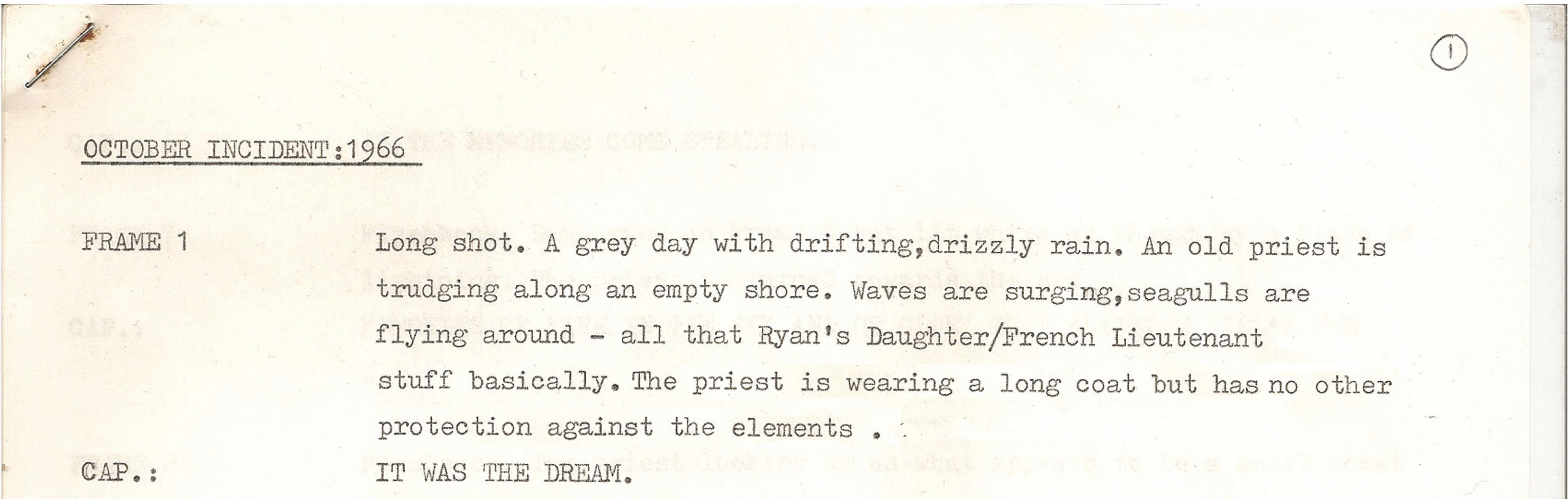
Here’s what Grant handed me.
Four pages.
Twenty-nine numbered panels.
Descriptions.
Dialogue.
And not a single page break.
Every decision about where a page ended, where a turn landed, what deserved a full page and what got compressed…
…that was mine.
I couldn’t wait to dig into it. Grant had given me an extraordinary amount of freedom to do my thing.
So I took those panels and started to break them down into pages. Pages with hopefully all the turns and reveals in the right places and a rhythm that would keep the reader engaged enough not to notice the men behind the curtain.
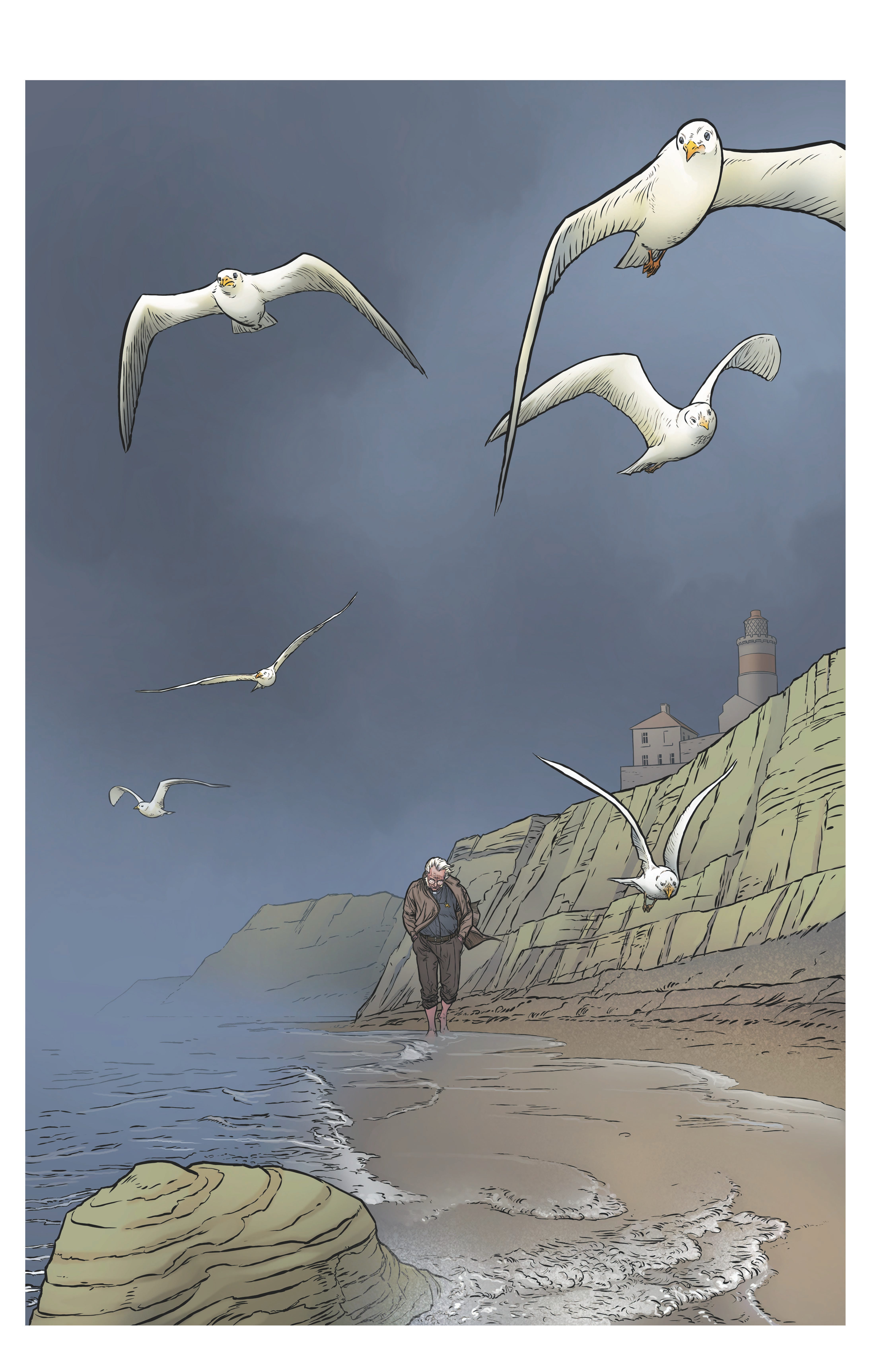
By the time I finished, Grant’s twenty-nine panels had become thirty-three spread across eleven pages, because some moments needed room he trusted me to find.
Remember Lesson 18.
The page turn is the one weapon no other storytelling medium has.
A writer who dictates every page break has to fully understand the craft because they’re spending the artist’s ammunition.
An artist who’s given the freedom to decide where those breaks fall has to understand it just as well, because the writer is trusting them not to shoot themselves in the foot.
It works the other way too.
An artist in a real partnership doesn’t just draw the page. They leave room for the writer to finish it. Fill every square inch with art and the writer has only two choices: cover the drawing or rewrite the script. Neither is a good compromise.
Back in Lesson 21, we talked about balloon placement as blocking.
The artist who leaves clean air where the dialogue needs to land is already doing the letterer’s blocking and the writer’s pacing before either of them touches the page.
Jack Kirby penciled notes in the margins telling Stan what was happening and sometimes what somebody might say about it.
That’s the artist writing to the writer.
A page can be a letter addressed to your partner.
Faces that act.
Staging that reads without captions.
Air where the voice belongs.
That’s what the artist leaves in.
So what actually makes the marriage work?
It isn’t agreement.
Stan and Steve settled that question sixty years ago.
A working collaboration is shared custody of the reader.
Every fight Stan and Steve had in that file pointed at one thing.
The page.
Is a demon right for this world? Is May’s death right for this kid? Is Betty’s?
Every argument was really the same argument.
What does the reader need this world to be?
Stan wanted Peter’s world to expand. Romance. Soap opera. Larger-than-life personalities. The whole colorful mess of being young.
Ditko wanted it to tighten. Responsibility. Isolation. Consequences. A kid learning that doing the right thing costs.
Neither vision was wrong.
And Spider-Man, the character you fell in love with, isn’t either one of them.
Spider-Man became Spider-Man because he had two fathers pulling him in opposite directions.
The tension was the fuel.
As long as it stayed pointed at the work, it powered the most important superhero comic ever made.
The divorce.
The same two men.
The same book.
But this time the fight comes off the page.
By the end, they weren’t speaking at all.
I’ll show you the issue where you can actually watch it happen in print: the artist drawing one story while the writer captions another.
It’s the reason so many creative partnerships fail.
The conversation stops.
The monologues remain.
Thanks for reading.
You’re AMAZING!
JQ
Comments
Nothing yet. Say the first thing.
Sign in to join the conversation.