
The 2026 Joe Q World Tour continues. The next leg of our adventure brings us back to the City of Brotherly Love and cheesesteaks. Wait… is it the other way around?
Pat’s or Geno’s? Or is it true what they say about John’s Roast Pork?
Before I agreed to take the job as Marvel’s Editor-in-Chief, I handed then CEO and Publisher Bill Jemas a list.
Not a wish list. A list of things Marvel had to commit to before I could accept the chair in good conscience.
One of them was getting Marvel out of the Comics Code Authority.
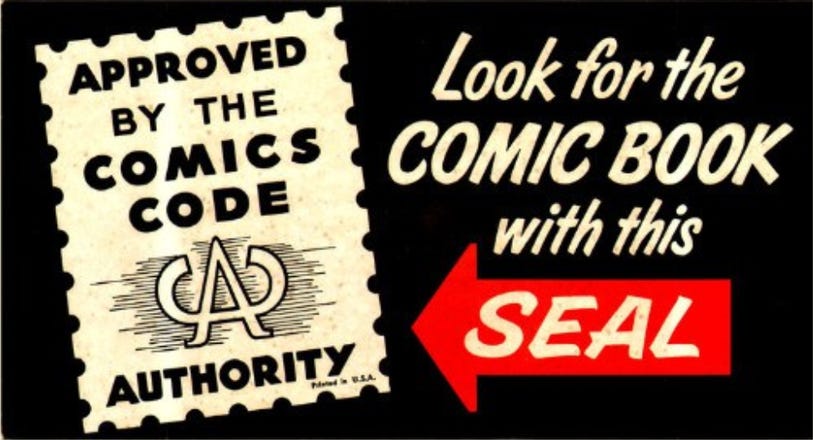
If you’re not a comics person, let me explain what the Comics Code was, because it matters and it’s also genuinely insane. In 1954, Senator Estes Kefauver’s Subcommittee on Juvenile Delinquency decided that comic books were corrupting America’s youth. The industry panicked and created the Comics Code Authority, a self-regulating body that reviewed comics before publication and stamped the ones that passed with a seal of approval. No excessive violence. No sympathetic criminals. Nothing that might make a twelve-year-old question authority.
Here’s the part that should make your head hurt: publishers paid for this. In some cases, literally by the book. They paid an outside organization for the privilege of having their own creative work censored. It was like hiring someone to come to your house, tell you your cooking was too spicy, and then writing them a check for the feedback.
As luck would have it, there was an upcoming annual meeting between DC and Marvel to discuss the Code. As the new Editor-in-Chief, I was actually looking forward to it. Maybe DC could make the case for why we should stay.
So I went uptown and sat down with Paul Levitz, DC’s Executive Vice President and Publisher, and Bob Wayne, their VP of Sales.
The meeting made one thing immediately clear: I was being perceived as a bit of a joke. The new guy. Loudmouth. No traditional editorial pedigree. In over his head. And, as I’d heard through the grapevine, the odds-on favorite not to last a year in the chair.
That was fine by me. I love being underestimated. It’s one of the most useful tools in any room.
I sat and listened. That’s when I learned something I had no idea was part of this yearly meeting: there was a discretionary fund, attached to the Code, meant to promote comics to the outside world. I honestly couldn’t tell you where the money came from, but it was there.
Then I learned where it was going.
Fliers. Printed fliers promoting comic books, to be distributed at book fairs and librarian conferences.
Fliers.
I’m going to let that sit there for a second.
Near the end of the meeting, this joke stood up and said, “Oh, by the way. We’re thinking about leaving the Code.”
Paul and Bob did their best to talk some sense into me. What a catastrophic mistake this would be. For Marvel. For the industry. For the republic, presumably. I told them I’d think about it and left.
When I got back, Bill was waiting. “How’d it go?”
“We have to get the hell out of the Comics Code. The sooner the better.”
That mischievous grin crossed his face. “Let’s do it.”
What we didn’t anticipate was the blind panic this would set off.
Before we knew it, incited by Richard Goldwater and Michael Silberkleit, the owners of Archie Comics, a request was made for an emergency meeting with us before we made a catastrophic, industry-ending decision. So we set it up.
Bill, being Bill, decided to add some seasoning. He invited Nanci, who wasn’t my wife yet but was running Marvel Knights, and her assistant, Kelly Lamy. No official reason for them to be there. Plenty of unofficial ones.
Nanci had worked at Archie for over fifteen years, and Kelly for about five. Nanci ran their entire Digest department, the most profitable division in the company. When Nanci handed in her resignation in order to join me and Jimmy to start Marvel Knights, Goldwater screamed at her. Told her she’d regret it. Told her she’d come running back, because the people at Marvel didn’t know what they were doing. More to the point, SHE didn’t know what she was doing. All of this coming from a man who used to remind her, with some regularity and the same tone of voice, that a monkey could do her job. Which makes it all the more interesting that he took her leaving so personally.
On the day of the meeting, Nanci, Kelly, and I headed up to the boardroom.
When we got there, everyone was already seated. They’d arrived early. The look on Goldwater and Silberkleit’s faces when they saw Nanci and Kelly walk in was worth every penny I’ve ever earned in this industry.
Then I noticed something else.
In front of Goldwater and Silberkleit sat a large portfolio case. Black. Oversized. Closed. I had no idea what was in it, but there it was, sitting on the table before a word had been spoken.
The room was something. Tense doesn’t cover it. You could feel the old guard, coiled and ready.
We did the introductions. The niceties. Levitz laid out the case for the Comics Code. The history, the value, and what it provides for the industry.
Our counter was simple: why are we paying an outside organization to approve our own books when we can do that ourselves? The film industry has a rating system. We could build one too.
When it became clear we weren’t moving, Goldwater and Silberkleit opened the portfolio.
Inside were yellowing newspaper clippings. Page after page of them. April through June of 1954. Story after story about the Senate Subcommittee on Juvenile Delinquency. The hearings. The panic. The threat to shut the entire comics industry down. And, for my money, the most shameful episode in the history of my industry. The moment when most of the industry, with Bill Gaines as the loudest and most memorable exception, collectively dropped their pants, bent over, and begged Senator Kefauver for another.
They turned the pages slowly. Deliberately. A presentation. A cautionary tale.
From 1954.
In 2001.
Silberkleit, frustrated by the look of utter confusion on our faces, cut to the chase:
“If we leave the Comics Code Authority, the senators will come after us again.”
Bill took a beat.
Then he looked at Silberkleit and said…
And I will never forget this as long as I live:
“To be honest, I’m more afraid of Sentinels than I am of senators.”
That was predictably the end of the meeting.
In May of 2001, Marvel publicly announced we were leaving the Comics Code and launching our own rating system. DC and Archie made a point of announcing they were staying. A necessary tool. A safeguard for parents. Translation: a safeguard for comics.
There’s an argument to be made that the Code was more valuable to Archie than to anyone else in the room. Their brand runs on wholesomeness. But it also implied, in some weird and perhaps delusional way, that when a mother was picking up an Archie Digest off a supermarket rack for her kid, the first thing she looked for was the Comics Code Seal of Approval.
I’ll leave that one right there too.
It took DC and Archie ten years to conclude that the senators weren’t coming. They dropped the Code in January of 2011.
Turns out that threat was about as real as Sentinels were.
Outside of Bill’s legendary line, here’s what I remember most clearly about walking into that final meeting.
Not the argument. Not the clippings. What I remember is the room before any of that.
Everyone already seated when we arrived. That portfolio case on the table, closed, not a word spoken yet. That’s three-point perspective. The architecture enlists before anyone opens their mouth. The world has already reorganized itself around a power dynamic.
Bill’s line worked like one-point. A single vanishing point. Every eye in the room converging on it, no side exit, no alternative reading. Just that.
The way I sat in that first meeting with Levitz and Wayne, watching, taking it all in. That’s two-point. The naturalistic angle. The one that lets the room exist without announcing itself.
If you’re scratching your head wondering what I’m talking about, read on, it’ll all make sense in the end.
Today’s lesson builds on things we discussed in some previous lessons. So I do recommend rereviewing Lesson 2 and Lesson 7 to get the most out of today’s. We’re now hitting the deeper-dive, or advanced, section of our curriculum.
Back in Lesson 2, I told you the brain reads an image before you think about it. Before context or intention. Pattern recognition fires first.
Always.
The same thing happens with a room.
Before the character walks, anyone speaks, or you know what this scene is about, the geometry has already made its argument.
Let me start by saying that while this lesson is about perspective, I’m not going to teach perspective here. There are plenty of resources out there that will explain it better than I can.
What we’re going to do is discuss perspective as to how it affects and can be used to great effect in storytelling, because, you know… see the title of the course.
One more thing worth knowing. The dominant perspective of any scene is set by its largest object. The widest building. The longest corridor. The biggest wall. Whatever commands the most space sets the rules. Everything smaller can have its own vanishing points, its own geometry. But the emotional argument of the scene lives in the dominant architecture. The characters arrive to confirm what the room has already decided.
The room makes its argument before the character opens their mouth.
One vanishing point, single-point perspective.
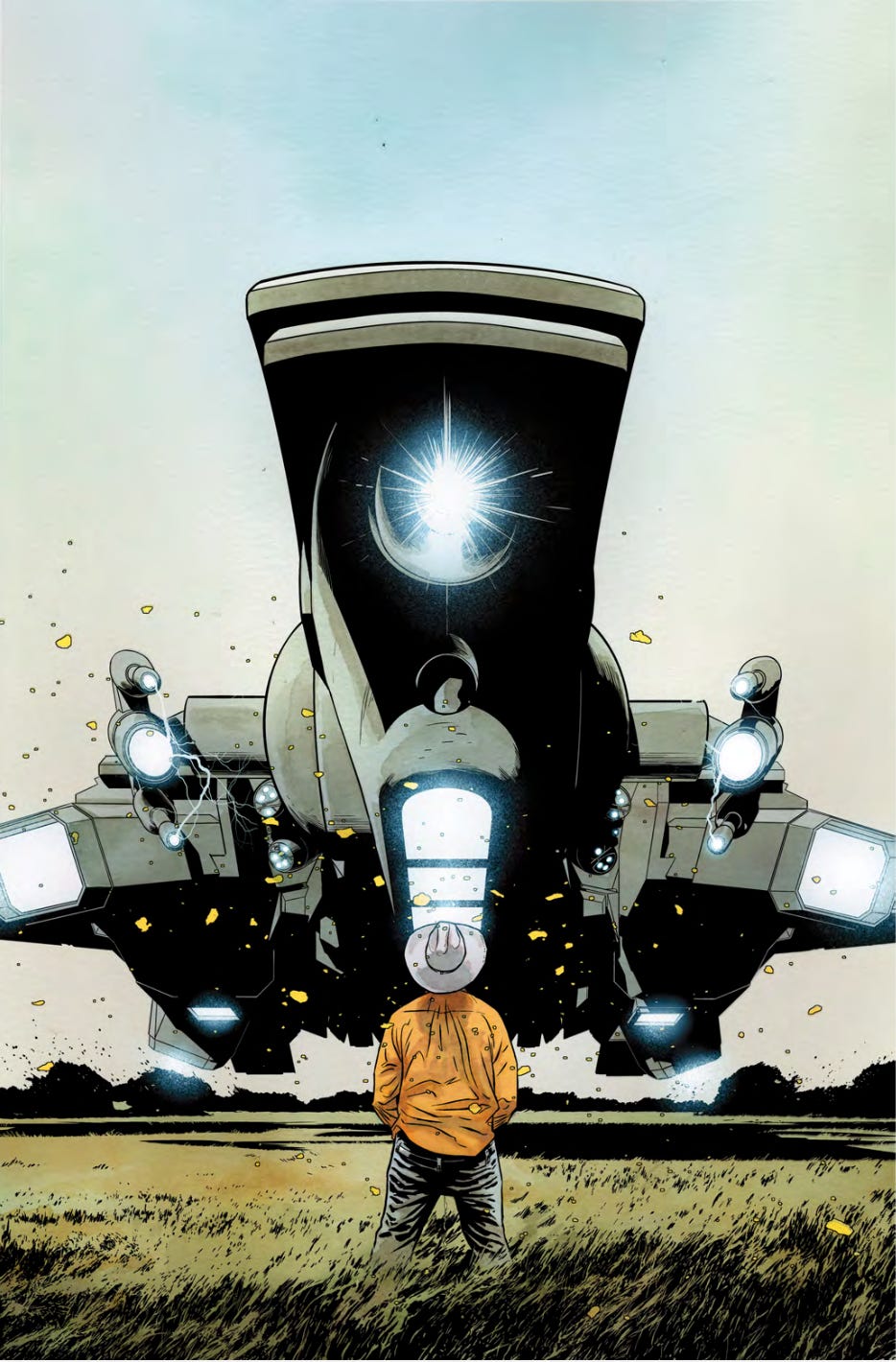
Everything in the scene converges on it. Every line, edge, and shadow, all pointing to the same spot.
That spot is either where you’re going or what’s coming at you.
The reader is nailed to the axis.
There’s no stepping around it.
No alternative reading.
No side exit.
The geometry says: look here. That’s it.
What you put at that vanishing point is the whole decision.
A doorway: invitation.
A figure standing at the end of the hall: confrontation.
A void: dread.
The perspective stays the same. The argument changes.
Geometry lines in the scene are lines of dialogue the reader can’t hear but absolutely feels.
Two vanishing points, two-point perspective, one off to each side. The horizon holds them both.
This is what most of the world looks like.
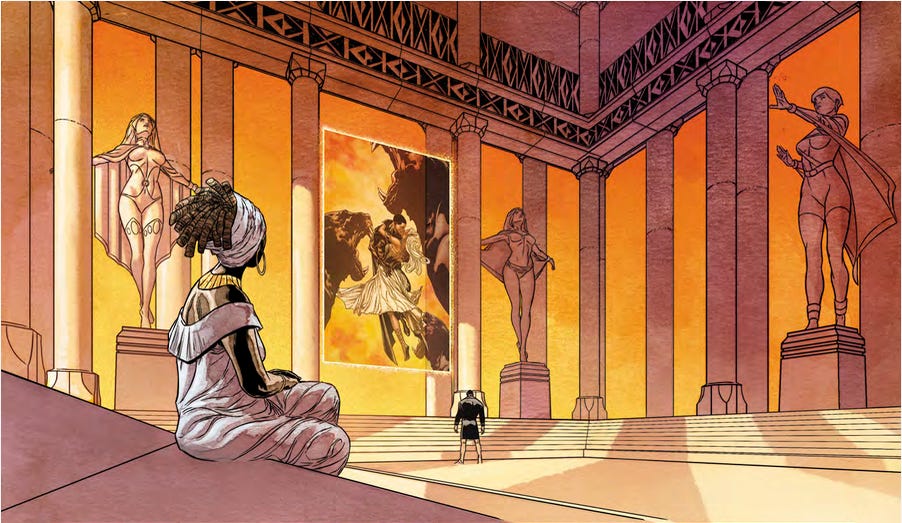
Two-point is the naturalistic perspective, the one the brain defaults to when the scene isn’t asking you to feel anything in particular. That doesn’t make it neutral. It makes it the foundation.
It lets the environment exist around the characters without the geometry making an argument they didn’t ask for.
Think of it like dynamics in music, yes, I’m going back to the music metaphor.
You don’t play loud through a whole song. You play at the level the moment calls for, so that when you do push the volume, it means something.
Two-point is that level. It’s what makes the dramatic choices register as dramatic, because it isn’t one of them.
Most of your panels will be two-point. They should be. That’s craft, not compromise.
The depth two-point creates isn’t only spatial, either.
A city built in two-point feels navigable. Real. Characters moving through it feel like they belong to a world with actual rules. You’re watching a story happen inside a place that exists.
Use it as your baseline. Let it breathe. Save the other tools for when the story needs them.
Remember: you’re not building a room. You’re building a feeling.
Add a third vanishing point, three-point perspective, and the geometry starts making moral arguments.
Two points on the horizon plus one above: worm’s eye.
The world looms.
Ceilings press down.
Figures tower.
The reader feels small before anyone does anything threatening.
Two points on the horizon plus one below: bird’s eye.
The world shrinks.
Characters become vulnerable without a single word spoken about vulnerability.
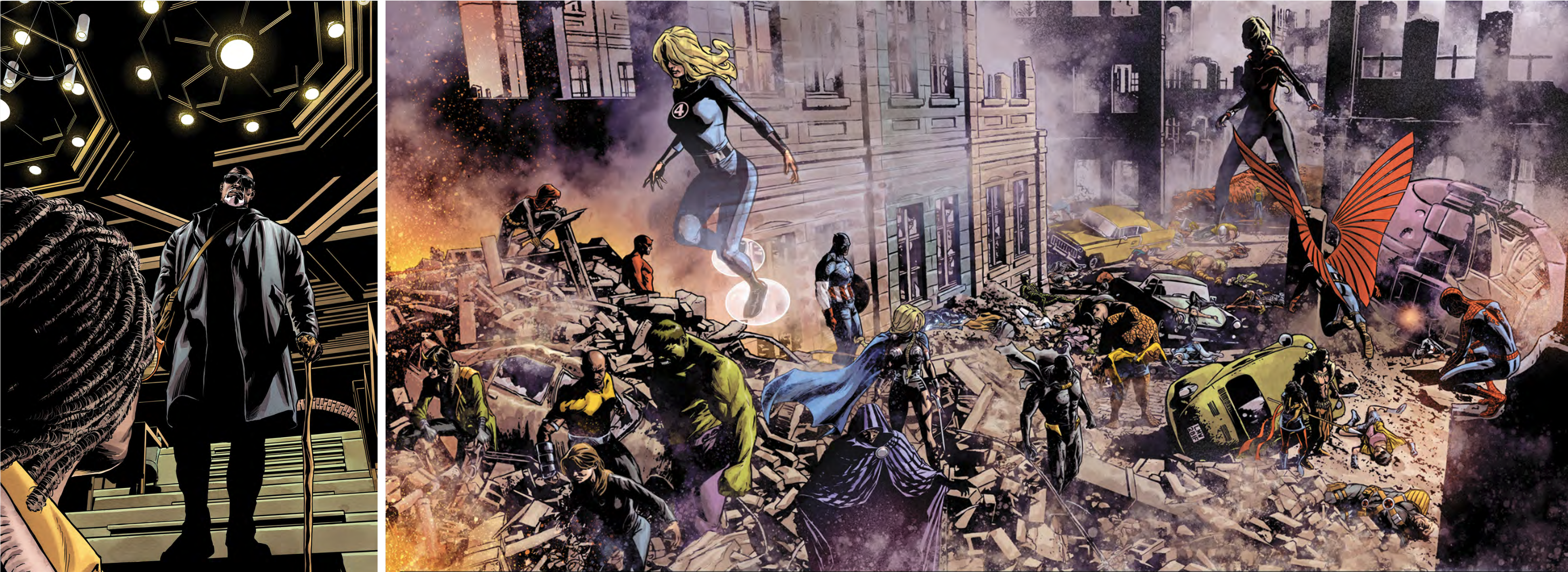
You can get some of this from one or two-point perspective. A low-angle shot can make a character look imposing. A high-angle shot can make them look exposed.
But three-point does something more aggressive.
It doesn’t just change the character.
It changes the room.
The walls lean.
The floor drops away.
The ceiling bears down.
Every edge in the environment is pushing the reader toward the same feeling.
From below, the character doesn’t just look powerful.
The world looks like it belongs to them.
Or, from above, the character doesn’t just look small.
The world looks like it has already swallowed them.
That’s what the third vanishing point does.
It enlists the architecture.
Back in Lesson 7, I talked about placing the audience in space relative to the characters.
This takes that idea further.
Because with three-point, you’re not only deciding where the reader stands.
You’re deciding what the room is doing to them.
And you don’t always need the full drama of worm’s eye or bird’s eye to make that happen.
There’s also a middle ground.
The slight tilt.
Not worm’s eye.
Not bird’s eye.
Just a few degrees off true eye level, enough to introduce a hint of vertical convergence without the full drama of three-point.
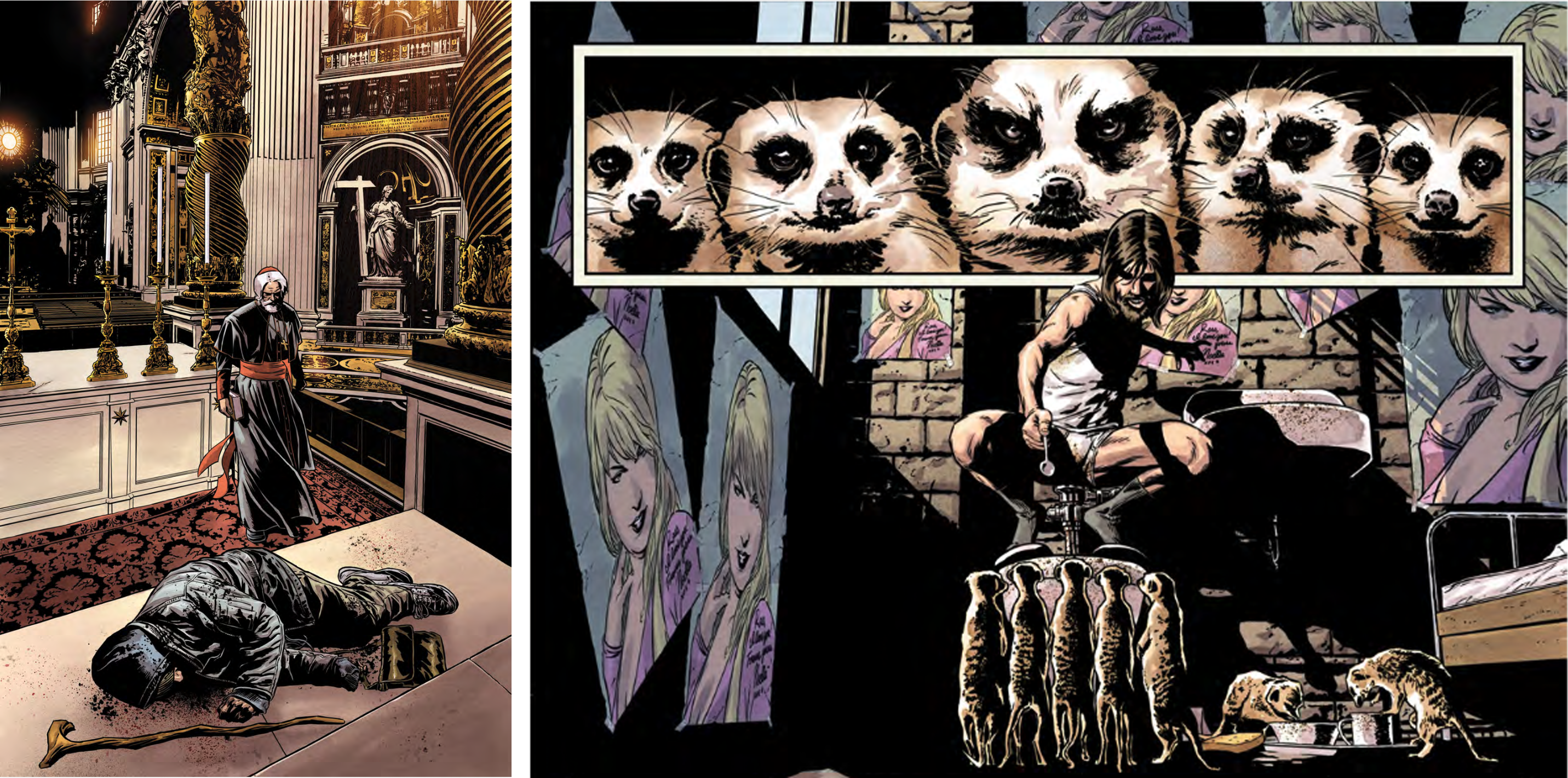
The reader won’t be able to name what they’re feeling.
They’ll just feel it.
A character who reads as slightly more powerful than the framing seems to justify.
A room that feels a little too large.
A ceiling that feels a little too low.
A space that feels a little too close.
The subtle version works on the subconscious. Which makes it, in some ways, more dangerous than the obvious one.
Because the geometry has already made the argument.
The geometry decides who owns the room before anyone opens their mouth.
Curvilinear perspective. Fish-eye lens. Five-point perspective.
You know what this looks like even if you’ve never drawn it.
The horizon bends. Straight lines curve. The room seems to wrap around the viewer, like the world is being pulled into one impossible field of vision.
That’s why it feels wrong.
Five-point perspective lets you see too much at once. The image gives you more world than the human eye normally knows how to hold, so reality starts to feel stretched, warped, and unreliable.
The walls feel too close and too far at the same time.
The room feels like it’s breathing wrong.
This is what perception looks like when a mind is under siege.
Reality folding.
Architecture betraying the person living inside it.
The reader doesn’t need to be told the character is coming apart. The lines are already saying it.
Use it sparingly. The moment you introduce it, you’ve made a promise: something about this character’s relationship with reality is no longer stable.
That’s a powerful card. Don’t play it on the wrong hand.
One other use worth knowing.
Curvilinear perspective doesn’t only mean psychological collapse. It can also mean superhuman perception.
A character with speed, heightened senses, altered consciousness, or abilities that don’t obey normal physics may not experience the world the way you and I do. So the image shouldn’t either.
In that case, the distortion isn’t a mistake.
It’s the point.
It’s the first-person view from inside an extraordinary mind.
Stanley Kubrick used this beautifully when he showed us how HAL 9000 sees the world.
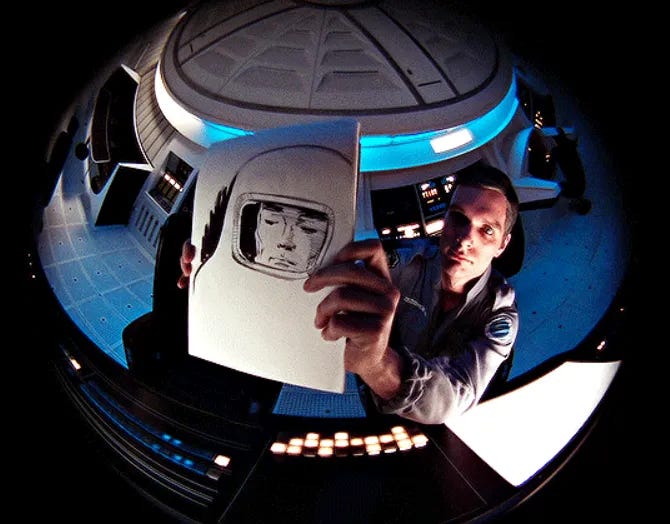
Either way, the message is the same:
Five-point perspective means the world itself is lying.
Here’s what many artists miss.
Perspective type isn’t a decision you make once at the start of a scene and leave alone. It’s a tool you can shift mid-sequence. And when you shift it deliberately, the shift becomes the story.
A scene that opens in two-point. The world just existing. Naturalistic, real, no argument being made. Then one-point enters as the confrontation begins. Every line in the environment suddenly converging on the same point. You didn’t write that shift. You drew it.
The reader felt it without knowing why.
Or pull it the other direction. A scene that starts in three-point. The architecture enlisted, the world already looming before anyone speaks. Then, as the character finds their footing, the scene settles into two-point. The world stops pressing down. Things level out.
You showed them finding ground without writing a single word about it.
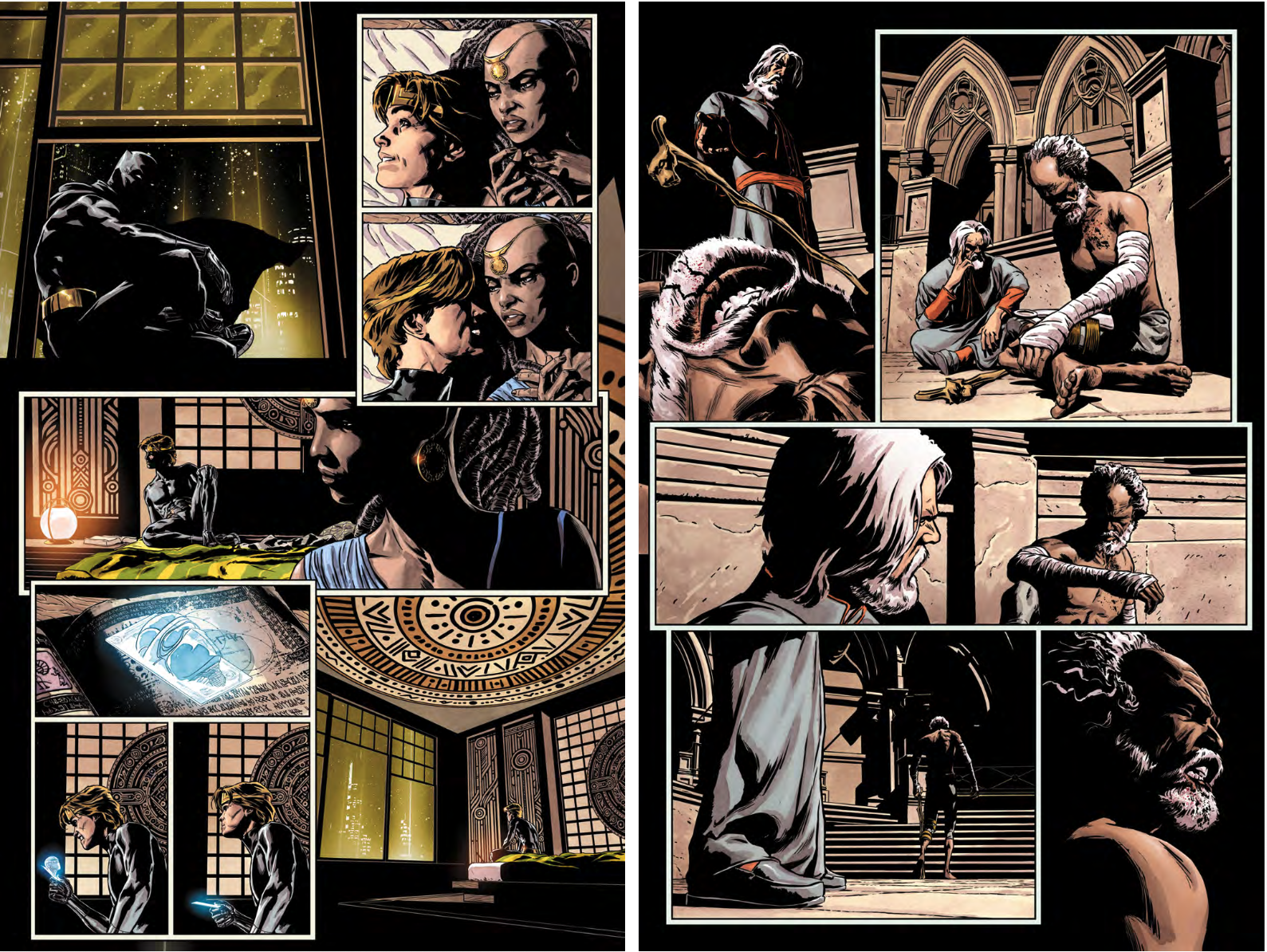
Between the dramatic choices, between the one-point confrontations and the three-point loomings, you need the moment that just breathes. Eye-level, two-point. The reset.
Neutrality isn’t weakness. It’s what makes everything around it land.
The geometry is always talking. Most artists set it and forget it. The ones who treat it as a living, shifting element of the sequence are the artists whose work you can’t stop reading even when you can’t explain why.
One-point pulls. Three-point looms. Two-point watches.
Know which one you’re reaching for. And why. Every single time.
We’re going to take everything this lesson just taught you and break it on purpose.
There’s a specific kind of confusion that only works when the reader is supposed to lose their bearings right alongside the character.
Confused?
Good.
See you in seven.
Thanks for reading.
You’re AMAZING!
JQ
Comments
Nothing yet. Say the first thing.
Sign in to join the conversation.