
I have mentioned before in my newsletters how common cemeteries are in Tokyo. In addition to the large public cemeteries, almost every Buddhist temple is home to a one, each with its own personality. So, I am surprised by how infrequently they appear in pictures of the capital city by its many photographers.1
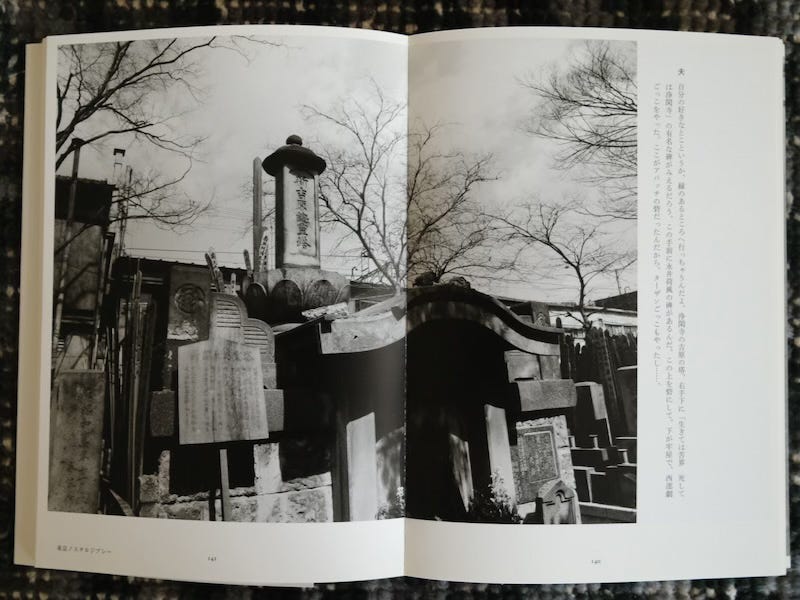
It seems that Nobuyoshi Araki would have made many photos with cemeteries, given his interest in death and his lack of inhibition when choosing subjects. But I’ve found only a few. One which I quite like is from Tokyo, in Autumn. It was taken in the cemetery at Jōkanji Temple in Taito-ku. Araki’s childhood house was nearby, and the photo is accompanied by his personal reminiscences of playing there when he was young. It feels to me as if the children are still there, hiding in the shadows. I have located other photos with cemeteries in Araki’s books Tombeau Tokyo, Eros Diary, and Photography for the Afterlife—but then, he has published hundreds of books. I expect that Araki fans know of other examples.
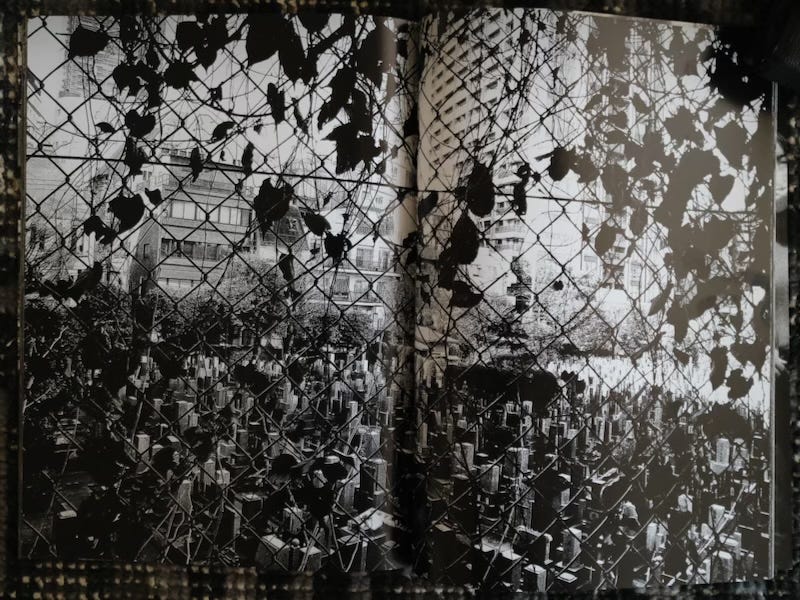
Daido Moriyama’s zine series, Record, contains photos of his wanderings around Tokyo (and, occasionally, other places). The photos in volume 47 are of the area around Tokyo Tower. The chain link fence in the below photo is quite unusual. Though Tokyo Tower is not far from where I live, I am not sure which cemetery this is.
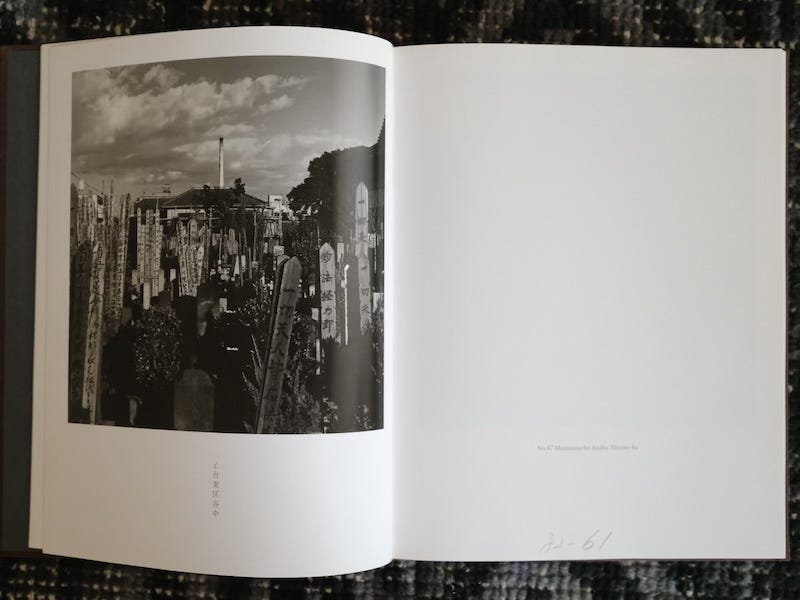
Many of Issei Suda’s books deal obliquely with death. In Landscape with Chimneys, the titular chimneys are reminders of his vanished youth (when chimneys were more common), but also of crematoria. Though cemeteries are rare in Suda’s books, this one is an exception. By my count, four of the 51 photos in the book include cemeteries as a significant element. The example below was taken in the large public cemetery in Yanaka. The sotoba—wooden grave markers inscribed with Buddhist texts—give a particularly strong impression, each one an echo of the central smokestack.
In the most recent issue of his large format zine, ariphoto selection, Shinya Arimoto turns his camera to Tokyo’s western suburbs. The cover image of the zine is a portrait of a woman in a spacious, well-kept cemetery (Tama Cemetery, I think). It is a mysterious and powerful photograph. I was fortunate to see the original print in one of Arimoto’s exhibitions last year.

Readers will surely be able to add others to this brief list; please write and let me know.
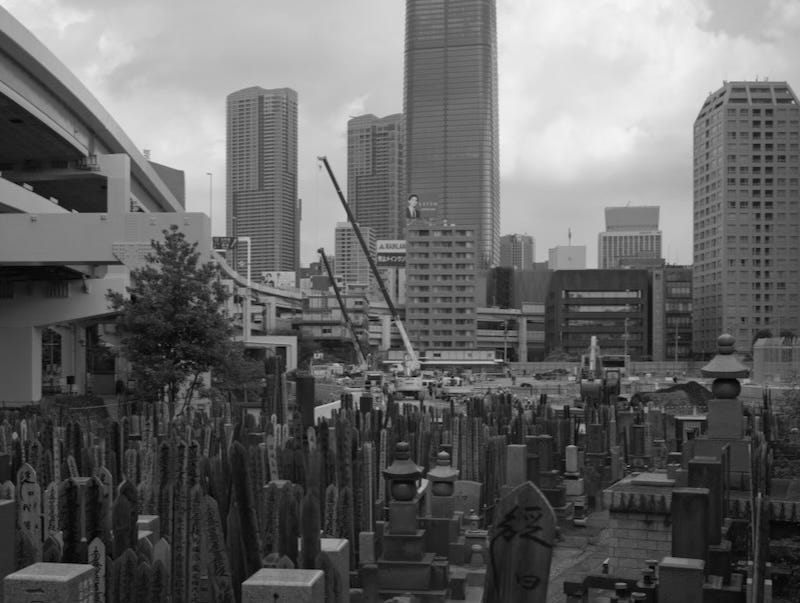
As for me—I have been taking photos of cemeteries in Tokyo for some time, as they seem to be the one feature of the cityscape that holds out against the continual cycle of re-development. This recent photo taken near my home is an example. The city’s latest large-scale project demolished an entire neighborhood to make way for more high-rise towers, yet came to a halt at the edge of this cemetery.
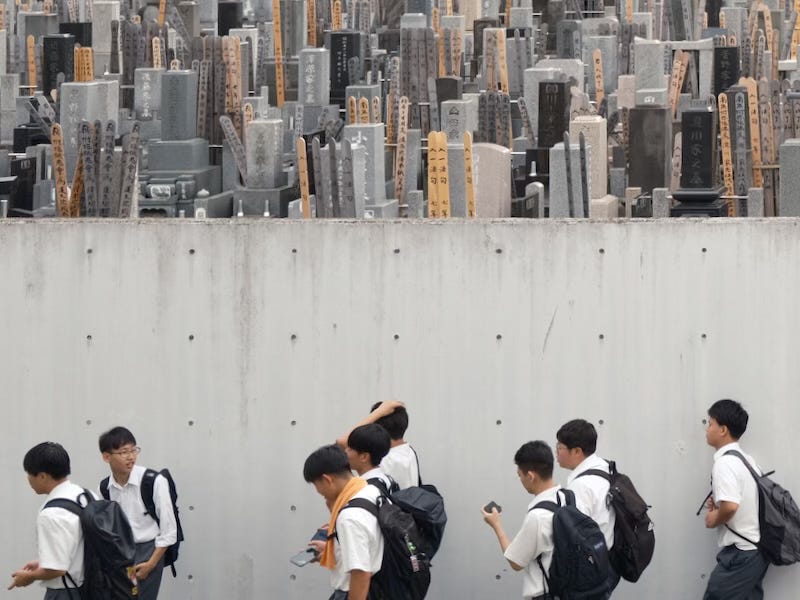
At the same time, I have been carrying in my mind the idea for a different photo: a cemetery surrounded by a high wall, while life goes joyfully on outside the wall, oblivious. The feeling I was searching for, if not the specific imagery, was perhaps inspired by the well-known haiku of Kobayashi Issa:2
世の中は地獄の上の花見哉
in the midst of this world
we stroll along the roof of hell
gawking at flowers
This fall, I happened to walk by a cemetery with a high wall such as the one that I had in mind. The gravestones and the sotoba were densely accumulated, their very tops just barely visible behind the wall. The photo I had in mind would need to be taken from a high angle.
Across the street was a small apartment building with an external staircase leading to the upper levels. I waited there a few minutes and a group of schoolboys came walking, laughing and looking at their phones. The gray and white of their uniforms and school bags matched the colors of the graves. The tanned color of their skins was the same as that of the sotoba. It seemed to me at that moment that the distance between this generation and those that have passed on was very thin.
Thank you for reading. If you enjoyed this issue, please do share it.
Conversely, cemeteries appear frequently in pictures taken by Japanese photographers outside of Tokyo. My photobook collection includes outstanding examples of such photos by Kazuo Kitai, Sakiko Nomura, Kazumi Kurigami, and others.
translated by Sam Hamill.
Comments
Nothing yet. Say the first thing.
Sign in to join the conversation.