
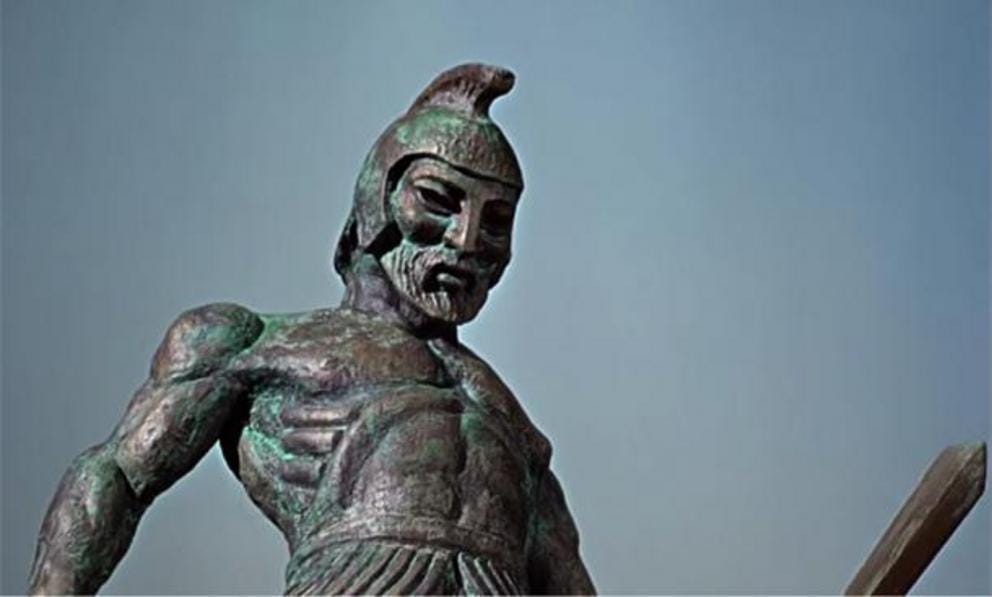
My big takeaway from sitting through Christopher Nolan’s Odyssey, the must-see blockbuster film of the summer, is that I wanted to go home and watch Jason And The Argonauts again. Unfortunately Nolan’s film had taken so long that by the time I finally got back to my family, it was a decade later, and my home was full of suitors, whom I had to slaughter in a lengthy kick-ass axe battle. But that’s modern film lengths for you.
Anyway, I finally got a chance to fire up my much-played DVD of Jason and the Argonauts, and it didn’t disappoint.
Jason is a film with a similar remit to the Nolan epic – to reboot ancient Greek myths for a popcorn audience, put bums on seats, knock your eyes out – but it does so with a lightness of touch and a Saturday matinee vigour that has never, I think, been beaten. Despite Nolan’s ambition, and his success at making event cinema that people flock to in venue-saving numbers (which has to be applauded), the IMAX-giddy director’s basic aim is not much more than to make a colossal adventure romp (I’m really not convinced that his film manages to say much beyond whee-this-is-loads-of-fun, so they’re comparable exercises, I think) and I have to report that Nolan doesn’t manage it anywhere near as well as Jason and the Argonauts, and that’s a kids’ movie that’s now over 60 years old, with its effects done by one madman in a shed, the Wallace And Gromit way.
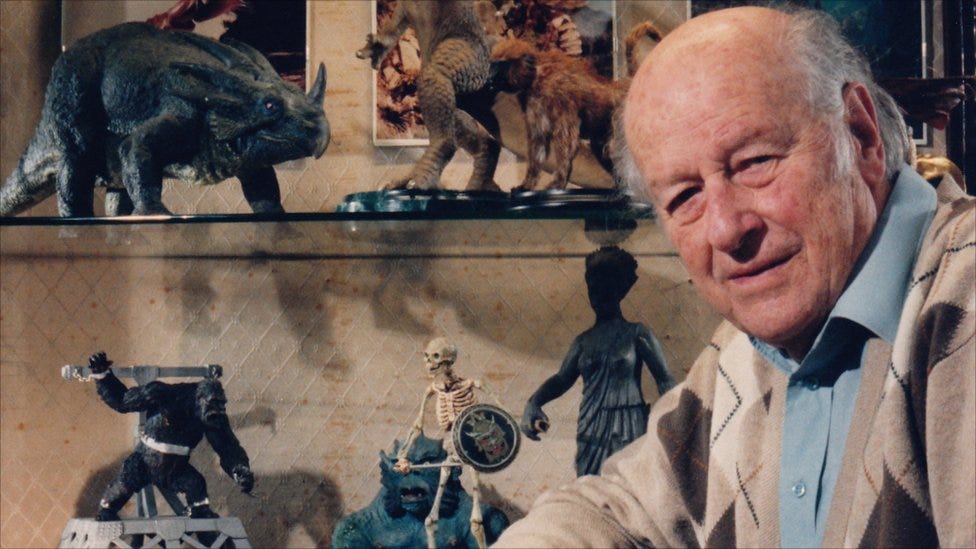
I want to talk about the crowning glory of the Harryhausen film (despite the other credits, all films with effects by Ray Harryhausen have him as their true auteur). So I’m not going to look at the climactic skeleton fight – jaw-dropping though that is – but rather the twelve minute chunk, half an hour in, where the Argonauts disturb the giant statue of Talos on the Isle of Bronze, and get their creaking comeuppance.
Here’s the opening set up for the scene.
The key moment is at around 2’50” in this clip, but that only works because of the stillness of the preceding few minutes. It’s an absolute masterclass.
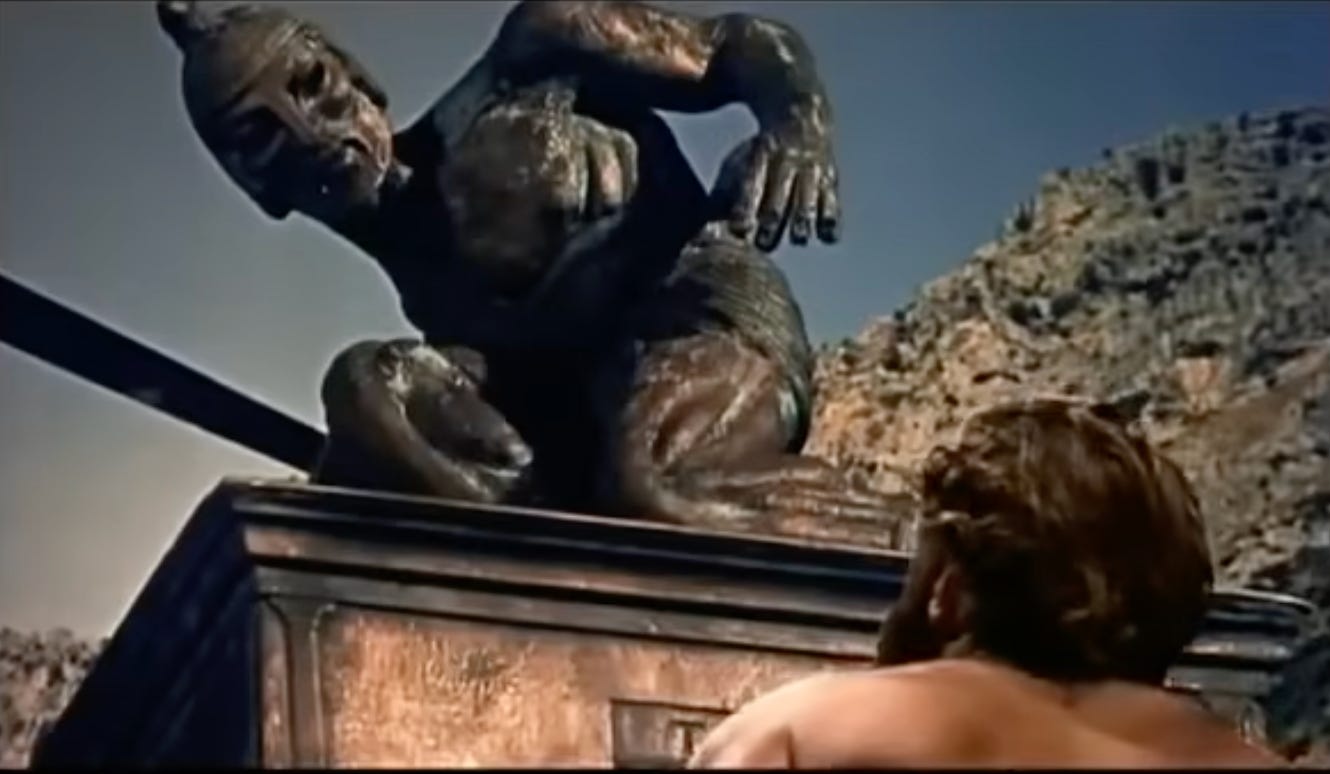
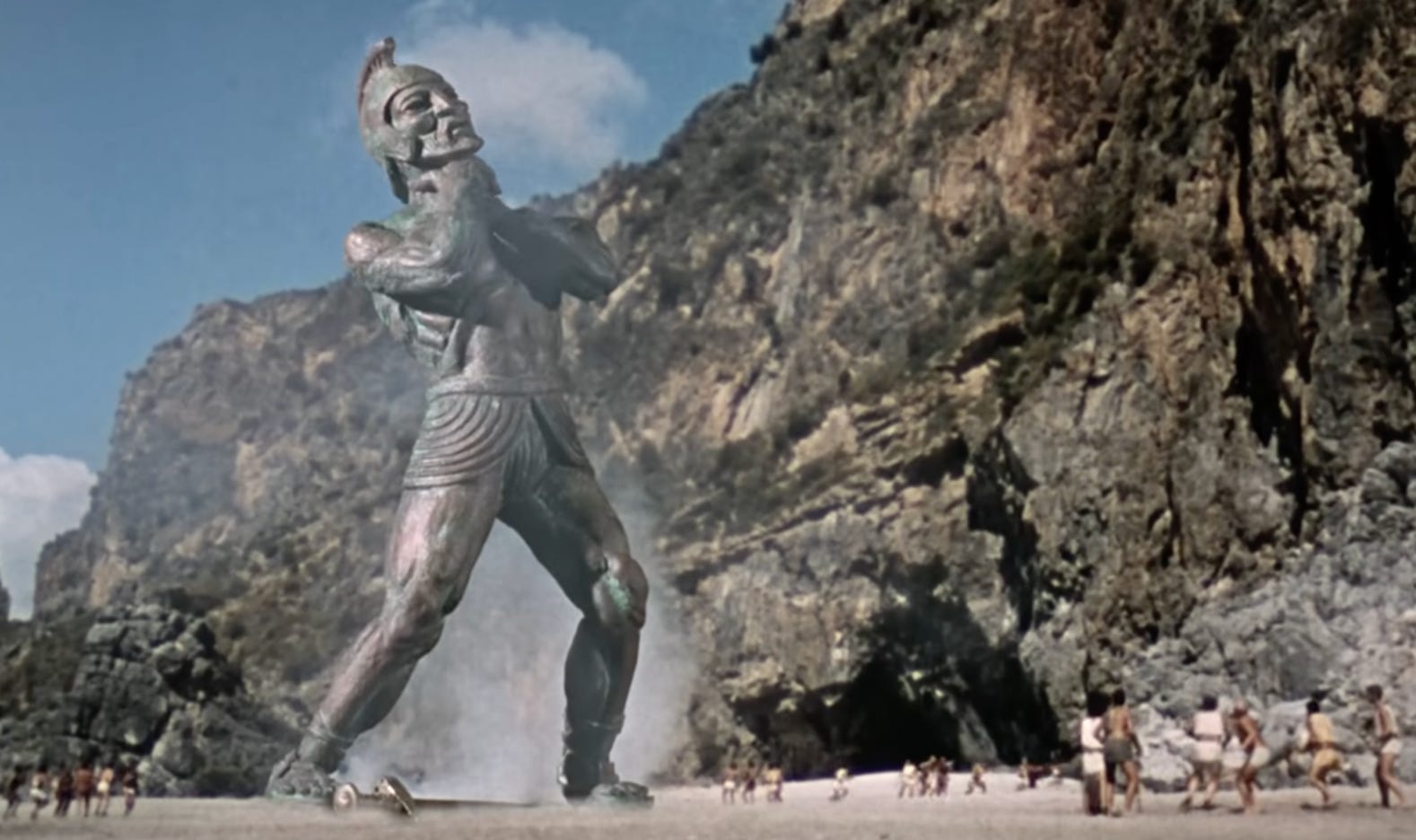
Generations of kids have grown up haunted by that single shot; the moment the Talos statue moves and looks, disdainfully, towards the pair of disobedient Argonauts who are raiding his gigantic treasure box.
Once seen, your dreams are forever haunted by three things:
the jerkiness of the movement
the sightlessness of the face
the creak of those salty, sandy, rusted joints, awakening after eternity on a beach abandoned by the gods.
It’s a moment where every single decision has been made just right. It’s beyond ‘special effects’. It’s what cinema is for. It is unforgettable.
The promise of cinema, from the Lumiere Brothers to Jurassic Park, is to show you something you’ve never seen before. Jason and the Argonauts has about half a dozen of those moments. And Talos is maybe the best one.
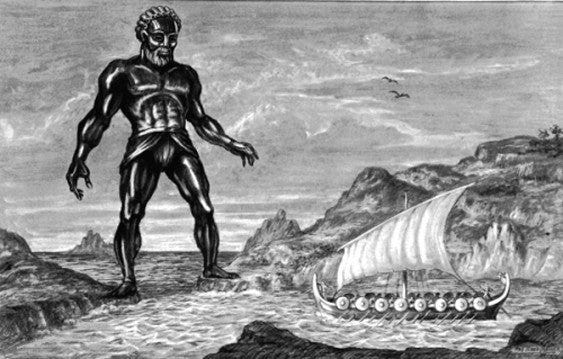
I’d always assumed a gigantic bronze statue was added to the film’s story because Ray Harryhausen wanted to bolt the Colossus of Rhodes into his yarn. But Talos appears in the original text (the Argonautica, by Apollonius of Rhodes). Here, Talos is a more normal-sized bronze man, not a colossus. He’s constructed, one of the first robots in fiction, by either Zeus or Hephaestus, depending on which myth you prefer, to protect the island of Crete. (Plato says Talos does three security tours round Crete in a day which, since Crete is a big island, might imply he had a gigantic stride... and so increasing his size for the movie seems fair enough by the rules of storytelling.)
In the source tale, Talos uses his metallic super-strength to throw rocks at the Argo, until he is dispatched by Medea, Jason’s witchy love interest. Medea summons female death spirits to buzzbomb the monster until he fatally damages his ankle; the bronze man’s weak spot.
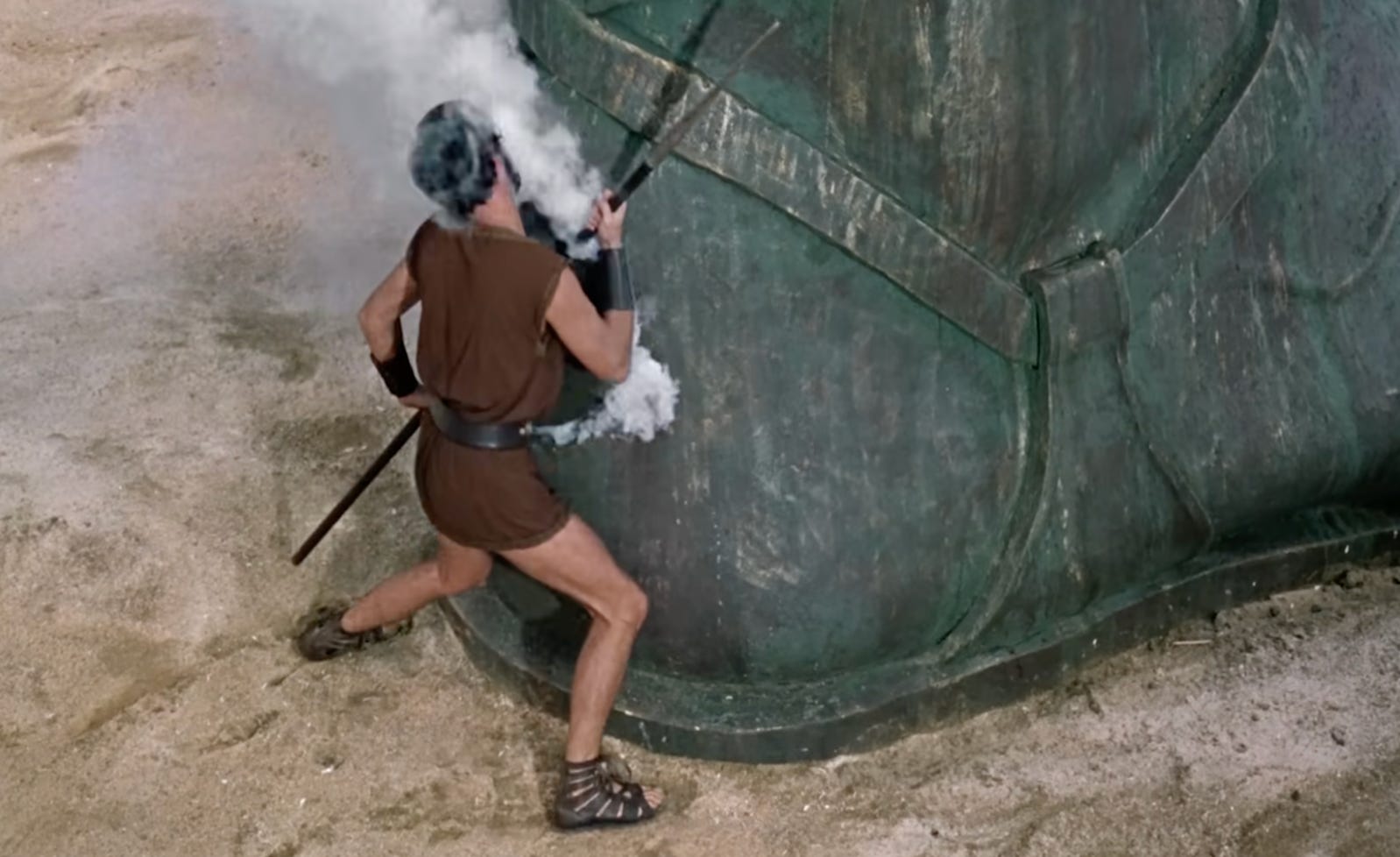
I’m probably not alone amongst bookish kids in thinking that Talos’ weakness in his heel was another Harryhausen mythic mash up, this time a swipe of the Achilles story, but allowing the magically animating ichor to flow out of a hole in his heel is exactly how Talos is dealt with in the original Argonautica. Which is cool.
As is often the case with Harryhausen’s trolleydashes through classical texts, just because he likes mixing and matching mythology’s greatest hits to create visually arresting images, doesn’t mean he’s not usually borrowing lots of this stuff directly from the source material. I bet a lot of classicists can trace their love of the subject to seeing these films on TV some childhood bank holiday afternoon. There’s a load of respect for the sources, even in their pursuit of whizz-bang Saturday Matinee adventure (an issue that’s become a hot topic in the discussion of Nolan’s Odyssey.)
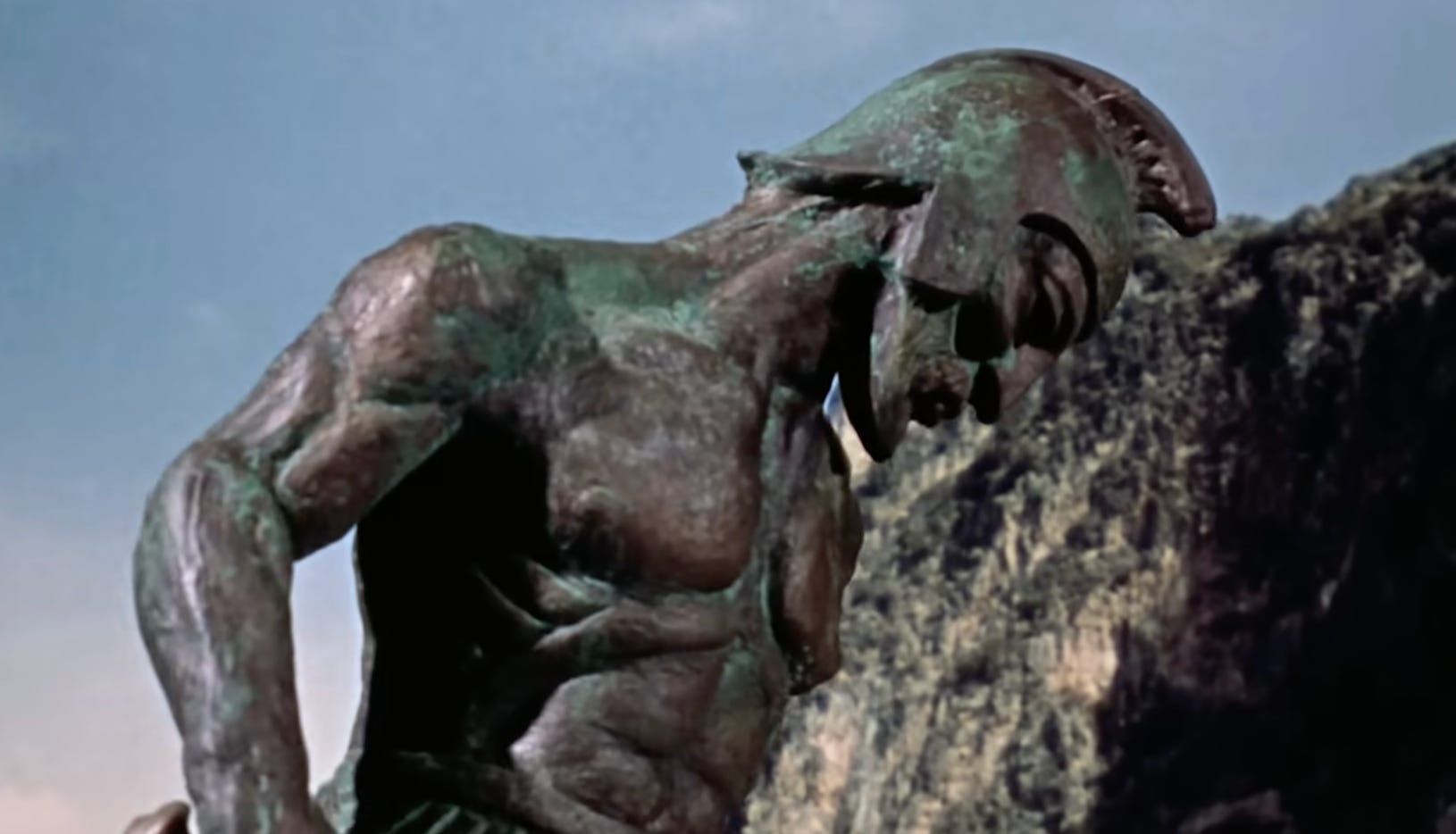
Talos is a perfect example of how to use the limitations of a technology as an advantage. Stop motion is cinema magic at its most primal. It’s painfully obvious how it’s done on a TV when you’re watching in your living room, making old films look a bit shonky (just like back projection for car driving scenes). But on a big screen - the place where the effect was designed to work – it’s surprisingly effective. Nolan’s always banging on about seeing films in the right environment: old films are meant to be watched on a big screen. The effects work in old movies is way more effective when you’re looking upwards at it, and it surrounds you. I remember coming out of the cinema after The Empire Strikes Back, and neither my dad nor I could work out how they’d done the Imperial Walkers and the Tauntauns. We both knew what stop motion was – we were Harryhausen fans – and we dismissed it as a possibility. On that huge screen, our suspension of disbelief in Phil Tippett’s go-motion work was total, our cynicism battered into submission.
It might be the flicker. Stop motion is the effect that uses the basics of cinema to make the impossible happen. Film is after all just a series of still images that our brain decides are really moving. The reason Talos moves on screen is the same reason Jason moves. None of it is real. We make it all happen in our imaginations. We’re all part of the special effects crew.
Perhaps this is best demonstrated by my favourite piece of audience collusion. Harryhausen isn’t trying to fool you really. He knows that even the kids in the audience know it’s just dolls. And he knows you’re expecting it, and that you kind of know how it works. So he does this. Look.
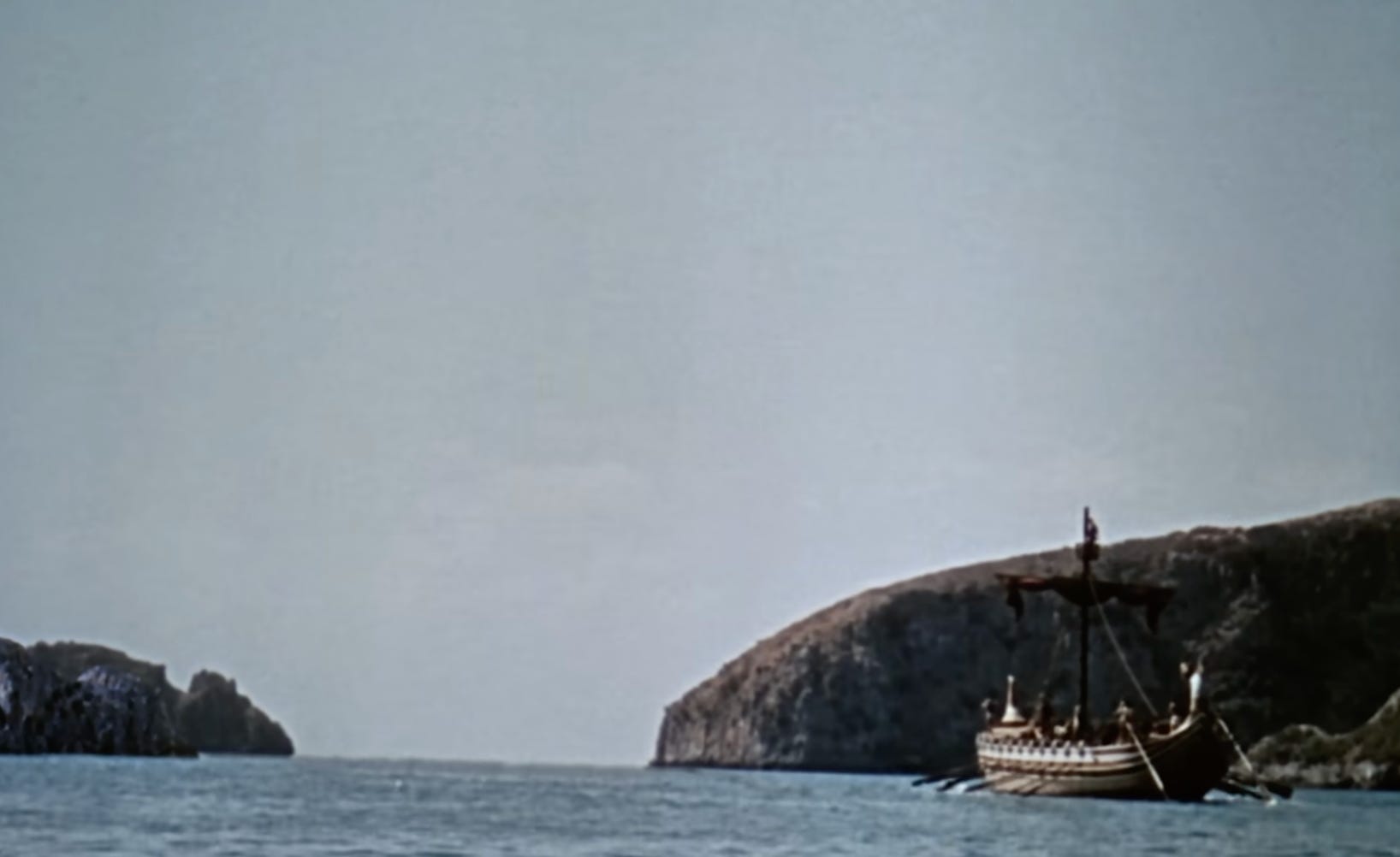
What do you think is about to happen? Yeah! Monster coming! And how do you know? One, the framing. There’s a big gap there. And two, the quality of the film is a bit grainy. By now, you’re aware, consciously or subconsciously, that when a monster turns up, the film has gone through the camera twice. Once for the animated section, once for the live action part.
So what they do is run the sequence through that process before the monster turns up. When there’s nothing there. So you recalibrate your expectation of the crispness of the image. You know it;’s coming. But there’s a bit of grainy film a couple of shots beforehand. We cut away to the Argonauts next, sharp and clean, from a single pass through the camera.
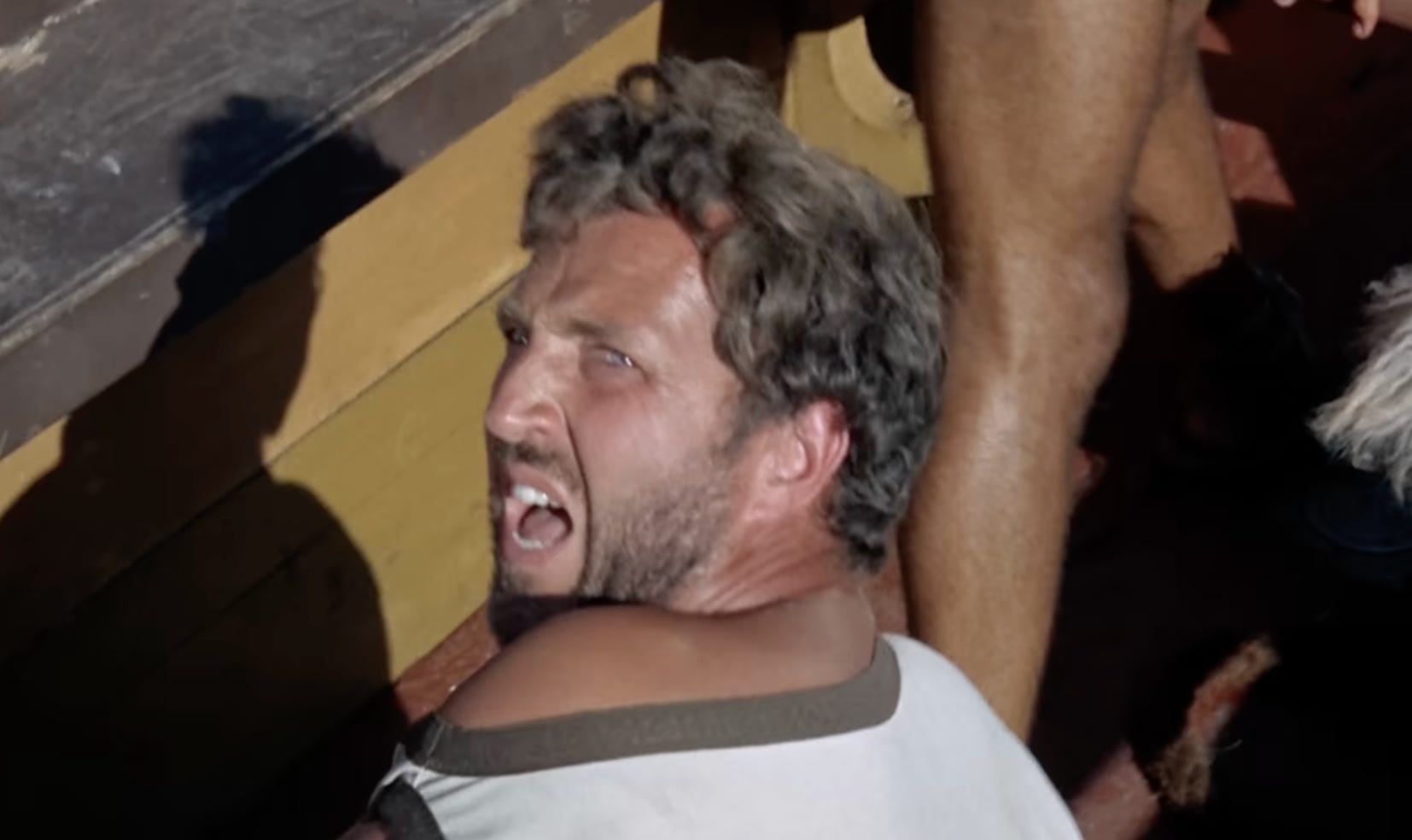
Look at that! Just look at it! It’s really happening! Bloody hell! The eyeline here tells you the whole story. Looking up, impossibly high, past the mast of the Argo, and that shadow creeping towards his face, and the actor’s reaction. We know what’s coming…
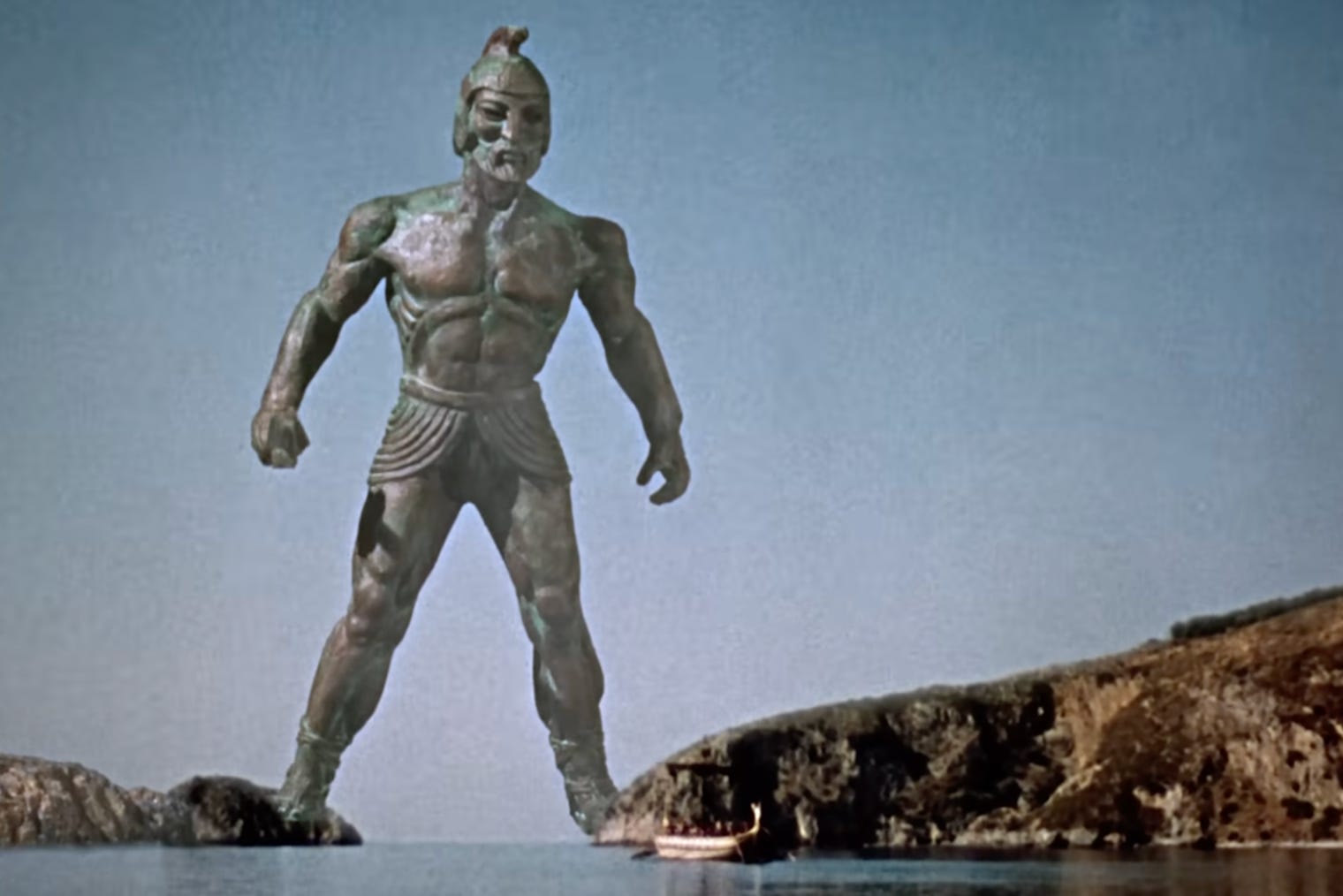
And there’s our big old boy, straddling the harbour. Way, way bigger than he was when he was on the pedestal menacing Hercules, but who gives a shit? You are totally sold on the magic. Because he stepped into a frame that was already degraded, and you bought it. It’s subtle, but beautiful. Again and again, Harryhausen uses this trick, establishing the theatrical set where the monster is about to appear, but not showing the impossible thing. Then cutting away. And back, for the creature to step onto its slightly fuzzy stage and perform.
It’s allowing the audience to speak the language of the film along with you, not patronising them. They know it’s not real. Importantly, this isn’t CGI – engineered by a digital priesthood behind closed doors – this is an effect we understand. We’ve made dolls dance and ‘come to life’ when we’ve played on the carpet at home. But part of making that magic is sometimes to set up a stage where they can appear more real - to conceal the trickery. Maybe ducking down behind a sofa and popping your puppet up, seemingly moving on its own. That’s the heritage here. Pure play. A conspiracy of belief in the impossible.
I’m sure many of us have lowered our head to ground level and pretended our toys are full size. Perspective is very important to children. As kids, we’re often down below, looking up, through a sea of legs. And that’s the lot of the Argonauts, all the way through this sequence.
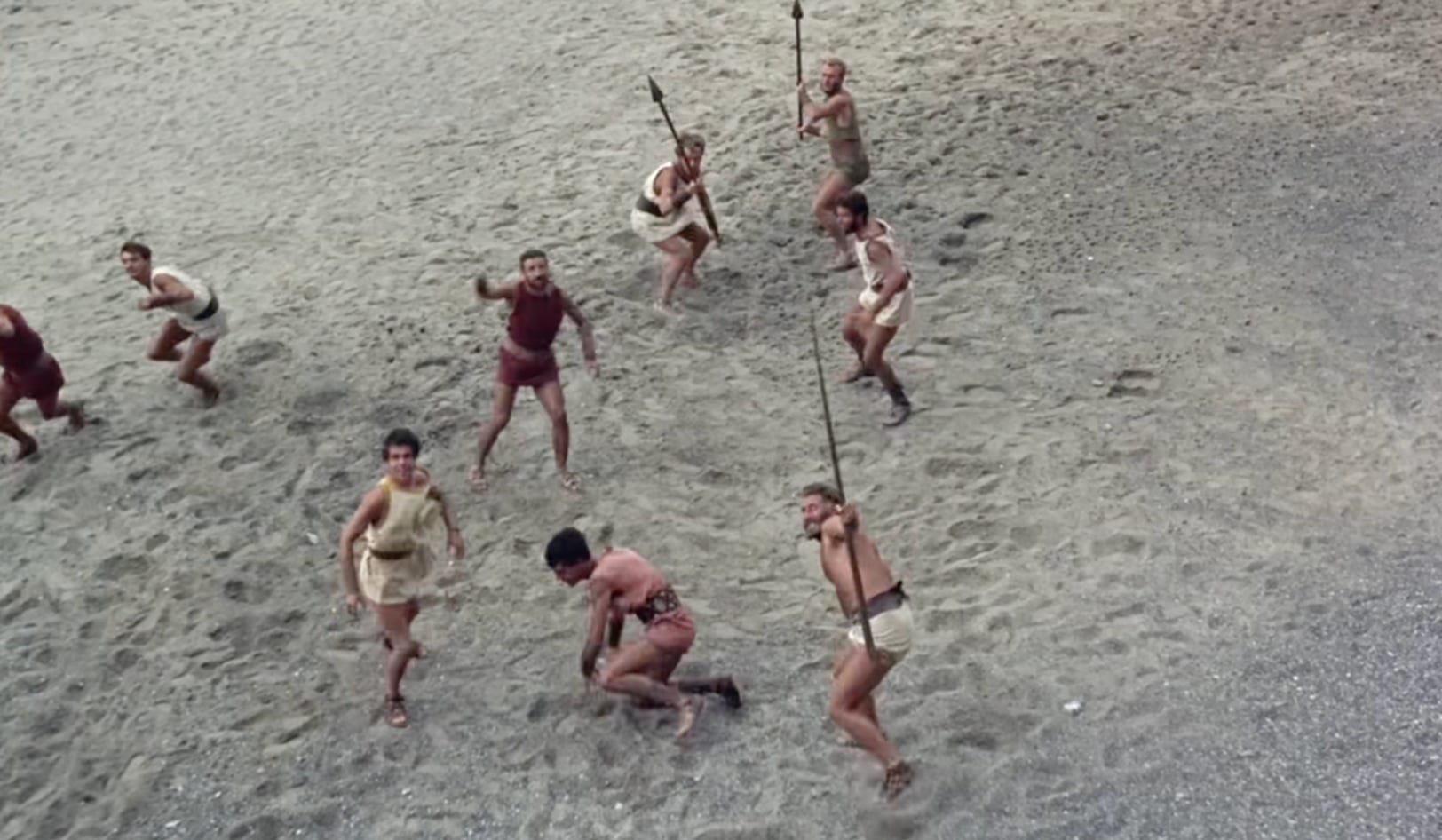
A high camera angle – we’re Talos now. The cast looking up at the crane or tower where the monster is meant to be. Now cut to that sightless head…
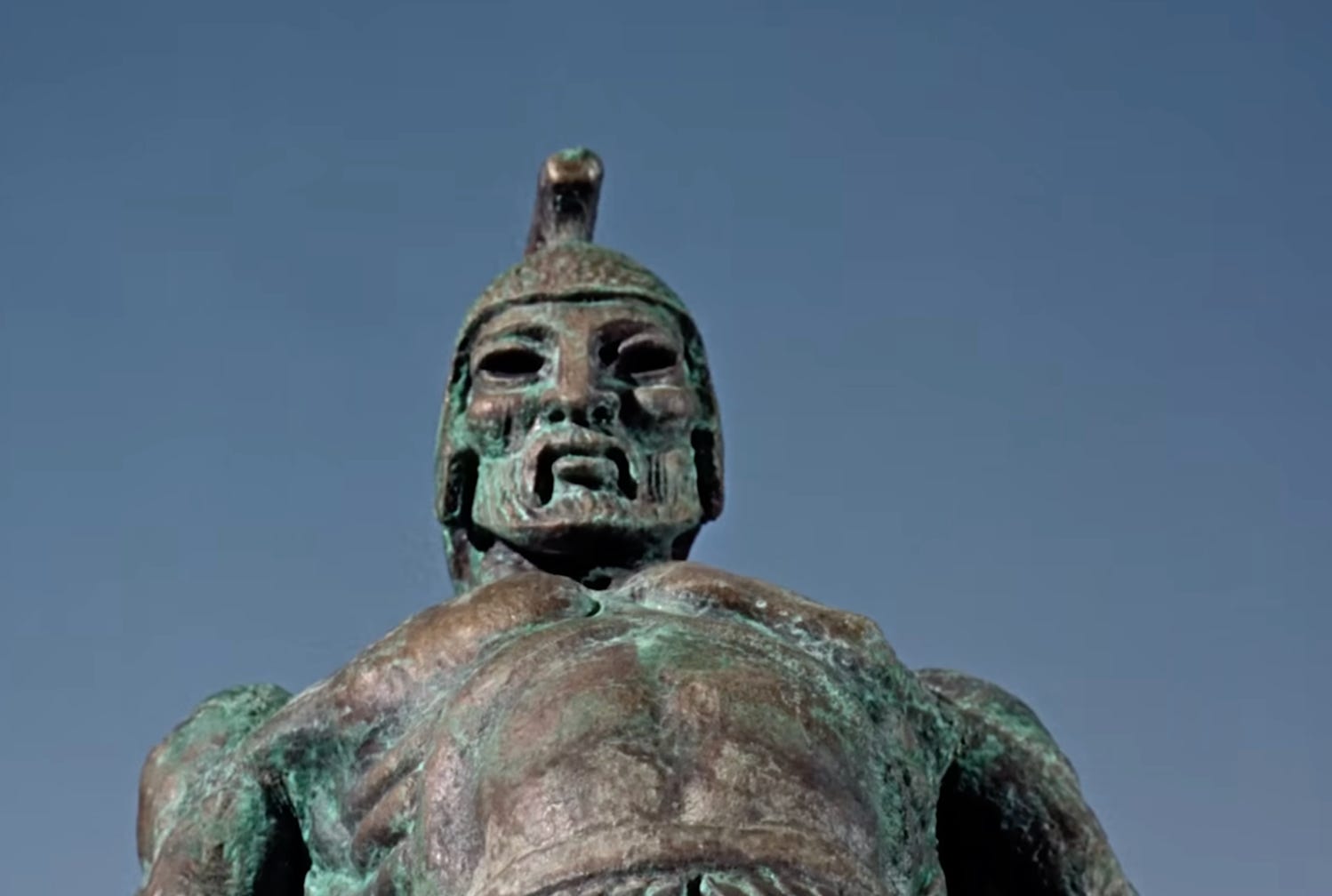
We’re on the carpet, looking up at our bear, or Action Man, which is a giant now. Talos has no actual eyes, but we are always following his eyeline. From that first creak and turn, we see what he sees. Then we see what the puny humans see. It’s a film about gods and men. This is all thematically strong.
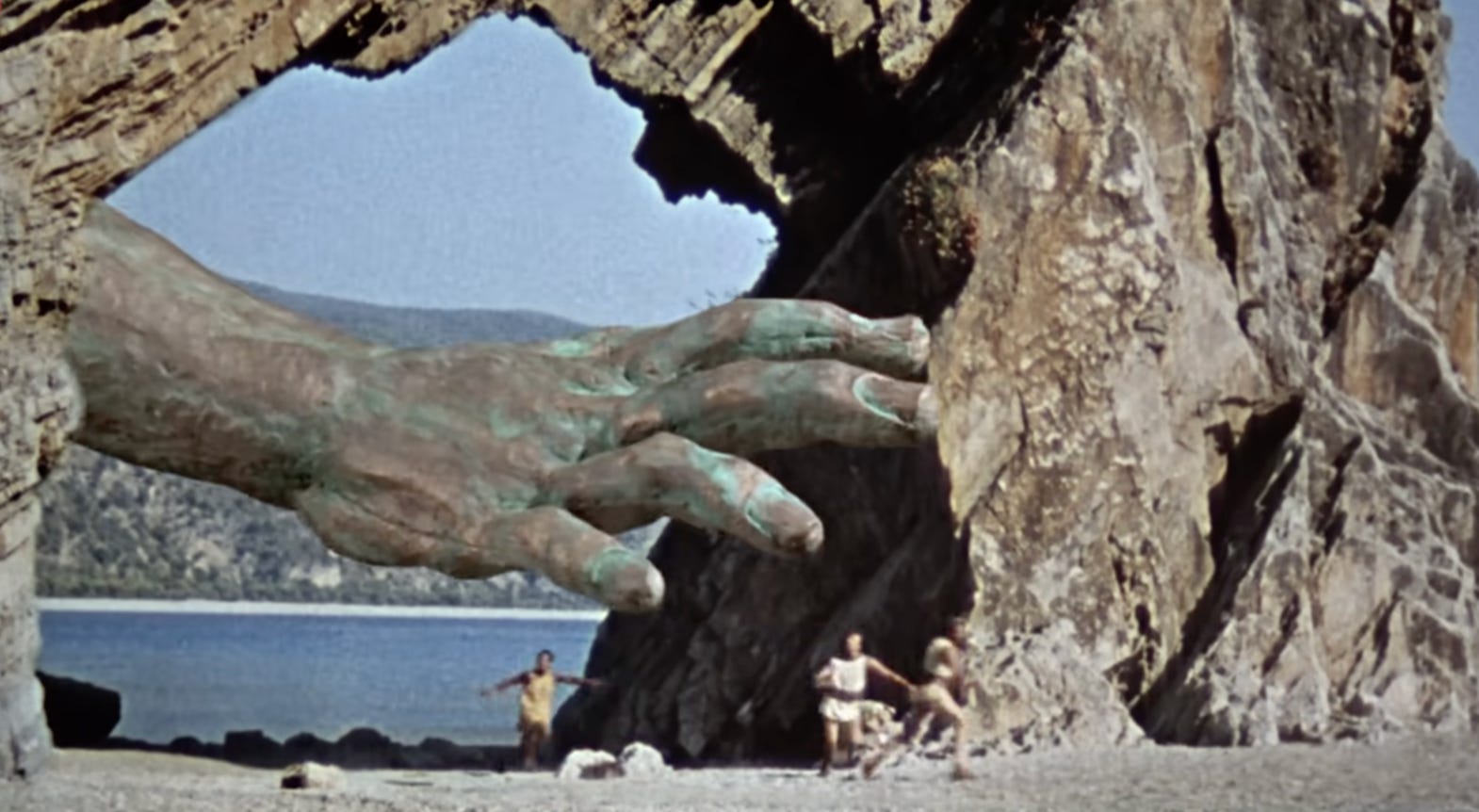
It’s a seamless sell, achieved with both optical effects and simple montage. The superimposition of miniature stop motion and live action is achieved within the same shot sometimes; for example this bit always blows my mind. The way the hand weaves between levels of the back projection.
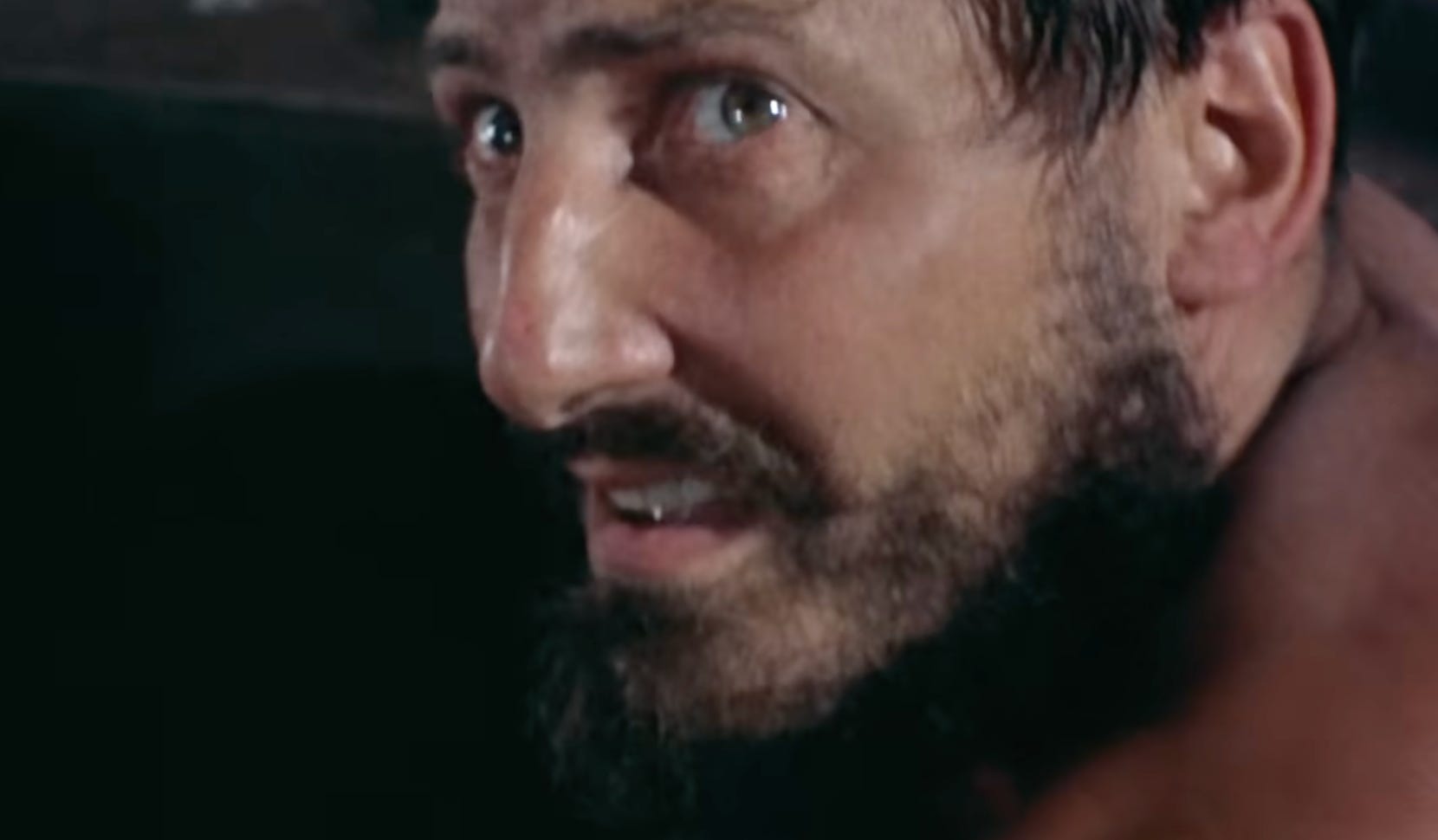
But for much of the sequence, Talos and the Argonauts don’t share a shot. We just cut between them, and are invited to follow the eyelines. We are seeing something we’ve never seen before, the basic contract of the film. And so are the Argonauts. We are watching their eyes see magic.
Yeah. You’ve seen it done loads. Particularly by the lad Spielberg. He’s a fan. He learned a lot.
So many things conspire to make this sequence work. The green detail on Talos’ rusting body, implying great age. The fact that jerky robotic motion, three frames at a time, is easier to achieve in animation than smooth organic motion (like the hydra).
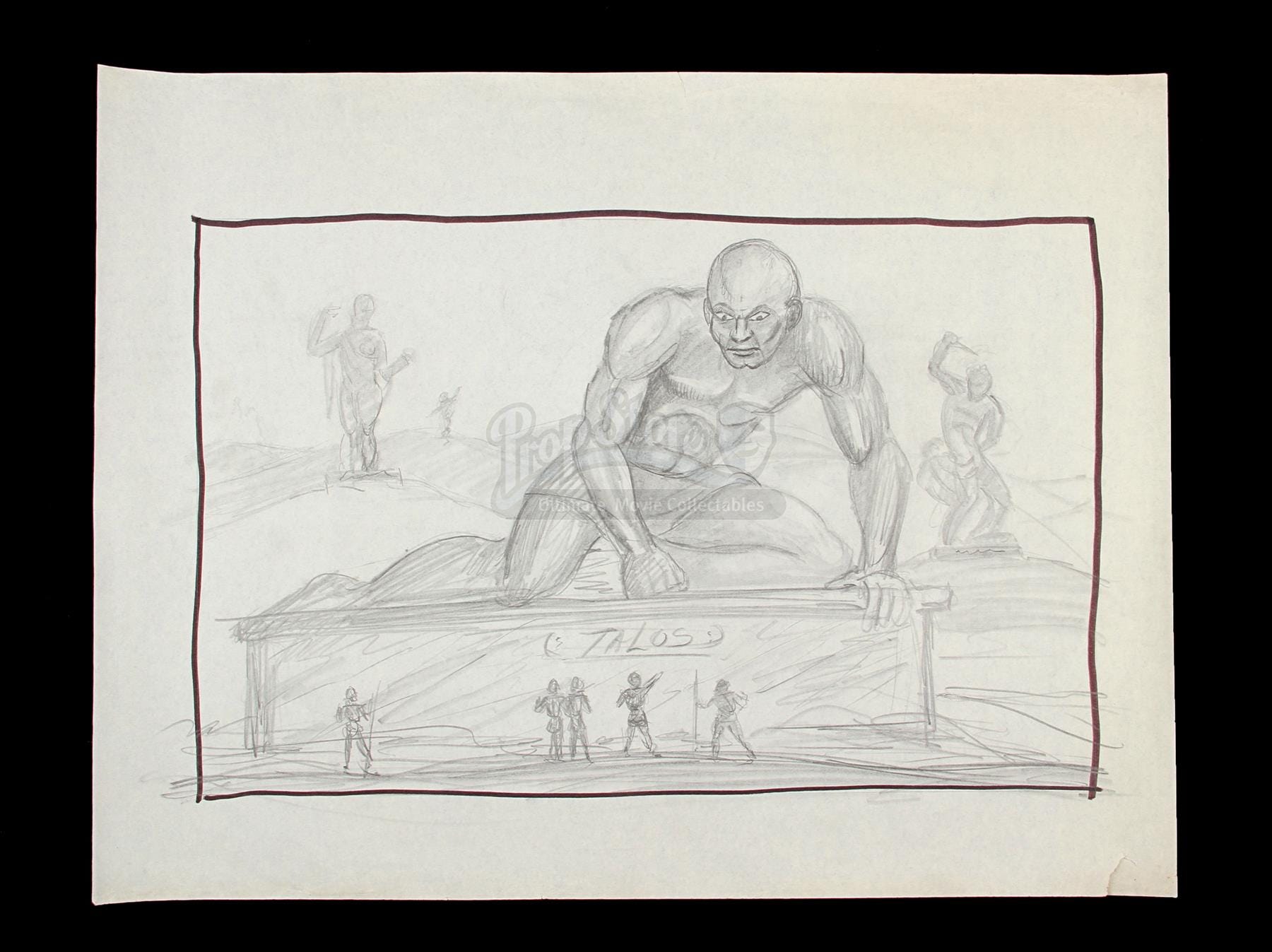
But maybe my favourite thing is the removal of the eyes. The rough designs for Talos have eyes, hair, facial features. But at some point, Ray Harryhausen gave him a helmet, shaded his eyes, and created an icon. It’s the same decision that Seamus Flannery made for the Wicker Man, removing the original floral eyes of his monster, and making the vengeful horror into an executioner, hooded, inhuman. Without the helmet, concealing his face, we wouldn’t care so much for Talos. It’s counterintuitive, but a masterstroke.
What’s fascinating about Talos though, is that Harryhausen makes him so sympathetic. The giant robot is only doing his job, and the Argonauts do deserve punishment for their greed and disobedience of the gods. Despite his impassive face, we care. There is an invitation throughout to read data into an absence, and invent so much emotion for this mute, eyeless monster, and his feelings are conveyed by mime. Harryhausen took acting classes at college, and all of it pays off in this moment here, where Talos grabs his throat, and realises he is dying.
In Talos’ demise, from 7 minutes in here, there is all the ambiguity you need in a kids’ adventure film. Even when I was small, I didn’t really want Jason to win here. I knew that there was moral complexity in the hero seeing off this colossal threat. We know that Todd Armstrong’s character has to screw his courage to the sticking place and do something heroic to save his crew. But he does a bad thing to protect them; he kills a ‘living’ thing that was only doing its job. We know that two wrongs have been done, theft and then murder, to keep our adventure going. And that is all achieved through Talos’ stop-motion mime as he chokes, shatters, and falls.
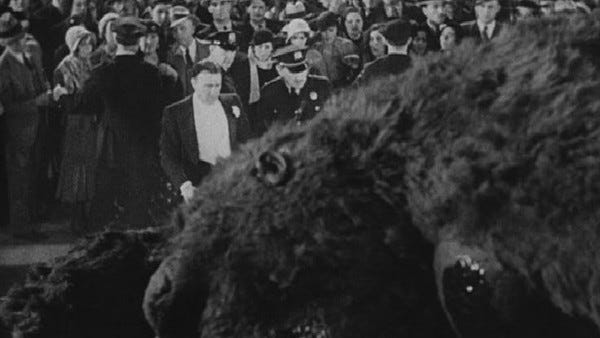
Talos’ fall is sad like King Kong’s fall is sad. The giant gorilla was another sympathetic giant animated by Harryhausen’s hero Willis O’Brien. I suppose it may have been deliberate reference. Whatever the inspiration, Talos’ denouement is a great piece of cinema. It’s followed by a long live-action sequence where the Argonauts repair their vessel and lick their wounds. We’re being allowed to get our breath back. But you’re not watching them kit up and set sail really. You’re thinking about Talos. Wondering what just happened. Was it right? That’s a load to put on kids. It’s big emotion. He casts a shadow even after he’s gone.
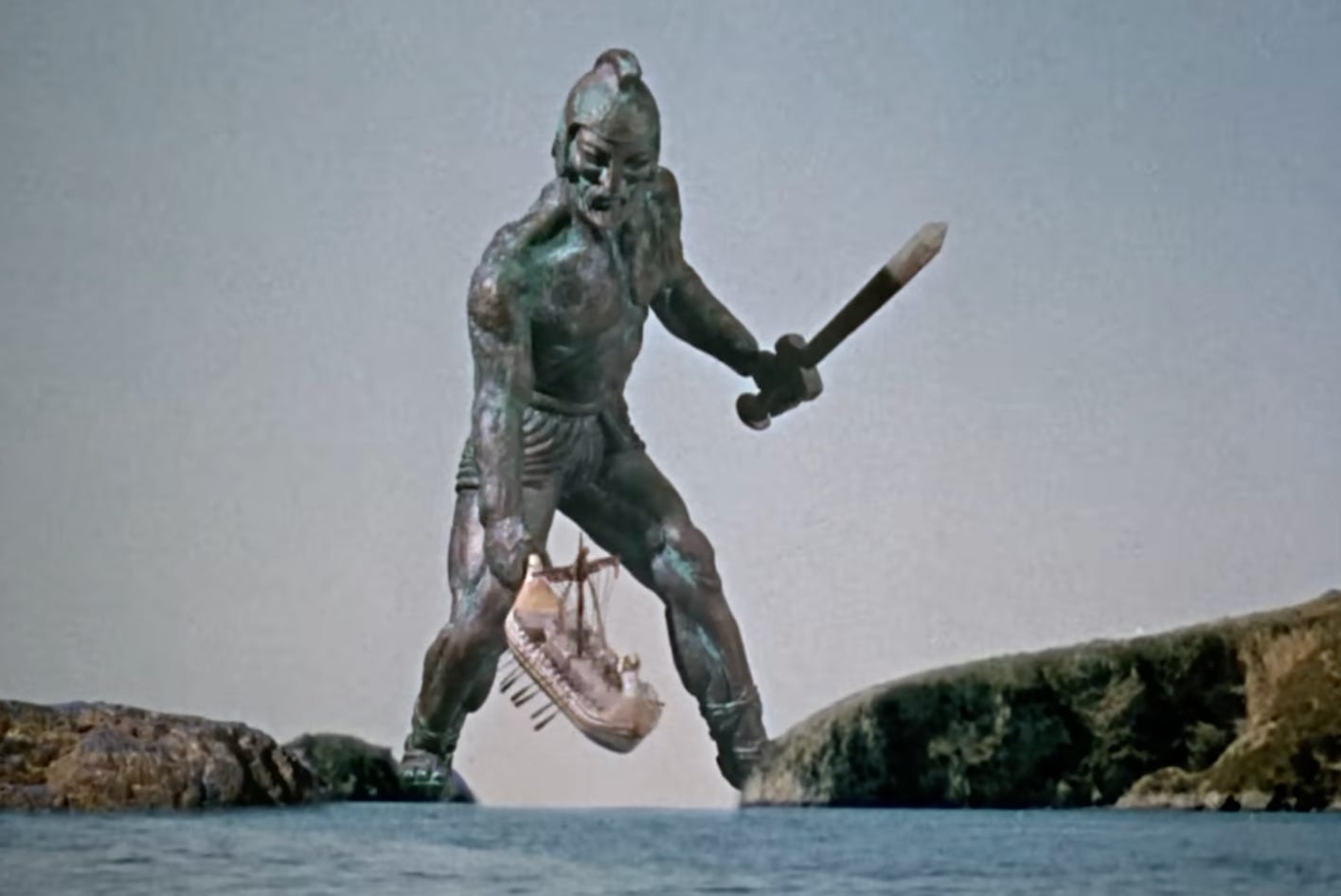
Talos remains one of the best movie monsters ever made. And, though Nolan’s The Odyssey is an enjoyable enough ride, with cutting-edge effects and some astonishingly expensive lenses, (apparently, we’re meant to say that as we come out of the cinema), I’d argue that, even though it’s constantly throwing men in helmets at us, their eyes in shadow, inviting us to guess what’s going on in there, I don’t really care for any of them as much as I do for this jerky stop-motion colossus from 1963.
Talos. RIP. Long live the Argonauts.
No posts
Comments
Nothing yet. Say the first thing.
Sign in to join the conversation.