
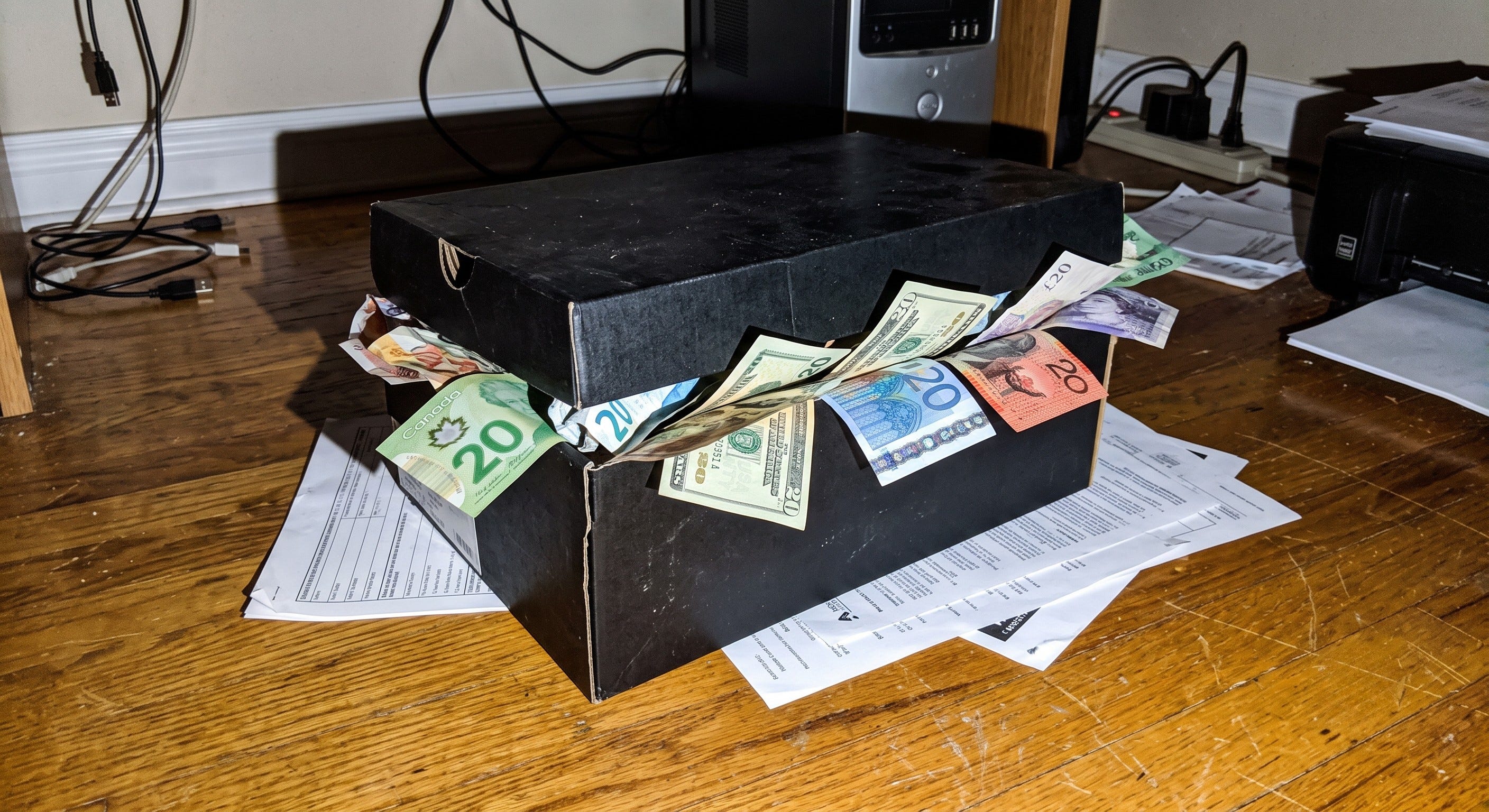
After I did a deep dive on the Royalty Black Box some weeks ago, I posted “How The Majors Get Rich Off Your Typos.”
I knew it was bad, but I didn’t know it was this bad. I worked in the PRO system for about five years — from publishing intern to sync rep to PRO repertoire analyst to neighbouring rights org data manager. I thought I’d seen it all. But it truly is way worse than it appeared, which was already brutal.
So many artists fall victim to the Black Box that it feels like the norm. So I wanted to build a guide that makes that victim pool smaller. There’s a ton of registration to do every time you put out or write a song. It’s built to be difficult.
It's truly mind-boggling how many hoops you have to jump through to collect the money you already earned. But to make it simple to digest, let's picture the simplest possible case: one artist, one song, written and recorded alone, released through a distributor and owned one hundred percent.
Collecting every dollar that song legally earns you requires all of this:
Join a Performing Rights Organization (PRO) as a writer — the org that collects when your song plays on radio, TV, in venues, or streams.
Register the work itself with that PRO, with correct splits — even when the split is 100% you.
Register as a publisher too, if you're self-published — because on some PROs the publisher share of your money has nowhere to land unless a publisher entity exists to catch it, and that entity can just be you.
Register with a Mechanical Rights Society — a separate org that collects when your composition is reproduced: streams, downloads, vinyl pressings.
Register as a performer with a Neighbouring Rights Organization — the org that collects when your recording plays on radio, TV, or in public.
Register again as the owner of that same recording — because the performer share and the maker share are two separate signups, often at two separate organizations, for the same broadcast of the same song.
Register with SoundExchange — because American digital radio pays artists worldwide and the money does not come looking for you.
Check The Mechanical Licensing Collective’s database — because a portion of your American streaming royalties may already be sitting in a pool with your name misspelled on it. This is far more common than you think.
Submit a setlist to your PRO every time you play live — every bar, every festival, every opening slot. The venue already paid the license. The money only goes to those who file the paperwork.
 - IMDb")
How it feels to correctly register a single song, unfortunately.
 - IMDb")
Who those organizations are depends on where you live:
Canada — SOCAN (performance), CMRRA (mechanical), Re:Sound (neighbouring rights).
United States — ASCAP or BMI (performance), The MLC (mechanical), SoundExchange (digital performance). Note the gap: there is no US neighbouring rights org for terrestrial radio, because America never signed the treaty that created them. That carve-out gets its own section in Part 3 of this series.
UK — PRS for Music (performance), MCPS (mechanical), PPL (neighbouring rights).
Europe — one society usually handles both song royalty types — GEMA in Germany, SACEM in France, BUMA/STEMRA in the Netherlands — with a separate neighbouring rights org beside it (GVL, ADAMI, SENA).
Latin America — SACM in Mexico, SADAIC in Argentina; in Brazil, ECAD distributes through member societies like UBC and Abramus.
Asia — JASRAC in Japan (performance and mechanical together, with CPRA for performers), KOMCA in South Korea, IPRS in India. There are more — if they’re missing here I encourage you to look into them.
Oceania — APRA AMCOS covers Australia and New Zealand for both song royalties in one membership, with PPCA handling neighbouring rights.
So nine registrations across six-plus organizations for one song owned entirely by one person. Pretty wild, right?

None of them share your data, and every one you skip feeds the Royalty Black Box — where unclaimed money eventually gets swallowed up by the machine.
Every music royalty in existence comes from a grid of two copyrights and two uses. Every song is two assets — the composition (the song as it’s written) and the sound recording (the song as it’s recorded) — and each asset earns money when it is performed and when it is reproduced.
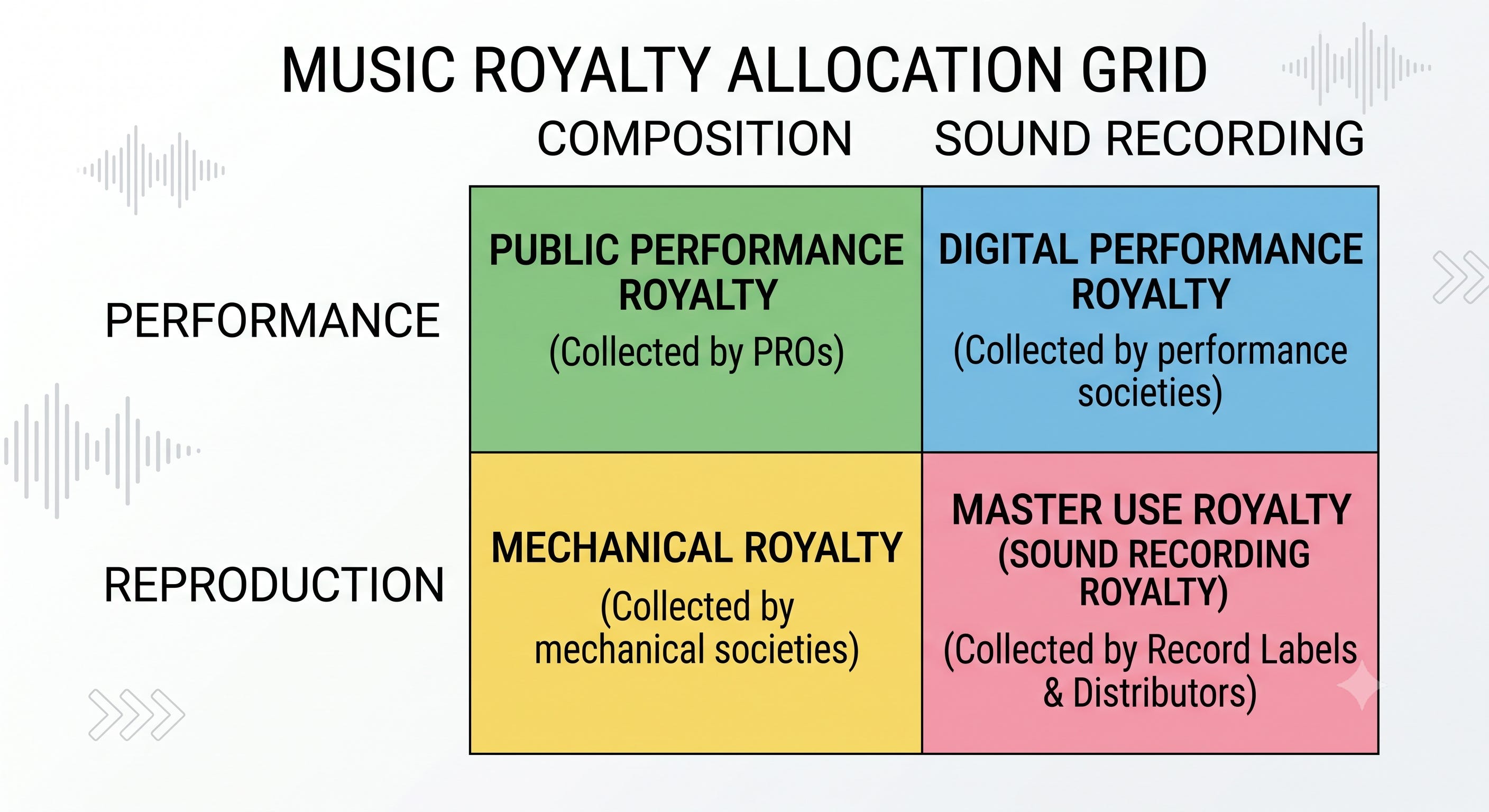
Every organization below is one territory's answer to one square of that grid.
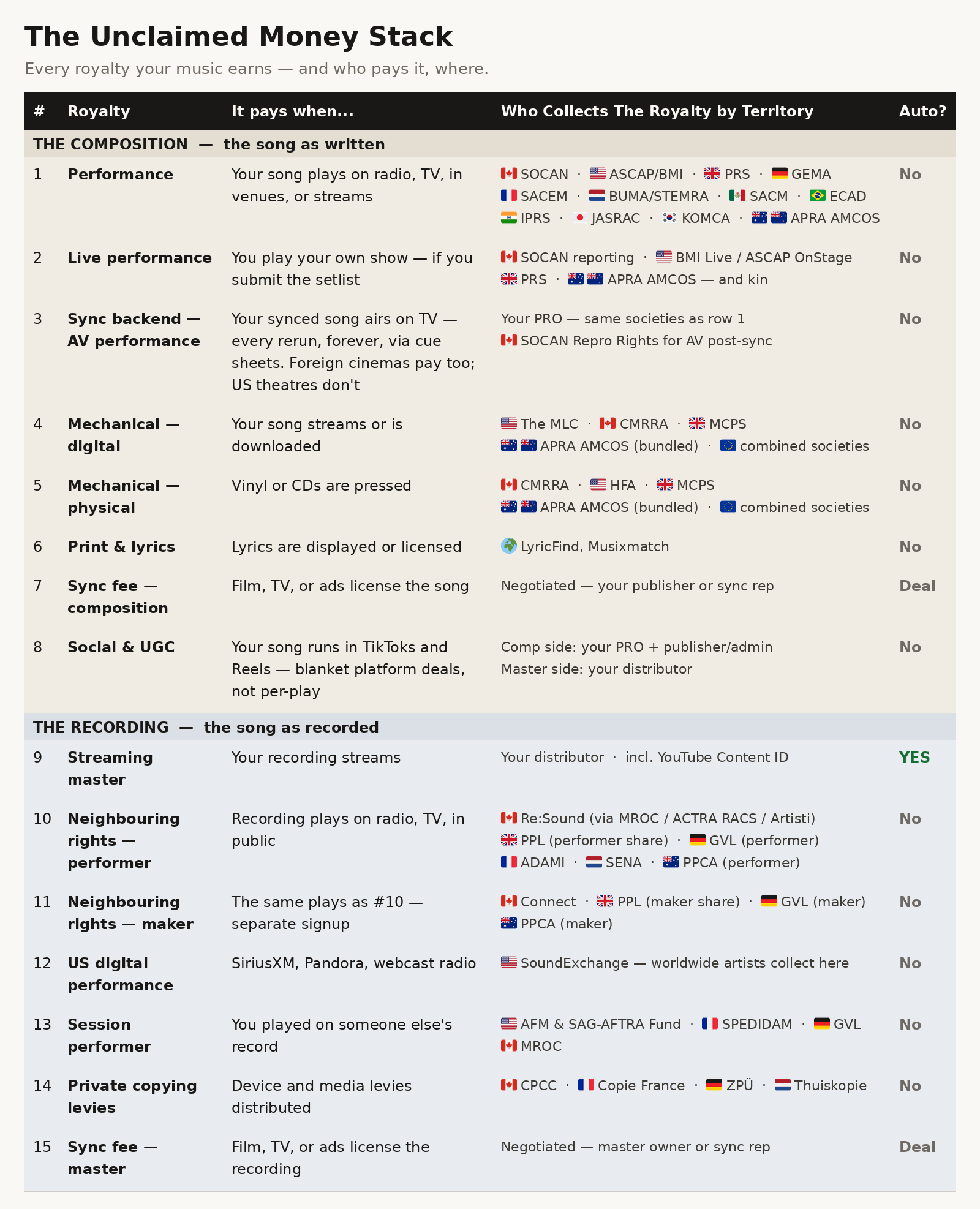
Fifteen streams — and most artists only register and collect on one or two of them, leaving the rest on the table to be fed back into the Black Box. One collects itself. The other fourteen only pay whoever filed the paperwork, and they keep the money of everyone who didn't.
This series walks the entire chart, one org type at a time. Part 1 starts where the most money and the most confusion live: rows one through three, the PROs.
Comments
Nothing yet. Say the first thing.
Sign in to join the conversation.