
There’s a Reddit comment I keep thinking about.
A user tried switching from Spotify to Qobuz, lost too many tracks in the migration, and gave up with a line that deserves to be framed: “So I’m sticking with the devil for now.”
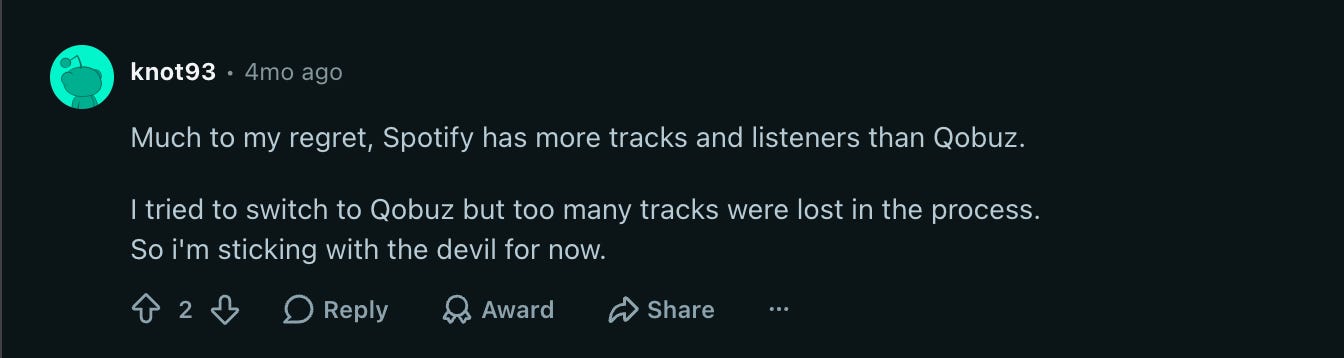
“Sticking with the devil” is a hell of a choice in 2026, mostly because the cage door is swinging wide open in the breeze. Third-party tools will heist your entire library from Spotify to a rival platform in about an hour—less time than it takes to dial in a decent guitar tone.
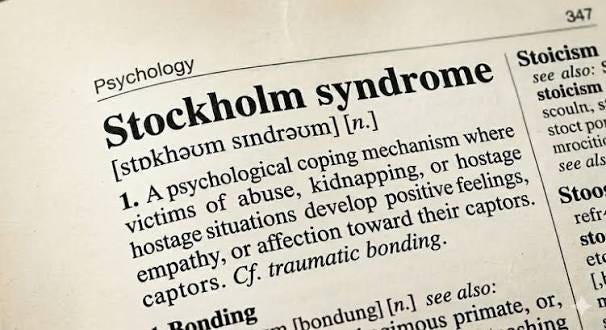
And yet, millions of listeners who openly loathe Spotify stay anyway. The Stockholm Syndrome is a decade deep. The algorithm knows their moods better than their partners do, and the app is already on the home screen.
Psychologists have a name for developing affection toward a captor who isn’t even holding you anymore, and I’d like to formally acknowledge that the company inspiring it worldwide is headquartered — I swear I am not making this up — in Stockholm.
So I did the thing I always tell artists to do with their own assumptions. I tested it. Two weeks on Qobuz, full switch, playlists migrated, daily listening moved over entirely.
Here’s what I found.
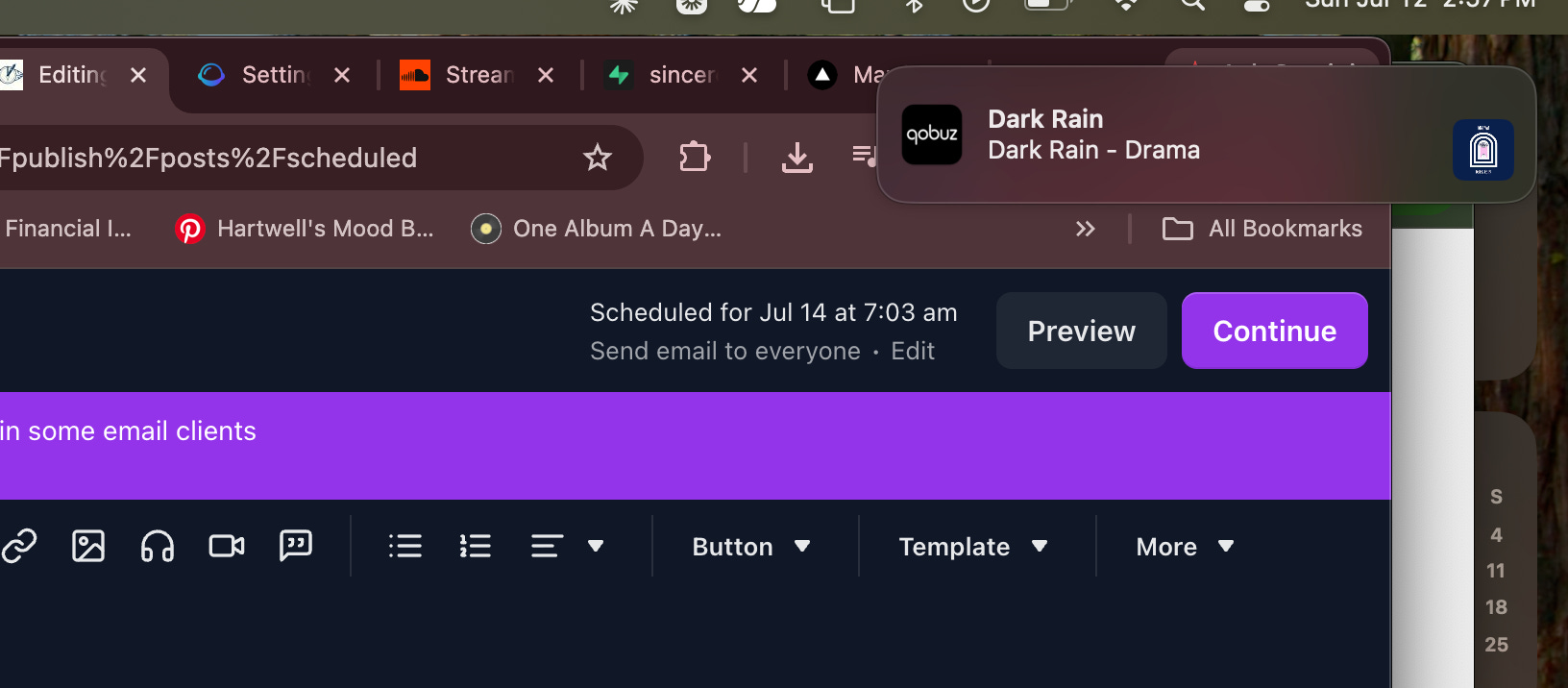
The first thing Qobuz did right was have the audacity to interrupt me.
Every time a track rolls over, a notification kicks the door open: Here is the artist. Here is the track. Look at the damn album art. It’s a tiny piece of code, but it snapped me out of my algorithmic coma within days. I stopped letting music bleed out as sonic wallpaper. I was forced to look the artist in the eye and decide if I actually liked the record, or if I had simply surrendered to it.
Qobuz, structurally, assumes you’re paying attention. The platform pushes full albums, in order, the way the artist sequenced them. Every album carries a written review by an actual human author.
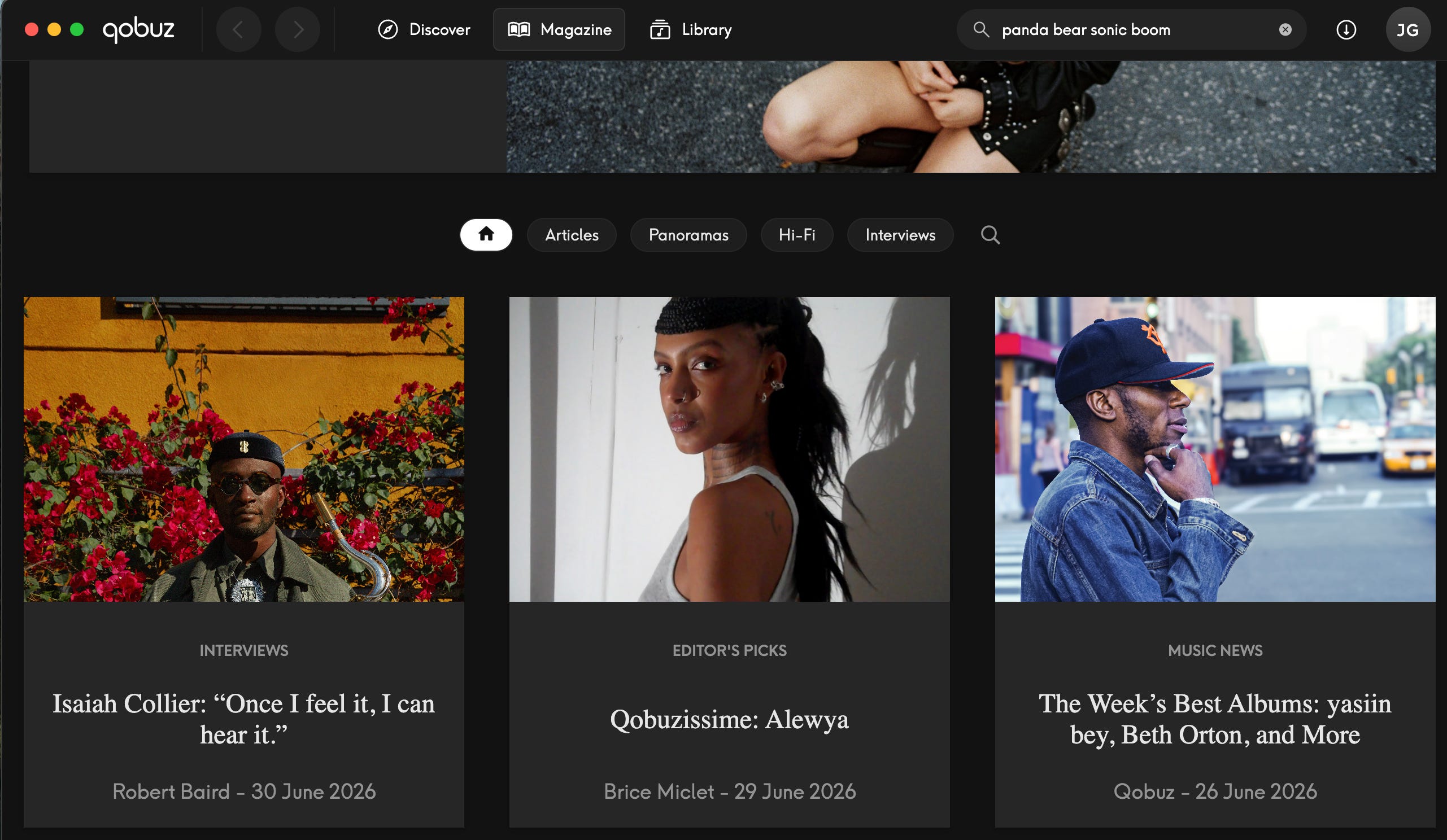
Artists each get editorial bios written by people with opinions. There’s a magazine section that functions as a genuine music-news hub — interviews, video features, a Week’s Best Album column written by humans, and coverage of what’s actually moving in culture.
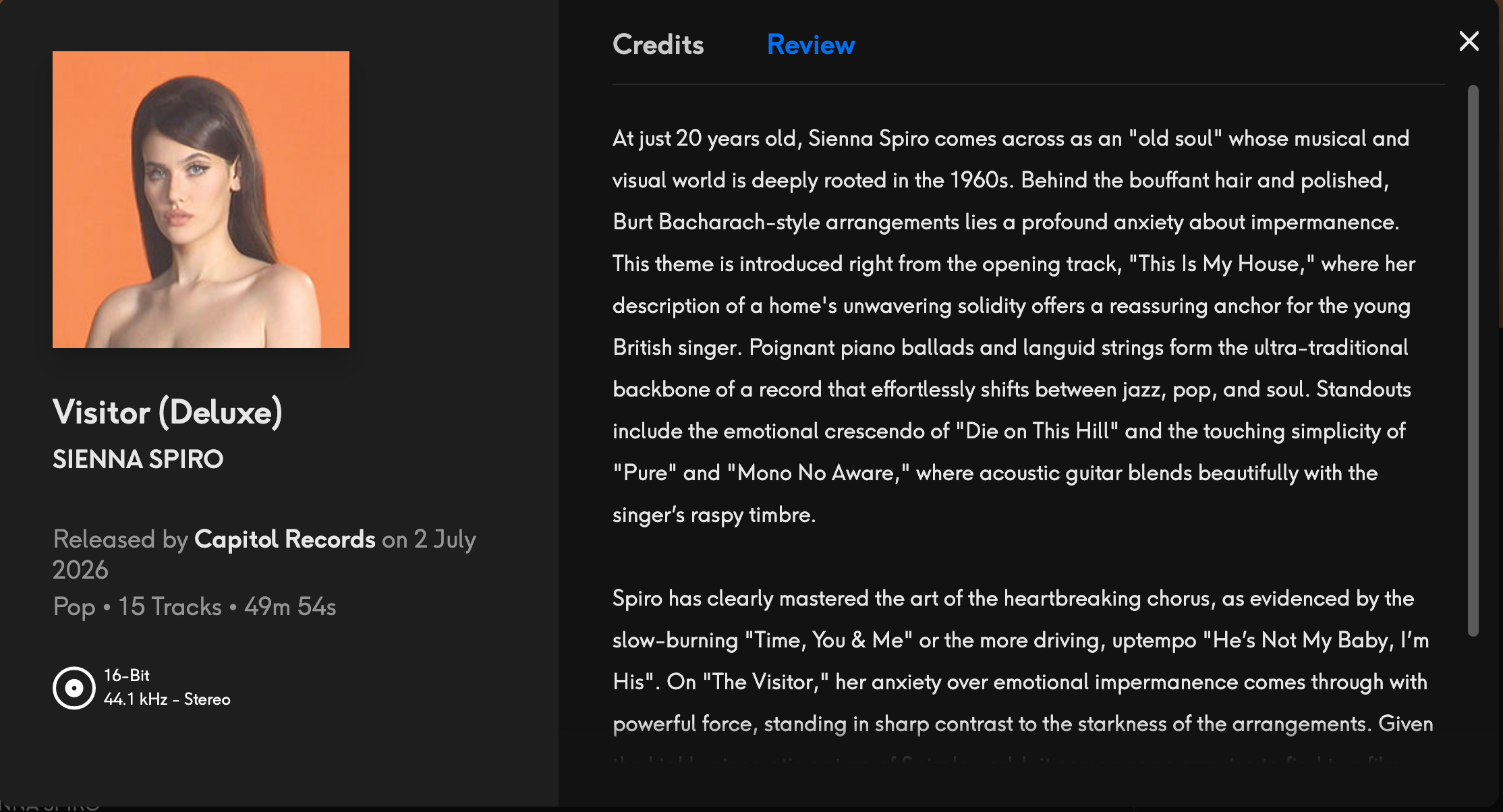
Their emerging-artist award, Qobuzissime, is straight human curation — an editorial team saying “we believe in this record” rather than an algorithm noticing you tolerated something similar last Tuesday.

I loved the Albums of the Week feature too, partly because the picks aren’t even always new releases. Somebody at a desk in Paris decided an old record deserved your attention this week, and that small act of editorial nerve is more curation than Spotify has managed in two decades.
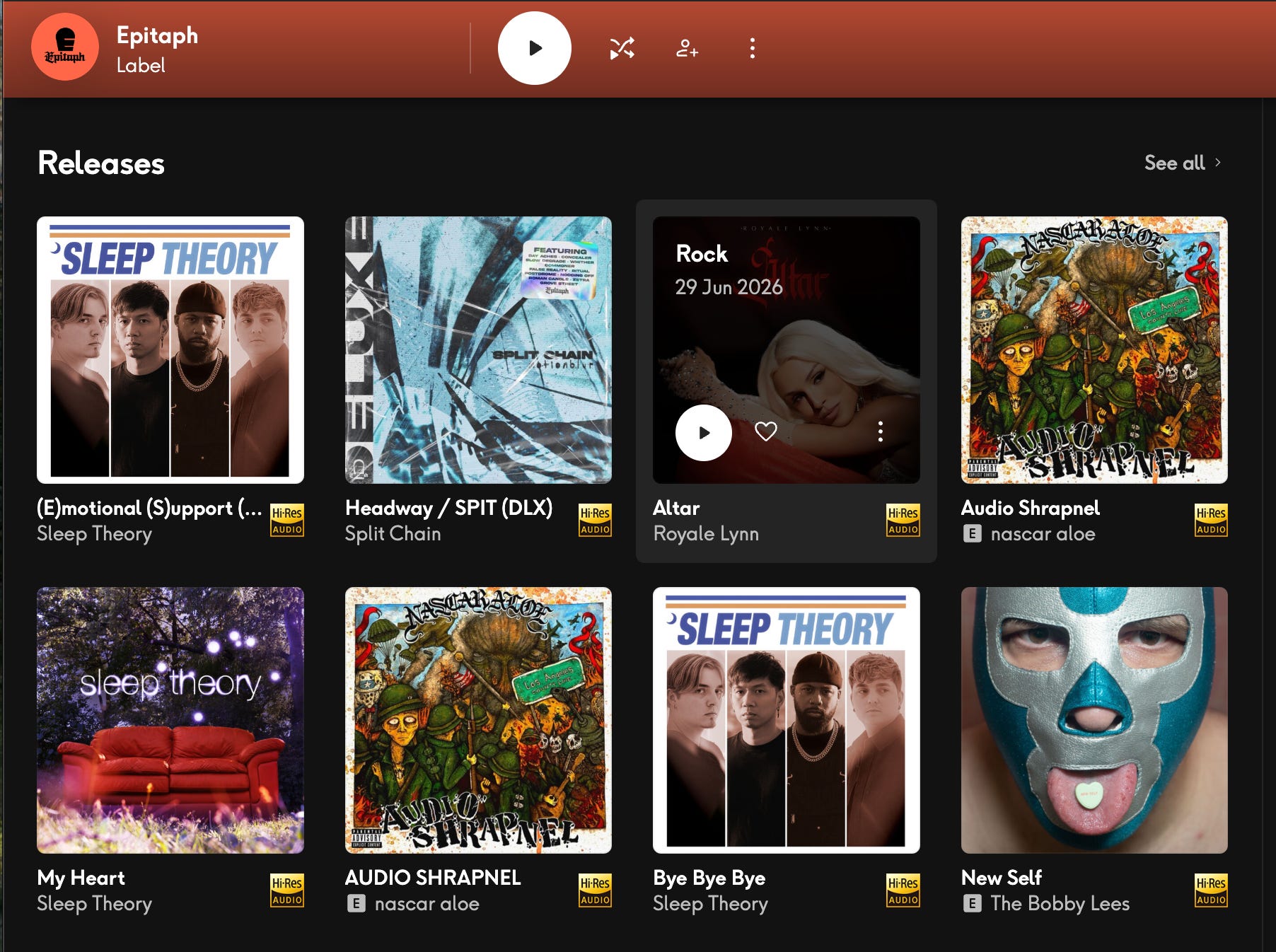
My favourite discovery was label pages. You can pull up any label and browse its entire catalog output — a genuinely useful research tool for anyone who understands that labels are curatorial brands. Spotify has never bothered to build this, because Spotify has spent fifteen years teaching listeners that labels, albums, and even artists are interchangeable inputs to a mood.
I found it pretty cool that Qobuz even takes requests. I read thread after thread of users who asked for missing records and watched them get added. There is an actual option in settings to request content. Picture emailing Spotify to ask for anything. Imagine they even read it.
So why does the attention thing matter so much? Because inattention is where the bodies are buried.
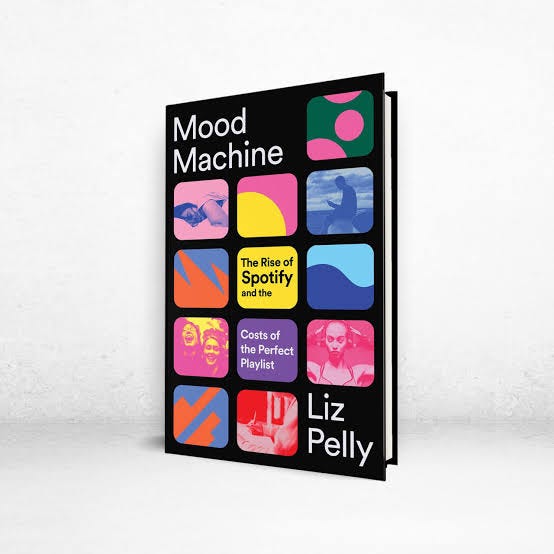
Liz Pelly’s book Mood Machine confirmed what indies have been accusing them of for over a decade. Spotify’s algorithm runs on a program called Perfect Fit Content, whose internal definition was music commissioned to fit certain playlists and moods “with increased margins.”
Translation: Spotify partnered with a handful of production companies to churn out cheap instrumental filler, released it under fake artist names, and had employees seed it across the platform’s own editorial playlists so the company could pay real musicians less.
By 2023, several hundred Spotify playlists were being monitored by the team responsible for this content. This was a scheme operating in plain sight, not a buried conspiracy.
The Swedish newspaper Dagens Nyheter investigated and put numbers to the story. Roughly twenty songwriters were operating behind more than five hundred fake artist names. One production company, Firefly Entertainment, was linked to 830 fake artists — at least 495 of which had music sitting on Spotify’s own first-party playlists — while Firefly’s revenue grew tenfold in three years.
The connection between Firefly and Spotify, as Dagens Nyheter and Liz Pelly documented, ran through a lifelong personal friendship between Firefly's founder Fredrik Hult and Nick Holmstén — the man who served as Spotify's global head of music, with ultimate responsibility for playlisting strategy. Two guys from the same small Swedish town. Family vacations together, dinners out, visits to the Spotify office, all lovingly documented on Instagram, including a photo of Hult posing with Firefly producers at Spotify’s 2018 Grammy party.
Dagens Nyheter’s analysis found that Firefly’s tracks land on flagship editorial playlists within one hour of upload—an advantage real artists wait a week or more for, having pitched through standard channels. This speed provides a massive algorithmic head-start — and because Spotify pays from a shared pro-rata pool, every stream these ghost tracks vacuum up is money that would have otherwise gone to legitimate, working musicians.
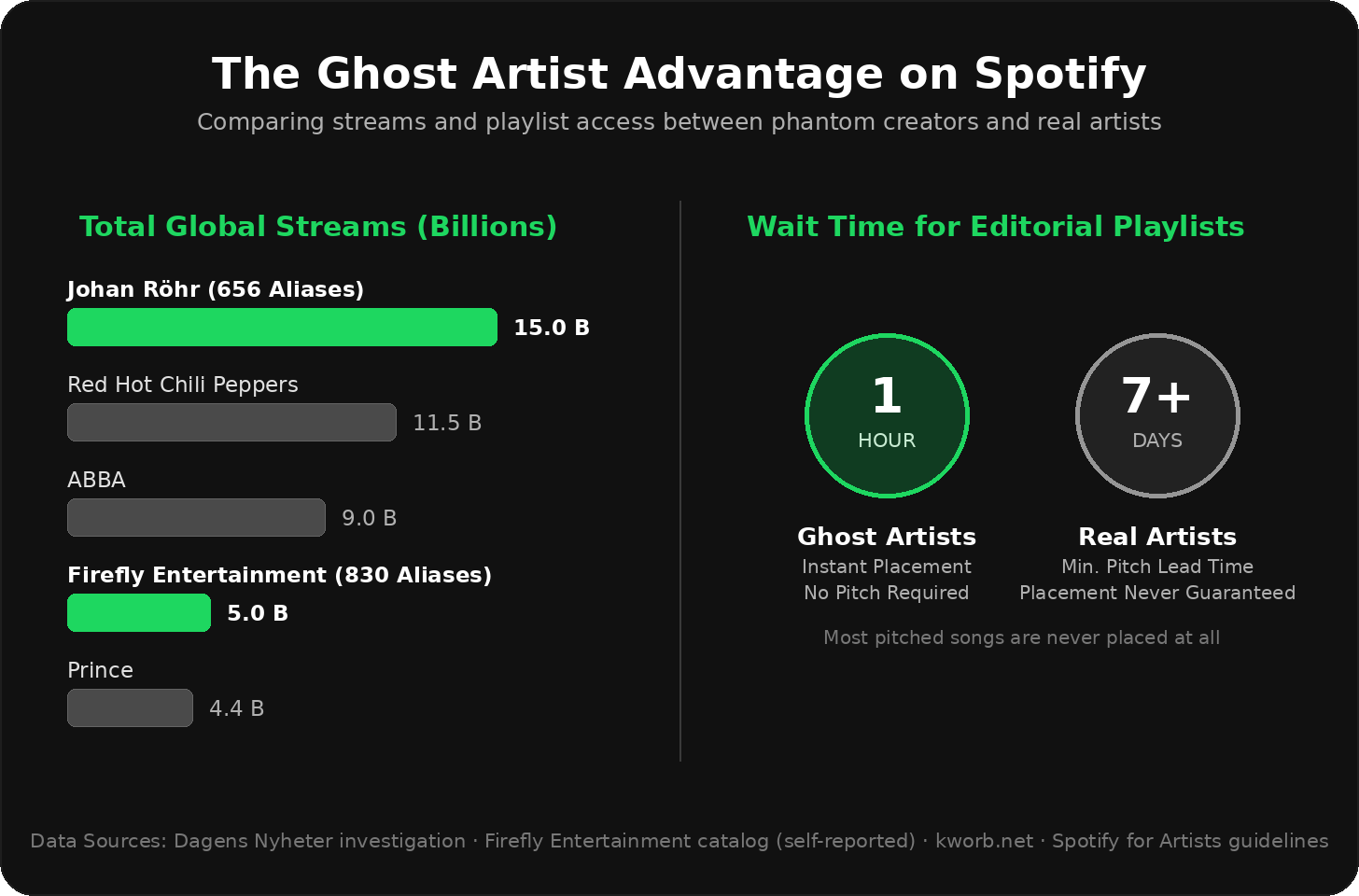
My absolute favourite villain in this corporate heist is a Swedish composer named Johan Röhr. This guy pumped out 2,700 tracks under 656 fake names and vacuumed up fifteen billion streams. That makes this phantom elevator-music kingpin mathematically bigger than the Red Hot Chili Peppers. The Chili Peppers bled into microphones for forty years and pioneered a genre; Johan cracked the matrix in sweatpants. If you’ve ever let Spotify Radio take the wheel while you did the dishes, you have funded this man’s empire. Yet you couldn't pick him out of a police lineup.
Is any of this illegal? Technically, no. Nobody wrote a law against a streaming platform quietly stocking its shelves with house-brand music, the same way the grocery store puts the store-brand cereal at eye level. And honestly, I can hold two thoughts at once — as a business move, I get it — margins are margins. But grocery stores don’t claim to exist for the love of cereal farmers. Spotify built its entire public identity on the promise of connecting artists with fans, then constructed a shadow workforce of ghosts specifically engineered to divert streams away from the artists it claims to champion.
The lean-back listener, the one who never checks who’s playing, is the load-bearing wall of the whole scheme. You cannot slip a fake Swedish jazz trio past someone who’s paying attention — which brings us back to that little desktop notification, and why a feature this simple feels radically wonderful.
Spotify began as an advertising company that happened to land on music, and it never stopped being one.
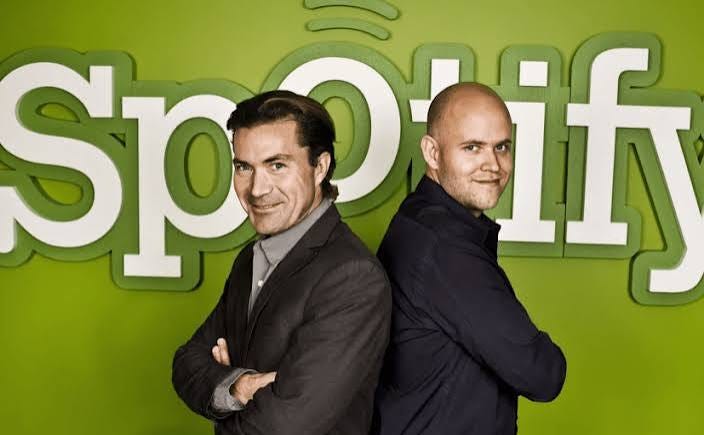
Daniel Ek and Martin Lorentzon came out of advertising technology — Lorentzon co-founded the ad-tech firm Tradedoubler — and Spotify was designed from the beginning as an advertising product in search of a traffic source. The founders weren’t precious about what that traffic source would be. They considered various forms of media, and music won the audition for unromantic reasons — the files were small, the demand was bottomless, and the industry was so wrecked by piracy in the 2000s that it would negotiate with anyone. Sweden was considered a lost market. The rights holders were desperate. Music was simply the cheapest fuel available for an attention engine built to sell ads. The first tracks on the platform were reportedly ripped from employees’ personal libraries, Pirate Bay downloads included, which is the kind of founding detail you couldn’t invent.
Ek later told employees — in a sentiment that should be carved above the door of every label office — that Apple Music and Amazon “weren't Spotify's real competitors.” The real competition was silence.
The stated enemy of the world's largest music company is quiet — not bad music, not piracy, just the absence of sound. Music is just cheap acoustic grout used to fill the cracks between mattress commercials.
Through that hyper-capitalist lens, the atrocities make perfect sense: the algorithmic sludge, the autoplay, the ghost artists. None of it is built to make you fall in love with a record. It is engineered to ensure no moment of your breathing life goes unmonetized.
Spotify never gave a shit about music. You cannot betray a love you never had.
In March 2025, Qobuz became the first streaming platform in history to publish an independently audited average payout rate: $0.01873 per stream to rights holders, covering both recorded music and publishing. One thousand streams on Qobuz generates $18.73 for the rights holders behind the song.
Spotify has never published its rate, and the reason becomes obvious once third parties calculate it. Duetti, a catalog investment firm that analyzed payouts to independent artists, put Spotify’s master-recording rate at roughly $0.003 to $0.005 per stream — the lowest of every major platform they measured, behind Amazon, Tidal, Apple Music, and YouTube. One thousand streams on Spotify generates around three dollars.
To be fair to the devil, Duetti's figure covers the recording only — fold in publishing and Spotify's all-in number climbs closer to five or six dollars per thousand streams. The gap narrows from six-to-one to roughly three-to-one. It does not close, and only one side of it has ever survived an audit.
And that three dollars comes with an asterisk, because since 2024, Spotify pays nothing at all on any track that fails to reach 1,000 streams in a year. The company frames this as fraud prevention. In practice it confiscates royalties from the long tail — a recent study of Southeast European independent labels found the policy hurting nearly two-thirds of the artists and labels surveyed, particularly those with deep catalogs.
Then there’s Spotify’s Discovery Mode, the program where artists surrender roughly thirty percent of their royalties in exchange for algorithmic promotion. The industry spent decades treating payola as a scandal. Spotify turned it into a settings toggle where the artist pays the bribe out of their own pocket.
So how does Qobuz afford a headline rate six times higher?
The answer is the most important number to take away from here. Qobuz generates $121.13 in average revenue per user per year. The market average for other digital service providers (DSPs) is $22.38. There is no free tier, no ad-supported layer, no discounted student-family-duo lattice diluting the pool. Every Qobuz listener is a paying listener, and the payout math follows directly from that.
Qobuz is a small platform that extracts more than five times the revenue per user of the industry average, from a base of people who care enough about music to pay a premium for it. That is a superfan business hiding in plain sight — proof, at infrastructure scale, that a smaller number of high-intent fans generates more real value than an ocean of passive ones. I’ve been writing that argument about artists for two years. Qobuz is the same type of argument expressed in the form of a streaming service.
The ethics question people usually ask about streaming is whether the cheques are big enough. I think the more damning question in 2026 is directional: which way is the company moving? What does it look like in five years? What about ten?
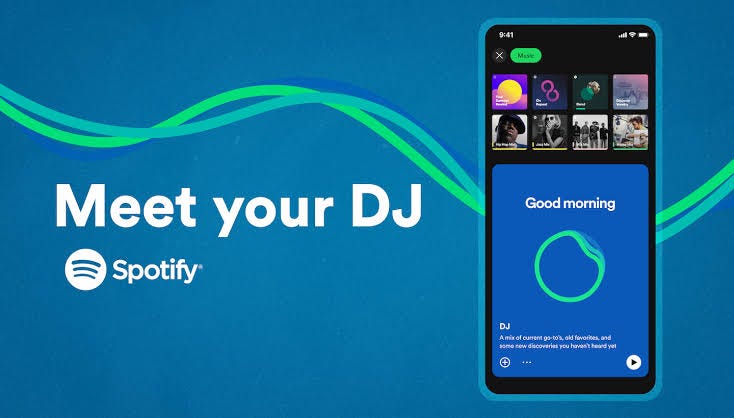
Watch where Spotify spends its ambition. An artificial-intelligence DJ that talks at you between songs in a synthetic California accent. AI-generated playlists conjured from text prompts. Reported tools to let users remix and mash up the songs themselves — because apparently the finished work of the artist is now raw material for your content.
Every flagship innovation of the past three years treats music as a substrate for a tech product, and none of them treats it as the point.
Meanwhile, the platform just posted its most profitable stretch in company history — a record 15.8% operating margin in early 2026 after finally turning consistently profitable — in the same era it stopped paying royalties on small tracks entirely.
The money exists. It’s simply being routed toward becoming a better tech company rather than a better music company, and those are now openly divergent goals.
None of this is a bug, or a growing pain that will work itself out. Every piece of it is a deliberate structural choice by a company that told us who it was from the very beginning — an attention platform at war with silence, for whom musicians are a supplier cost to be optimized downward.
Qobuz’s ethics case is simpler and, refreshingly, a bit boring: charge a fair price, pay a documented rate, publish the audit, employ human editors, add requested records. The company was founded in Paris in 2007, only reached the United States in 2019 and Canada in 2023, and remains a niche player. Niche is not a moral failing.
I promised to show my work, and pretending Qobuz is some flawless sonic utopia would turn this piece into a sponsored post. It’s not.
The catalog has potholes. I went digging for Turnstile’s debut album and came up empty-handed. I’m not sure if it’s a corporate licensing standoff or just a glitch in the matrix, but when you’re looking to tear the roof off your morning commute and the record isn't there, it stings.
The search engine has the deductive reasoning of a stoned roadie. Spotify’s algorithm can read your mind if you misspell a lyric with your elbow, but Qobuz will look at a slight typo and throw its hands up in total confusion.
The interface is clunky, the sorting requires manual labor, and the design language is a few years behind.
The recommendation engine is the weakest link. Two weeks in, the Discover feed still doesn't know me. Spotify would have sequenced my genome and weaponized my nostalgia by day three, but here, the machine doesn't know you. You actually have to do the digging yourself.
The New in Genre playlists don’t display dates added to the playlist, so a music junkie can’t tell whether a “new” record dropped yesterday or in March until they go into the album itself. Genre tagging runs loose in places.
The metadata gets weird enough to make a vinyl archivist hyperventilate—like crediting my copy of Wish You Were Here to the band’s reissue imprint instead of the original 1975 label. Occasionally, the audio routes to the wrong speaker and stutters like a blown amp.
And the third-party ecosystem — the Receiptifys, last.fms, StatsForSpotifys and other fun data tools that make listening socially shareable — mostly doesn’t exist here yet.
But look at that rap sheet. A confused search bar, sloppy metadata, a cold-shoulder algorithm, and some loose wiring. These are software bugs. And software bugs are the cheapest, most solvable problems on earth. Give a competent dev team eighteen months and a pot of black coffee, and they close that gap.
Compare that with Spotify’s rot: a royalty structure that starves the working class, a phantom-artist racket, and a corporate DNA that fundamentally despises the concept of art. Qobuz needs a few good engineers. Spotify needs an exorcism.
Qobuz’s rough edges exist because the company blew its budget on the things that actually matter—human editors, audited payouts, and keeping the catalog pristine. They built a service for the listener who actively chooses to pay attention.
Now, some music nerds (like me) are people who will happily eat some friction in the name of ethics and artist-friendly economics. Most listeners do not care about payout rates, will never read Liz Pelly, and would not trade one second of convenience for all the moral clarity in the world.
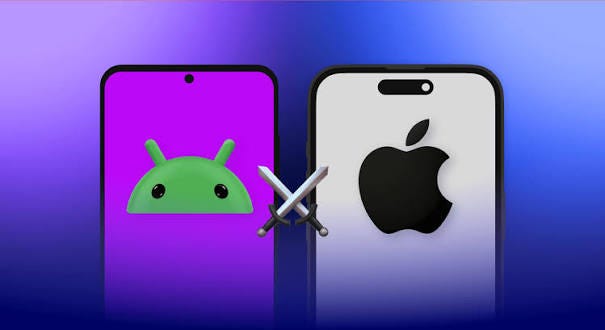
In consumer technology, the sleek experience beats the righteous one every single time. Android phones spent years with objectively superior hardware specs, and Apple still walked away with nearly all the profit in the category, because Apple understood that the interface is the product. Ethics gets you an article like this one. UX gets you the planet.
So if Qobuz wants to break out of the audiophile basement, the roadmap is sitting right there: steal Apple's playbook instead of lecturing from the moral high ground. Close the software gap, then build a real developer API so the social ecosystem can grow outside of Spotify's walled garden. Build a flawless, one-click playlist migration tool, because a defector's first hour in your house is no time to trip over the welcome mat.
Then, weaponize that audited payout rate. Market it the way brands sell fair-trade coffee or conflict-free diamonds. An entire generation already buys with a bleeding heart in every other category; nobody has just given them the frictionless button to do it with their record collection.
The obvious objection is that the math only works because Qobuz is small — scale it to Spotify's size and the $121 dilutes back toward $22. But that assumes Qobuz has to chase the free tier, and it doesn't. There are roughly 293 million people already paying for Spotify Premium. Qobuz needs the fraction of them who care. Whole Foods scaled for three decades without ever becoming Walmart.
And don't buy the myth that Spotify is untouchable—that aura of invincibility is just a cheap parlour trick. Its share of global subscribers has been eroding for years, down to 31.4% and drifting. YouTube Music is currently eating their lunch across the Middle East and North Africa, and Apple Music is serving as a grim cautionary tale of how fast a silver medal turns into bronze. Streaming monopolies slip. They slip slowly, and then all at once. The entire industry is currently scrambling to build premium superfan tiers because the labels finally figured out the passive-listener well has run dry.
The next era of streaming will be fought on the exact bloody turf Qobuz already occupies. They just need their code to catch up to their conscience.
I’m not saying Qobuz is the silver bullet for everyone. For working artists, the math is still a nightmare—Spotify’s reach is a necessary evil even while its economics spit in your face. But as a listener, two weeks on the other side crystallized something I’ve felt in my gut for years. The platform you use trains the listener you become. Spotify bred an entire generation to treat music as cheap ambient utility, then built a shadow army of ghosts to harvest the exact apathy it manufactured. Qobuz, with all its beautiful, clunky flaws, trains you to give a shit again.
Eighteen dollars versus six. Human editors versus fake Swedish jazz trios. An audited public rate versus a war on silence. The devil's main advantage was never a locked door. The door has been open the whole time — his real trick is making comfort feel like loyalty to anyone who never tests it.
But I tested the door. Ripping the algorithmic IV out of your arm takes exactly one hour. And let me tell you—on the other side, the music actually bleeds.
No posts
Comments
Nothing yet. Say the first thing.
Sign in to join the conversation.