
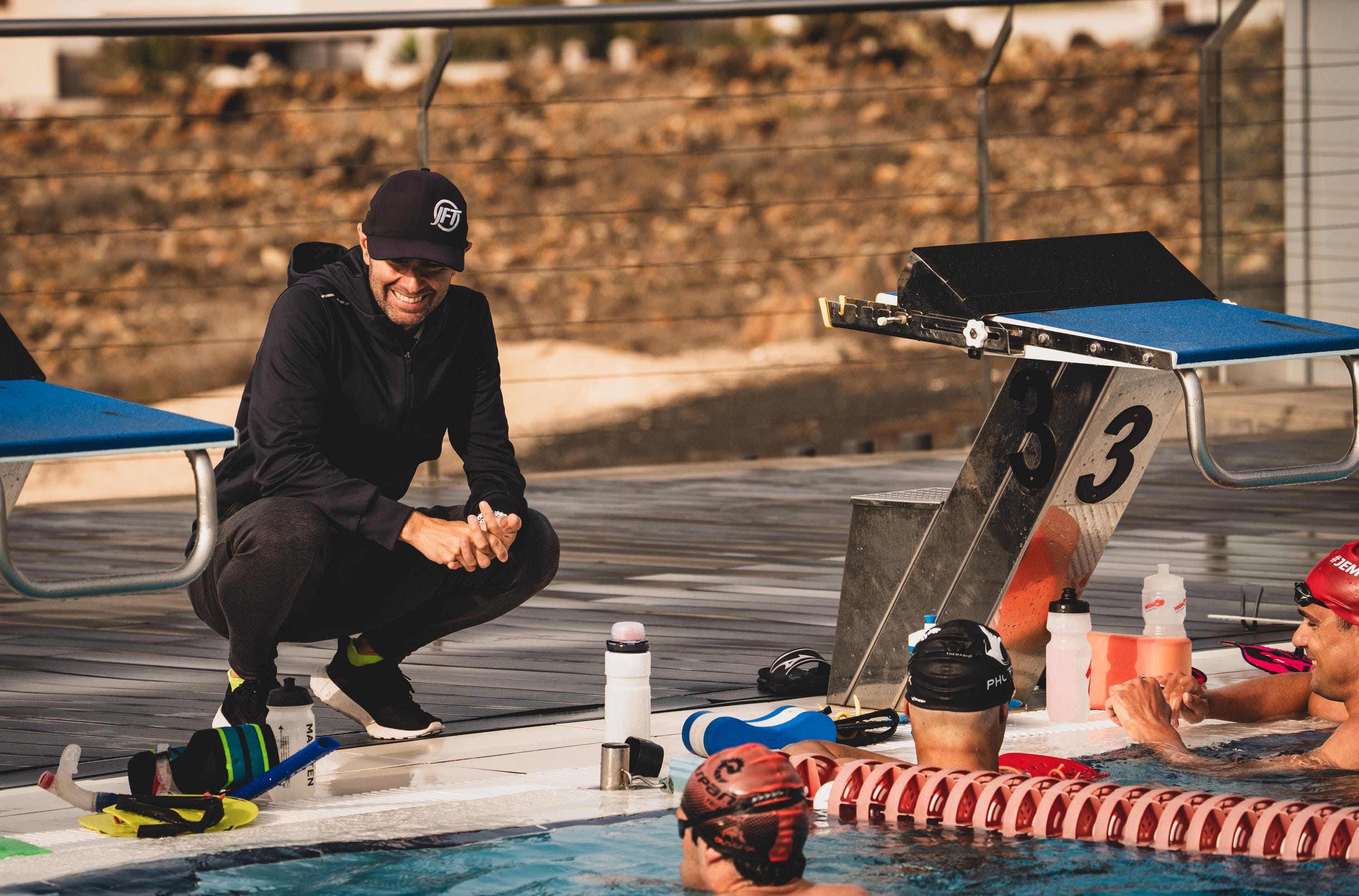
For many in triathlon, swimming is the toughest discipline to master. Often people coming into the sport don’t have a swim background, and probabilistically don’t have the highest motor learning skills and proprioception (self selected endurance sports types, who are mainly better at going in a straight line only), so learning technical proficiency in the water comes slowly, if it all.
In response to these challenges with swimming, and from my own experiences in attempting to make progress with those for whom swimming doesn’t come naturally, I wrote this article “The Top 20 Rules for Faster Triathlon Swimming” on key ‘truths’ I’ve learned about coaching swimming for triathletes.
This was article was originally published back in 2012 (on the blogspot platform). At the time it had a lot of engagement and stimulated discussion in forums and elsewhere. In 2015 and 2020 I published podcasts on this topic on the Real Coaching podcast. There will be a new podcast produced with this 2026 update following this article. It’s an evergreen topic for triathletes.
Recently I was introduced to a colleague who made reference to the “swim rules article“, and at the same time there appeared to be discussion still going over on the slowtwitch forum, so with those prompts, I thought it was time to revisit this perennially hot topic again to see how the rules hold up in 2026.
The Top 20 Rules for Faster Triathlon Swimming
1. Conditioning trumps drills. Technique matters, but the way most athletes try to improve technique doesn't work. Get fitter, and your ability to hold good technique improves. It takes a lot of work to develop aerobic conditioning in your upper body. If you think you are already swimming a lot but are not improving, swim more and keep at it. There are no shortcuts.
2026 Update: This holds up well. The irony is that holding good technique / form requires deep aerobic conditioning to be able to maintained for the durations required. Particularly in full distances races (Ironman), being conditioned enough to get through the swim without being overly fatigued is the critical part. With wetsuits and swim skins adding addition ‘support’ for body position, this pushes the balance even more towards the conditioning side. For a practical example, as coach and former swimmer, I know what good technique looks and feels like, but as I no longer train in the water, I can hold good form for only a very short time without any conditioning.
2. Traditional drills don't work. The type of drills and the way that most triathletes do them don't actually have any material effect on swimming technique.
2026 Update: This holds up well. As written in the introduction, most triathletes have poor motor learning abilities. Meaning it’s difficult to teach and learn better technical skills. These athletes don’t have strong proprioception abilities, meaning they can’t discern well the position of their arms / bodies, and therefore have a hard time knowing if they are making changes, if they making the right changes, or even what their arms / hands are doing. Teaching people without the ability to learn motor skills quickly (usually adults in the triathlon context) can be painfully slow and not effective in many cases. As most people only have a limited time in train in the water, their efforts are better focused elsewhere. In addition, drills, as in breaking down movement patterns into component parts are understood to be less effective vs the whole movement approach to skill acquisition. There is a whole field of literature in this space, but for triathletes, the way they do drills just doesn’t help very much.
3. Swim more often. Frequency is the best way to improve your swimming. Also see rule #4
2026 Update: This holds up well. No doubt frequency is a powerful tool for performance improvement, across all three disciplines. It’s my starting point for improvement - increasing frequency in the water. In particular for the more skill / technical disciplines like swimming and running. Getting into the pool more often, even for short durations can be of significant benefit.
4. Do longer main sets. You can't expect to swim fast and be fresh on the bike if you rarely do main sets with the same or higher volume and pace than you expect in the race. For short course these should be at least 2km, for IM 4km, or more. And that looks like 20-50x100, not many short broken sets adding up to 2-5km.
2026 Update: This holds up well. The inspiration for this rule was the stereotypical masters swim sets with a myriad of different short sets on the board. Keep it simple and specific. If time limited (most triathletes), cut out the faff and aim to get enough consistent work done in the water, without excessive interruptions. The goal is to be able to comfortably manage main sets of the same duration or longer than the goal race distances.
5. Don't over think it. Don't under think it. Be engaged with what you are doing in the water, and use tools to help get a better feel for the water. But don't over think every stroke, and suffer from paralysis by analysis. Swimming fast is about rhythm and flow, when good technique becomes automatic.
2026 Update: This holds up well, but I would expand on the explanation of over and under thinking. There are certainly many athletes who go the pool, do their sets and go home without having engaged in how they are swimming technically. For these athletes there can be something left on the table in terms of technical awareness and improvement. However in the space of highly motivated and ambitious athletes, it’s easy to fall into the trap of overthinking swimming, to such a degree that technique actually suffers and could get worse. Overthinking is a big problem, that I see a lot. And with any technical skills, thinking too much causes efficiency to decrease (at least temporarily, but for many athletes they just stay in this overthinking space and never improve).
6. Increased swim fitness translates to the bike and run. Being able to swim harder, starting the bike both fresher and with faster riders is how that works.
2026 Update: This holds up well. Across all triathlon disciplines, exiting the water without excessive fatigue is a benefit for the bike and run. Having enough fitness and conditioning also helps to be able to push the swim harder, when it makes sense strategically. This principle connects to the idea that triathlon is not three sports, but instead one sport, and the impact from one discipline carries over in the next. Much like bike into run - the better your bike condition, the more likely you’ll be able to run to your potential.
7. Deep swim fitness allows you to swim on the rivet. See rule #6. Most triathletes don't know how to really swim hard for the duration.
2026 Update: This holds up well. As above, swimming hard at the limit is a skill to be learned. Much time time trialling on the bike, learning how to get stuck into a good hard rhythm can be refined and with the conditioning to back it up, can be used to your advantage on the race course.
8. Include some quality in every swim. If you are swimming less than 5x per week, having easy swims is a waste of time. Always include quality, from band, to paddles, to sprints, in every swim.
2026 Update: For this one I’d qualify the statement slightly. There is not such thing as a swim session being a waste of time in general sense, even an easy swim, is better than no swim. However the principle that every swim can include some form of quality, even short series of fast stroke rate, or resistance work like band does hold up. This is due to the more technical nature of swimming compared to bike and run. Therefore there can be a benefit from including these kinds of stimuli into every session, even if not a strong physiological dose, but still can be a useful technical stimulus.
9. Don't count strokes. See rule #2. The objective is to get faster, not take fewer strokes.
2026 Update: For this one I’d qualify the statement slightly again. there is some benefit to understanding the concept of distance per stroke, and for that counting can help frame whats happening. However, this can be overdone (see Goodhart’s law). There was a time when counting strokes was getting confused with the outcome of what we are trying to do with swim training, and it resulted in athletes going slowly but with few strokes. In addition, effective open water skills require a wider range of stroke rate abilities. At times the ability to hold a higher stroke rate is an important skills (such as within a dense group, or in choppy water), and we should practise these skills as well in our training. So don’t get caught into the trap of long strokes, going slowly.
10. Learn now to use your kick but don't spend a lot of time with kick sets. Kicking is about stroke control and body position, not propulsion for triathlon. Kick fitness doesn't matter.
2026 Update: This holds up well. For the speeds most triathletes are going, their kick doesn’t provide any real propulsion, and it’s not limited by kick conditioning. Spending time in kick sets is a waste of time for most triathletes, and they are better off learning about the impact of kick on body positing and timing in other ways.
11. Use a band frequently. The best swimming drill there is. Do short reps with lots of rest at first. Both propulsion and body position will improve.
2026 Update: This holds up well. Band only is a whole skill advanced drill that requires the ability to hold stroke rate and body position together. It’s an example of a constraint based drill that requires the athlete to ‘figure it out’ while doing it, without the need to think too much, as the body (position) provides feedback when it’s not effective, as the legs sink. It’s advanced in the sense that the starting point of body position and awareness has to be at a sufficient level or the athlete can’t really move very far effectively, leading it to be a big struggle. The key with band for athletes new to this tool is to keep the reps short, 25m is enough, and do repeats, mixed in with some whole stroke swimming, so we can connect the sensation of the band directly to whole stroke freestyle, closing the skill loop between them. Also the band can be any old inner tube, doesn’t have to be an ‘official’ band.
12. Use paddles with awareness of engaging lats. Paddles are primarily a technical tool to take more strokes with better mechanics, the result of which is learning how to use your prime swimming movers: your lats.
2026 Update: This holds up well, but can be expanded upon. For many triathletes, the pull gear ends up as a crutch to use instead of full stroke swimming when tired. Now there can be a benefit to using the full pull gear as the buoy helps maintain better body position, in particular under fatigue - as poor body position is one of the first signs of systemic fatigue, and triathletes with the amount of total volume on run and bike, often turn up at the pool fatigued. So this can mean swimming a lot of meters with poor body position. However the principle of this rule was also how we use and think about paddles as a swim tool. The pressure on the hands created with paddles acts as feedback that can be translated to awareness of keeping the armpit open under water early in the catch and therefore activating our prime swimming movers, the lats. Dropping the elbow is the most common swimming technical issue after basic body position, and is the biggest obstacle to improving propulsion. Using the paddles as a technical cue helps address this issue if done in an engaged way. Also using different types of paddles can vary the stimulus in this area. I prefer flat, slightly flexible paddles that have a water feel, and only using the finger straps, not the wrist straps. This allows for additional feedback on the angle of the hand. Without the wrist strap it feels like the paddle will come off or is slipping when swimming with the wrong pitch. Also I like the finis agility paddles, which have no straps at all, but are held on with water pressure during the catch, and a bit of thumb pressure to hold them on during the recovery.
13. Keep head low on breathing and in open water. Head down, feet up. It's a common body position error.
2026 Update: This holds up well. The most common error in particular in open water is the head position being too high (too much sighting and / or maintaining that high head position due to perhaps being uncertain on the direction of travel. Also lifting the head too much on the breath is common, causing the legs and hips to sink. This head position awareness can be practised both in the pool and in open water conditions.
14. Do many short repetitions for stroke quality. It takes fitness to swim with good technique for long durations. Start shorter, and swim faster. 50x50 works wonders. Don't have time to do a 2500m main set? Drop the warm up and warm down.
2026 Update: This holds up well. I still work with shorter repeats for many athletes, who don’t have the conditioning to hold good technical for many longer reps, or for athletes under high load (many triathletes). Long sets of short reps are effective for increasing the relative amount of rest, to allow for neuromuscular and overall recovery, with the goal of accumulating more ‘good strokes’ over the course of a session. For many athletes longer full stroke swim reps can mean degraded technique and body position over time, reinforcing bad habits. For longer sets, it can be useful instead to put the pull gear on to maintain good form, under fatigue. But for full stroke sets, the short rep volume principle is effective.
15. Learn to swim with a higher stroke rate. This takes conditioning. It will pay off on race day, and particularly anytime swimming in a group and in rough conditions.
2026 Update: This holds up well, see the explanation in rule 9 about counting strokes, and rule 11 about swimming effectively with the band. Having the ability to swim with a higher stroke rate can make dealing with difficult open water conditions more effective. Of course this can’t be done just on race day, swimming with a higher stroke rate requires skill and strong conditioning, so has to be integrated into your swim training. This can take the form of short efforts such as 50s with stroke rate as the focus.
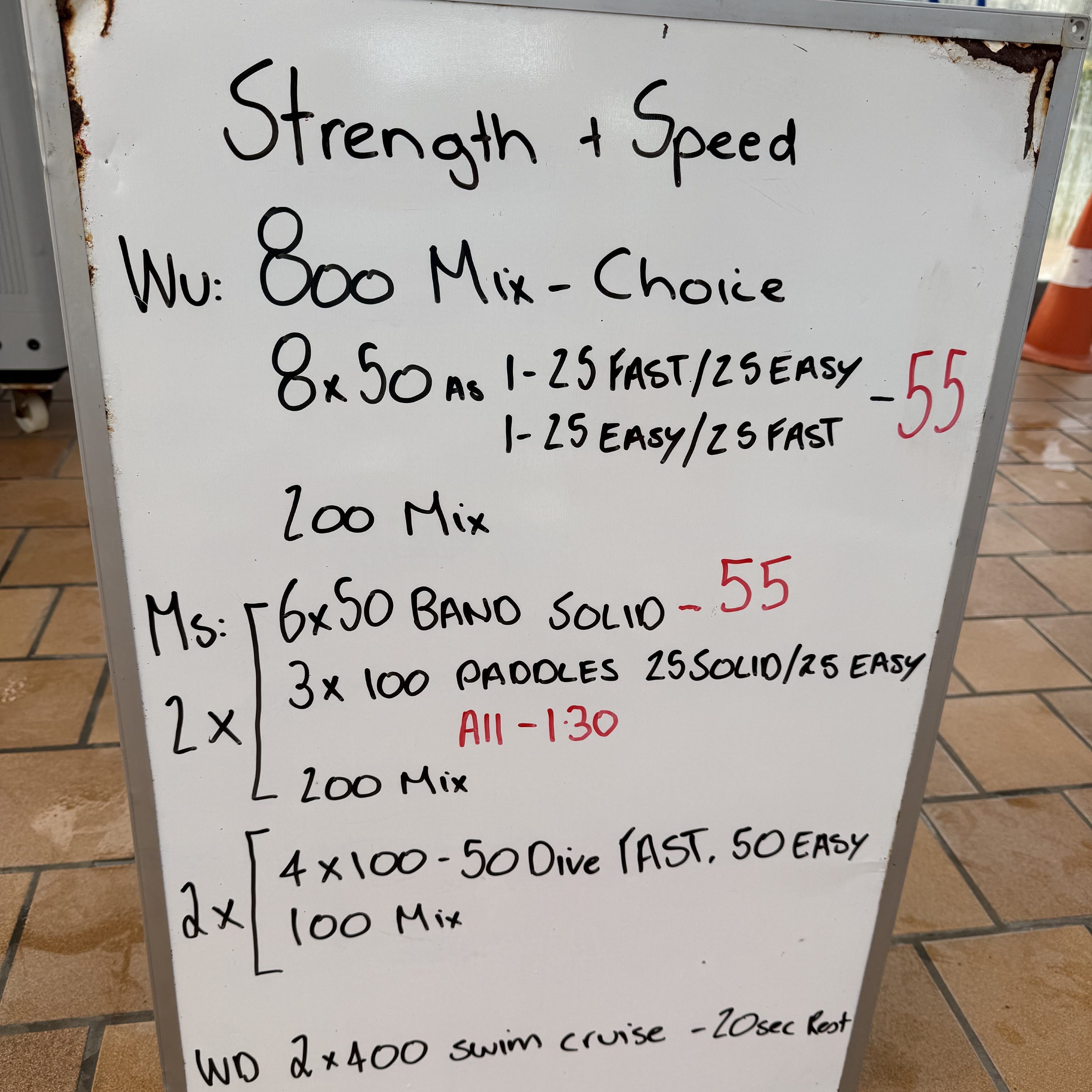
16. If you need to write your swim session down on the white board or paper, it's too complicated. Keep it simple.
2026 Update: This holds up well, although in my context we recently had a number of new athletes with english as a second language so we have been writing the sessions down this year to ensure they understand the session. However the principle remains - keep the sessions simple enough to understand and communicate. If it’s too hard to remember then it’s probably too complicated to be effective.
17. Find a good masters programme. Long main sets is a good sign. Swim with others to challenge yourself. Good programmes are the exception rather than the norm, unfortunately.
2026 Update: This holds up well. For many triathletes who train a lot on their own most of the time - they are missing out on the social aspect of training and being pushed / challenged by others (at times can be a big benefit, at times it can be too much). Swimming with a group also creates an accountability structure that benefits athletes looking to invest in their swimming performance. Knowing you have a group to join at a specific time reduces the changes of talking yourself out of going to the pool.
18. Don't use swim tools as a crutch. Paddles and bull buoys are tools with specific uses. Don't reach for them out of simple laziness, because the set is hard.
2026 Update: This holds up well, albeit with all the caveats above about the technical utility of swim tools. But there are triathletes who rarely ever swim without their tools, or as soon as there is any effort involved are reaching for the pull gear. Full stroke swimming has to be developed in order to be effective on race day without the swim tools (even if the wetsuit helps in this regard, we still want to develop effective specific conditioning without the paddles).
19. Do use swim tools when you are very fatigued, and will otherwise swim with poor quality. See Rule #18.
2026 Update: This holds up well, as explained above. Triathletes are often in a state of heavy fatigue, hence the high usage in general of pull gear. And this fatigue is often part of the reason why it’s hard to improve swimming. Often the ‘best’ way to see this is when unloaded on the bike or run (often unfortunately due to injury) and then we see the swimming performance suddenly improve significantly in a short time frame, illustrated how much impact fatigue from the bike and run has on swimming for triathletes. This is often a harder concept for pure swim coaches to really understand and accept, and many end up frustrated coaching triathletes in the water for this reason.
20. Dry land and gym can help swimming for some via improved neuromuscular recruitment. Use body weight and tubing not machines.
2026 Update: This holds up well, and I continue to use and recommend both on deck tubing / elastic exercises as part of the pre swim warm up, as well as specific gym based work to help recruit and pattern the swim prime movers out of the water. Machines can still be beneficial, but free weights or cables / tubing where there is more control over the path of movement and a stability element is more effective.
Bonus: Love swimming if you want to get faster. Embrace the process of getting faster in the water. Chlorine sweat is a good thing.
2026 Update: This holds up well. No doubt that frustration with progress or lack thereof in the water is a significant problem for many triathletes that ultimately ends up slowing down improvements. Making changes and improvements in the water for most triathletes is a long game of consistent work over time. Beyond some early gains through higher frequency, there are no short cuts for the investments needed to truly make significant swim improvements. So the right mental attitude, with patience, perspective, being kind to one-self through the process makes a big difference (there will be good days, and bad days in the water, don’t over focus on the bad days, it’s a normal part of the process for triathletes bringing that outside fatigue into the pool).
#21 Repetition is your friend. Variety is for the weak minded, and interferes with the learning process. Repetition, Repetition, Repetition.
2026 Update: This holds up well, and is timeless across the three disciplines. This concept has never been more relevant than now, in our era of constant novelty seeking. There is no escape of doing the work of going up and down the black line at the bottom of the pool, and following the rules of consistent, simple and effective training. Doing the swim basics well means a huge amount of repetition, and being able to maintain focus over the long term is which makes the different to improve your swimming. Too much variety seeking can become a distraction from doing the work.
Summary
Overall it’s interesting that the “ The Top 20 Rules for Faster Triathlon Swimming” article holds up very well looking back with the perspective of today in 2026 to all the way back to 2012 when it was originally written. While there has been some refinement and addition perspective added, the core of the ‘rules’ have guided my coaching since then, and indeed connect very well to how I see bike and run training as well (subjects for future articles perhaps). The more things change, the more they stay the same.
“Follow the rules above to swim faster, and ultimately to be a faster triathlete. Enjoy.”
Recent Updates:
Risk and Reward article + Podcast + YouTube video
Zone 1 is where the magic happens article + Podcast + Youtube video
How to show your support:
Subscribe to the Real Coaching podcast: iTunes | Spotify | Youtube
If you’ve found value from my work, consider sharing with someone who may beenfit and becoming a paid subscriber
“Champions are all around us, all you have to do is train them properly ”
— A. Lydiard
Personal Coaching for Triathletes
Coaching, Consulting and Coach Mentorship is available:
Email at coaching@joelfilliol.com to inquire or visit joelfilliol.com
Joel’s current project is his independent elite multi-national triathlon squad #JFTcrew, consisting of Olympic athletes focusing on the World Triathlon Championship Series, through which he has supported athletes to achieve more that 30 World Triathlon Series winning performances, as part of more than 100 World Triathlon Series podiums, and 6 overall World Triathlon Senior Elite World Championships Titles.
Previously Joel served Triathlon Canada as National Senior Coach and Beijing 2008 Olympic Coach, where he guided Canadian Simon Whitfield to the Silver Medal, British Triathlon as Head Coach, Federazione Italiana Triathlon in the role of Olympic Performance Director, and Triathlon Australia in the role of Podium Centre Head coach and Olympic Program Head Coach.
Instagram | Facebook Page | LinkedIn | X | Youtube | iTunes Podcast
No posts
Comments
Nothing yet. Say the first thing.
Sign in to join the conversation.