
We’ve all been there.
Your partner says something that hits just a little too hard: “You left the fridge open again.” “You’re driving too fast.” “You’re just like your mom.”
And before you even respond, it happens. Your jaw clenches. Your brain immediately starts building a legal case to prove your innocence.
They’re wrong. You’ve got evidence. They made a mistake yesterday—should we talk about that? You’re not listening anymore. You’re defending. Retaliating. Rehearsing your rebuttal.
That’s what clear “statements of fact” can do—especially when they come with pressure or accusation. They push us. So our brains push back. Instantly.
But story?
Story doesn’t push. It pulls.
When you hear a statement presented as a fact, your brain processes it in one specific place: the Wernicke’s area—the part responsible for decoding language and meaning.
That’s it. It’s a narrow, logical transaction. You hear the data. You assess it. And if it doesn’t fit what you already believe, your refute it.
But when you hear a story, your entire brain lights up—sensory, motor, emotional centers all firing at once. As we discussed in Part Three, this is called neural coupling: your brain syncs with the storyteller’s as if you’re living the experience too.
So what does all this mean?
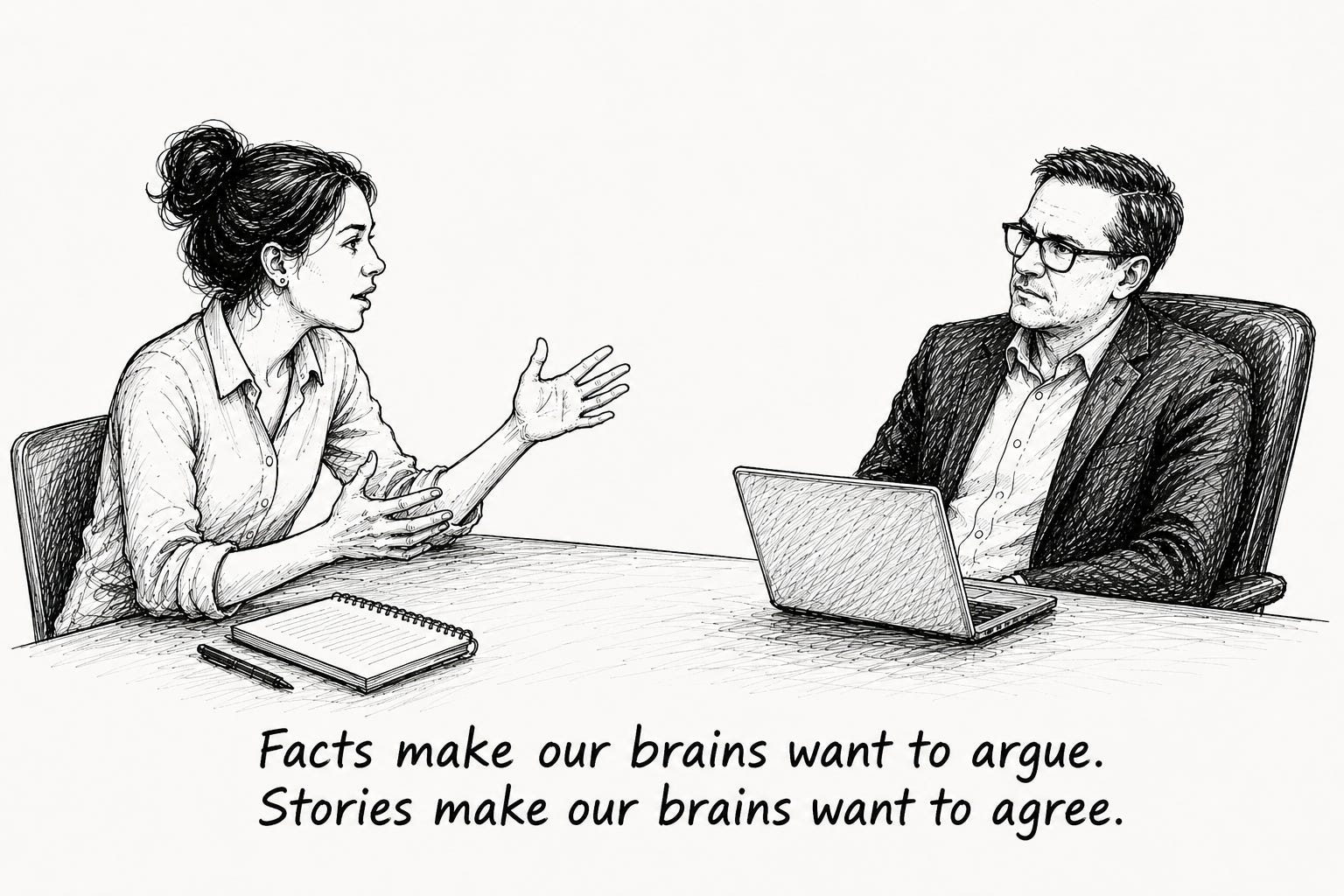
Facts make our brain want to argue.
Stories make our brain want to agree.
We resist lectures. We resist slogans. We resist anyone who seems like they already have all the answers.
But we don’t resist a human being telling a story from their own life.
Because story levels the playing field.
It doesn’t come from above—it comes from beside.
That’s what makes it so effective in leadership, especially in hard moments. You can either say: “We need to make a painful change, and here’s what it is.” Or you can say: “I want to tell you about the last time I was in this kind of situation—and what I learned.”
One of those triggers resistance.
The other creates resonance.
You don’t need to argue your way into someone’s brain.
Even if everything in you wants to do that, it rarely works. It’s a waste of time.
Just invite them to stand where you were standing for a moment. To see what you saw. To feel what you felt.
If they can do that, even for a second, they’ll feel a connection with you. And often, they will then reevaluate their initial position.
That’s the secret: Story doesn’t force agreement because it’s right.
It bypasses defenses because it connects.
Arguments harden positions. Stories soften hearts.
If you want to change someone’s mind, don’t push harder. Tell the truth you’ve lived—and let the story do the work.
That’s how resistance gets replaced with understanding.
**Up next in this series? Part Ten: Stories Change the World
All of my work here is free so I am dependent on your voluntary support to keep this going. In addition to becoming a paid subscriber, you can support my work by preordering my upcoming book, Story Is the Strategy, or by making a one-time gift via Venmo or Buy Me a Coffee.
No posts
Comments
Nothing yet. Say the first thing.
Sign in to join the conversation.