
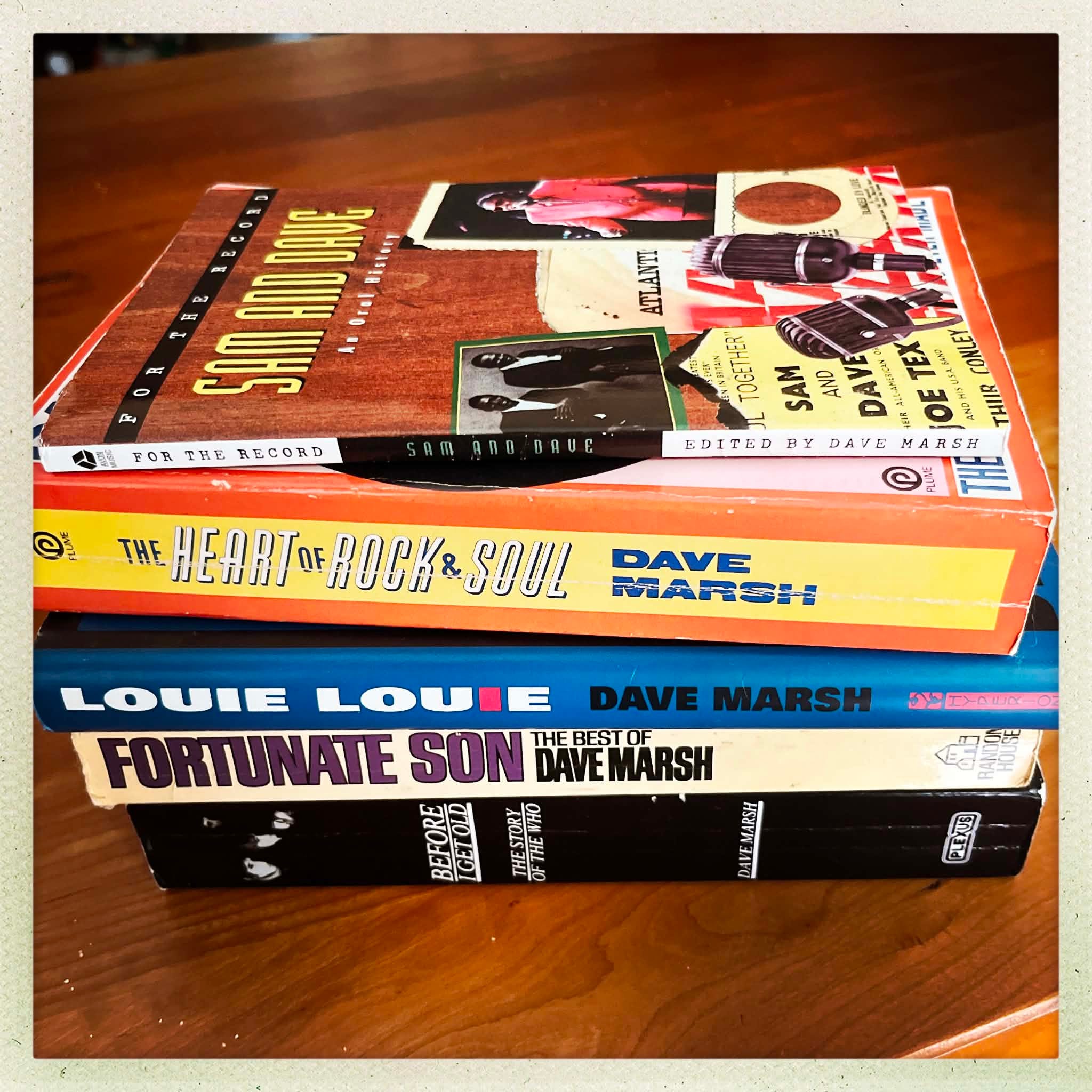
The pioneering and influential music critic Dave Marsh has died. His writing was an enormous influence on me even before I knew I wanted to write about music. As a teenager, I inhaled my older brother’s copy of the first edition Rolling Stone Record Guide (1979) and distinctly remember the one-word review that Marsh gave of Pure Music by the band Chase: “Flee.” Though I eventually cooled on such self-conscious snark, Marsh’s humor and attitude remained undeniable to me. In the wilds of Appalachia in the late 1980s, I special-ordered Marsh’s The Heart of Rock & Soul: The 1001 Greatest Singles Ever Made at the local bookstore, and spent the following couple of years returning to it as a kind of holy writ, so taken by Marsh’s blend of passion, smarts, command at the sentence level, conversational style, and confidence in his takes. I hardly agreed with all of his assessments, but that was part of the fun.
Later, I’d read his seminal books on Bruce Springsteen (Born to Run: The Bruce Springsteen Story, Glory Days: Bruce Springsteen in the 1980s) and the Who (Before I Get Old: The Story of the Who), as well as the history of the Kingsmen’s “Louie Louie” (full title: Louie Louie: The History and Mythology of the World’s Most Famous Rock’n’Roll song; Including the Full Details of Its Torture and Persecution at the Hands of the Kingsmen, J. Edgar Hoover’s F.B.I., and a Cast of Millions; and Introducing, for the First Time Anywhere, the Actual Dirty Lyrics). The latter of which may be my favorite Marsh book, because it showed me early on that a lot can be said about a seemingly rudimentary and simple rock and roll song, a charge that I’ve carried every since.
Marsh’s short books Sam and Dave and the Beatles’ Second Album were fun, and I also dug, and return often to, Fortunate Son, his 1983 gathering of his journalism and criticism. For me personally, Marsh’s politics were certainly in the right place, and though he irked some, especially the musically conservative types, by foregrounding his social writing and politics in his later decades, manifested in his Rock and Roll [later Rap] Confidential newsletters, those passions were no less authentic than his love for and belief in the redemptive possibilities of music on the personal and cultural levels. His fandom and almost naïve allegiance to rock and roll as a saving force were appealing to me, particularly in the ways he’d craft intelligent arguments out of pure heat, out of love for the artists he loved and sometimes out of the heartaches they gave him. He could be one-sided, but he’d usually articulate and argue that side well, if at times arrogantly. He’ll be missed.
Below is a piece I wrote in 2022 about Marsh, Bob Seger, rock and roll, and ground zero Detroit.
Say what you want about Dave Marsh—and for a while there back in the 80s and 90s, people said a lot—he really understood rock and roll. Though he was prickly and at times smirkingly arrogant about his tastes, which you should, he assured you, share, and too interested in cultural politics for some, he was genuinely moved by loud, righteous rock and roll, and his urge to share his passions was ultimately generous and right-minded (and longstanding: he currently hosts three Sirius XM Radio shows).
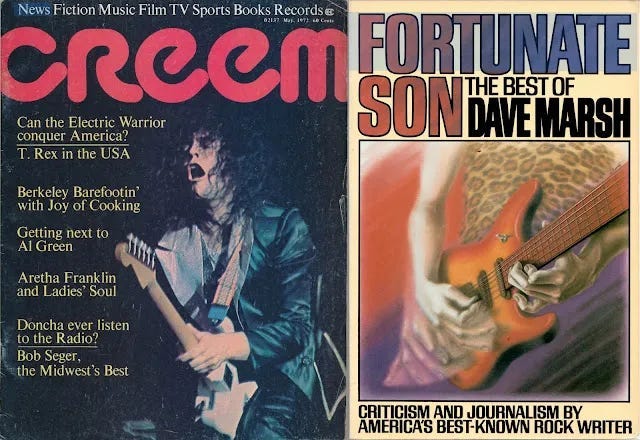
He was on the ground in Detroit, in the crowds and backstage at the Grande, and in the offices of Creem and, later, Rolling Stone, for some of the most exciting music there was. Lately I’ve been re-reading Fortunate Son, his terrific, long out-of-print collection published in 1985, and was happy to be reminded of “Doncha Ever Listen to the Radio?”, a run-down he wrote of Bob Seger singles that ran in Creem in May, 1972. At the time, Seger was doggedly grinding it out as a native (Detroit) son-star, on the cusp of national attention. Marsh’s take on Seger’s incredible “Heavy Music (Part 1),” his last single for Cameo-Parkway, released in 1967, is still humming a half century later.
I love reading on-the-ground accounts of rock and roll that emerge in real time, as it were, the sounds of writers making sense of a band, artist, album, song, or show within weeks or months of the music having emerged. Given how the parameters in music criticism have changed in the last few decades, it’s somewhat bittersweet now to read Marsh’s of-the-era enthusiasms for the likes of the MC5, the New York Dolls, the Sex Pistols, and Bruce Springsteen, among other heroes. Vaguely quaint in some quarters these days, his belief that rock and roll—read, loud spectacle made by (mostly) white men with guitars—could genuinely change people (if not systems) might fall on deaf ears, irrelevant or tiresomely rockist in the culturally diverse era of Hip Hop, EDM, Pop, and Dance and the billions in revenue they produce.
And if that development, along with the implacable passage of time itself, dates some of those takes, for both the reassessing writer and the reader, what often lasts down the decades is the palpable thrill of the initial contact. Here, Marsh considers “Heavy Music” a long five years after its release, yet he writes as if his ears were still ringing, his heart still racing, enthusing that the song “hasn’t lost a drop of the magic it possessed in 1966 [sic],” that it’s “so simple it’s almost primal.” He recalls that “Everyone who heard [the song] was incredulous. No one had ever put it that way before, but suddenly the phrases seemed to have been there all the time. And the music that punched the message home said the same thing, just as effectively,” adding that the song’s “musical power abets its lyric, so that together they’re improbably strong.”
What startled and thrilled Marsh in “Heavy Music” was its self-consciousness about rock and roll—still relatively young in ‘67—which, rather than hobbling the song’s message, liberated it. On top of a pummeling groove, provided by Seger on guitar and organ, Carl Lagassa on guitar, Dan Honaker on bass, and Pep Perrine on drums and percussion, Seger howled a manifesto about the power of AM radio and the stage and the sounds that leap from them, the song boldly “proclaiming itself,” as Marsh recalled. “Its opening lines (’Doncha ever listen to the radio / When the big bad beat comes on’) are as magically rhetorical as anything ever written. Of course you do—otherwise you wouldn’t have heard this,” adding:
Sometimes it’s just a stone-cold, drop-dead-in-your-tracks pronouncement that a new phase has dawned:
Doncha ever feel like goin’ insane
When the drums begin to pound
Ain’t there ever been a time in your life
You couldn’t believe what the band is puttin’ down
A new phase as yet un-billed. “[I]t must be remembered that no one had thought to call [music ‘heavy’] before,’ Marsh wrote. “Though the song may never have reached your backyard, it was Bob Seger who coined the phrase that sums up everything since Zep unzipped and the Jeff Beck Group zapped us right in the guts with a whole new sound. That sound was what the Who and the Yardbirds had been implicitly promising but never quite defined.” You could hardly be anywhere in the Detroit metro area, Marsh remembered, “without hearing ‘Heavy Music,’ and every time you got into the car, you practically had to keep one foot on the dash to keep it from driving you right through the windshield.” Yet Seger’s local hits often dropped into commercial oblivion when his label’s promo people pulled wide; this was deeply frustrating for Seger. In typical luck, Cameo-Parkway folded soon after “Heavy Music” was released. Seger asserted that the problem was Allen Klein (”Yes, that Allen Klein”) who had purchased the label, causing the stock to soar “and then the federal government shut the company down,” Seger sighed. “The stock went from two to seventy, so the company was literally shut down.”
There was another stumbling block to getting the heavy “Heavy Music” into the Top 40. “A lot of people really misconstrued [the song],” Seger remarked. “That was a song about the music but a lot of people thought it was a song about music and sex, the two together. There was nothing sexual in it, it was simply read in by a lot of program directors. The part about goin’ deeper.” Seger added that those program directors told him that he oughta go in “and rerecord that tail end, put something different on the tail, because no one’s ever gonna play it’.” More a downed-power-line groove than a song, born out of a late-night jam one long night in Columbus, Ohio, Seger and his band riffing on the word “deeper” and the righteous, mind-opening concepts it inspired, “Heavy Music” was destined to be ignored by the masses, and dug by those in the know.
For decades, the early Seger singles traded at high value, and YouTube opened up the songs to a whole new audience. Near the end of the piece, Marsh mentions that the celebrated Detroit label Hideout was interested in buying the Cameo masters and releasing them on a compilation titled Bombs Away. Alas, that never happened. It took nearly half a century for the material to finally come out on Heavy Music: The Complete Cameo Recordings 1966-1967 released in 2018 on ABKCO. (Yes, that Allen Klein.) The wait was worth it.
On the flip side to “Heavy Music,” an unhinged Seger riffs over the backing track, near the end name-checking an artist who I imagine he felt was close competition when writing the tune: “Stevie Winwood’s got nothin’ on me.” That signaled a sonic turf of sorts in heady ‘67, yet the wailing, sublime, hypnotic groove that Bob Seger & The Last Heard laid down that night utterly transcends its origin. It sounded exhilarating to Marsh in ‘72; it sounds the same to me in ‘22. Turn it way up.
You might also dig:
This can't go on much longer
·
May 15, 2024
The week I was born, the Beatles were in the studio laying backwards-guitar overdubs onto “I’m Only Sleeping,” the Who were building the futuristic industrial soundscape of “Disguises,” and the Rolling Stones released their bold new single, “Paint It, Black.” In Slug’s Saloon on the Lower East Side of Manhattan, saxophonist Albert Ayler and his free jaz…
Revisiting Roxon's Rock
·
October 5, 2024
Since migrating my old blog over to Substack, I’ll be periodically revisiting and revising some older pieces.
Tripping with Ellen
·
November 14, 2024
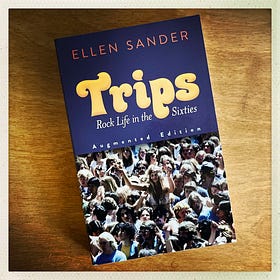
In June 1967 the music writer Paul Williams broke a story that never happened. “It looks very much as though Michelangelo Antonioni will direct the Beatles’ third film, Shades of a Personality, shooting for which is scheduled to begin in Malaga, Spain, in September,” he reported, in a column later gathered in his first book
Thanks for reading No Such Thing As Was! This post is public so feel free to share it.
Comments
Nothing yet. Say the first thing.
Sign in to join the conversation.