
Every profession kills the thing it loves.
Not maliciously. Reality is just far too complicated to work with directly.
Take something as apparently straightforward as a customer buying a loaf of bread. Why did they buy that loaf?
Price? Habit? Packaging? Hunger? Childhood nostalgia? The weather? The smell of the bakery? The lack of a queue? The recommendation of a friend? A million years of evolution?
Good luck building a profession around all of that. Sooner or later you have to make a choice.
You have to decide which parts of reality matter and which can be ignored.
Economics decided that incentives matter. Psychology decided upon cognition. Law decided precedent is paramount. Physics decided particles are the thing to focus on.
See how even the most complex domains require acts of extraordinary simplification.
But simplification is not inherently a bad thing, a recipe is useful because it isn’t dinner.
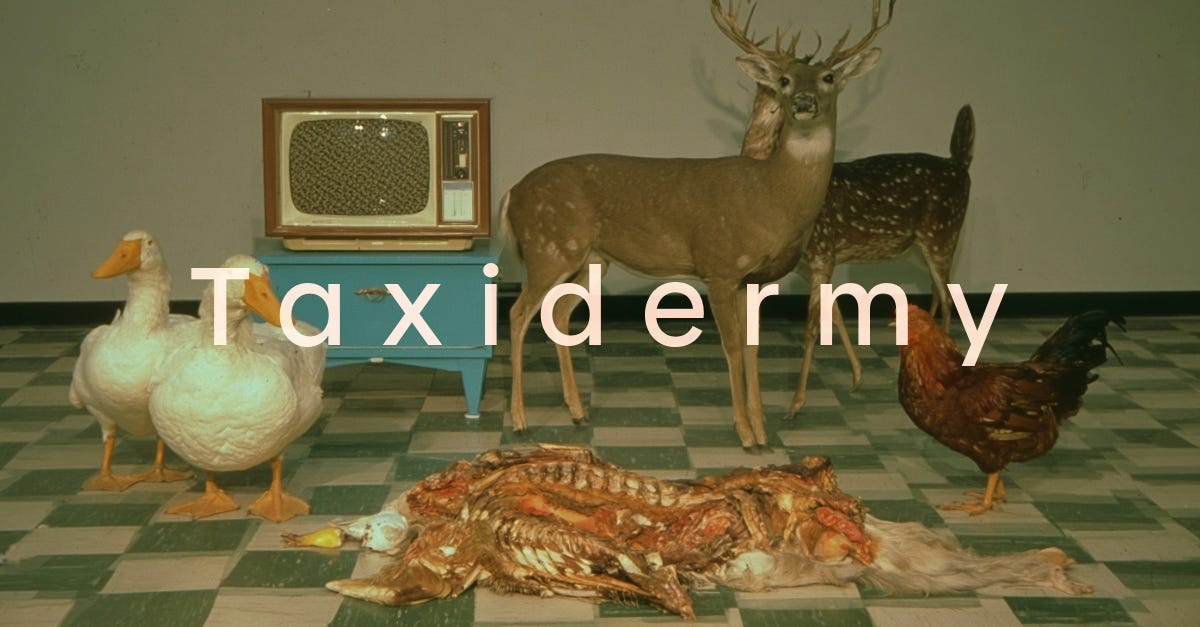
The Victorians were obsessed with taxidermy. Creating elaborate tableaux of rabbits attending school, kittens boxing, squirrels drinking tea and hedgehogs playing cricket. They transformed dead animals into tiny middle-class melodramas. It was charming, it was bizarre.
Taxidermy preserves the appearance of life. And the first thing a taxidermist does is remove the living bits. The organs conveniently disappear, as do the muscles and blood.
What’s left is shape. A representation. A useful substitute. Simpler, but much easier to work with. All disciplines do something similar. Reality is always wriggling and nipping your fingers. So we remove everything we don’t know how to manipulate. Then we can work with the stuffed version.
Advertising does this. In fact, advertising may be the funniest example because we’ve managed to produce a dozen competing taxidermists, each convinced that only they know how to preserve the animal.
Ask a creative what advertising is made of. Ideas. Ask a media planner. Reach. Ask an effectiveness consultant. Incremental sales. Ask a behavioural scientist. Choice architecture. Ask a brand strategist. Memory structures. Ask a project manager. Meetings.
Every discipline has selected which of the organs to remove and which to keep.
The creative simplifies things until only the execution remains. The media planner cuts away everything besides distribution. The econometrician reduces until just the variables are left. The strategist takes out all the bits that don’t fit into their favorite framework..
These are not stupid people, it’s just reality is a stupid thing to deal with.
Reality contains an absurd quantity of information, and at times that information is highly contradictory. Every second there are more things happening around you than you could ever hope to consciously process. Fortunately, your brain is ruthless and great at ignoring things.
Herbert Simon called this bounded rationality. The reason people don’t make rational decisions is because perfect rationality would require us to process an infinite amount of information at instantaneous speeds. Instead, we do what he calls ‘satisficing’. We intuitively and reflexively construct sets of much simplified little working models of the world, and those retain enough detail to let us get on with the business of living without getting hung up on the incessant barrage of mental stimulation.
This is where James J. Gibson, another psychology boffin, is worth bringing up.
Gibson figured that we don’t primarily perceive things in terms of what they are. We perceive them in terms of what they might afford us. A chair isn’t encountered as an arrangement of timber, upholstery and screws. It’s encountered as something to sit on. A staircase shows up in our brains as something to climb. A handle appears as something to pull.
We don’t begin with a neutral objective appraisal and then infer function. We perceive what something is for directly and then just sort of don’t think about what the thing is very much.
I think expertise seems to work in much the same way.
An experienced media planner doesn’t imagine individual people watching TV. They see reach curves and frequency. A strategist doesn’t look at a supermarket shelf. They see category entry points, distinctive assets and mental availability.
So our abstractions don’t just help us explain the world after we’ve looked at it. They literally determine what we see in the first place.
The implication there is that experts don’t simply disagree with one another. They inhabit different worlds.
Most famously, Thomas Kuhn pointed this out in the sciences. He argued that scientists working under different paradigms weren’t simply offering different explanations of the same phenomena. Their paradigms determined what counted as a phenomenon in the first place.
The paradigm being a shared social construct of what was worth observing. What constituted evidence. Even what counted as a satisfactory explanation. In other words, they weren’t just reaching different conclusions. They were looking at different universes.
Kuhn is usually remembered as the bloke who popularised the whole idea of paradigm shifts. Copernicus replacing Ptolemy. Einstein replacing Newton.
But I think his more interesting nuggets are what he says about the things that happen between the shifts. Most science is located in the routine, not the revolutions.
Scientists spend the overwhelming majority of their careers solving specific puzzles rather than questioning the existence of puzzles themselves. They don’t arrive at work each morning wondering whether gravity is really a thing. Those questions have already been settled. The paradigm has done the hard work for them.
That’s kind of the point of having a paradigm. It’s something that dramatically reduces the number of decisions a community has to make. It establishes what sort of things exist, what counts as evidence, what methods are respectable, what questions are important to be asking and, more importantly than that, which questions are no longer worth asking.
In essence, paradigms allow expertise to accumulate.
By agreeing on the fundamental furniture of reality, thousands of people can stop debating first principles and start building upon each other’s work.
They’re a crucial piece of intellectual infrastructure. And they’re also a bit of a trap. Simplification creates blind spots and shared language becomes shared blindness.
Every discipline falls into a vocabulary that makes certain things astonishingly easy to perceive and discuss and other things almost impossible to even think about.
Maybe this explains why the disciplines within marketing have become such an argumentative bunch. We like to imagine we’re all disagreeing about the same thing. But clearly we are not.
Brand and performance aren’t really arguing with one another. Neither are creatives and media planners. They’re all making perfectly reasonable observations about entirely different versions of reality.
This was Kuhn’s most controversial observation. That scientists working under different paradigms eventually become incommensurable. That they eventually lose the ability to properly translate between one another. Evidence that seems overwhelming to one group barely registers with another because each has inherited a different idea of what counts as evidence in the first place.
The disagreement is ontological. The respective paradigms have established what sort of things populate reality. And those are not the same things, and therefore they’re not the same reality.
No posts
Comments
Nothing yet. Say the first thing.
Sign in to join the conversation.