
I have never trusted a person who does not have a hot dog opinion. Mine is simple: ketchup should never touch one. Unfortunately, I married into the opposition.
My wife Vanessa grew up in Maturín, Venezuela, where her mother and sisters will tell you she ate ketchup with the devotion other children reserved for candy. In our house, she is known as the Ketchup Queen of Maturín, a title she earned honestly. She still believes almost anything can be improved by ketchup, including hot dogs and eggs, which is a difficult thing to discover after you already love someone.
I grew up in New York, where the rules were simple: mustard, maybe sauerkraut, onions if you were paying attention, eat it standing up, and move on. You do not build a hot dog, you finish it. The simpler the food, the stricter the code. When I was a kid and I could not tell how sick I was, I would picture eating a dirty water dog from the cart on the corner. I thought it was the most delicious food in the world. If I could imagine it, I went to school. If I could not, I stayed home. It worked better than a thermometer.
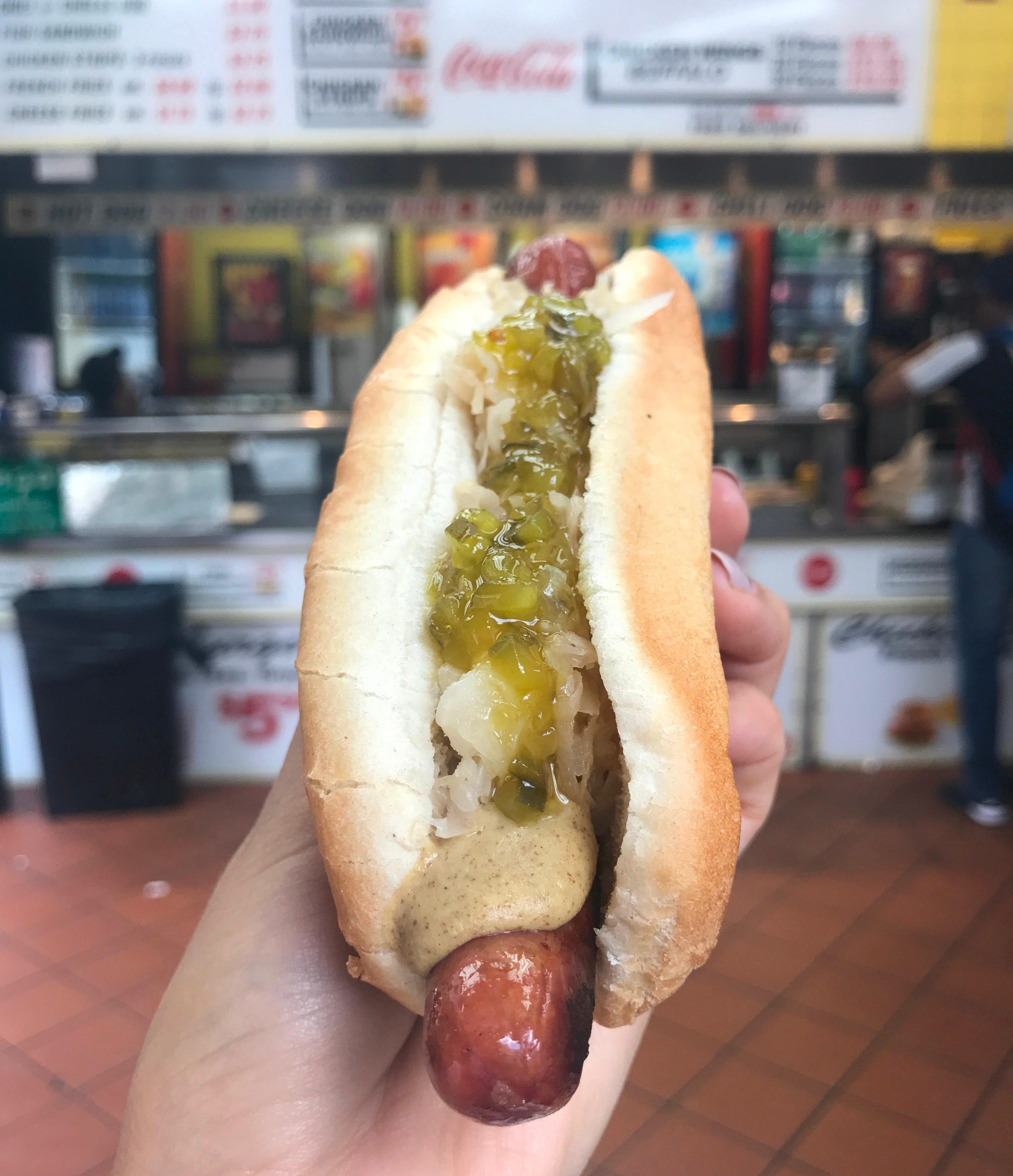
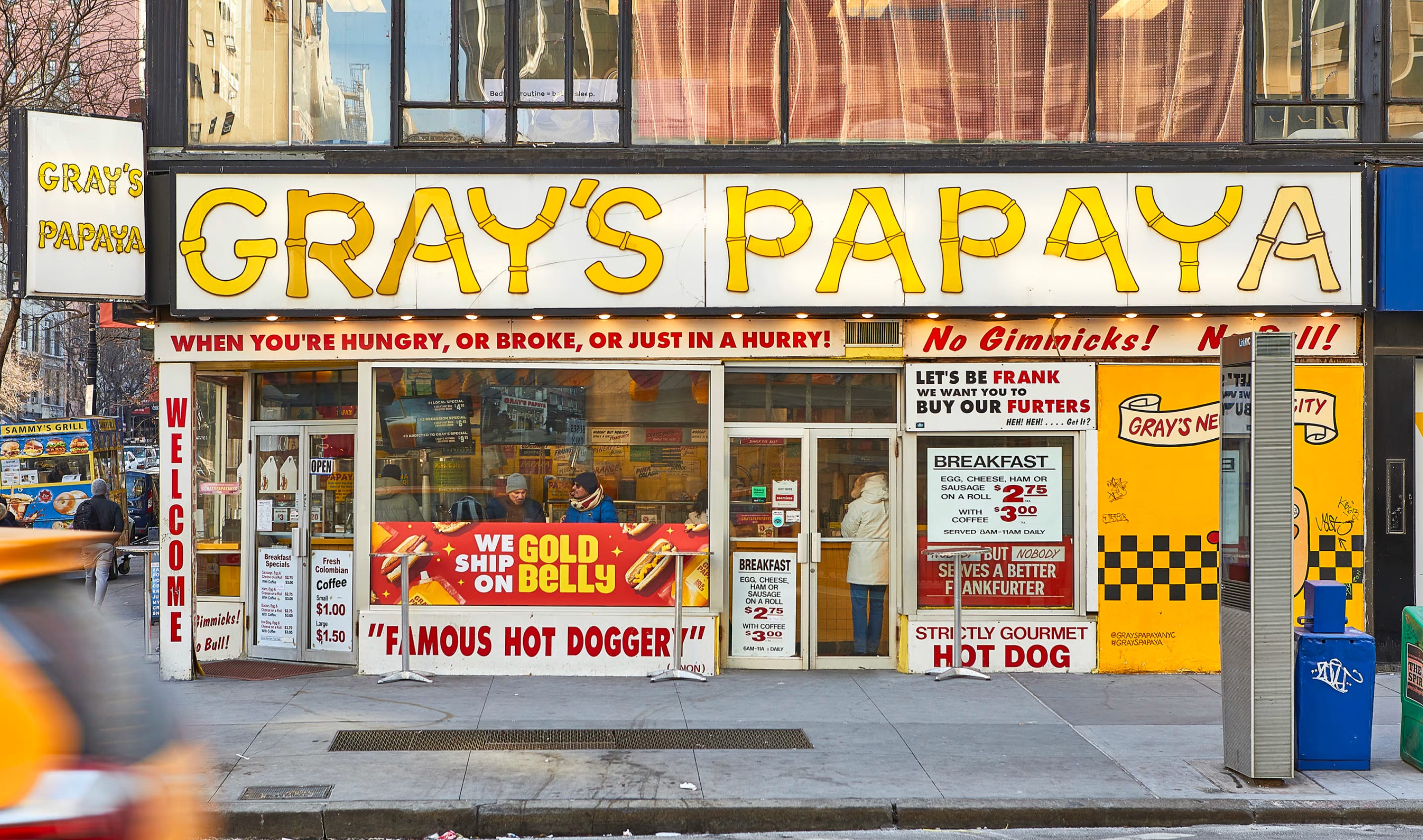
Gray’s Papaya sits at the corner of 72nd and Broadway, a few blocks from where I grew up, and has been there since 1973. They hand the franks across the counter and you take one step back and bite. The casing snaps. The grill char hits first, then the sauerkraut brine, then the mustard underneath doing its job. The bun is warm and soft and smart enough to stay out of the way. Every hot dog I have ever eaten has been measured against that one.
My grandfather Eugene ate his first meal home from World War II at the original Nathan’s. He was a Jewish kid from Brooklyn who had flown in the first air raids over Berlin. His plane was shot down over Amsterdam, and he spent the rest of the war as a prisoner of the country he had been bombing. When it ended, he came home and ate a hot dog. A German sausage on a Coney Island boardwalk, handed to a Jewish soldier who had just bombed the country the sausage came from. It was his favorite food. Think about that.
* * *
Charles Feltman got there first. He was a German immigrant selling sausages on rolls from a pushcart at Coney Island in 1867, and he understood something early: Americans would eat almost anything if you let them keep moving. He turned the hot dog into an empire. Beer garden, hotel, carousel, restaurants, a whole city block at the edge of the ocean, all built around a sausage on a bun.
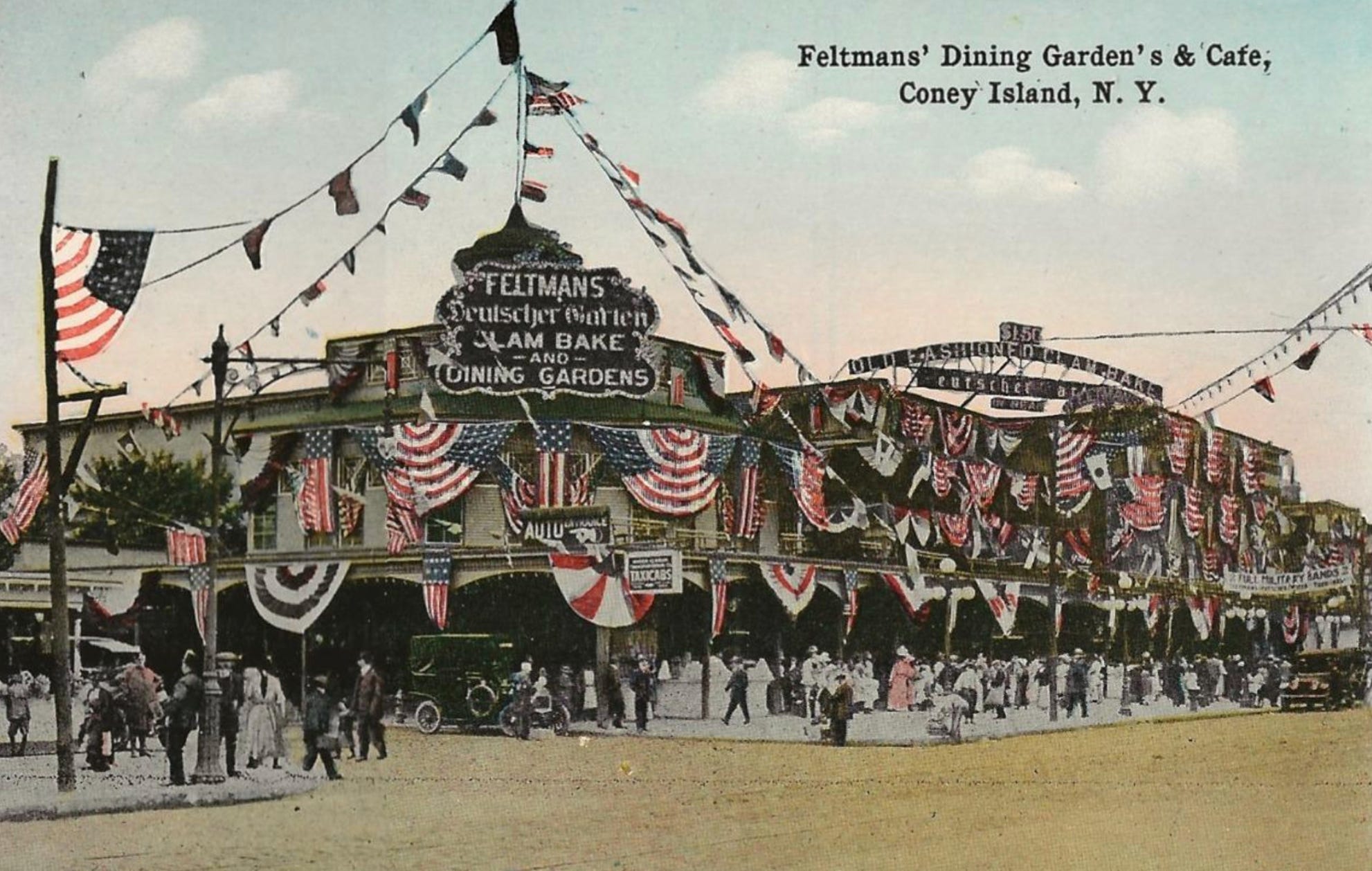
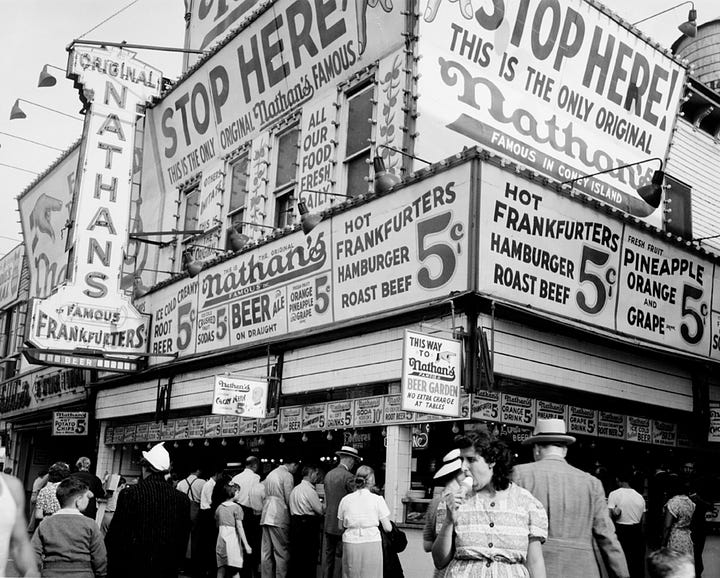
Nathan Handwerker was in his early twenties, Polish Jewish, one of thirteen children, sleeping on the kitchen floor and slicing rolls at Feltman’s for five dollars a week. He had grown up hungry, and hunger made price personal. Every day he watched people pay a dime for a hot dog. Every day he reached the same conclusion: it should cost a nickel.
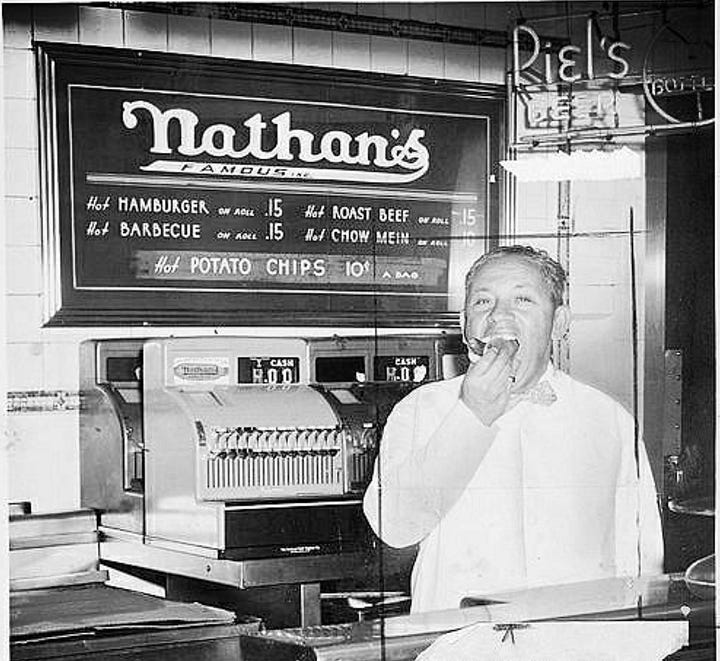
In 1916, after years of saving every spare dollar and eating the free hot dogs at work when he had to, Nathan opened his own stand a few blocks away with his wife Ida’s recipe and three hundred dollars. Feltman had the buildings but Nathan had the line.
The accusations came fast: inferior meat, unsafe conditions, suspiciously cheap food. So Nathan paid doctors to stand at his counter in white coats and eat hot dogs.
The customers came for the doctors. Then they came for the hot dogs. Nathan won. We’ve been paying some version of that nickel ever since, which is the real reason the hot dog showed up everywhere our public life happens: ballparks, boardwalks, street corners, backyards on the Fourth. Cheap enough for a kid, a soldier, a factory worker, a father with three children and no plan for dinner. Cheap enough to belong to everybody.
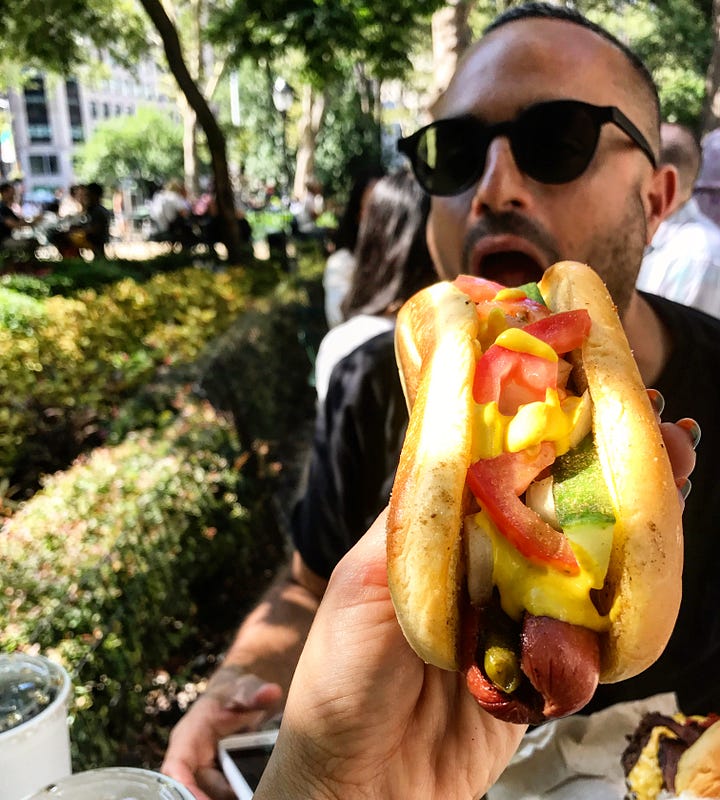
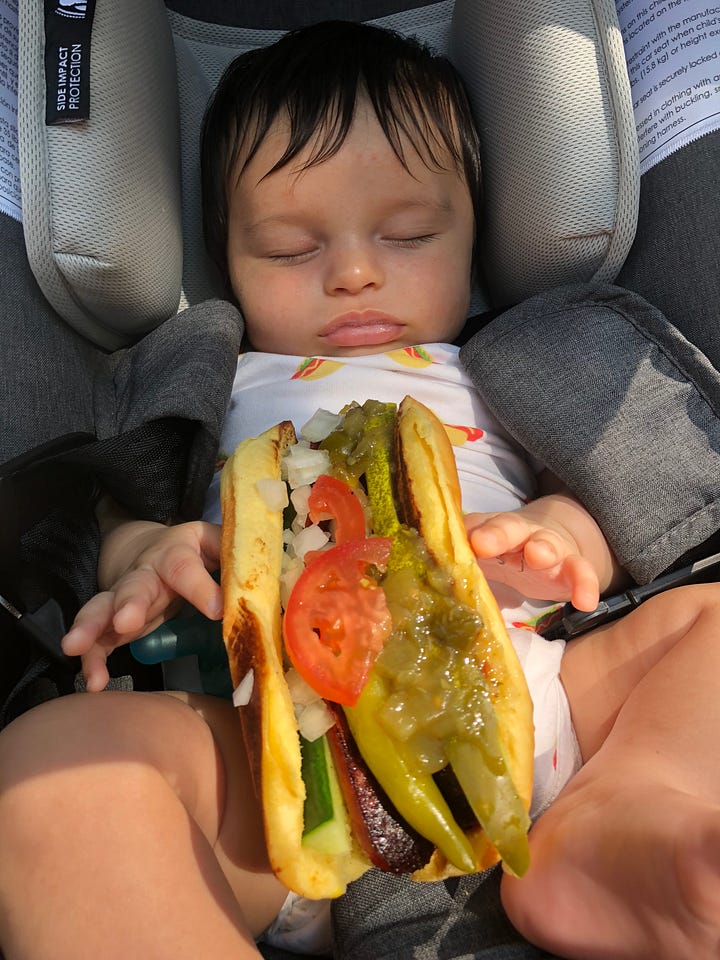
A Chicago dog is what happens when a city looks at a hot dog and decides it needs vegetables. Not one vegetable. All of them.
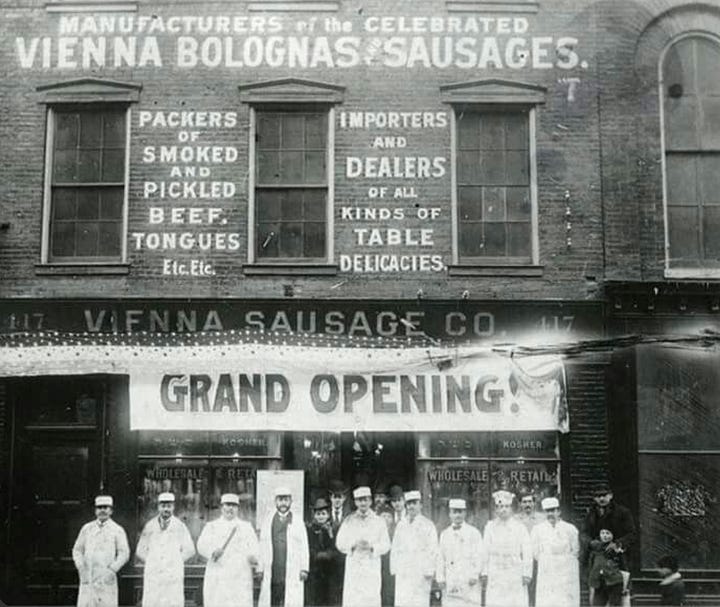
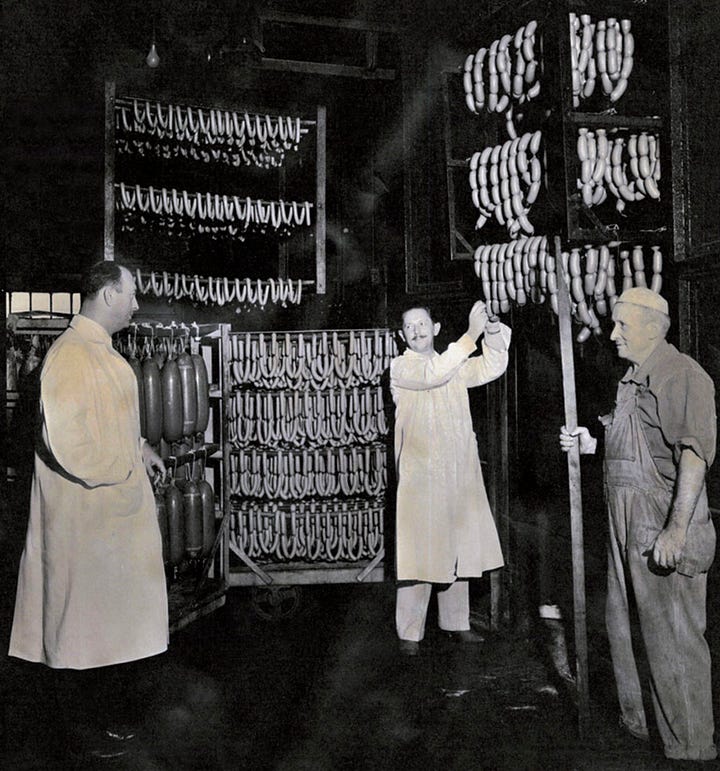
The all-beef frank under every Chicago dog exists because Vienna Beef was founded in 1893 by two Austro-Hungarian Jewish immigrants, Emil Reichel and Sam Ladany, who kept kosher. Chicago began with a kosher sausage and then dragged it through the produce aisle: mustard, onion, neon relish, tomato, pickle, sport peppers, celery salt, a poppy seed bun. By the time they were done, the hot dog looked less like lunch than a civic project.
Then, after all that, Chicago took one look at ketchup and said: absolutely not. The city will put a salad on a sausage and still somehow decide the red stuff is where civilization ends.
Most people eating one have no idea it began as a kosher product. The same irony shows up at Hebrew National, founded on the Lower East Side in 1905 by Theodore Krainin and sold today mostly to people who are not Jewish, on the strength of a slogan that turned kosher law into an American quality promise: we answer to a higher authority.
The food that does not check who you are was built by people who got checked everywhere they went.
* * *
The fan already had a scorecard in one hand and a beer in the other. He wanted dinner, but he did not want to stop watching. He also believed, as every fan believes, that his attention was somehow affecting the outcome of the game. Harry Stevens, a British-born concessionaire working the Polo Grounds around 1901, understood the problem. He needed food that could move through a row, pass across strangers, survive fourteen knees and a spilled beer, and still arrive as dinner.
The hot dog solved the logistics.
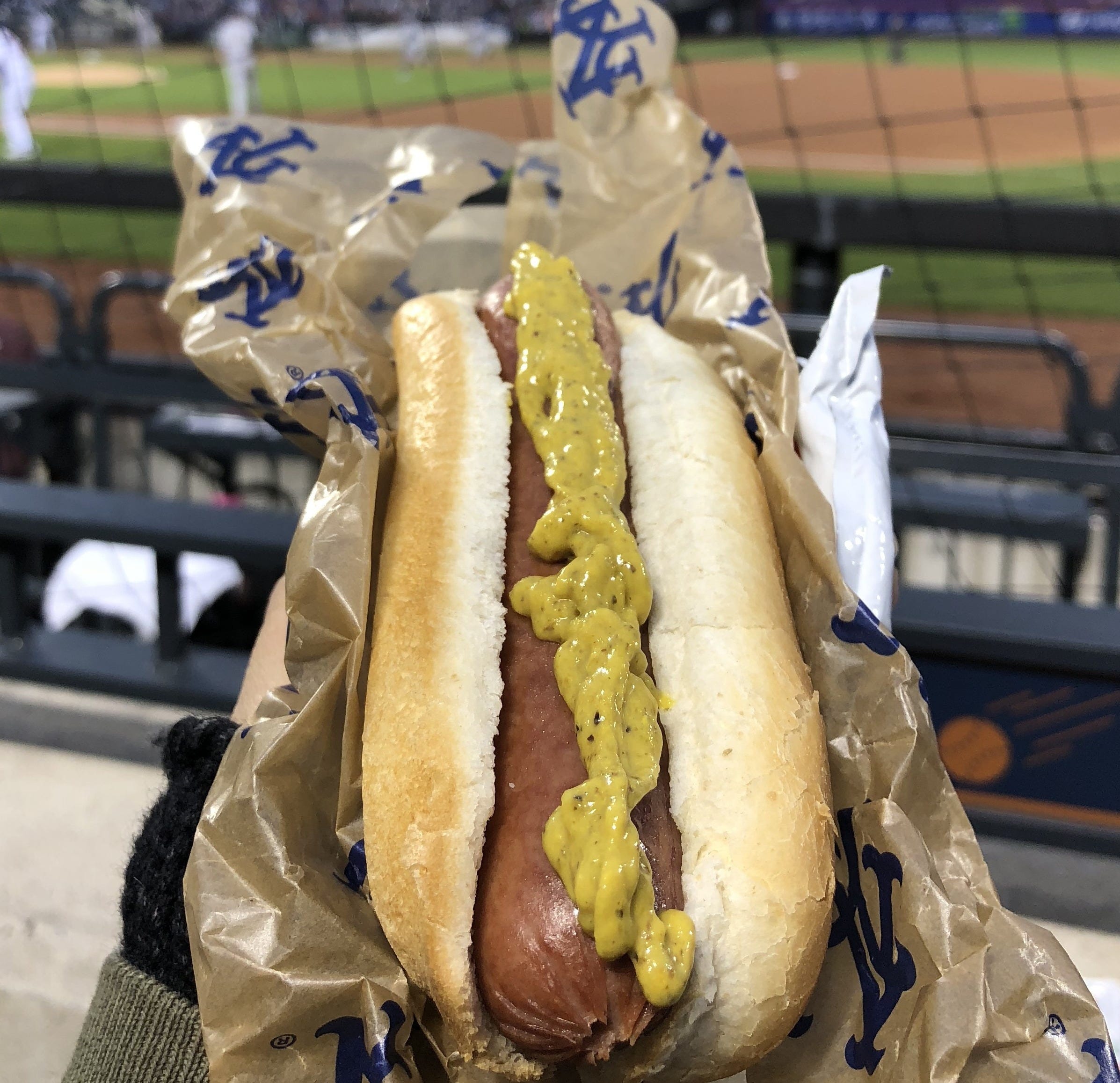
The hamburger asks you to stop watching. The hot dog does not. You can eat one while keeping score, yelling at an umpire, walking a boardwalk, holding a child’s hand, or standing on a corner pretending you are not late. The vendors still pass them hand to hand down the rows, and they still arrive warm, which is more than anyone has a right to expect from food that has traveled across half a section of strangers.
In the summer of 1939, Franklin Roosevelt invited the King and Queen of England to Hyde Park and put hot dogs on the menu. His mother Sara was horrified, reasonably, because you do not usually invite royalty to your home and hand them tube meat. Roosevelt did it anyway, because nobody accidentally serves a hot dog to a king. The Queen asked how one was supposed to eat such a thing.
Roosevelt told her to push it into her mouth and keep pushing until it was gone.
She used a knife and fork. The King picked his up with his hands.
Sixty-two years later, the hot dog found its strangest American stage. Every Fourth of July, Nathan’s runs an eating contest on the same Coney Island boardwalk where Nathan Handwerker opened his nickel stand, and in 2001 a 130-pound competitor from Nagano named Takeru Kobayashi arrived and ate fifty hot dogs in twelve minutes, doubling the standing record overnight. Everyone had to reconsider what the human body had apparently been capable of this whole time. Joey Chestnut has spent the next two decades making that seem normal. Somehow, it has become normal.
The restaurant was founded by a Polish Jewish immigrant and still closes for Yom Kippur. The contest is broadcast on the Fourth of July on ESPN. We built a country where this makes perfect sense.
What else were we going to do?
The recipe didn’t survive America. The hot dog did. Detroit ladles Greek-spiced chili over the same German sausage, and two restaurants on the same block, American Coney Island and Lafayette Coney Island, have been arguing about whose is better for a century. Sonora sent it across the border to Tucson and came back wrapped in bacon with pinto beans, jalapeño salsa, mustard, and mayo, built in twenty seconds, hundreds of times a night. Nobody ever needed to ask whether the hot dog required beans. The question was why everyone else had been so timid.
Cheap enough to belong to everybody, plain enough to become local. German meat, Jewish hustle, Greek chili, Mexican bacon and beans, the Chicago produce department, New York mustard, a pot boiling in a suburban kitchen, none of it cancels the rest. The hot dog never asks America to agree. It just lets every place be wrong in its own way.
I have watched this play out for fifteen years. People do not send hot dogs across the country because they cannot find a hot dog where they live. They send them because the one from home is the only one that tastes right. Detroiters want their Coney. Chicago wants Vienna Beef in the right order because the order is part of the memory. New Yorkers want Gray’s Papaya because they know the corner, the counter, the snap, the mustard, the argument. Nobody is sending a sausage in a bun. They are sending proof of where they’re from.
* * *
For years, there was a family mystery about how Eugene had put on thirty pounds in the 1960’s. Eventually somebody figured it out: after work, he had been stopping for a hot dog almost every day.
When I was a kid, my grandparents drove three hours from Long Island to East Rutherford for Giants games like it was nothing. By then, Eugene had had a stroke and couldn’t walk without help, and my grandmother Shirley barely cleared a hundred pounds, so getting him up the ramps fell to the two of us, one on each side, all the way to the twenty-first row.
We bought hot dogs from the vendor with the metal tray and the strap around his neck, passed hand to hand across strangers, arriving warm.
Shirley was never much of an eater, but she ate a hot dog the way other people eat filet mignon, and she meant it. That was not nostalgia. That was her actual position. I used to think that was funny. Now I think she might have been right.
The grills are hot at the original Nathan’s right now, waiting for the next line to form. At Gray’s Papaya, the orange neon is still on, and nobody is there for the papaya. In Chicago, someone is putting a salad on a hot dog, still refusing ketchup on principle. In Tucson, someone is wrapping one in bacon and adding beans like the rest of us had been underthinking it. Somewhere in the suburbs, a father is boiling eight Oscar Mayer wieners because Mom is not home and Dad is showing the kids he can cook too.
Nobody followed the recipe.
Nobody could have.
Joe Ariel
No posts
Comments
Nothing yet. Say the first thing.
Sign in to join the conversation.