
In the aftermath of Donald Trump's victory over Kamala Harris in the 2024 presidential election, we were flooded with hot takes about why Kamala Harris lost. Everyone had their pet theory: Bill Maher blamed "woke-ism," feminists pointed to deep-seated misogyny, others said pro-Palestinian student protesters, transgendered student athletes, Joe Rogan, the price of eggs, you name it. It was as if Trump's victory had become a Rorschach test for political commentators, each seeing their own preconceptions reflected in the electoral ink blot.
Several people asked our thoughts. But as any campaign veteran will tell you, election autopsies require time, data, and slow, deliberate analysis. So now, having spent four months thinking about the election and seeing its immediate ramifications, we have a story to share.
The most compelling narrative of 2024 to us isn't Trump's victory, nor how he gained amongst many long-time Democratic constituencies. There are myriad reasons for that — 2024 being a change election globally, inflation, surging immigration, his cult of personality.
No, the most interesting story is why Kamala Harris lost approximately 6 million voters compared to Joe Biden in 2020. While this still represents the third-highest vote total in presidential history, the decline reveals a troubling pattern of Democratic brand erosion.
Consider these stark metrics:
Harris received approximately 6 million fewer votes than Joe Biden in 2020, while Trump's vote count only increased by 3 million, suggesting many Democrats simply stayed home.
For the first time in 50 years, Republicans lead in presidential election party share, claiming 35% of the electorate compared to Democrats' 31%.1
In California, Harris's home state, Trump gained a modest 75,179 votes while Harris lost a staggering 1.83 million compared to Biden.
New Jersey saw Trump added 84,902 votes while Harris shed 387,687 from Biden's total.
In Cook County (home to Chicago) where Democratic turnout was historically guaranteed, Trump won 25,583 additional votes while Harris lost 278,152 votes.
Senator Amy Klobuchar comfortably won Minnesota by 16 points, while Harris scraped by with a 4-point margin.
In Arizona, Democratic Senate candidate Ruben Gallego outperformed Harris by 8 points and won Latino voters by 22 points (compared to Harris's 10-point margin).
These numbers would suggest that the problem was enthusiasm with the Harris/Walz ticket. Yet Harris consistently outperformed in swing states where people heard from the campaign.2 It was in the places where advertisements and voter mobilization were scarce that support collapsed from Biden’s high-water mark.
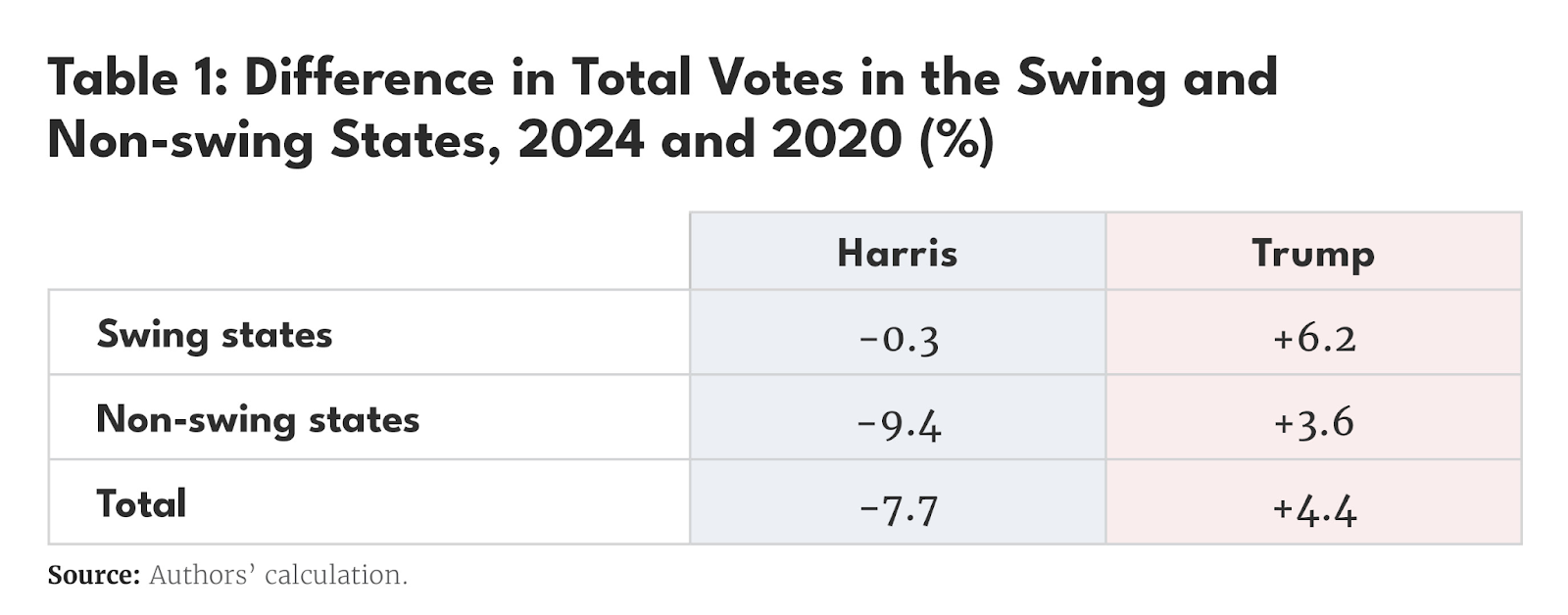
It wasn’t just that Democrats were losing to Trump; they were losing their own base.
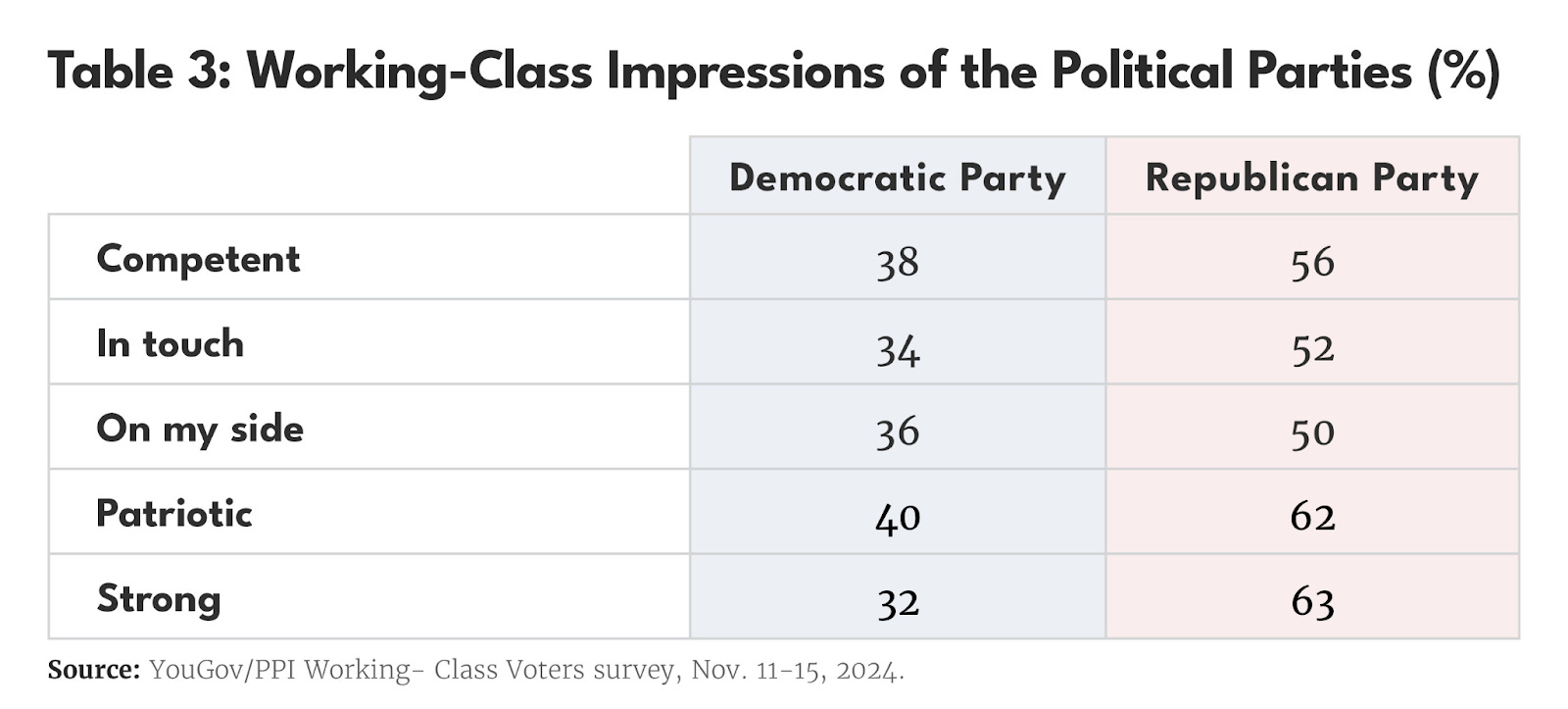
The Democratic Party has developed an image problem that would make any brand manager grimace: it’s increasingly seen as an out-of-touch elitist clique rather than a people's movement. Even worse, it is viewed as more performative than effective.
The issues that Americans believe Democrats are focusing on (in part due to a more effective right-wing media system) don’t feel relevant to their lives. Recent YouGov research reveals that only 34% of working-class voters believe the Democratic Party is in touch with their needs.
When Americans were wrestling with skyrocketing grocery prices, the Biden administration's communications felt deeply disconnected. A Harvard CAPS / Harris poll in September found that only 54% of Democratic voters thought the economy is on the right track. Even fewer 40% said that their personal financial situation was improving.3 As Eugene Ludwig's research showed, the economic indicators Democrats relied on were fundamentally disconnected from kitchen-table realities.4 Attempts to sell the macroeconomic successes of "Bidenomics" rang hollow and led many voters to believe that the administration was out-of-touch.
This perception was compounded by efforts to emphasize Trump’s threat to democracy. While the threat has significant real world implications, Democrats explained it in theoretical ways that felt academic and irrelevant to everyday lives. For many struggling to simply get by, the focus on unfathomable tasks of protecting democracy pointed to politicians who just didn’t get it.
2024 campaign tactics emphasized this disconnect. The Harris campaign prioritized polished interviews and choreographed events (e.g. 60 Minutes interview, rally with Beyoncé) that aimed to appeal to the widest possible audiences, while Trump spoke to a specific set of voters through a more ‘approachable’ free-flowing format with voices like Joe Rogan, Theo Voss, and Dave Portnoy. Applying a homogenous view of culture and constituents was efficient and successful for Democrats 15 years ago, but in the age of sub-internet feels out of touch.
There’s an adage that US presidential elections are won by the person that voters want to have a beer with. Trump (despite being an abstainer) provided an unfiltered, unpolished, personal look into who Trump is — demonstrating his backyard bbq credentials much better than Kamala was. And while the campaign and the White House did extensive outreach to influencers, creators and podcasters (Kamala did far more than people gave her credit for), it just didn’t shift perceptions.
Consider this revealing quote from a young male voter: "He talks to people directly as if we're at a coffee table. He doesn't talk down to us. He doesn't look down to us like most Democrats do."5 When your political brand makes Trump sound like the approachable one, you've got a serious problem.
The Democratic Party finds itself in a peculiar position: positioning itself as democracy's last line of defense while being viewed as guardians of a broken status quo.
For the past decade, Democrats (especially presidential nominees Clinton, Biden and Harris) presented themselves as bulwarks against Trump’s threat to democracy. Members of Congress would stage fist-waving press conferences deriding Trump’s rampant abuse of power even though (a) It was often more a violation of norms and (b) Democrats did similar things when they were in power.
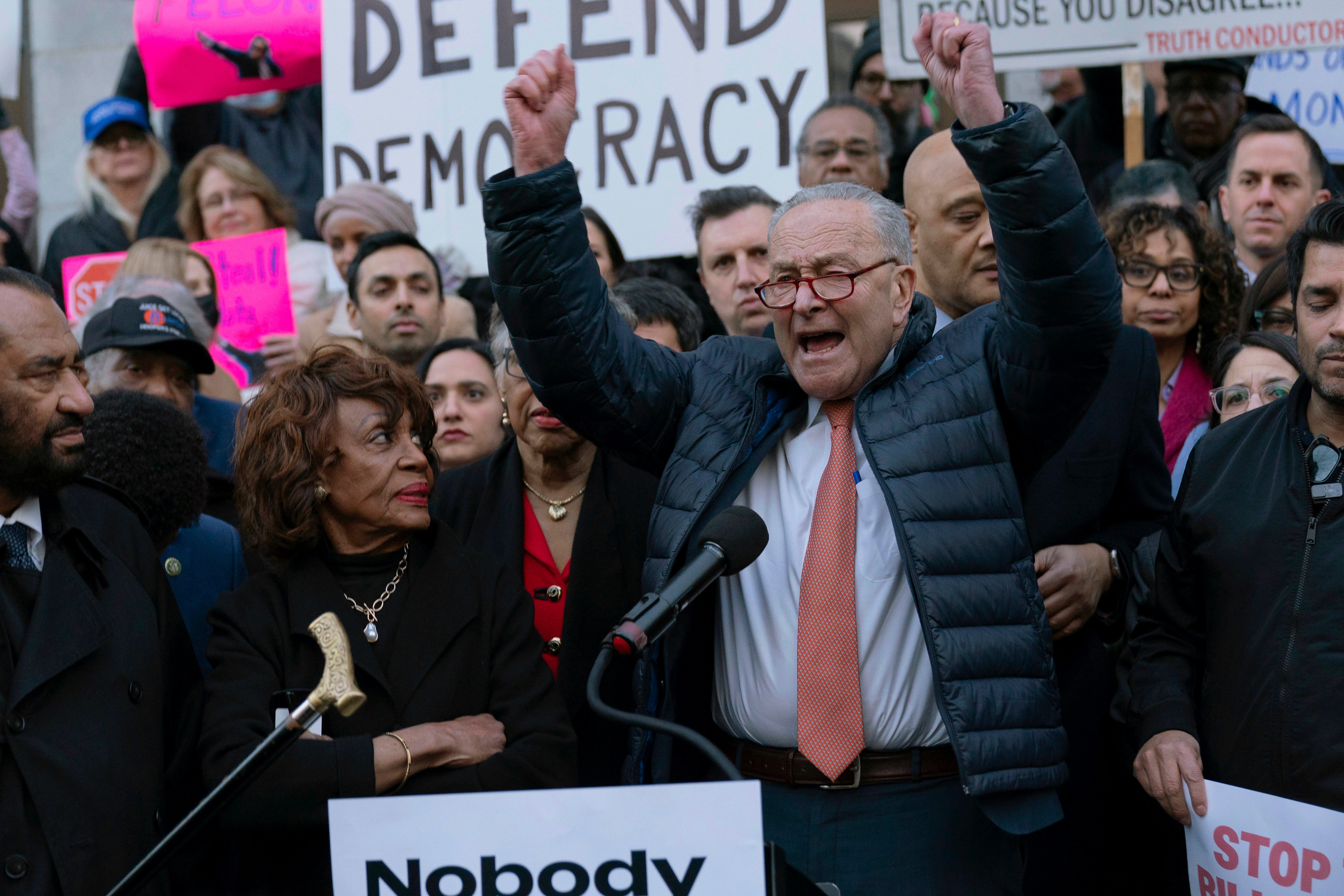
The party's positioning as democracy's defenders has become increasingly hollow to voters. Consider these paradoxical findings:6
34% of voters cited democracy as their top issue, yet 18% of these voters chose Trump
39% of voters saw democracy as threatened, with 52% of them backing Trump
In Pennsylvania, 73% of voters believed democracy was threatened, yet 53% of them voted for Trump
It’s now looking like voters saw Democrats’ fervent defense of democracy as it exists today and decided they want an alternative. As journalist Quico Toro observed, "Voting to weaken the guardrails of democracy looks not like an act of mindless vandalism, but like a rational rejection of a status quo rigged against both their material interests and their cultural values."7 Voters chose the disruptor, even while acknowledging the disruptor's risks.
This stems in part from a declining lack of trust in the Democratic Party, with recent Quinnipiac polling showing only 31% of voters holding a favorable view - the worst showing since 2008.8 But the numbers get even more interesting when you dig deeper:9
23% of Democrats think big corporations have too much sway over the Democratic Party
24% of Independents feel Wall Street and big banks have outsized influence
23% of Democrats, 29% of Republicans, AND 32% of Independents believe wealthy campaign donors have too much influence
The Obama-era decision to avoid prosecuting financiers after the 2008 crash (unlike after the Great Depression) accelerated distrust in Democrats and the status quo. The party tried to position itself as both the people's champion and the system's defender - yet Americans were left with the impression that it was the bankers and not their customers who had been bailed out.
It’s not limited to corporate-beholden policies, the handling of President Biden's age-related cognitive decline (however slight or severe) became a perfect metaphor for this institutional distrust. When concerned Democrats raised valid questions about an octogenarian president's stamina, the party leadership's response was essentially "Trust us, everything's fine" — a response that felt about as reassuring as Elon Musk claiming that he’s not going to steal your personal information.
Furthermore, rather than cultivating relationships with the Uncommitted movement or engaging base Democrats who expressed opposition to the administration’s policies in Gaza — a move that polling suggested would have unlocked votes — the campaign instead pivoted toward an unexpected alliance with Liz Cheney. The Harris campaign's embrace of Liz Cheney, a hawkish Neo-conservative who disagrees with virtually every Democratic value, was representative of the fact that it wasn’t “Country over Party,” as the rally banner suggested, but “Status Quo over Values.”
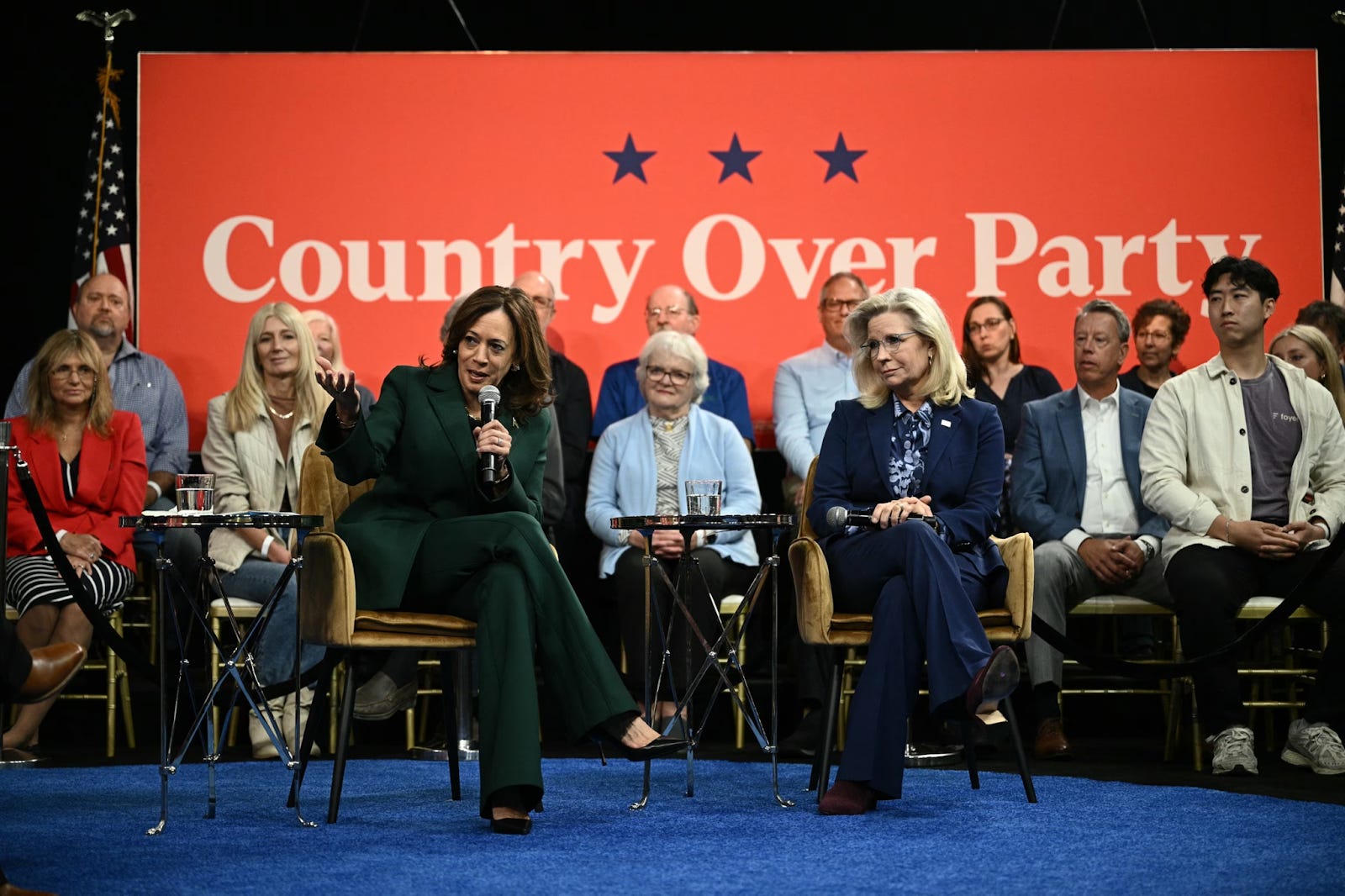
And when given the chance on national television to break from the status quo and present herself as a candidate of progress and change, Harris responded “There is not a thing that comes to mind.”
The stream of post-election DNC donation emails would agree.
The Democratic Party has transformed from a big-tent movement where everyone is invited into something resembling an eating club with an impossible entrance exam.
The evolution has been stark. In the 20th century, the Democratic party welcomed single-issue voters whether they only cared about the environment, social safety nets, or women's rights. Today, those same people don’t know if there’s a home for them in the Democratic party. To them, one must support all progressive issues — but what those positions are is unclear. Failure to understand risks being labeled as uneducated or intolerant.
But this exam is not just coming from the “activist” left. It’s being driven by all sides. The misguided evolution of Cancel Culture. Josh Marshall noted, “Back in the first Trump presidency, Trump’s critics spent an inordinate amount of time trying to get Trumpers to admit they’d done this or that, to apologize, whatever. This was always a mistake.”10 In the zealous pursuit of progressivism, we’ve made it impossible for anyone to feel progressive enough.
As one Illinois voter put it: "You have to put your pronouns [in your email signature]... They're trying to force their thoughts upon you, and you can't disagree with any of it."11 This rigidity discourages progressive-leaning people from better understanding the issues for fear of asking the wrong question.
Trump, meanwhile, capitalized on this. While many mocked Trump’s so-called “weave,” it proved to be remarkably effective at inviting people in. You could be “for some of Trump,” without requiring total buy-in. Trump’s existence outside of the twenty-first century binary of Republican/Democratic policies helped people embrace what they like and ignore what they don’t. That is a flexibility that many believe the Democratic brand doesn’t currently permit.
If you’ve come this far, let’s talk about where we go from here. Many have suggested that Democrats need to shed their progressive agenda and pivot to working class platitudes such as “common sense middle-class policies,” and essentially become Diet Republicans. I respectfully disagree.
What if the solution isn't abandoning progressive values, but reimagining how they're packaged, delivered, and experienced? Look at the perception-reality gap. While 58% of Americans view the Democratic Party as too liberal (YouGov/PPI), the Brookings Institution revealed that of 868 Democratic candidates for Congress in 2024, a mere six were affiliated with Democratic Socialists, only 13 mentioned defunding the police favorably, and just four favored open borders.12 Compared to left-leaning parties in Australia, Canada, and the UK, the Democratic Party is actually the most conservative of the bunch.
But if the first 50 days of this Trump administration has shown us anything, this problem won’t be solved by Hakeem Jeffries, DNC leaders nor consultants on K Street alone. And we can’t wait for them to take the lead. History shows that in countries witnessing authoritarian growth or two-party system collapse, revival rarely comes from established political leadership. Our rebrand must be driven by all of us who believe in progressive values — it's a shared responsibility rather than something we can outsource.
So instead of recycling old political strategies, what if we adopted a fresh approach inspired by the brand world?
Recent Blueprint research reveals that most Americans (65%) believe the Democratic Party lacks a proactive vision.13 Trump's chaos-as-strategy approach has transformed Democrats into the "#resistance" party, becoming defined solely by what we oppose.
The problem? Can you name a single successful brand built entirely on being the alternative to something else (and no, 7UP doesn’t count)?
We need to establish clear philosophies, principles, and beliefs that articulate our vision for the future of America. And that vision can't resemble the abstract, esoteric approach of a Starbucks brand mission that claims “With every cup, with every conversation, with every community – we nurture the limitless possibilities of human connection.”
Say what you will about MAGA, but "Make America Great Again" is a vision that voters can grasp without requiring a policy explainer. As Democrats, we need a north star that speaks directly to Americans' immediate needs – taking care of their families, protecting personal rights, and improving everyday lives.
And since party leadership seems stuck in an endless cycle of reactive politics, it's time for all of us, as Democrats, to advocate for our own vision of what the Democratic Party should represent.
As Democratic supporters, we need to relearn the art of inclusion. Brands with passionate followings like Duolingo, On Cloud, and Aldi succeed because their customers become enthusiastic advocates who invite others into the experience.
As a recent New York Times video pointed out, saying "I told you so," no matter how satisfying it feels in the moment, won't bring anyone new to our cause. When someone expresses buyer's remorse about voting for Trump, our instinct should be to welcome them, not quiz them about their past choices.
Appeal to these potential-Democrats’ values. When discussing issues like foreign aid with skeptical listeners, skip the wonky "it's only 1% of the budget" argument and focus on the ROI: every dollar spent saves $10 in military costs. It's about meeting people where they are, not where we wish they were.
Each of us needs to become an ambassador for Democratic values by sharing why we personally believe in them (and not just because “Republicans are racist”). We should articulate what these values have done for our communities, our families, and our futures. This positive advocacy creates space for others to join us, without feeling judged for their past political choices.
In “How Brands Grow,” Byron Sharp talks about "Mental Availability"— the probability that a buyer will notice, recognize, or think of a brand when it matters. The Democratic Party's current problem, to borrow Mad Men's Don Draper's brutal dismissal: most Americans "don't think about you at all."
Through institutional paralysis and commitment to decorum, many elected Democrats believe the best way forward is to avoid rocking the boat. When Rep. Al Green staged a protest, fellow Democrats called it a "distraction." From what exactly? C-SPAN coverage of procedural votes?
In a media ecosystem where Trump and Musk’s every extreme word and action receive wall-to-wall coverage, Democrats' commitment to institutionalist decorum makes the party thoroughly ignorable.
The most effective brands and political movements know the power of making. But much like the difference between a purposeful activation and a simple brand stunt, we need our actions to deliver a meaningful message.
The historic sit-ins of the 1960s weren't just protests – they highlighted racial segregation with moral clarity and purpose. The 1930 Dandi Satyagraha wasn't just a march – it directly challenged an unjust salt tax through powerful symbolism that anyone could understand. Both created unforgettable images while advancing specific policy goals.
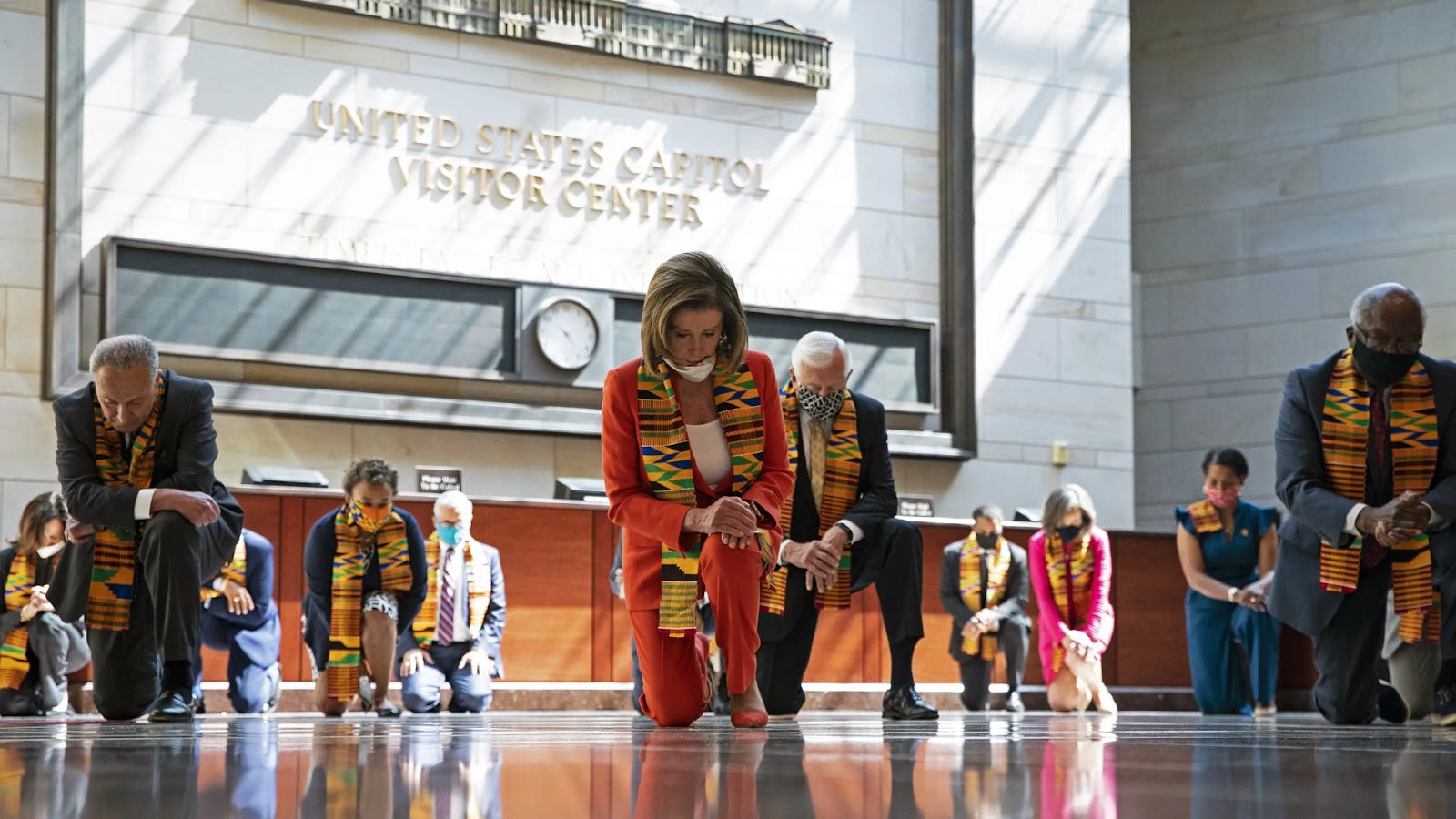
By contrast, wearing matching outfits to a speech might keep decorum but it fails to capture attention or communicate purpose. It lacks the brilliance of something like Patagonia's "Don't Buy This Jacket" campaign that paradoxically boosted sales while highlighting environmental values, or Burger King's "Moldy Whopper" that showcased their commitment to removing preservatives through deliberately shocking imagery.
In the immortal words of the late Rep. John Lewis: "Speak up, speak out, get in the way. Get in good trouble, necessary trouble, and help redeem the soul of America." Our Democratic brand needs the courage to disrupt the political conversation — not through empty stunts but through meaningful actions that capture attention while advancing our values.
A recent conversation with a Zimbabwean illuminated a fascinating paradox in democratic participation. While he pointed out my privilege of choosing between multiple political parties, he described how his compatriots often abstain from voting in what amounts to political theater — elections where competition exists only in name. Yet I wondered, perhaps even more dangerous than citizens skipping one-party elections is voters in multi-party democracies staying home because they've lost faith in the system's ability to effect change.
When citizens in functioning democracies begin to echo the resignation of those living under authoritarian systems, we truly witness democracy’s erosion. As one Pennsylvania non-voter put it, "I'm not even really concerned about [the direction of the country]. What's going to happen is going to happen."14
The 2024 election wasn't just a loss — it was an existential brand crisis. In the words of one focus group participant, "I keep using the phrase, 'Well, you can't blame me. I didn't vote.'"15 When your core customers start taking pride in not using your product, it's time to rethink your brand.
The path forward requires more than just new messaging. It demands a fundamental reimagining of how the Democratic Party connects with, speaks to, and delivers for the American people. The alternative, the status quo, is a recipe for irrelevance in an era that desperately needs progressive ideas.
Harvard CAPS / Harris poll, conducted online within the United States on September 4-5, 2024
Navigator Research. “Party Brands. A Guide for Advocates.” 10.01.25
Navigator Research. “New Trump Voters and Non-voters on the 2024 Election” 18.12.24
Navigator Research. “New Trump Voters and Non-voters on the 2024 Election” 18.12.24
No posts
Comments
Nothing yet. Say the first thing.
Sign in to join the conversation.