
Text within this block will maintain its original spacing when published
nettles sing out
their hot cloth of
seeds-rags
meadowsweet
breaks hedgerows
into lunate foam
rye stretches spirals
of devoted sun
greening the fox-dance
in all this
what if we stilled
to collective moonlight
and let the white
summer
grow us into fur?
With Time
I wrote the above poem on a hot evening walk, before the sun clouded over and the rain came back. In this wet, cold summer, I notice myself – and many friends – struggling. Despite threads of elective hope, world politics is like a gathering, radioactive storm. The burred griefs of winter still cling too tight. We want to shake back into community, and yet the gateways of connection are through an endless staccato of screen code that deviates our attention from the ecstatic relationality of body, earth and breath.
I come on here, to try and pick up the threads of voice and thought, but allow myself to be bound in distraction and patterned with eager bindings of procrastination. Social media bombards us with other people’s successes – including our own – because there it is not the space for quiet hopelessness, lost opportunities, or silent steeping.
We are porous, I think, to an untethered, voracious system that doesn’t trust in change. Doesn’t let it body. Doesn’t hunker over it while it beds into the wet earth.
I’ve been thinking about porosity a lot. To be porous is to be open, vulnerable, absorbent; we cannot help absorbing the broken systems in which we are embedded. But what if porosity was also alchemy and the fulcrum of old power?
With Stories
Outside our village is Ditchling Common, one of the tiny fragments of land in England whose space has not been obliterated into ownership. As Nick Hayes writes so eloquently in The Book of Trespass, in the fifteenth and sixteenth centuries our land was parcelled out through Enclosures, fencing it away from those who lived with and through it, like a slow and deliberate dismemberment. Those few fragments which remained common were seen as out of control, “outside the scope of the heedful eye” (170). It was then that rumours started to spread of “Wild Sabbats on the plains and in the forests, great satanic orgies where men and women would come together to spurn the word of God” (171).
They still tell stories about witches on the commons. In Ditchling, it is said, a witch once lived who had the power to stop wagons and carriages in their tracks. This happened until one man, his wagon stuck in the mud, took out a knife, and cut notches in the wooden wheels. Screaming came from inside the cottage, and the witch came tumbling out, clutching her hand, her fingers bleeding (Discussed in Jacqueline Simpson, 97-8).
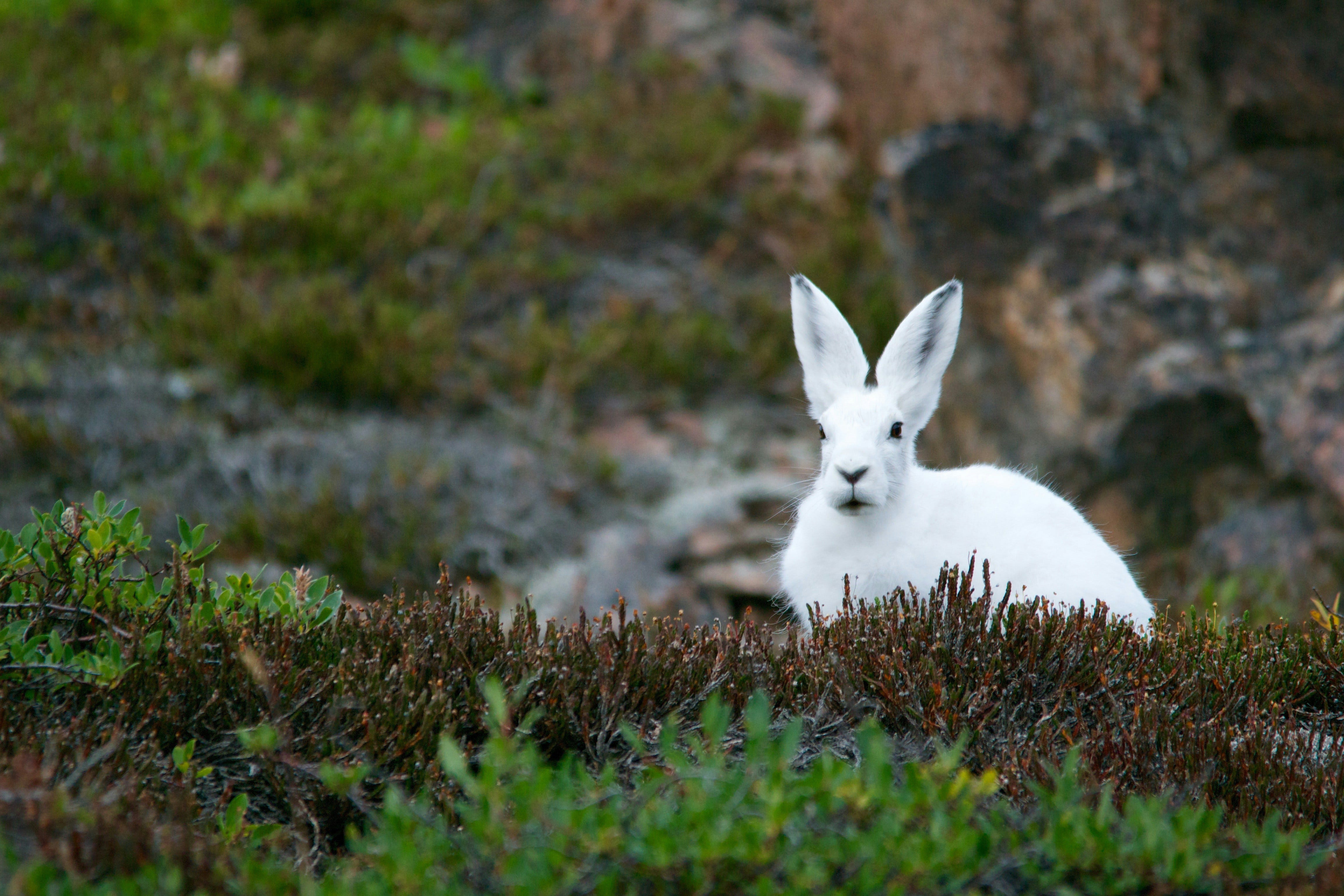
That is one of the witch stories that resides around Sussex. Another one has an old woman able to turn into a great, leaping hare. The village dogs chase her, but never catch her. Rumours spread of witchcraft. One day, a man gathers a great crowd of villages to go hunting, but none of the bullets touch her. That night, the man, remembering his stories, takes a silver sixpence and moulds it into a bullet. The next day he goes out by himself as the sun is streaking blood across the sky, and shoots. Bullet reaches thigh, and the hare limps home, trailing blood from her wound. The old woman is lame for the rest of her life.
These stories are far from the patterning of wild dances on the bracken-brushed commons. In the words of folkorist William de Blecourt, they are patterned by hunting, maiming, shooting; he terms them “very much male stories” (3), stories that would have been more likely to be passed down by groups of men than gatherings of women. Without wanting to set up a gender-binary of voices, to tell these stories and to feel into them is to feel into violence against the female or shifting body, as well as to recall the land-scaped enchantments of moon-ribbed change.
At Summer Solstice this year, a gathering called the Court took place in Brighton, the first incarnation of a live folklore zine hosted by singer and composer QueenMab. I told stories about witch hares, and Queen Mab and folk band Abracabadger enchanted us with music. In a gleaming, glorious Sheela Na Gig costume, writer and storyteller Serena @RunesnRoses took us through some of the history of Sheela Na Gig’s in England, those wonderful female figures on churches who enchant and transfix us with the power of their vulvas. (More about Sheela Na Gigs in this beautiful article by Serena.) There were once two Sheela Na Gig sites in Sussex. Now there is one, in Bishopstone. The second, a full body stone-figure figure at All Saints Church in Buncton, near Wiston, was hacked away by a vandal in 2004, with only a ghostly impression left now in the stone.
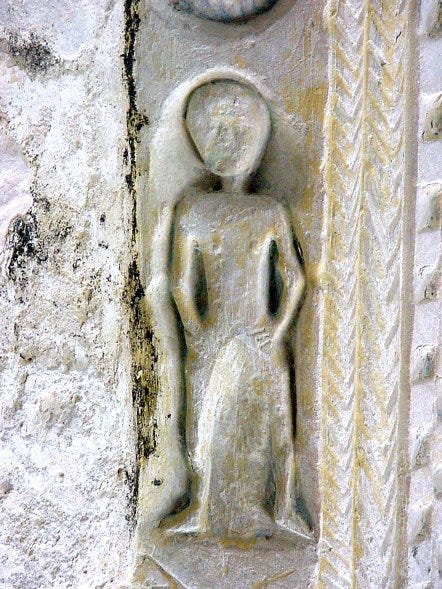
Picture of original figure by Shae Clancy, from the Sheela Na Gig Project.
Nobody knows who did it, but investigations suggest it was prompted by disapproval from within the church itself. As if these stone women who open themselves to the wild air are too outrageous to continue to exist. Wiston’s Sheela Na Gig is there, but not there, her stone pattern etched into the air around intertwined memories of both her existence and its erasure.
The ghostly impression of the Sheela Na Gig is how I feel about these witch hare stories. Their shape now both recalls and erases the stories. By telling them as maiming tales, that shamanic porosity with world is re-patterned into a binary of violence. To be that open that you can flow into air, breath, fur is reframed into wound: inflicted or received. But it is not a wound. It is the rhythm of endless change, that, as Octavia Butler has written, is the only God we have (Parable of the Sower).
Shapeshifting tales, says philosopher and ecologist David Abram, both open us out and invite us in. They remember that the Earth is “the very body of wonder” (80), that “each mountain, each cloud, each wolf or oak or hives of bees” is “a distant variant of our own texture and pulse” (70 - 71). They tell us that we are not unique or isolated, rather the body, as Abram puts it, is “an open circuit that completes itself only in things, in others, in the surrounding earth” (254).
These stories remind us that we are, as Donna Haraway has said, “holobionts”, “sympoetic, provisional entities with porous and layered and palimpsestic and provisional kind of boundaries.” Or, as Sophie Strand writes, “What if we didn’t need to enter into a sacred marriage? What if we already were one? Right down to the cells in flake of dried skin. Contaminated intimacy at our very core. Lovemaking in every vibrating part” (The Flowering Wand, 151).
It is hard, though, to allow somatic memory of this holy fluency, when we are constantly braced against the malignant contaminations of accusation and the systematic violence that takes away our earth-stone and fences us off from ourselves.
There are more stories than this, though. Stones and stories that have been chiselled away are hard to find; but sometimes they are easier if we don’t look directly at them. If we look squint-wise or otherwise, to other threads of song and root-tangled memory. In the Storytelling Choir, we practice chiasmic telling; letting stories talk to each other. We’re not interested in distilling – or hacking – out a universal pattern or meaning. We’re interested in witnessing what arises when we invite them, with respect to their context and courtesy to their complexity, to be in good company. There’s a discussion, sometimes, about whether we need old or new stories. But perhaps we don’t need new stories, we need old relationships. We need our old stories in wild practices of forgotten chorus that make new songs across the violet, stone-placed land.
What if we invited these witch-maimimg, hare-wilding stories into conversation with other half-forgotten fragments preserved in text, land, and stone? This inviting of archetypes, as Sophie Strand has put it, out of their static prisons and into relationality is not, ever, something we can do alone, it’s a collective kind of breathing (128).
So to open and close this writing, I’ll name in a few stories of fluid change. I’m including links to the recorded sources. I do so with the reminder that the source – and all retellings of it – are only words gesturing towards a deep and wildly turning story.
With Bodies
An Irish princess named Melangell loves the caress of grass and stone. When her father wishes her to marry, she runs away across the mountains and finds her way over the sea.
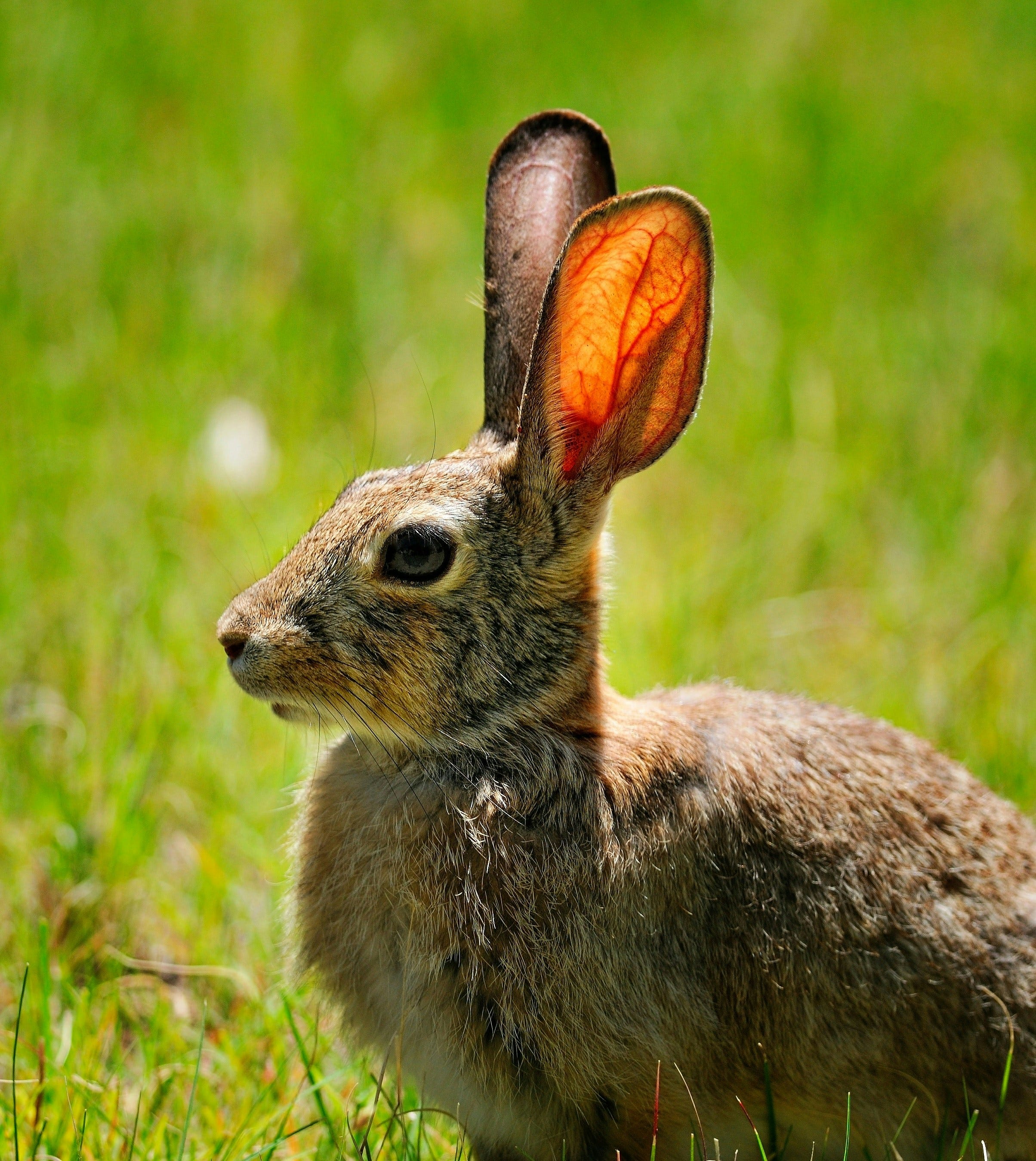
Melangell finds sanctuary in the wild Welsh county of Powys, in the valley of Pennant, with the skylarks and the adders, the boars and the deer. One day the Prince of Powys is hunting a great hare. Pursued, panting, the hare runs towards Melangell and hides in her skirts. The dogs make a great roar in their direction, but when they reach her, they begin to whine and whimper, and then they turn and flee.
“Who are you?” asks Brochwell. As Melangell explains, Brochwell is struck in the heart by the god in her words. He feels his own shape begins to waver. He lets the hare be. He lets the valley be. He uses his own words to gesture towards the power of Melangell, offering his land in service of God, a place of perpetual asylum and refuge.
So Melangell continues in the valley of Pennant, sleeping on rocks, in caves, with bees and wild roses. Women and wandering folk gather to her, and she becomes Abbess of a community of nuns.
When she dies, a church is built around her the tomb, and it is still there today. If you see a hare in danger in the Pennant valley of Saint Melangell, and you call on her name, then they will always be safe.
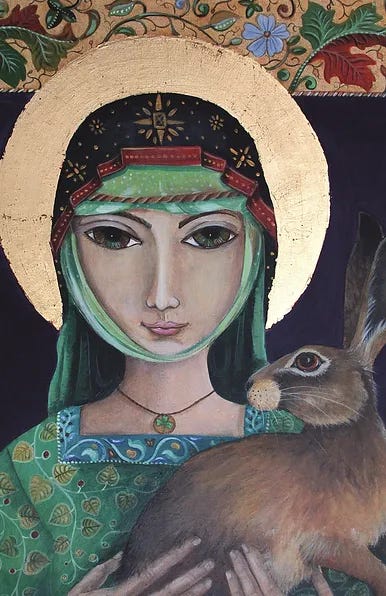
Saint Melangell and the Hare by Jemima Jameson
https://stmelangell.org/saint-melangell/
“Melangell’s Lambs”, The Welsh Fairy Book, W.Jenkyn Thomas
-----
In Ireland, Mary and John move into a house that has belonged to John’s grandmother. In the attic, Mary finds a mirror, round and dusty. She looks into it, and feels space of urge and fur begin to slip under the rug of her thoughts. She puts it away.
They clean the house, and, in the clear pattern of full moon, make love in the new bed. That night, Mary cannot sleep, so she slips up to the attic. There on the floor (although she put it away) is lying the mirror, full of moon. She looks into it, and this time, does not want to look away. It is her eyes which change first, deeper, swifter, she sees the dust in the room like labyrinths of time and place. Her ears get longer, her hands softer.
John is there, suddenly, in the door. He stares, to see his wife, and the glass, and the shift that lies between them. He is not afraid. He feels as if life has been a rehearsal for this. Gently, he takes the glass from her. It is a choice whether to let her go, or let it in. It is a choice whether to hold the house, or to hold her company. It is a choice whether to believe the back of his own dreaming. He looks in the mirror.
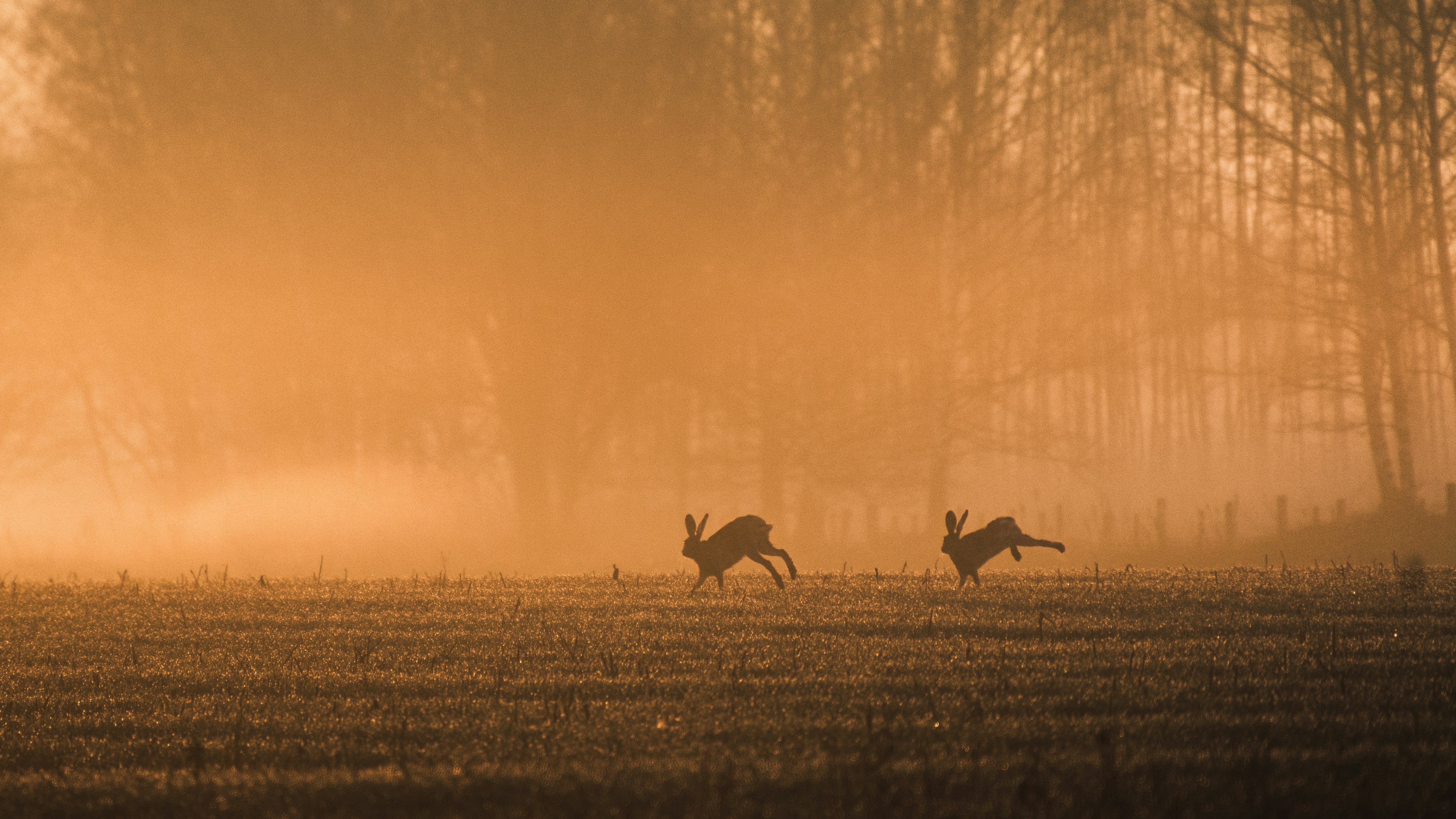
Two hares slip out of the red door, that night. They leap through the corn fields underneath the full moon. Something is calling them, something more than the high constellations of stars above. When they reach it, they realize it is a parliament of hares. A great circle of fur and thudding, and someone else, coming in down through the wind, coming with hoofs and trees and wind.
They do not know how to be there. Their hearts are thudding too loudly, and the others turn to them, knowing they are long-shadow, swift-fear, human-heart. The two then, as one, turn away, piercing the hedgerows, kicking the hard-packed earth, running, leaping, running, until they are there, up to their dusty path, down to their red door, back to their home.
Afterwards, they return to bed, hand in hand, human body to human body, thinking their own thoughts. But through their hands is a common custom and wild hope that they know a way somewhere else, and when the time is right, they’ll find it again.
From a folkloric fragment quoted in Carolyne Larrington’s The Land of the Green Man, 74.
-----
In Heathfield, one summer’s night, a middle-aged woman named Ann wakes up, and gets out of bed. She puts the baskets on her horse, mounts, and has ridden out the gate halfway to market before she realizes that it is midnight, not dawn, and the stars are still out.
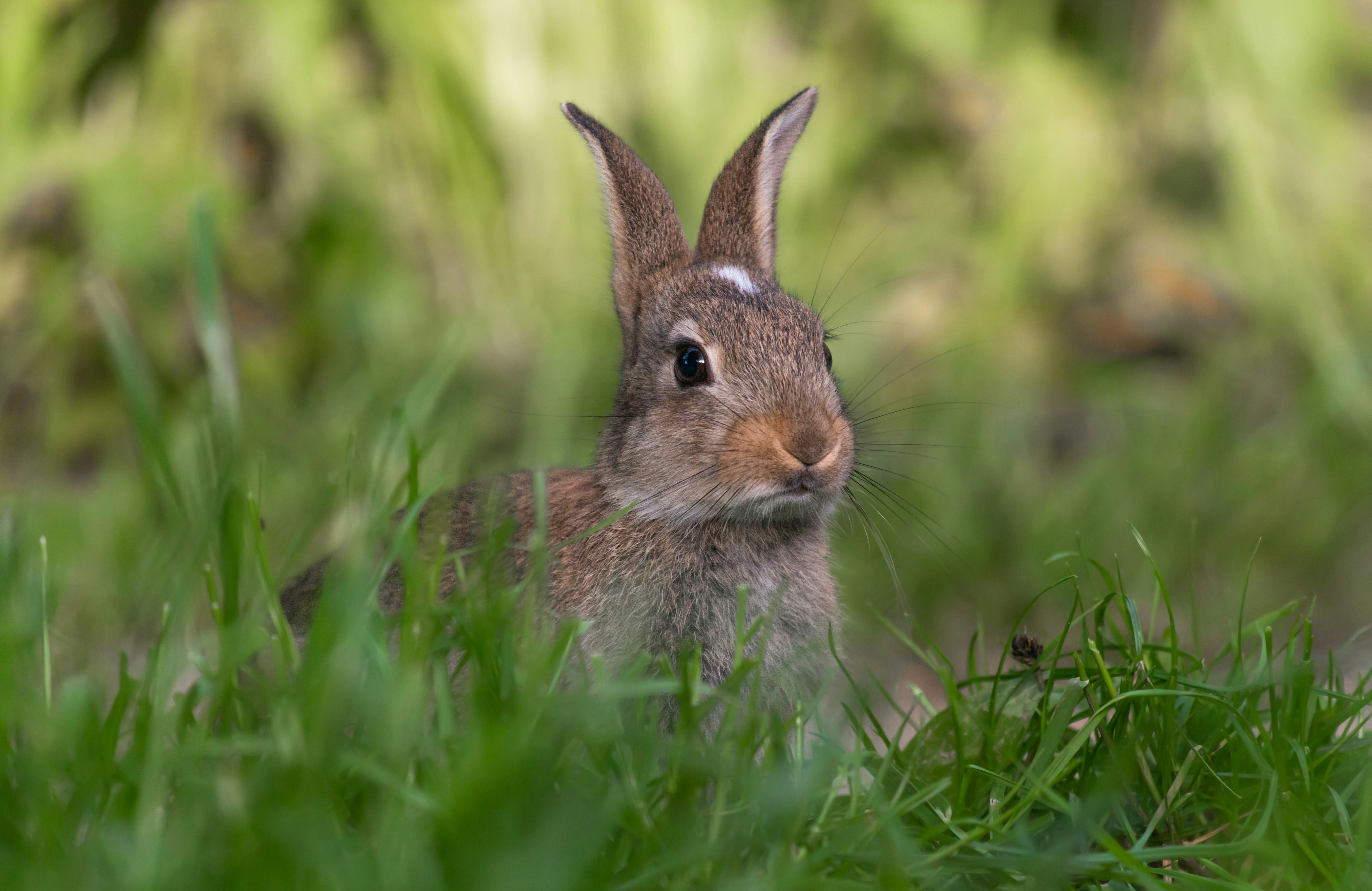
As she and her horse are standing there in the confusion of twisted time, she hears the cry of hounds, and a thumping, and then sees a great white hare galloping towards her. The hare makes a great bound, and lands a-top a hawthorn hedge. It turns back to Ann, with a spark in its great dark eyes, as if to say – catch me if you can.
Ann, never one to refuse a hunt, spurs her horse to action and makes a grab for the hare, catching it, mid-air as it leaps along the hedge. She places the furry body into one of the baskets. As she does so, a grey cloud seems to pass across the moon, and there is frost in her breath. A howling fills the air, and when she looks up, she sees a headless horse coming towards her, and a thousand skeletal hounds with eyes like branding fire.
The figure astride the horse is not man or beast, not bone nor blood, not breath nor death, and it strikes fear into her heart like the straight edge of an axe. But its voice is cool, though there is an grating to it, and it nods to her, and asks her whether or not she’s seen a hare pass by. Although it seems atrocious to speak in that rank, sulphurous air, she manages to form the words. No hares have passed by her that night.
There is a pause then, where the stars of time seems to hang in the balance, but then the figure nods, and the horrible horse and the skeletal hounds with their burning eyes are gone.
As soon as their hooves can no longer be heard, the woman hears laughter coming from her basket, and smells the May-sprung air of lilac. A woman, white-dressed, emerges from the woven willow basket, singing and laughing.
Text within this block will maintain its original spacing when published
They tricked me
into hare
not knowing
I was turning there
They bid me
to be chased
not knowing
I am long-run race.
Forbad me
coming home,
not knowing
I am gracious bone.
The woman, luminous, long-haired, in the strange exceptional midnight, is the most beautiful being she has ever seen. She reaches out her hand to Ann to offer her thanks.
In the story we have written, Ann is blessed, after that, with plentiful eggs, flow of milk, flowers and sweet grasses. Whether she is blessed elseways is not recorded. Perhaps because silence is also a sweet, safe space of memory and magnificence, remembering as it forgets, speaking even as it gathers us into the clovers and sweet-grass of unspoken time.
“The Hunted Hare”, English Fairy and Other Folk Tales, Edwin Sidney Hartland.
_____
Addendum: On Safety
These are not full stories, they are only the naming of preserved fragments. What would happen if we walked with them, danced with them, told them in chorus with old wilderness of other thudding stories?
I love the fact that all of them have safe places for the hares. In the skirts of the saint. At the back of the mirror. In the basket of a woman who is momentarily outside of time.
In the last few months, my friend and fellow-writer Rowan has started a book club to discuss Johann Hari’s Stolen Focus, about our disappearing attention and the ways in which the internet is fracturing our thoughts. It is a beautiful and important book.
In the first session we discuss, together, the privileged nature of rest. In these entrapped and entwining systems, how many of us are able to say no, to turn off, even for a while, from the hectic plunderings and vicious sequences that keep us subject to unbedded fluctuations, rather than porous to star-flung, earth-wet change?
Sophie Strand says, one way to unsettle the system while you are in it is to bind it, muffle it out, suffocate it, like the fertile green power of Dionysius’ vine (89 - 91). Perhaps one way to do this is to make these safe places for star hares in the midst of our hectic living.
For ourselves. And for our others. To pray. To get up at midnight and ride to market in the folds of mistaken time. To look into an old and dusty mirror. To read wildly, listen porously, offer obstinately, and art them in.
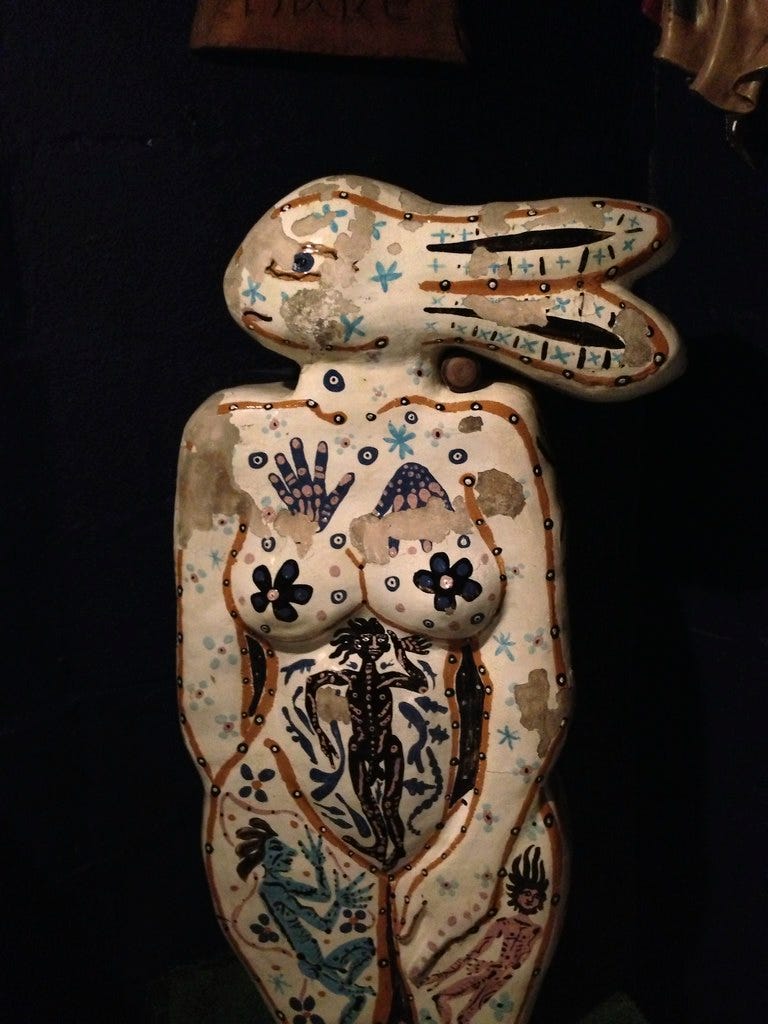
The Hare Woman, from the Boscastle Museum of Witchcraft
References
Abram, David. Becoming Animal. Random House, 2011.
Blécourt, William de. “The Woman Who Changed into a Hare.” The International Society for Folk Narrative Research. 2017. https://isfnr.org/files/HARES.pdf.
Butler, Octavia. Parable of the Sower. Headline, 2019.
Hartland, Edwin Sidney, ed. English fairy and other folk tales. Vol. 55. W. Scott, 1890.
Haraway, Donna. “SF: String Figures, Multispecies Muddles, Staying with the Trouble.” ResearchCreation. Edmonton: University of Alberta, 24 March 2014. Youtube Lecture.
Hayes, Nick. The Book of Trespass. Bloomsbury, 2020.
Larrington, Carolyne, The Land of the Green Man. Bloomsbury Academic, 2019.
Strand, Sophie. The Flowering Wand: Rewilding the Sacred Masculine. Inner Traditions. 2022.
Thomas, William Jenkyn. The Welsh fairy book. TF Unwin, 1907.
No posts
Comments
Nothing yet. Say the first thing.
Sign in to join the conversation.