
A commitment to letting stories breathe means that stories should have the first word — Arthur Frank
Once upon a time, in the hot, dry heat of Greece, there was a king who had thirty daughters. These daughters were strong and powerful, and had a thirst for knowing, a hunger for adventure, and a desire to direct their own lives.
When they were of marriageable age, the king married them off to his barons; some of them kind, some of them cruel. One month afterwards, the sisters met in the olive grove as the sun was cascading ribbons of blood into the sea. As they talked together it became clear that to submit to unasked for husbands was neither their choice nor their fate.
They had been brought up to swift action and violent resolution, and so there in the olive grove they agreed that, night of the next moon, they would murder all their husbands in bed unless they agreed to submit to their will in all doing. The plot was agreed, the day was fixed, and the sisters’ fury settled.
The youngest sister, though, bore within her a love for a new husband that seared like a knife. Though she loved her sisters more than the whole world, she couldn’t spill the blood of her young man on the white sheets. So when her husband asked her what was wrong, she told him. And he took her to the King, and together they told the King the story.
The twenty-nine sisters were brought to trial, and eventually admitted the truth. Their punishment was deliberated and decided: not death, but exile. If they wished to have no direction over their lives, then that would be their fate. A great ship was made, without a rudder or way of navigation. Then the twenty-nine sisters were placed in the ship, without food or drink, and the ship was set out on the waves. All who watched thought they would be lost within the pounding sea and under the whitening stars.
At first the sisters believed in the power of their wills to lead them on, for their wills were sharp as knives and as strong as thunder. But the winds took them deeper and deeper into the sea, and soon the sisters wrapped their hands around the wood of the deck, knuckles bloodless, the waves as dark as walls, their bodies sodden and their throats burning.
The sisters were not afraid of death; neither of dealing it or of being dealt it. As the ship plunged into the dark waves, they knew they would journey on together. But instead of the shores of the afterlife, the bow, after many days of tossing and turning, crunched down upon wide stoney shores. When they wiped the salt from their eyes, they saw a great white curtain of folded rock that seemed to reach from sky to sea, as if it would open to worlds unknown and unnumbered.
They dried in the sun on the beach. They found sweet springs and put their faces in the water. They gorged on dulse, bladder wrack, and haws from thorn bushes. And, when they had the breath to do it, they walked up those high cliffs, and looked to the left and right and saw no human being. Albina, the oldest, said then: this land is our land, and as the oldest of you all, I declare myself the Queen of it. I shall name it Albion.
The sisters learnt its wood and forests. They gathered soft boletes from beneath the white and spiralled birches. They used the abundance of green nettles to sew nets for fish. They ate mackerel, bream, eel. They sharpened its flint and made arrows to kill hare, rabbit, deer. When they bled, they let their blood fall onto the soil, offering their coppersong back to the earth which fed them. When their energy rose like the white moon, they listened to the rising hunger of their skin and hearts.
Spring came. One day, one gleaming night, the sisters’ desire was like fire burning within their skins. Together, drawn on by the strange blossom call within the winds, they walked into the woods, their bare feet meeting the warm and wind-dressed earth, the soft conspiracy of moss and soil.
There under the full moon they found the deep beings, the wind-whistlers, the thorn-hobs, the ink-sprites, and others, with horns and hoofs and shifting faces. The folk drew the sisters into their dances, first with their spines to the stars, next with their backs to the earth, and they danced all night, until the fire within the sisters’ skin had flowed out into the violet soil.
Every month Albina and her sisters went out into the woods and danced. And soon enough their bellies began to round. Everyone knows when they are with child that the child will reforge the world; but these sisters, something about the weight of what they were carrying drew them downwards, back to the pebbles of the first beach, back to the dulse and kelp and cracking bladderwrack. They pressed their faces to the damp stones, pressing the agony of the growing, tearing bodies back, into the deep hungry spirals of the earth.
When the mothers were ready to birth, when the infants were ready to come, they each had twenty-eight midwives, midwives who had wills as sharp as knives and loves as strong as thunder; and had it not been for that, none of them would have lived. But live they did, all of the sisters, and in their arms were babes of flesh and stone.
The babes of flesh and stone fed on milk, and then on the blood of deer. As they grew, their feet thudded like hearts down onto the soil, down into the rock, making imprints and lines and carvings. The mothers loved them, the earth loved them, and the giants grew. They grew until they were the size of great ships. Their mothers held the edges of the new world, mating with its kin, learning the lovesong of its demons. Their giant-children covered the island; they mated with one another, wildly, until the island of Albion was covered in a race of giants, and the land took shape from the dancing of their feet and the roaring of their heads and hands.
***
The story of Albina and her sisters is a strange story, and strange that it is so little known today, despite the energy with which it pulses. It’s a story first recorded in an anonymous Anglo-Norman poem, Des Grantz Geanz (On the Great Giants). Long after Albina and her kin, legends say, came Brutus of Troy, descendent of Aeneas, who came with his men to settle on Albion. When he arrived he slaughtered all of the giants, and named the land Britain. The old name of Albion was lost in the waves and mists of time, and the giants remembered only in the rocky bodies of the lands they had shaped.
In our Bodies of Wonder course this winter, a course on storytelling with and through the body, we’ve been exploring the relationship between stories, immensity and land. We were telling the tale of Albina and her sisters, and looking at the stories of other giants who populate the British landscape. It makes us think about the weight of stories. We normally think of stories as feather-light, a place to rest our thoughts, those who think in stories have “their head in the clouds.” Yet stories have weight, also. Strange things happen when we invite stories to take their stone-weight, to inhabit their grass-weight, their salt-water weight.
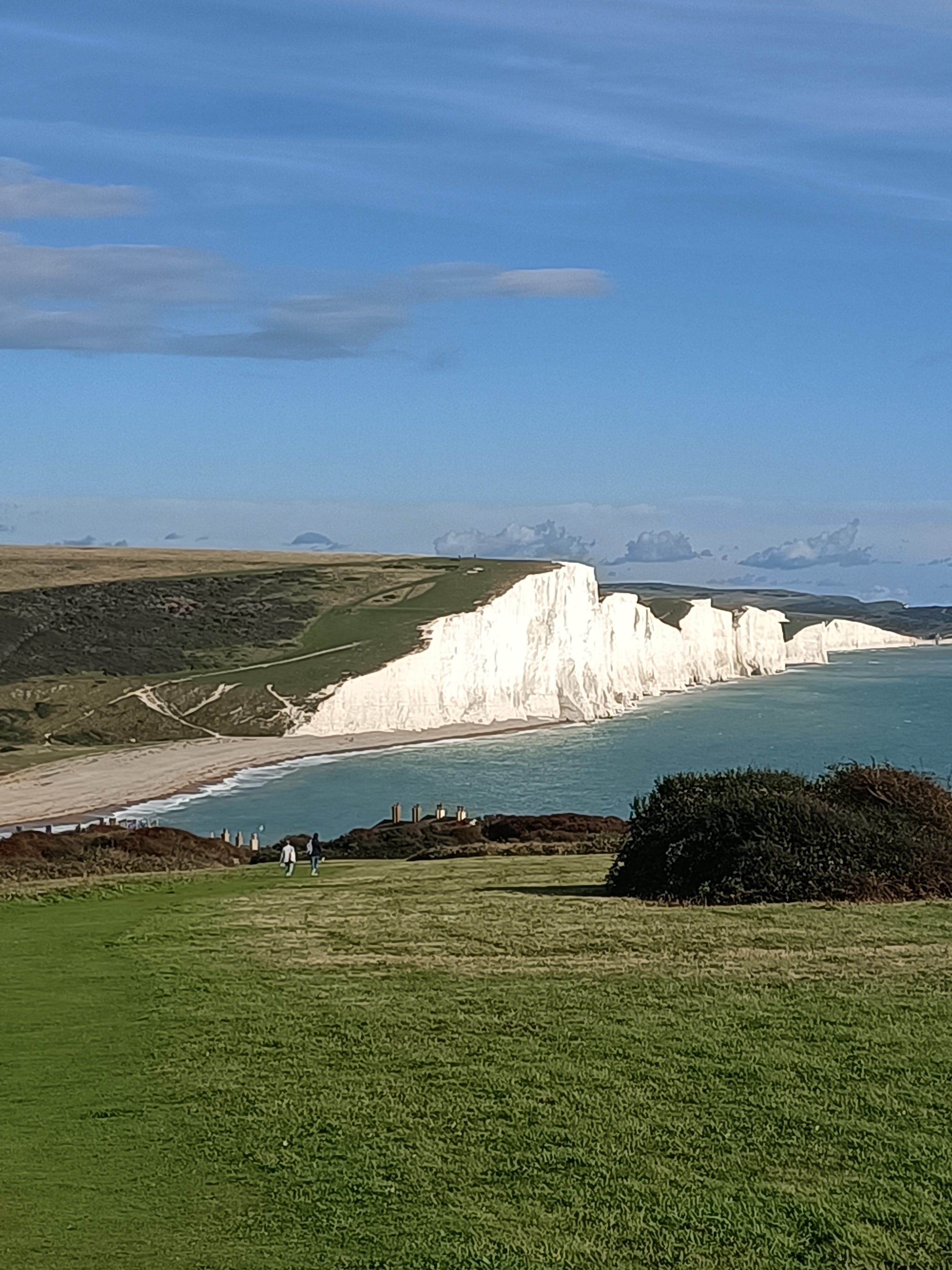
What happens when we notice and attend to the weight of stories? As a storyteller, I know that sometimes, there isn’t space to bear them like that. This autumn, I was invited to tell as part of a stunning arts festival celebrating the Sussex cliffs. It is a joyous, breath-taking labyrinth of art within the landscape, and its an honour to be there. My storyteller friend and I are invited to tell atop the cliffs, among the land art; stunning wicker birds, giant objects sculpted with seaweed and shells, incredible flags that flap with rainbow and patchwork patterns, connecting land to sky, sky to sea.
I chose to tell a modern myth-weaving by storyteller Xanthe Gresham, both crafted and very old, about the Pleiades. In the story as Gresham has written it, the Seven Sisters cliffs are named after the Seven Star sisters, who “use the cliffs as their landing pads” when they come down to dance on Earth.1 A beautiful, tender, living story which I feel excited to offer.
But the day is complicated. When we arrive, the ritual of the art festival and the rite of storytelling don’t – quite – meet. Those who manage us are not those who had invited us; those on the ground aren’t quite sure what to do with storytellers. While the audience is processing down the cliffs in a masked procession, my friend and I are struggling to arrange for mics. Where we would have preferred to weave our stories together, we are set up side by side, so our voices and our presences compete. The fault is not the festival’s, nor ours, but somewhere in the miscommunication between us means that rather than slotting in, the stories have to proclaim their right to be there.
As we stand above the sea, and tell our stories, I feel myself struggle. The audience drift between tellers, and the wind blows, and the sea crashes. I reframe the tale so it is faster, easier, more entertaining. I can feel the ancient silence of the story behind me, and the swirling immensity of the sea in front of me, and yet the words I tell need to stay in here and now. I can’t ask of the audience, because I need to swiftly please them. I can’t give the story the unfolding space of slow time in which it could invite listening attention back to the cliffs; the continuously unfolding chalk bodies; the blue grey solar sea. The audience enjoys the story. But I cannot say whether the cliffs have. Afterwards, I chat with families, colleagues, with my friend, and allow the incredible visual art to bowl me over. The families head back up to the car park afterwards having had a satisfied day out. But what about the slow weight of the story? Where has that landed?
I return to the same spot twice afterwards, once with some friends, and once with a group of children we take rock-pooling. Both times, I am barred by the lambent sea. Our friends have come all the way from Germany and have a deep desire to walk the Seven Sisters cliffs, but I take them to the wrong side of the beach. I don’t know why. We walk from the clifftop where I was storytelling, and when we get to the beach, we realize it is split by the roaring Cuckmere river, and a combination of wrong tide, tired children and limited time means we don’t have capacity to walk the winding four miles round, to reach the Seven Sisters. We turn around, and walk along the other cliffs, with rolling, running children along the grass green slopes of Seaford Head. But everyone, children and adults, are shaken by the swift, watery rebuke of this unreaching. The moment of cut-off by the river stays with me, hard to shake off.
The next time, I come back again as part of our foraging gang, with a group of children to explore the rock-pools. I come almost to return to an ease I didn’t find before, where we couldn’t explore the beach because we were all too upset that we couldn’t reach the cliffs. This time, seven children, one dog and three adults take luxurious time to explore the rock-pools. But I am again, breath-taken by the sea; we go to a part of the beach that is cut off by high tide, I miscalculate, luckily my husband notices, we rush back, all of us, and just make it back through the rising tide before we are completely cut off by the grey waves.
I don’t know. Only I think; I tell a story that doesn’t quite reach the sea. And twice after, the sea swims and swirls around, so I almost don’t quite reach me. In the Western world in which matter around us is seen as mute and meaningless, it doesn’t make sense to pattern the world like this. But why not? Perhaps things would be easier for us if we acknowledged the weight of the stories that we carry. Why should I not live in a world where the sea responds to a unreaching story with its own tangle-water of reaching? Why should a tale that doesn’t quite unwrap feel afterwards the grand unwrapping of the god-sea?
And I think, not just about storytelling, which has its own conversations with people, landscape and dreams. I think about all of the stories which pattern our lives today. We live in a criss-crossing matrix of stories. Like Albina and her sisters, though most-times with less immediate violence, we try our best, today, to navigate our own lives, to extricate ourselves from restrictions or mutilations that are not our fate, to tell our own stories. But when we do that, when we set ourselves outside of what society has laid out for us, it’s even deeper stories that we end up carrying. Stories in which stars fall, rivers lift, wild ones dance.
And I think about Albina and her sisters, surviving the birth only because they have the company of wild, bone-brewed midwives. For all of us who have stories winding from their belly, new stories, old patterns, old dreaming – perhaps each of us deserve twenty eight midwives with wills as sharp as knives and loves as strong as thunder.
This autumn, as part of the Sustainability Transition Town group I’m in, we show the film Once You Know, where French film-maker Emmanuel Cappellin interviews environmentalists and climate scientists, not only about what’s coming, but about how they can bear it. We must, he says, in conversation with French energy expert Jean-Marc Jancovici, learn to live with constraint. The issue, says Jancovici, is “our confrontation with limit.” I think about how Albina and her sisters refused the limits of patriarchy to mate with the wild ones, and give birth to those who set the stone-ground patterns of the ground and sky. The modern Western world has told us to transcend our limits. But it isn’t about that, is it? Is it about choosing the limits we let go of, and the ones we dance with. The ones we cut ourselves away from, and the ones we give birth to.
The twenty-nine of them survived the birth because of their midwives. Which, some people say, is after all, what started society in the first place.2 How do we hope? Cappellin asks Jancovici. I like Jancovici’s answer. We cope by not being alone. The best safety net, he says, “is having people around to help you.” It is your network which will offer some resilience.
How do we bear the wild transition of our changing stories? The stories always have been a bridge between earth and sky, some of them at least. Some of them are a bridge between mud and stone, between earthworm and fungi, between fruit and nestling shell. Stories are mediators between imagination and the living matter of the world. Perhaps we need to remember that our bodies will always know that. And so will our stories. Perhaps if we acknowledge the weight of the stories we bear, then we will also learn how to be midwives for each others body-stories, life-stories, dream-stories. In boats with no rudders, in worlds with disappearing havens, as flood rise and we don’t know how to keep our homes open, let’s invite in the wild, glorious weight of stories, and find the kin for us to bear them together.
1The story was “Seven Sisters and One True Shepherd”, woven by Xanthe Gresham Knight and Robin Knight in their stunning book Sussex Folk Tales for Children.
2Explored, for example, in the film by Stefan Milo, “Life and Death 3000 000 years ago”. This discusses the impact of both upright walking and larger brain size on the increased difficulty of giving birth. As a consequence, it was likely that births became a co-operative process, and this in turn may have had an impact on the development of complex, co-operative societies.
No posts
Comments
Nothing yet. Say the first thing.
Sign in to join the conversation.