
Digging in with Joan Fernandez” is a bi-weekly newsletter with ideas for you on shattering limits to reaching your true potential, told through bits from the life of Jo van Gogh (the woman that would not allow Van Gogh to die twice). Please sign up here.

In the last newsletter, I announced that I am writing Book #2: a non-fiction book about the twelve marketing strategies I discovered while researching my biographical novel, Saving Vincent: A Novel of Jo van Gogh. You can read Strategy #1 from the last issue here and Strategy #2 here.
I’m back with an update on my draft of Jo van Gogh’s playbook—the marketing tactics that ultimately bulldozed through a mountain of resistance against her brother-in-law Vincent’s recognition.
Today’s post covers Strategy #3. As a completely objective fan of Jo 😃, I admire her business acumen across the board, but Strategy #3 is a personal favorite. I think it demonstrates just how ballsy she was—plus another important truth I’ll get to.
I’ve tried this strategy. You can do it, too.
It’s about responding to insults.
In brief: Rather than getting defensive—or worse, flailing—you listen for the objections buried inside the critique. Instead of dwelling on the sting (or curling into a fetal position under your desk), you take note of what’s inside the insult, pivot, and address those core objections head-on.
Sounds about as easy as thanking a bee for stinging you. Yet, that dynamic was clear in Jo’s response to the censure she faced when launching outreach for Van Gogh’s work—a flavor of vicious rejection her art dealer husband, Theo, had never experienced.
For the act of believing in Vincent’s art and daring to promote it, Jo was attacked. These weren’t mere disagreements; they were deliberate attempts to reprimand and slander:
Patronizing Art Critic: As biographer Hans Luijten notes, Dutch art critic Richard Roland Holst publicly attacked her in a letter to the editor: “Mrs. Van Gogh is a charming little woman, but it irritates me when someone gushes fanatically on a subject she knows nothing about... blinded by sentimentality... it is schoolgirlish twaddle, nothing more.”
Intellectual Elite: Renowned German critic Julius Meier-Graefe sought to undermine Jo’s lack of formal art credentials: “Jo is uneducated... driven [by] the pious cult of a dead brother.”
Family Opposition: Early art dealers and members of the Van Gogh family urged her to throw the canvases away, claiming Vincent’s efforts were merely the scribbles of mental health issues. Jo’s brother, Andries Bonger, insisted the art was “the product of a deranged mind and [had] the visual output of a lunatic.”
Notice the old misogynistic tropes within these insults: Jo was dismissed as emotional (“blinded by sentimentality”), gullible (“uneducated... driven by a cult”), and oblivious (“output of a lunatic”).
If Jo had listened to the “experts,” she would have shoved those canvases into a furnace. Instead, she mapped these exact objections and used them to identify ways to flip their scripts. (more on these in Strategies #4–6).
But the critical piece in these examples—the heartrending observation—is that being an entrepreneur can mean facing resistance. Even more so, if other people have a lot at stake with the way things are.
Since the underlying mechanism of status quo (Latin for "the state in which [things are]" is stasis (Greek for “standing still”), if an entrepreneur’s idea rocks the status quo’s boat, there’s pushback. When the attack is personal, I think it takes courage and faith in yourself to not just weather the storm, but with Strategy 3 to use those choppy waves to propel you.
Here’s a brilliant example of a contemporary of Jo’s who did just that.
French actress Sarah Bernhardt (1844–1923) took the stage with sensational style in her day. Her art blasted through societal expectations with such impact that outrage rushed at her like a magnet pulling knives. Press attacks, constantly circulating rumors about her private life, conservative group anger at her antics. By all accounts, it was relentless.
Yet, Sarah didn’t waste breath defending herself. She didn’t ask critics to change their minds or lower their standards. Instead, her acts became more eccentric.
For example, when a rumor spread that she slept in a coffin, Sarah embraced it. She hired a photographer, staged the imagined scene, then mass-produced printed the photos as postcards. Notice how she reclaimed control of her public persona and then capitalized on it.
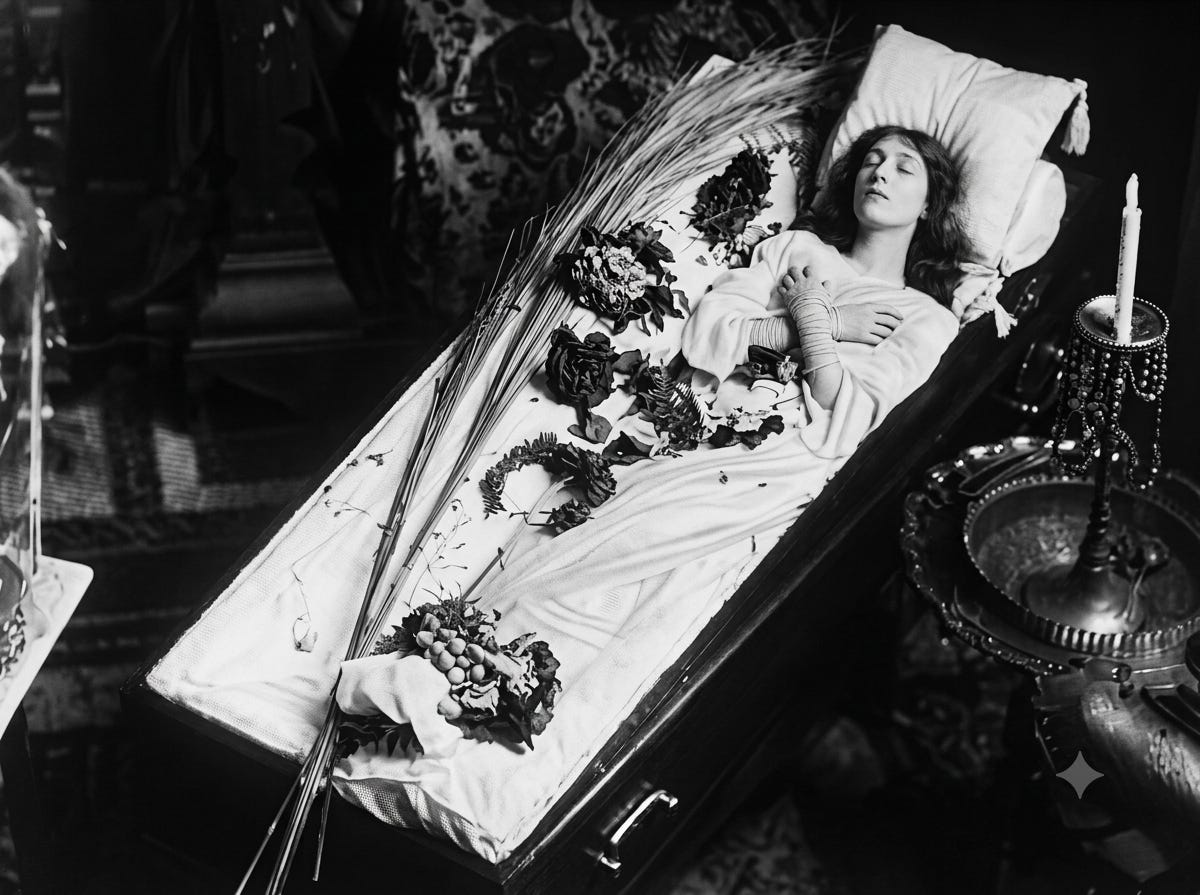
In her 1907 autobiography, Double Life, she noted, “I prefer to be hated than ignored. Hatred is a force, a stimulant; it forces you to fight.”
And in a reflection on the public’s insatiable fascination with her larger-than-life persona and how they’d been drawn to the myth she constructed around herself, she wrote, "Legend always wins of necessity.”
Sarah proved to be a master impresario whose spectacle always served a purpose. She was among the first global performers to recognize personal brand equity—licensing her name and face to cosmetics, perfumes, and fashion to ensure every commercial tie-in reinforced her persona of avant-garde, high-art luxury.
Neither Jo nor Sarah wasted time reacting to criticism. They had a finger on the pulse of their own individuality, their own unique gifts, and had the conviction to stand for their own truth. Within the pushback, they saw nuggets of fear they could respond to—with creative daring. You’ll be introduced to Jo’s responses in the next strategies, but for now poet e.e. cummings captured this mettle: “To be nobody-but-yourself—in a world which is doing its best, night and day, to make you everybody else—means to fight the hardest battle which any human being can fight.”
And so, without further ado:
What will you mine?

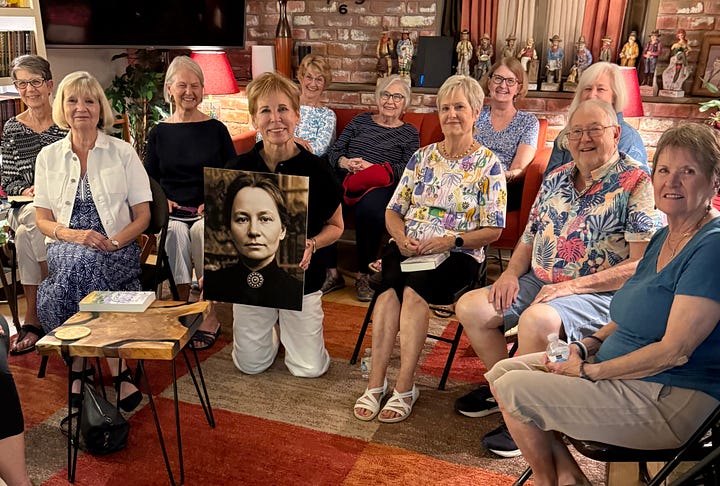


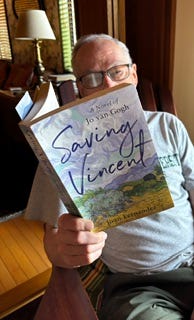
(Captions are left to right)
Our lively evening talking about inspirational Jo van Gogh, my chaotic journey as an author, and story spoilers made the evening fly with the lively Birnamwood Book Club of Ballwin, MO.
Discovered Indie Reader gave SV a 4.5 (out of 5) rating - woot! “Joan Fernandez’s SAVING VINCENT, like the art of its eponymous demiurge, brilliantly evokes both the dignity of the mundane and the fire of revolution at the turn of the 20th century.” Read the review here.
So happy to find out Saving Vincent is on BARD, the Library of Congress’s National Library Service for the Blind and Print Disabled. This icon is for the BARD mobile app that gives access to Braille and audio reading of books.
“‘I can’t put it down,’ says Tom”—writes an SV admirer!
Book Recommendations: Thrills and Chills!

I’d heard about Jen Sinclair’s twisty domestic thriller through friends—It more than met its promise. The story follows three women—Cam, Josie and Sophia—each from different backgrounds, tormented by hidden secrets all coming to a head as they approach turning points in their lives. My brain raced as I grappled with the puzzle pieces; each character study and their obstacles drew me in. Sinclair’s writing is confident and clever, carrying the reader along on a tense journey. And the climax is a doozy!
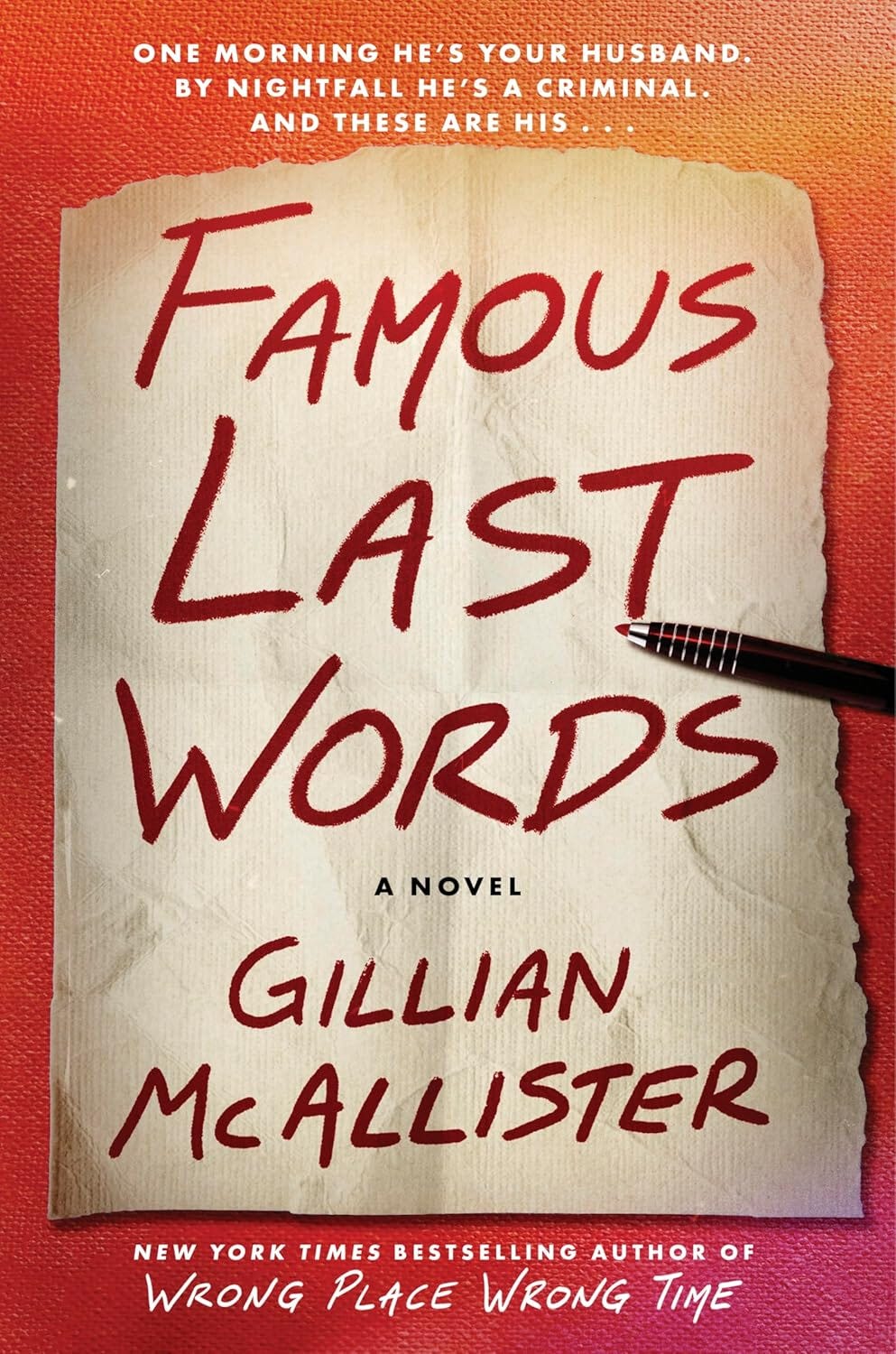
Order on Gillian McAllister's website
This is my first Gillian McAllister book (@Pen and I picked a good one! This suspenseful domestic thriller starts with a nightmare surreal scenario—Camilla wakes up to a cryptic note from her husband, Luke, only to discover hours later that, unbelievably, he’s the gunman in a major hostage situation. As the tension unfolds, the story counterbalances Camilla’s perspective with Niall’s, a police hostage negotiator, and his thought process. The result is story-telling through tense narrative interpretation, questions about memory and truth and trust, suspicious secondary characters, all delivered with page-turning reveals (no need for adrenaline chase scenes here!). I loved the question again and again: How well do you know the person you love? Excellent twisty thriller at its best.
Comments
Nothing yet. Say the first thing.
Sign in to join the conversation.