
Digging in with Joan Fernandez” is a bi-weekly newsletter with ideas for you on shattering limits to reaching your true potential, told through bits from the life of Jo van Gogh (the woman that would not allow Van Gogh to die twice).
Today’s post is a favorite (edited) essay I’ve published each year ago to commemorate the anniversary of Vincent’s death.
“I don’t want to end up simply having visited this world.”
— Mary Oliver, “When Death Comes”
Did Vincent van Gogh die from a broken heart?
And how did he die? Was he alone?
Mary Oliver wrote that she didn't want to end up simply having visited this world. Vincent died certain that was exactly what he'd done.
This week, July 29, is the anniversary of Vincent’s death in 1890. One hundred thirty-six years ago.
It’s brought back the memory when I visited the small room in which he died.
How he might have felt in those last moments.
And why it could matter to you.
A few years ago, my husband and I took a Sunday train out from the Gare du Nord train station to Auvers-sur-Oise, a village northwest of Paris.
We were on a little trek for me to do research for my book but also just to enjoy travel to European cities. We’d both retired so for the first time neither of us had professional accountability to jerk us stateside and back into a 9-to-5 routine. Nevertheless, old habits die hard and I was still squeezing productivity out of every minute.
So even though trains run less frequently on weekends, that Sunday I suggest we go to Auvers to visit the cemetery where Vincent and Theo—his brother—are buried. I plan our day around the sparse train schedule. "Easy peasy," I assure my husband.
“Besides I took French in high school,” I add, putting to rest any possible doubts of my scrupulous travel planning.
After a little garbled French-English wrangling to get train tickets from an annoyed ticket agent (couldn’t blame him), we’re on our way. Yes, we smoothly switch trains to make a tight connection—see? no big deal—and step out onto a pretty street where a nearby bakery’s fragrant breads and pastry tantalize the air, and cheerful red and pink flowers border the two-lane road.
A perfect Sunday expedition.
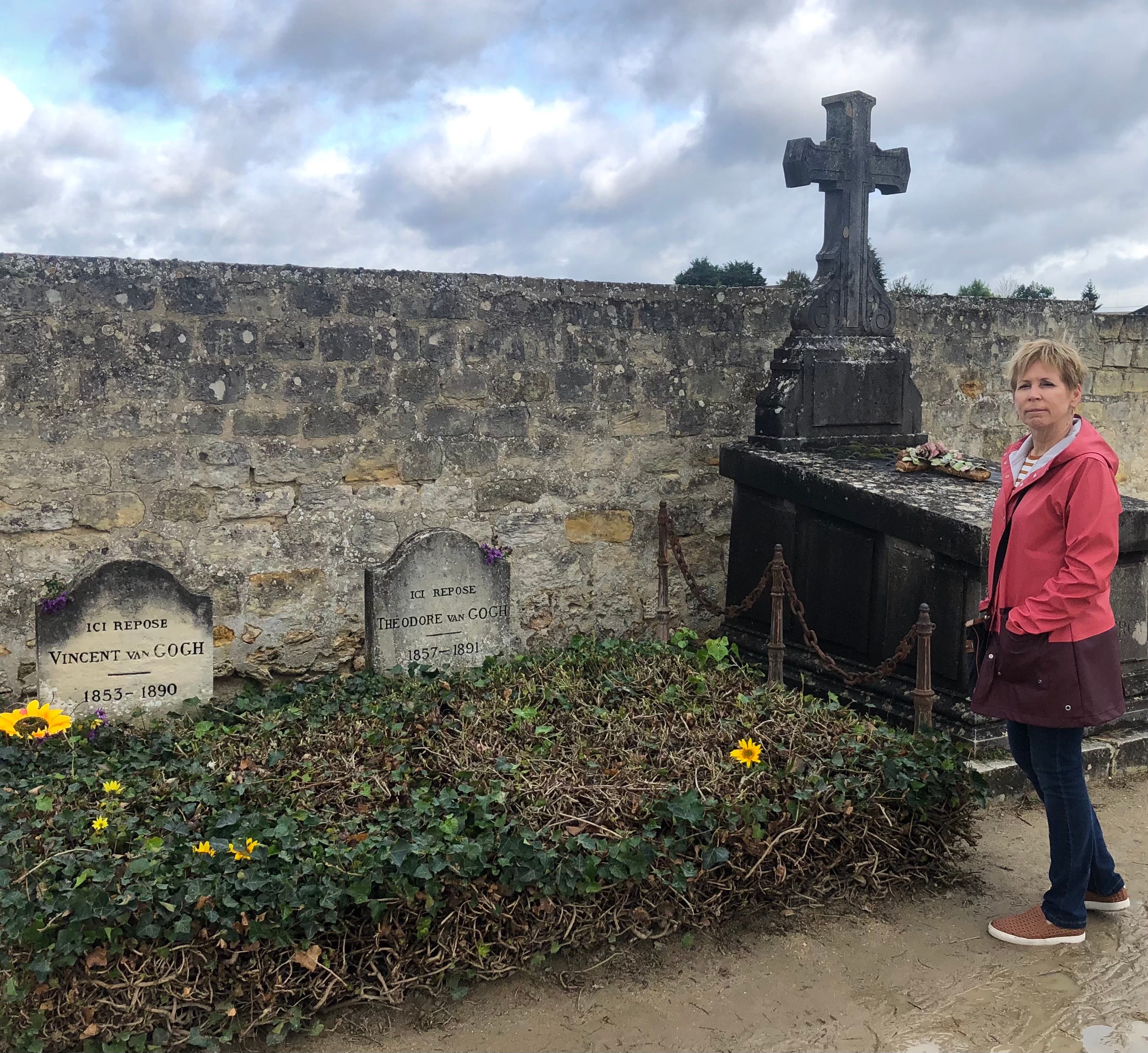
Map-less, we wander a little, eventually coming across the actual church Vincent painted (The Church at Auvers) when he lived here, and then follow the DIY-Vincent-trail signs up a dirt road alongside a wheatfield to the cemetery where Vincent and Theo’s graves lie side by side under a bed of ivy. (Later in my book’s research I would learn that Jo —Theo’s wife and the person who ultimately enabled Vincent’s art to become broadly known — would move her husband’s remains to lie here next to Vincent’s in 1914).
I stand at the foot of the graves staring at the tombstones.
I imagine that Jo stood here too. How her thoughts must have tumbled. A combination of gratitude and heartache, for her life had changed and taken on new meaning because of these deaths.
My husband clears his throat. I check my watch. Ninety minutes before the train returning to Paris makes its stop. Plenty of time to explore more, right?
So, we find the small house where Vincent rented a room. Pay a few euros for the next tour. Spend time waiting by reading all the info plaques scattered around the courtyard. I snap iPhone photos for future reference. My stomach rumbles and I make a mental note to stop at the bakery. Then once the tour group finally amasses—about eight or ten people—my Cuban husband chats with a couple from Spain, but I’m only half trying to translate, because the group is moving forward and I squeeze myself closer to hear the tour guide.
We mount narrow stairs, bunching a little at the turns. The tour guide continues to talk, but now I don’t differentiate what she said from what I would later research. I do remember the reproductions of Vincent's paintings leaning along the walls that lead to his room, and inside the room once we're there.
We crowd in.
You know what? It’s really small. Non-descript, even with those colorful posters. Enough room for a twin bed against one wall, a little window, but not much more. During his stay in Auvers, Vincent produced a burst of creativity and vitality with his explosion of 80 paintings and drawings in just two months. It’s a crescendo of color. A boundless unique expression.
And so sad that he died thinking that few people had noticed.
The guide is talking, but I am lost in the image of Theo sitting at Vincent’s bedside on July 29th. Clasping his hand. Two days earlier in a field a mile away, Vincent had shot himself in the abdomen, then managed to walk back to this house, climb those stairs and collapse onto his bed. An urgent letter to Paris would bring Theo and a few close friends racing.
Vincent would die as an ordinary laborer. His talent only recognized by a few. Theo, heartsick and overcome with grief, must have felt enormous remorse that he hadn’t been able to sell more than one of Vincent’s paintings, The Red Vineyard.
For his annoying, exasperating, talented big brother had tried with every ounce of his being to surmount mental illness and still paint when he could. Studying, experimenting, following an uncharted way toward expressing a wordless urgent passion to portray transcendence.
Theo would have grieved in self-reproach: Could have, should have.
Vincent too. For in these final moments he believed his life and talent had been for nothing. With Theo by his bedside, his last heartbroken words were “La tristesse durera toujours.”
The sadness will last forever.
I have tears in my eyes.
I had ninety minutes in the town where he spent the last seventy days of his life. I was visiting. He wasn't.
He died, never knowing that his life had not been in vain. That—unbelievably— his works would be rediscovered and revered, turning him into one of the most popular, beloved artists of all time.
My husband nudges me, pointing to his watch. I snap to! We have ten minutes to get to the train! We elbow through the tour group—me “excusez-moi-ing”— hurriedly scoot down the stairs, and dart onto the street in a jog toward the train. Pass the bakery—still emitting such fragrance, oh! Dodge tourists on the now-crowded sidewalks. Glance back for traffic so we can run on the street. Sweaty, puffing, no time for the women’s room, charge up the steps and onto the train.
"I was a bride married to amazement. / I was the bridegroom, taking the world into my arms"
— Mary Oliver, “When Death Comes”
That trip took place in 2019. In April 2025 I published the book I was researching then: Saving Vincent, A Novel of Jo van Gogh. It chronicles the true story of how Vincent did become known after all through the tireless, lifelong efforts of a person he barely knew: his sister-in-law, Theo’s wife, Jo.
Vincent was 37 years old when he died. He would never know that someday his works would inspire others. That his decision to follow his own intuition and inspiration would not only be remembered, but celebrated worldwide.
Yet, like the long flaming tail of a comet, he persisted for ten years—producing 900 paintings and 1,100 drawings—”taking the world into [his] arms” with this creative surge before succumbing to despair.
It would have been unfathomable to him that Orchard with Cypresses painted two years earlier in Arles would one day sell for $117.2 million (at Christie’s New York in 2022).
And that millions would flock to his exhibitions.
It takes such courage to stand for your own creative vision and voice. I'm grateful Vincent did. And I'm grateful to Jo, the woman who finally saved him. They both are role models to me of following one’s unique inner voice. They persisted in spite of pushback and disappointment. For without an urgent internal nudge, I wonder if I would have screeched my corporate career to a halt, and pivoted to write Jo’s story.
To attempt to create—and to live—a new life.
I believe we each have this voice.
You, too.
Why hold back, then? Why hesitate in doubt? Our time to love and live is short, short, short. Mary Oliver put it better than I can: don't simply visit this world.
Take it into your arms while you’re here—all of it.

When my husband and I got back to the Gare du Nord station in Paris late that Sunday, the station was mostly vacant. The ticket windows were shuttered. Tired, we walked to the electronic exit doors, inserted our tickets for the doors to open but they didn’t budge. Tried again. Same result. It dawned on me. Dear god, in my mangled French, had I bought one-way tickets to Auvers? We were trapped! Juan glances at me. A man steps in front of him to exit, inserts his ticket, the doors open, and my husband smoothly walks through the door behind the traveler and is out the other side! I look at him now grinning at me through the slats of the aluminum fence. A woman traveler passes me, inserts her ticket, the doors slide open, and I step behind her and through the doors. Voila! We’re out! Next time I will let my iPhone do the translating.

(Captions are left to right, top to bottom)
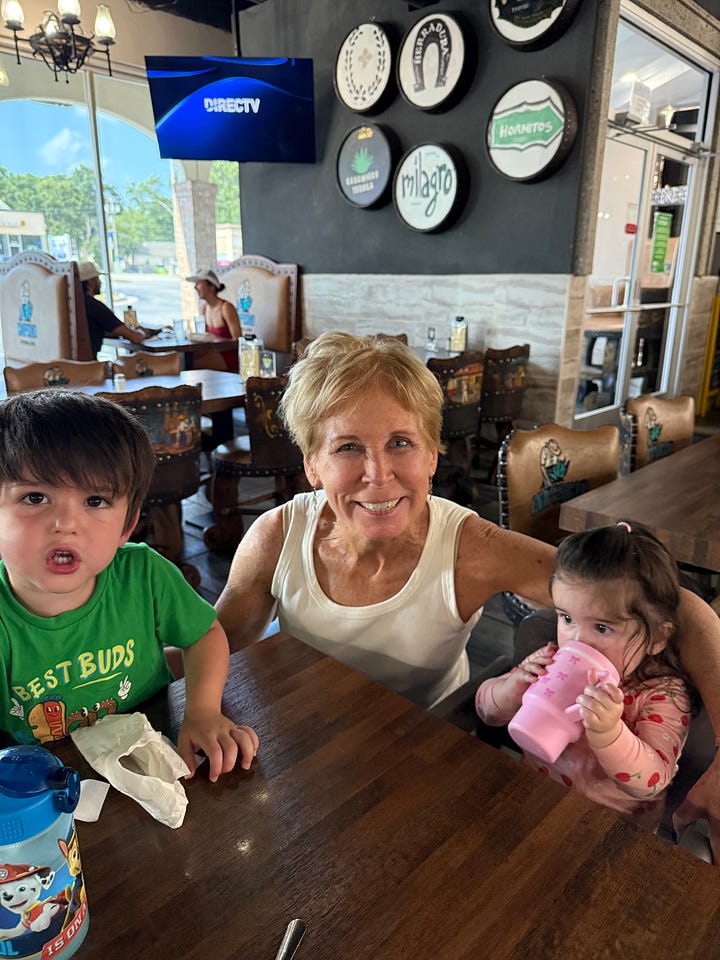
My grandkids do not live near me, so my visits as Grandma Jojo are precious.
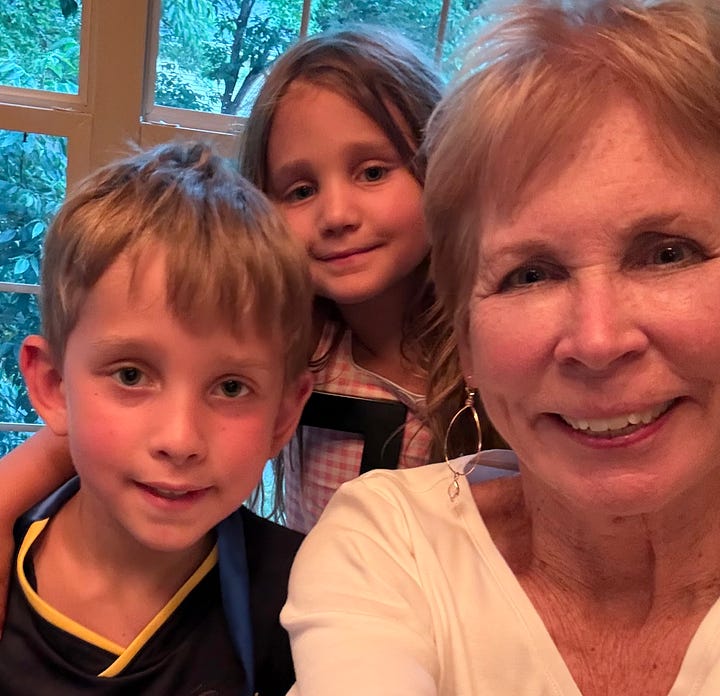
Two more grandkid imps—notice the clever twinkle in their eyes—Grandma Jojo gets fooled, but only once per trick.
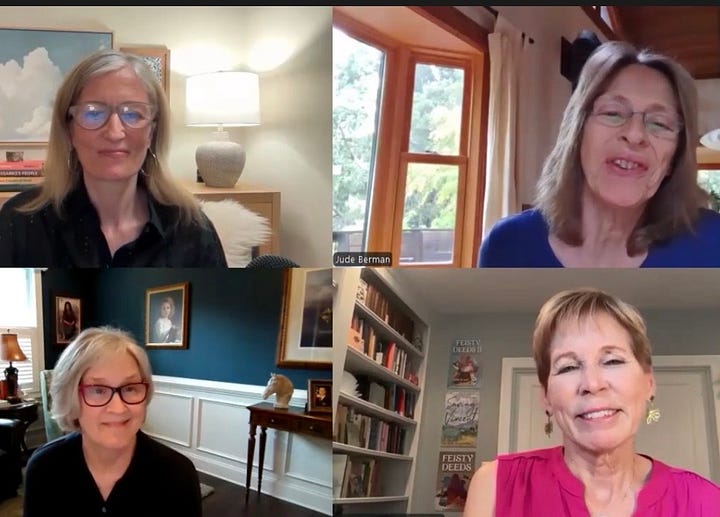
Zoom photo of the “Art of Independence” video panel and live Q&A I collaborated on with sister authors Jude Berman, Mary Cassatt and Herstory Revisited (N.J. Mastro). If you missed the video, here’s the page.
“Digging In” is now a Youtube Channel! Check it out Digging In Youtube Channel. I’m gradually loading all my short reels to the page.
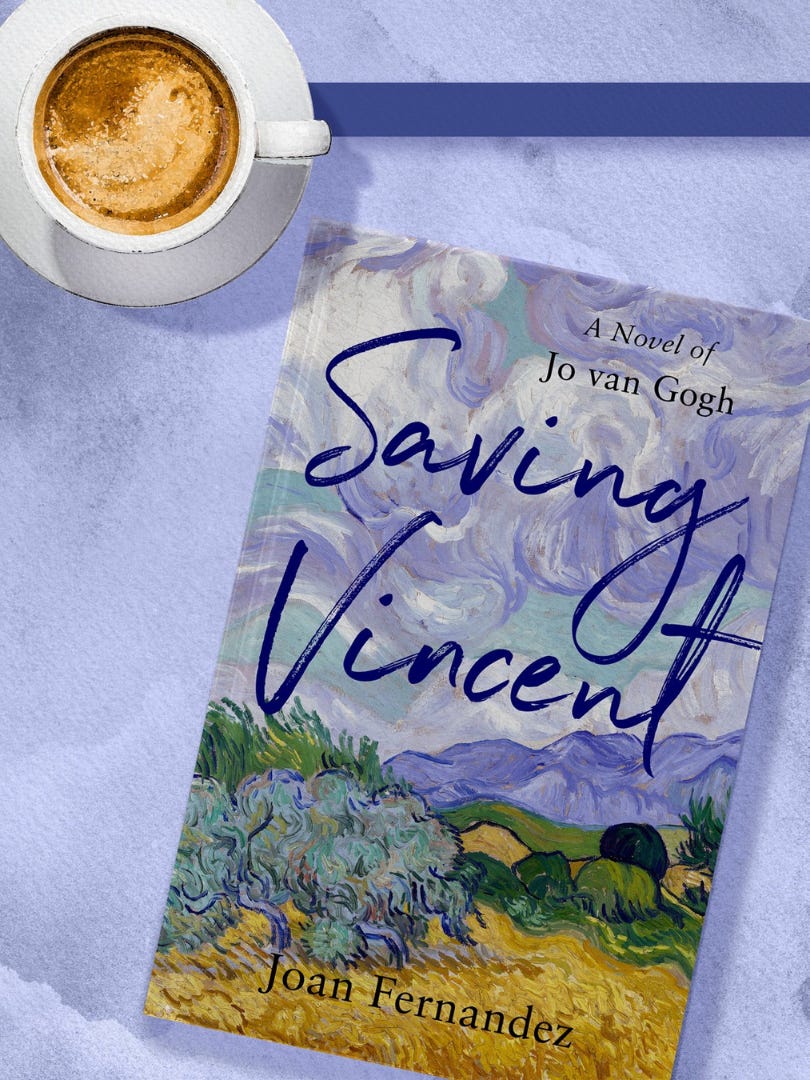
I have a Sneak Peek for you! As a thank you for subscribing to this newsletter and following my journey with Jo and Vincent and Theo, I’m offering this Free Sneak Peek of the First Chapter of Saving Vincent. It includes insider scoop with research and extra info. Enjoy!
Comments
Nothing yet. Say the first thing.
Sign in to join the conversation.