
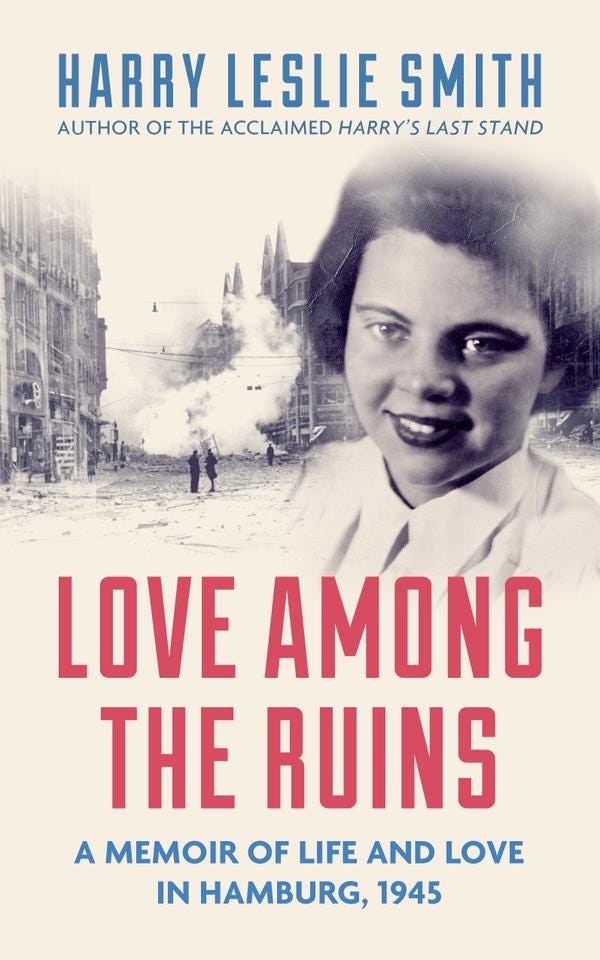
We are now at Chapter 6 of Love Among the Ruins, the second volume of Harry Leslie Smith’s The Green and Pleasant Land trilogy.
Recently, I inscribed these words in a copy of the book for a supporter. As I wrote them, I realised they perfectly capture how my father would have felt about each and every one of you who has chosen to read this chapter, and his books.
My father wrote his books to bear witness to history and to remind people never to make his past our future. Yet in Love Among the Ruins, he also wanted readers to remember the joy and hope that accompanied peace, and the building of the Welfare State.
I know he would have been delighted to welcome a new reader into the world he left behind.
Chapter 6
Behind the screen door
Occupied Germany was much like a boarding house in the seaside town of Bridlington. Every farce or tragedy was hidden behind closed doors. In Fuhlsbüttel, the people kept schtum and thought it good table manners. Their ability to conceal unpleasant truths was so sophisticated, a statue of the three wise monkeys wouldn’t have been out of place on the main square. The town was adept at ignoring evil, but their true talents lay in doing evil with suburban routine at the local gaol.
Known by locals and inmates as KolaFu (a contraction of Konzentrationslager Fuhlsbüttel), it was constructed in 1911 to house drunks, wife-beaters and swindlers. By the time British forces liberated it on 3 May 1945, it had become a way station for Nazi Germany’s undesirables. Many of the region’s Jews, gypsies, communists and Jehovah’s Witnesses, along with Russian slave labourers, marked time at KolaFu before being dispatched to their deaths at Buchenwald and Ravensbrück.
In the last month of the war, Himmler ordered that the memory of the camp and its prisoners were to be erased from Fuhlsbüttel. On 12 April, the remaining prisoners were marched out of Fuhlsbüttel and north to the port at Kiel. The SS hoped the prisoners of KolaFu might disappear into the Baltic Sea fog.
It was difficult to comprehend that this quiet, bucolic retreat from Hamburg was a willing accomplice to the Holocaust. Barbarity seemed as out of place in Fuhlsbüttel as litter on the streets or untended gardens. Like people who can’t remember where they put their keys, Fuhlsbüttel collectively forgot about KolaFu or the prisoners’ death march along Langenhorner Chaussee. I did wonder if, on their way to extermination, the prisoners passed Friede’s apartment. But much like the first wise monkey, I thought it prudent to hear no evil.
I was now in Friede’s company as often as my duties at the airport allowed. We found it difficult to find any privacy for love-making, except on weekday afternoons at her mother’s apartment. Intimacy became more complicated for us after the Gellersons, a homeless couple, were allocated a portion of the apartment by the occupying authorities. When Friede’s widowed grandfather showed up at their door, the apartment truly became claustrophobic.
‘He isn’t even my real Opa [grandpa],’ Friede said with disdain, ‘because my mother is also a bastard.’
‘Then who is he?’ I asked.
‘A miserable old man who says spiteful things about Mutti and me any chance he gets.’
Before one of our afternoon trysts, Friede greeted me on the street with a kiss and said, ‘I was getting worried that you wouldn’t show. Opa and I have had a terrible row.’
‘Nothing could stop me from seeing you,’ I told her. ‘Look, I brought you some fresh supplies. There is enough meat, veg and wine to last everyone a week.’
‘Wonderful, but remember I have to make sure my foster parents get some of the provisions because they can’t survive on their rations.’
‘I’ve only got two hands,’ I retorted, overwhelmed by her entire family’s need for extra food.
‘I know it is hard for you to keep pinching stuff from the base, but it is keeping us from becoming beggars on the street. Look, you can see for yourself what good you have done me. The sores on my legs are healing because of the vitamins you got for me.’
When we entered the apartment, a sullen old man greeted me. It was the cuckolded grandfather. He snarled at me in unintelligible German. ‘What’s up with him?’ I asked.
‘Oh, he is in one of his moods today. Isn’t that right, Opa?’ she asked sarcastically.
Friede turned to me and explained: ‘He has been on his hobby horse all day. About how everyone is stealing from him. How he never gets enough to eat. Stealing what, I ask? He hasn’t had a pfennig to his name since 1913. Before you arrived, he screamed that Mutti and I showed him no respect. We were just illegitimate guttersnipes. I gave the ingrate an earful. I told him he was lucky Mutti let him stay, considering he chucked her out when she was twelve years old.
‘That is when he got nasty. Isn’t that right, Opa? You went on about how the Nazis knew how to do things and wouldn’t allow an old man to be treated like rubbish by the daughter of a whore.’
The unshaven old man sat on a wooden stool. He wore thick, uncomfortable woollen trousers held up by bulky braces. He looked as thin and fragile as a tall blade of grass in the dry season. The old man muttered, ‘Thunder and lightning.’
‘Harry, please give him a cigarette or else we will get no peace.’
I pulled out my cigarette case and offered him a Player’s. With shaking hands, he pulled one to his mouth. For a moment, our eyes met; his were filled with watery hatred for everything around him.
‘Come,’ Friede said. ‘Let’s get out of the kitchen. I don’t know how long we’ve got until the Gellersons come back. Bring a bottle of wine with you. We’ll take it to my room,’ she said playfully.
It really wasn’t a room, but an alcove that housed a wood-stove and a chaise longue. The walls were thin and covered with heavy floral wallpaper. Along the wall, Friede had pinned up small photos of her girlfriends and glamour shots of German movie stars cut from defunct magazines published during the war.
We put some pillows behind our backs and propped ourselves up on the day bed. We drank warm Rhine wine out of a shared coffee cup and ate slices of bread slathered thick with butter. ‘Did you hear,’ Friede said excitedly, ‘the British have started up Radio Hamburg again. So we can finally listen to jazz and dance music banned by the Nazis.’
I laughed and sipped back my wine. I thought these moments with her were the closest to paradise I had ever got in my short and squalid life. Lying beside Friede was like a wish come true from Aladdin’s lamp. To me, she was as mysterious as the sphinx and as sensual as nightfall in an exotic garden. I clung tightly to the hope that my desire for her was more than physical want, and that her interest in me went beyond food parcels. Perhaps that was all we could demand from each other after a long war.
We finished half a bottle of wine, and I sang silly songs. I made extravagant compliments to her eyes, her hair, her body, and her soul. After a while, we undressed each other. We made love on the chaise longue, which was just large enough for us to hold each other tightly, in a selfish and generous longing. For a long time, we remained in Friede’s small lair, while outside the thin shuttered door the old man raged against the occupation, his life, and his new lodgings. The din slowly dissipated and faded into the background like a smudge on the wallpaper.
I must have dosed off because I woke to the nakedness of her back and the curve of her spine. I traced my fingers against her skin and noticed that just below Friede’s left shoulder she carried a horrible discoloured scar. ‘What are you doing back there?’ she asked in a sleepy voice.
‘Nothing,’ I replied nervously as if I had been caught eavesdropping.
‘You are staring at my war wound, aren’t you?’ she asked, turning over to kiss me on my forehead.
‘Come on then, give us a cigarette,’ Friede demanded, hungry for nicotine. She drew her knees up underneath the blanket and blew a smoke ring from her lit cigarette. ‘If you are wondering about the mark on my back, I was in a fire.’
‘Did it happen in an air raid?’ I asked.
‘Nothing so dramatic,’ she replied in a matter-of-fact tone. Friede explained that the Nazis were very big on women being perfect cake- and baby-makers for the Fatherland. At fourteen, Friede was sent by the Hitler Youth organisation to live as a domestic servant with a rich family in Coburg. She was to be taught to be a proper wife, for a proper National Socialist, in a new world where Germany controlled the globe.
Friede giggled as she explained. ‘It was a crazy fantasy world created by Himmler and Goebbels. Every girl in Germany was supposed to be like a Rhineland maiden who cooked and cleaned and fucked like a rabbit to make blue-eyed, blonde-haired Aryan babies for the Reich.’
Friede laughed and continued her story. She was sent to live with a horrible family who were fanatically pro-Hitler. ‘If I didn’t clean the silver correctly, the mother scolded me with: “If the Führer was watching you now, he would be very disappointed in you, Friede.” I think they treated their dog better than me.’
One morning while Friede was making breakfast for the family’s youngest son, her back was to the gas stove. She stood too close to the flame, and her thick woollen house coat caught fire. The little boy waiting for his meal noticed the smoke rising from Friede’s back and screamed, ‘Friedl, you are on fire.’
‘I was so stupid,’ Friede said. ‘I panicked and fled, running down the hallway.’
The last thing Friede remembered before blacking out was running down the hall towards a giant mirror. There, she stopped and watched, horrified, as her burning body reflected back into her eyes.
Friede awoke in the hospital with third-degree burns on her back. It was difficult for her to endure the pain because there was no morphine to ease her suffering. The hospital was overwhelmed with victims from a bombing raid that had caused many casualties in Coburg.
Friede said what was worse than the pain were the cries from the near-dead and dying all around her.
‘It was horrible. People were crying out, “Jesus, save me. God help me, someone please help me.” I was so afraid I was going to die in that hospital, and the authorities in Hamburg wouldn’t give permission for my family to visit me.’
‘What about the family you lived with as a domestic?’ I asked attentively.
‘That stupid family, they came once, maybe twice,’ she said harshly. ‘The mother wanted to make sure the doctors understood that my injuries were from my own foolishness. You see, they were a good National Socialist family who always took the correct safety precautions. They didn’t want any problems from the police because of my accident.’
‘It must have been very lonely.’
‘It was,’ she said with her eyes closed and her back resting on a pillow. ‘But there was a nice little boy in the bed beside mine. He called me Edelweiss. His legs were crushed after a building collapsed on him in the bombing. He was very sick, but he was always optimistic and happy, and then one day he said, “Edelweiss, I can’t feel my legs.” It was gangrene, and he was dead the next day,’ she finished sadly. ‘I don’t think he was more than eight.’
‘Well, now you know how I got my mark. Later, I will tell you about the time I was evacuated to a farm near Coburg. I really enjoyed living with that family, but it had its negative side. Their grandfather was a deviant and tried to molest the girl evacuees when they used the outdoor privy.’
Friede crushed her cigarette into a saucer and hastily jumped out of bed. I watched her quickly throw on some clothes.
‘You’d better go,’ she said. ‘Mutti will be back soon. I don’t want her to meet you like this, stark naked with a glass of wine in your hands.’
‘When will I get to meet your mother?’ I asked.
Friede was frantically brushing her shiny hair in front of a tiny mirror hanging from the wall. ‘You will meet Mutti on my birthday, which is less than a month away. I can guarantee you on October 20th we will be on our best behaviour and not at each other’s throats, like we will be today. Especially if she sees you now, looking like some afternoon Casanova. Come on then, I can hear the Gellersons coming through the door, get up.’
I stood up from the makeshift bed. I picked my uniform off the floor while Friede straightened up her room.
Just before she opened the door and breached the safety of her bedroom, Friede said: ‘Before you go, give Opa a few cigarettes; he will be less mean to me when you are gone.’
I followed her out and noticed that the old man had not stirred from the kitchen. Suddenly, the front door opened, and the Gellersons entered.
It looked like they had been foraging for supplies because they were carrying potatoes and firewood for the oven. They greeted Friede warmly and ignored both the old man and me.
Before I left, I handed the old man a half packet of cigarettes. He grumbled, ‘Danke schön.’ It could have been fuck you, judging by the tone of his voice. I gave Friede a perfunctory peck on the cheek and departed for the base.
It was dusk, but there was still a steady stream of refugees making their way through town. On the way back to camp, I whistled the tune from ‘The Teddy Bears’ Picnic’ and ignored the dispossessed and homeless spawning down the road.
Not far from our camp gates, I stumbled onto a family stalled on the road. Their cadaverous horse refused to drag the family’s rickety cart an inch further. It looked like the beast had probably hauled this family and their weighty, useless possessions along the eastern corridor only paces ahead of the Russian army for the past three months. The children on the wagon looked anaemic, stricken by both terror and extreme hunger. In contrast, at the front of the trap, the parents looked equally desolate.
The father cursed the horse as it stood stooped in the middle of a crossroads. He jumped off his wagon and lashed the animal with threats of God’s damnation. Froth dripped from the horse’s mouth and puddles of foam formed on the cobblestone street below. The man drew a flashing leather whip from his wagon and began to beat the animal. The horse’s thin hide was pierced by each lash, while its eyes bulged out of their sockets from pain and hunger.
The blows quickly became too much for the horse; a groan erupted from its mouth. It sounded sad and resigned, and it said no more. The horse’s bulging eyes turned upwards, and watery turds fell exhausted from its backside. Its head twisted up and towards me like a ship before its stern dragged the bow to the ocean’s depths. The horse’s agony was over in seconds. It dropped dead to the ground, still shackled to its shuck. Even though the horse weighed nothing, it still brought the cart down on its side. The mother in the front of the wagon and the children at the rear crashed down onto the pavement. The contents of their lives aimlessly spilt from the broken wagon and onto the road.
Crumpled on the side of the road, the mother wailed in indecipherable German. The peasant woman made the sign of the cross. But I thought God had left some time ago and no one had taken over his shift.
The father stood over the animal. He looked as perplexed as a motorist peering under a car bonnet billowing with steam. It was the expression of, ‘How could this have happened? I had this car serviced only a month ago.’ He dropped the whip and unshackled the horse to right the cart. Then he reloaded the cargo that had fallen across the road. The children climbed onto the back of the cart, the mother sat in the front and continued to gesticulate to Jesus, while the father took the dead horse’s place. The man slowly pulled the cart, with his family and the jetsam of their life, away from the crossroads.
The dead horse looked like a pile of old clothes dropped on the cobbled streets. Its lifeless eye stared up into the setting sun. Before flies had time to settle on the dead beast, an old woman came out of her house. She began cutting into the horse’s belly and yanked out chunks of flesh and threw them into a leather bag.
Others gathered around the old crone and followed her example. They hovered over the horse’s corpse with pocket knives or hatchets. They roughly butchered the warm body of the dead animal.
I walked around the famished mob hacking and sawing away and jogged back to camp. The guard on duty at the gate recognised me and said, ‘You always come back to camp looking a stone lighter than when you left.’
‘One of the many benefits of walking,’ I replied.
‘As long as you stick to walking and no monkey business, you be all right, Harry.’
‘Too right,’ I agreed and passed through the gates. Inside, my mind was calculating how to keep Friede and her family alive through the autumn, let alone the winter, on stolen rations.
Thank you for reading and supporting my Substack.
Your support helps keep me housed and allows me to keep Harry Leslie Smith’s legacy alive.
Living with cancer and lung disease makes life more challenging, especially during this cost-of-living crisis. Every bit of support goes a long way. Below, I’ve included a tip jar. It helps pay the rent and keeps a candle burning for The Harry’s Last Stand Project.
Over the last 18 months, I’ve worked to complete my dad’s The Green and Pleasant Land, the unfinished history of his generation’s youth that Harry left behind.
The manuscript is now complete, apart from a few minor edits. It traces his life from his birth in the Barnsley slums in 1923 to Labour’s landslide victory in the general election of July 1945, and the birth of Britain’s Welfare State.
No posts
Comments
Nothing yet. Say the first thing.
Sign in to join the conversation.