
The following reflection is a composite of stories from my emergency medicine rotations. Each case is grounded in a real encounter, with identifying details changed for privacy.
“Dr. Lind, you were supposed to give the patient 6 milligrams, not 6 grams.”
My evening alarm wakes me from a recurring nightmare. In real life, I’m on my emergency medicine rotation, having supposedly “flipped” my schedule from 12-hour dayshifts to 12-hour nightshifts. But there’s construction in the apartment next door and a parade of ambulances outside my window, so I’ve been running on fumes. I roll out of bed and into my scrubs, eager for “breakfast” (dinner for the rest of us).
Torrey is a saint and made bacon and eggs to maintain the illusion. Our 18-month-old daughter has already cleaned her plate and is sneaking scraps to our dog Lola, who energetically licks her fingers. Lola is a rescue with anxiety and leash aggression refractory to our many attempts at healing, from treats and training courses to electric shocks and antidepressants. We’ve resigned ourselves to a chain collar that at least dampens the barking.
I say grace for our food and dig in. Sometimes I’m struck by the mysterious chain of events linking the food on my plate to the mercies of the Lord—but right now, I just want fuel. I don’t think about how the pig whose cooked innards I’m chewing spent most of his life in a concrete stall barely bigger than his body. He never went outside and was force-fed until his first half-birthday, at which point he was huddled into a metal gondola and drowned in CO2, thrashing for a minute or so before his throat was cut. That’s how about 70 million pigs die in America each year. The hen whose eggs I’m now soaking in Tabasco fared marginally better, “cage-free” and all. She was packed into a warehouse with thousands of other chickens who never went outside, lights on to force their cycle, calcium pulled from brittle bones. When her production slowed, she was stunned and cut for meat, joining another 9 billion American chickens annually, supported by grassroots funding from folks like me. I scarf it all down in five minutes before kissing my wife and child goodbye.
On the way out, I’m careful to close the door quietly so as not to attract the attention of our neighbors. One of them is blind and frequently asks for help, and I’m in a time crunch. I used to assist her around the apartment, but ever since she screamed bloody murder at that Spanish-speaking woman for using the shared washing machine, I’ve been trying to set some boundaries. On the way to the hospital, I walk past another disabled man camped on the side of the road, swearing at something unseen as he asks for change. I pretend not to notice, consoling myself with the thought that if he really needs my help, we’ll meet again soon enough.
The ER is crowded, so tonight’s handoff is harrowing. “34-year-old female, G2P1 at 6 weeks by last menstrual period, positive beta-HCG, presenting with lower abdominal pain and vaginal bleeding—ectopic rule-out, transvaginal ultrasound pending. Stable, OB hasn’t dropped recs yet, hopefully not much to do.” The day team signs out another seven patients to me in this manner. Thankfully only one is unstable, so I’ll say a quick hello before seeing the new patients. In the time it took for the day team to sign out, two more names have been added to the board.
The unstable patient is an older man with COPD and now COVID pneumonia, having passed on the vaccine after hearing “bad things” about it on a podcast. He’s currently on six liters of oxygen but barely keeping up, with his oximeter readings dropping as I approach. Together with the nurse we suction out some of the secretions that he’s been gargling through, hoping it’s a mucus plug that will pass. It does, and once his oxygen comes up a bit, I’m free to see the new patients. He may be headed to the ICU.
First up is an undomiciled man who looks eerily similar to that guy I walked by on the way to the hospital. His vital signs are fine but he’s out cold; a bystander had told EMS that they saw him trip on a curb, dropping an empty liter of vodka. A quick chart review shows me that he’s been to the ER dozens of times for similar problems involving intoxication. There’s no report of headstrike, but when I teeter on whether or not to get imaging, my senior cuts me off: “Get the scan. Do the full workup. It’ll give him enough time to get a nap and a meal, and when it comes time to actually do the scan, he’ll walk out.”
Next up is a similar but different case: a young Florida woman visiting the Hamptons for a bachelorette party, brought in by the NYPD after assaulting staff at some lounge. She was apparently pretty drowsy when they picked her up, but she’s awake now and trying out new swear words on me. I’m aiming to get a sense of whether she ingested a dangerous amount of anything besides alcohol, but the conversation is going nowhere, and I have other patients to see. Her vital signs are good enough. I let her know that I’ll circle back once she’s had a bit more time to sober up, which doesn’t land well. She sends me off with two high-flying birds.
A few minutes later I’m telling that pregnant patient from earlier that she does, in fact, have an ectopic pregnancy. I explain that, though she’s feeling medically okay right now, there are serious risks associated with carrying the pregnancy to term. It’s a terrible and terribly brief conversation, given the time constraints of the emergency room. When I ask if there’s anything else bothering her, she mentions back pain. I ask her what’s been helpful to date, and she says she’s been on ibuprofen (which is associated with birth complications) ever since the government falsely claimed that Tylenol causes autism. That’s the same government that feeds off a hearty bite of my paycheck every two weeks. I look at the clock—it’s only 9pm.
There’s a steady stream of new patients and problems for the next five hours, each person experiencing what amounts to a momentous occasion in their own life: an inflamed appendix soon to be removed, a gangrenous foot soon to be amputated, a supposed stroke that’s actually a migraine, a supposed heart attack that’s actually a panic attack. I’m called to the trauma bay to watch a woman being rolled in with sunglasses over her black-and-blue eyes, her swollen head cracked open by a violent boyfriend who nearly killed her. I’m surprised by the effect that the case has on my senior resident, whose gallows humor lapses for a moment as he chokes back tears. It takes him all of about thirty seconds to snap back.
All my patients are stable with plans in place by 2am, so it’s time to get “lunch.” I forgot my Nalgene so I buy a disposable plastic bottle of water along with a disposable plastic cup of iced coffee to go with my disposable plastic tray carrying my factory-farmed chicken sandwich. The bottle will fragment into micro and then nano plastics over the next 400 years or so, accumulating in our oceans and atmosphere and lungs. I ruminate briefly on the news about microplastics discovered in autopsies. Future generations might curse us for our selfishness, vandalizing creation not out of need but out of want—a tastier sandwich, a cheaper convenience. We know this, but we’re addicted. Paper straws get mushy, so I get plastic.
Cases are still trickling in, but the slower pace affords some small talk. It starts dry and educational, focused on social determinants of health and barriers to care, before taking a cynical turn toward the insurance companies and private equity firms driving up costs and undercutting care. One of my attending’s favorite memes is a scene from Rugrats where Stu Pickles is making chocolate pudding at 4am, lamenting that he’s lost control of his life. It’s 4am now in the ER, but there’s no pudding to be found.
Our questionable coping session is interrupted by a cry for help. A man is now posturing and spitting at his nurse, who says he’s threatening her for opioids. The scene is a circus and we are the spectators, trying to defuse the situation with words so that we don’t have to call security or order sedating meds. Carnies used to shout “Hey, Rube!” as a rallying cry when they got into fights with the townspeople, which seems apt for the moment. Thankfully he’s open to negotiation. He gets his Percocets per his home regimen and is asleep ten minutes later.
When the dust settles and I see that the board miraculously remains clear of new names, I realize that I might have a chance to catch the sun rising over the East River, a site usually obscured by skyscrapers and high rises. Our hospital is on the water and my senior gave me the go-ahead, so when the time comes I slip out into the ambulance bay and squeeze through a gap in the brick pillars, my face splashed with the warm glow of the sun peering over Queens. The rays of light have finished their voyage across the Atlantic and will soon run the span of the country. I’m one of the first Americans to meet them.
My patriotism is interrupted by the sad wail of an approaching ambulance. I slip back inside in time to man the nearest computer, hoping to get a jump on the orders. They won’t be necessary. My shift ends with the bleakest case of the day: a young woman who jumped off a building. It seems obvious that her suicide attempt was successful the moment they wheel her in, but EMS has started CPR, so we’ll need to finish it. I’m pumping her heart with chest compressions, my gloves slipping in the fluid. My shirt might be stained, but no worries—these scrubs are cheap, put together by poorly paid factory workers overseas. I’ll buy another.
The walk home is tranquil and free of anyone asking for change. I tiptoe across the floor to our apartment, careful to sail beneath the radar of our blind neighbor, who I can overhear yelling at someone on the phone. I think of the last time I saw her, when her strange behavior left me wondering (a bit shamefully) whether she was truly blind. But she has to be, right? Imagine how much energy it would take to spend your whole life pretending you’re blind.
I peel off my scrubs and slump to bed, wired-tired as the morning light streams in. On my bedside is Augustine’s Confessions, a book I’ve often quoted but never read. It’s a classic that I figured was overdue, though my page-a-day pace has dulled its spiritual effects. Now I rely on it to wind down.
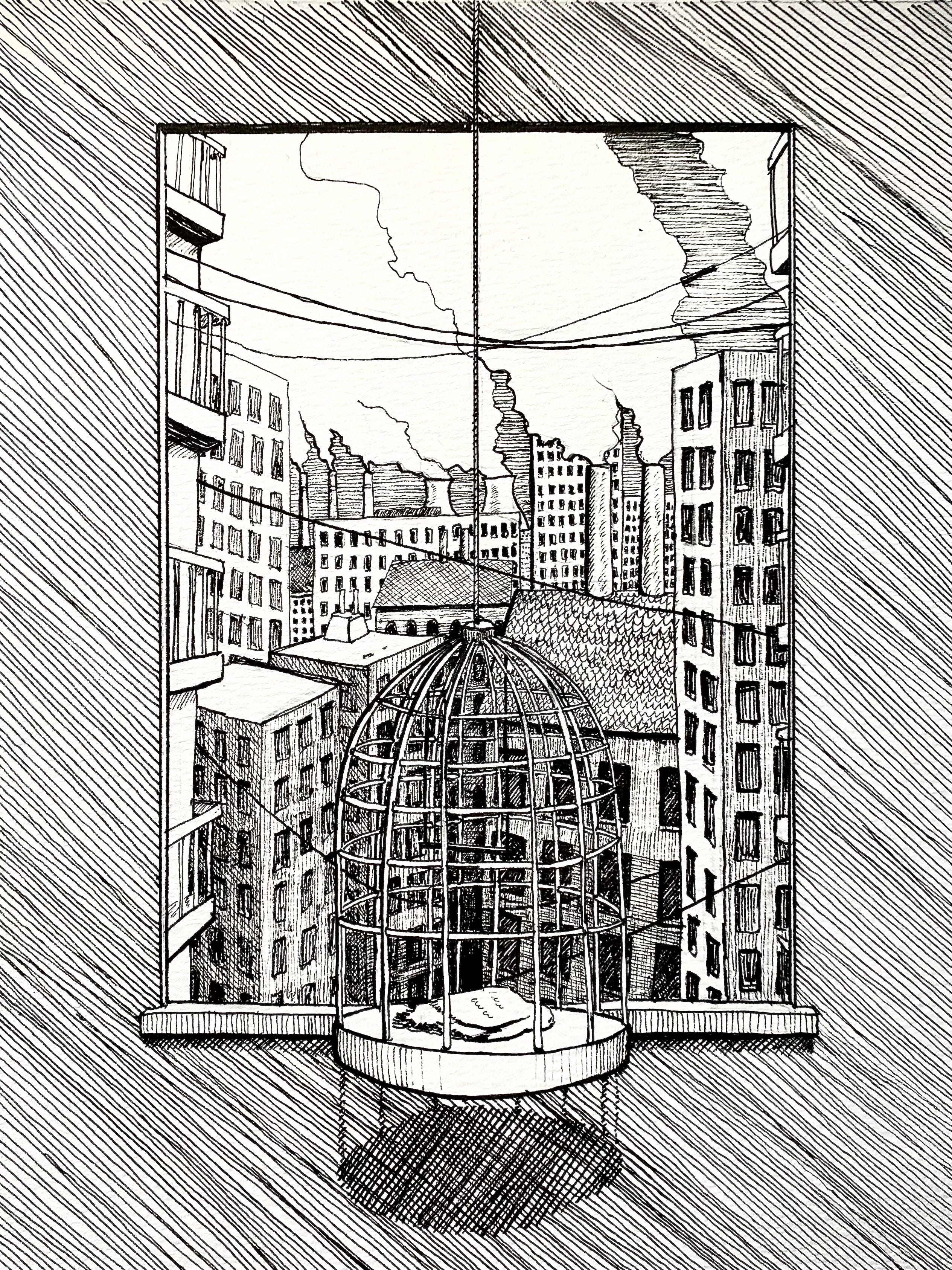
The enemy possessed my wanting, and from it he had constructed a chain for me and constricted me in it. Inordinate desire arises from a twisting of the will; and in the course of slavery to this desire, habit forms; and through lack of resistance to this desire, a certain inevitability emerges. With these links, as it were, interconnected (and that’s why I’ve called this a chain), a harsh slavery held me tightly in check.
What a beautiful passage. I highlight it, hoping to quote it in a book or essay some day. That’ll do for now, though. I close my eyes and fall asleep.
No posts
Comments
Nothing yet. Say the first thing.
Sign in to join the conversation.