
When we began excavating at Skipwith, I thought I knew what the story was.
An Early Religious Centre
The church was the obvious focus, but not where we began our work. Beneath the tower lay evidence for an earlier church, Anglo-Saxon burials and fragments of carved stone sculpture. The site seemed to fit neatly into a growing body of research suggesting that Skipwith may once have been an important early religious centre.
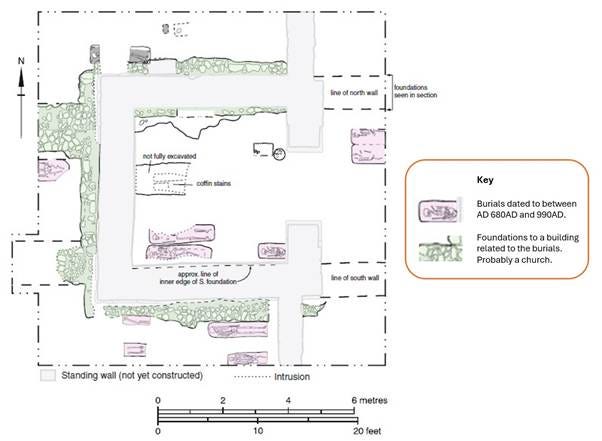
Plan based on York Archaeological Trust work showing an earlier structure and datable burials. Could this be a Minster church?
Like many archaeologists, I found myself drawn towards the big names and big events of history. Could this have been one of the religious communities established during the great Christian transformation of Northumbria? Might it even connect, however distantly, with King Oswiu and the church expansion that followed his victory at the Battle of the Winwaed in AD 655?
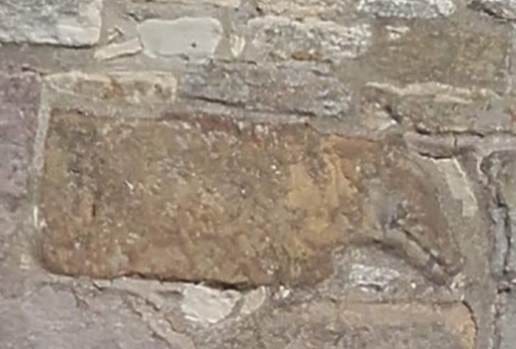
The Bear Stone. Possibly an arm from an Anglo-Saxon Stone Chair
Those questions remain interesting.
But increasingly I suspect they may not be the most important ones.
Recent reading has led me in a different direction. Instead of asking who founded Skipwith, I have begun asking why power remained focused on this small corner of Yorkshire for so long.
The archaeology suggests that something significant was happening here by the late seventh century. A church was built and burials began to fill the cemetery around it. A stylus found in a field opposite hints at literacy. Two pieces of Anglo-Saxon sculpture were built into the later church tower. One burial may even have been placed within a wooden chest rather than a simple grave.
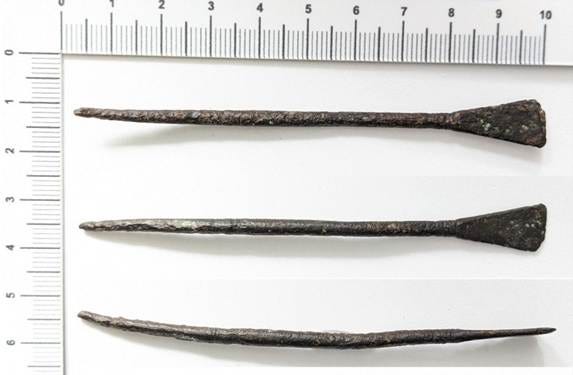
Three different views of the Early Medieval Stylus from Skipwith
This was clearly more than an ordinary village church back around 700AD. Perhaps it was a Minster as suggested by Thomas Pickles (in his book Kingship Society and the Church in Anglo-Saxon Yorkshire, published in 2018.
Yet the story does not end there.
Rebuilding Power
Around a thousand years ago the earlier (Minster?) church appears to have been dismantled and replaced by the substantial tower church that still dominates the village today. This was not simply a repair job. It represented investment, planning and resources. Somebody wanted to make a statement.
The rebuilding is particularly intriguing because it took place during a period when local elites across England increasingly expressed wealth and authority through churches, residences and estate centres (as pointed out by David Gould and others in their paper Where Power Lies: Lordly Power Centres in the English Landscape, published in 2025). The earlier church could have been maintained. Instead, it was replaced with a more substantial building. The decision suggests confidence, ambition and access to resources. Seen in this light, the rebuilding of Skipwith may tell us as much about power as it does about religion.
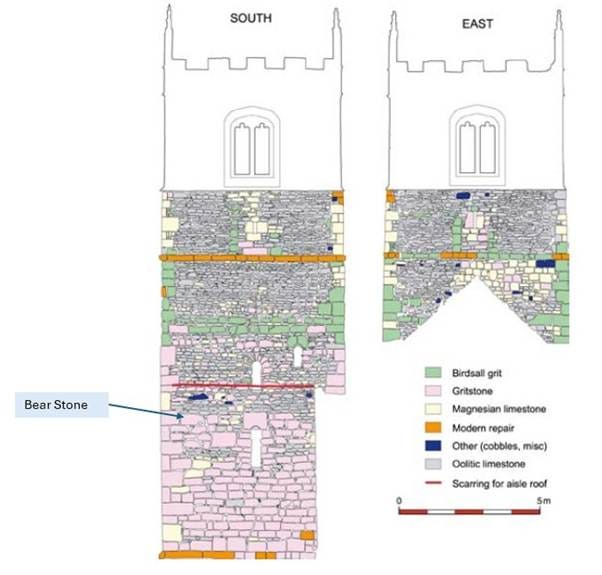
Recordings of the south and east facing aspects of the church tower.
Note the Bear Stone rebuilt into the tower.
For a long time, I viewed this rebuilding purely as a church story.
Now I wonder whether it was also a story about power.
Recent research into early medieval lordship suggests that churches and elite residences often formed part of the same landscape. Lords expressed authority through churches, halls, enclosure ditches and control of land. Power was not merely exercised; it was displayed.
Which raises an intriguing question.
If Skipwith possessed an important church around AD 1000, where was the lord’s residence?
The answer remains elusive. No Anglo-Saxon Hall has yet been found. But once the question is asked, the village begins to look rather different.
Instead of seeing a church standing in isolation, I find myself imagining a wider landscape of authority. Priests and worshippers. Estate officials and tenants. Fields, rents and obligations. A place where religious and secular power may have existed side by side.
The Norman Conquest complicated matters further.
Three Hundred Years of Shared Authority
For the next three centuries authority appears to have been divided. The church increasingly operated under the influence of the Bishops of Durham. The de Skipwith family emerged as important local lords. Royal government imposed its own taxes, laws and expectations.
Nobody held all the cards.
What historians describe as fragmented authority may have felt very different to the people working the surrounding fields. They still had crops to grow, rents to pay and families to support. If anything, they may have found themselves answering to more masters rather than fewer.
And perhaps this is where the story becomes most interesting.
Archaeologists are naturally attracted to churches, moats and manor houses because they survive. Yet none of them could have existed without the labour of ordinary villagers.
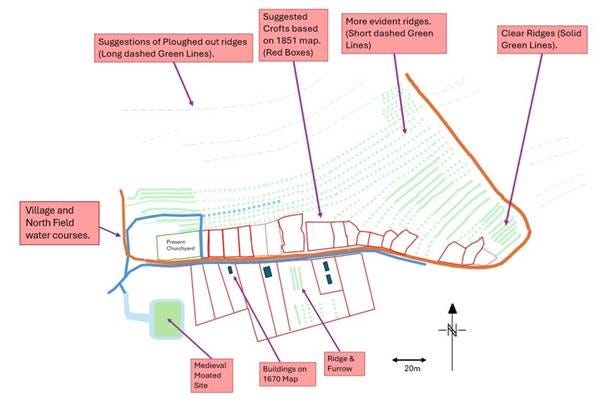
Plan to show relationships between the church, Moated site and village tofts and crofts
The church was built by local hands.
The fields that supported the priests were worked by local families.
The rents that enriched the lords came from local farmers on the great fields surrounding the township.
The great monuments of Skipwith were ultimately created by people whose names are now lost.
The Return of the Lords
By around 1400 the balance appears to have shifted once again. For perhaps three centuries authority within Skipwith had been shared and negotiated between church, lordship and Crown. By the late fourteenth century that balance appears to have moved decisively in favour of the de Skipwith family.
The family consolidated control over the township and expanded the moated manor. By then they were no longer merely local landowners. Their interests stretched well beyond Yorkshire. Yet they still chose to invest in their ancestral estate.
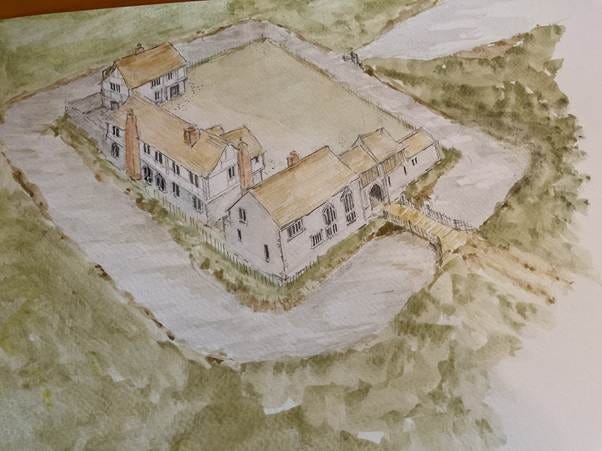
Artists impression of rebuilt Skipwith manor after 1400 (John Broadbridge)
The People Behind the Monuments
The enlarged manor was a statement of power.
But it was also the latest chapter in a story that had already been unfolding for seven centuries.
Perhaps that is what fascinates me most about Skipwith.
Not whether a particular king once granted the estate to a monastery or a minster.
Not whether a famous lord lived in a particular hall.
But how power continually reinvented itself in the same landscape.
The church changed.
The lords changed.
The institutions changed.
Yet generation after generation of villagers continued to live, work and die in their shadow.
Today the church, moated manor and village can still be seen within a single landscape. Together they preserve the physical expression of seven centuries of changing authority.
Our excavations began by revealing a moated site. York Archaeological Trust revealed an early church.
Increasingly, however, I suspect they are revealing something much bigger. The church, the manor and even the village itself may be chapters in the same long story: the story of how power was expressed, challenged and reinvented in one small corner of Yorkshire.
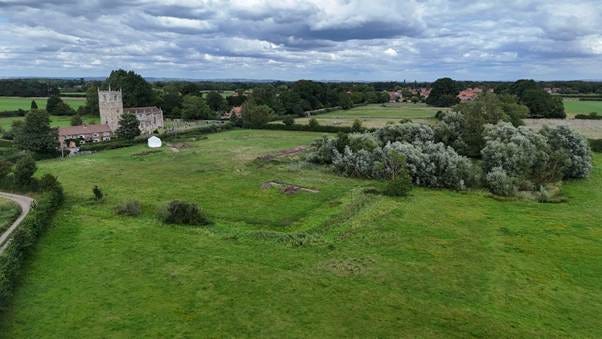
Aerial image of Skipwith showing church to the left (north), moated site to the right (south) and the village stretching to the distance (east).
No posts
Comments
Nothing yet. Say the first thing.
Sign in to join the conversation.