
When most people think about the fourteenth century, they think about disaster.
The Great Famine devastated harvests. The Black Death killed perhaps half of England’s population. War with France drained resources. Peasant unrest challenged the old order. Kings were deposed and murdered.
It was not an easy time to be alive.
Yet archaeology occasionally forces us to ask uncomfortable questions.
What if some people benefited?
Over the last few years, I have been involved in community archaeology projects at three medieval moated sites in the lower Ouse and Derwent valleys of Yorkshire: Skipwith, Hook and Cawood.
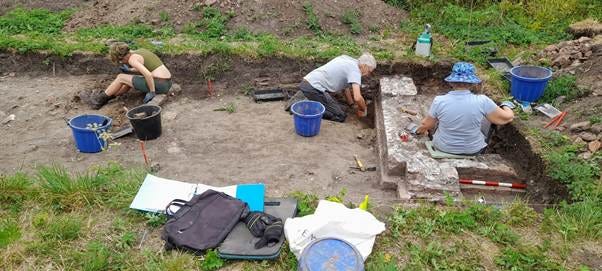
Community Excavation at Skipwith
At first glance they appear to tell similar stories. Each was the home of a local lord. Each was surrounded by water. Each represented status and authority within its community.
But the more I have worked on these sites, the more I have become interested in the families behind them.
Because they did not all experience the fourteenth century in the same way.
Some prospered; some stood still; some slowly disappeared from the local landscape altogether.
Three Families
The de Skipwiths were the most successful.
Originally one of several interests within the manor of Skipwith, they steadily expanded their influence through marriage, inheritance and investment. By around 1400 they had consolidated control of the estate and undertook a major rebuilding of the moated manor. The original hall became part of a much larger residence with additional ranges extending across the platform.
The archaeology reflects growing confidence.
Ironically, the more successful the de Skipwith family became, the less central Skipwith itself became to their fortunes. By the fifteenth century they had become a regional family with interests extending well beyond the village that had given them their name.
The de Hooks also prospered, at least initially.
Their moated site near Goole was substantially remodelled during the early fourteenth century. New platforms were created. Existing areas were raised and rebuilt. The manor became a carefully organised landscape separating domestic, agricultural and possibly garden spaces.
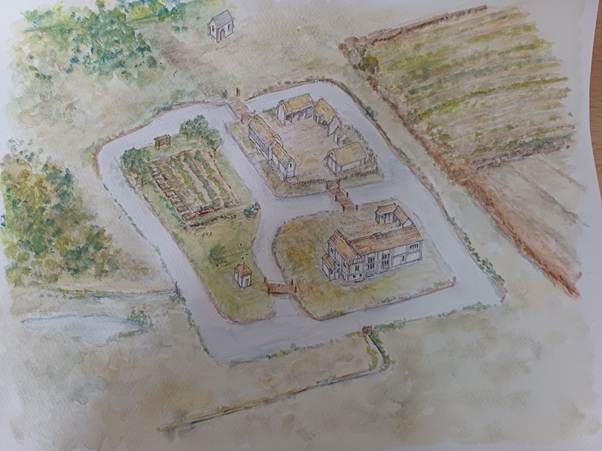
Reconstruction imagining of Hook moated site circa 1325
Their ambitions are written into the earthworks. The de Cawoods tell a different story.
They held half the township of Cawood and occupied a moated manor immediately south of the archbishop’s great residence. Yet unlike the de Skipwiths or de Hooks they never developed a wider network of estates. They remained local landowners living beside one of the most powerful ecclesiastical lords in England.
Archaeologically there is little evidence for major expansion.
While their neighbours prospered, the de Cawoods appear to have remained largely where they started.
Together these families raise an intriguing question.
Why did their fortunes diverge so dramatically during one of the most turbulent centuries in English history?
Not Castles, But Statements
One clue lies in the remarkable investment visible at all three sites.
The lower Ouse landscape contains surprisingly few castles.
That is perhaps unsurprising. The region already lay within the shadow of major centres of power. York possessed its royal castle. The archbishops maintained their palace at Cawood. Great aristocratic families dominated places such as Sheriff Hutton and Wressel.
Lesser landowners were unlikely to compete directly with such neighbours.
Instead, they developed a different language of authority.
The moat became their statement.
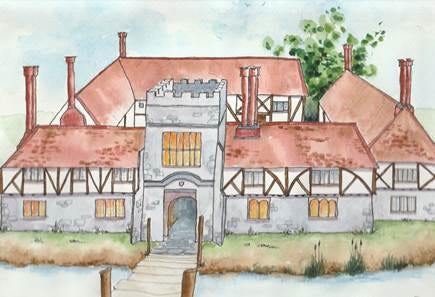
Reconstruction imagining of the courtyarded manor at Skipwith rebuilt after 1400
Crossing a bridge onto a moated island physically separated the lord’s household from the surrounding community. The water marked a boundary between ordinary and privileged space.
These were not defensive fortresses.
They were carefully constructed landscapes of status.
At Skipwith, Hook and Cawood the moats announced wealth, authority and aspiration to anyone approaching the site.
The Archaeology of Ambition
The excavations reveal that these were far more than simple farmsteads.
At Skipwith, the moat enclosed a carefully organised courtyard residence. Water was managed with considerable skill, allowing both drainage and control of supply.
At Hook, new platforms were created and existing ones enlarged, an inner garth was created, a garden was included, suggesting significant investment in the appearance and functioning of the manor.
At Cawood, both the archbishop’s garth and the neighbouring de Cawood manor demonstrate how water, industry, transport and display could be combined into expressions of power:
Gardens; Bridges; Stone (partly at least) buildings; Towers; Gatehouses.
These were not necessities, they were choices.
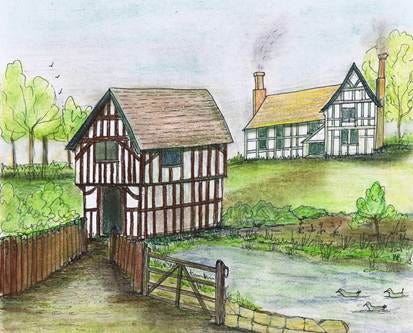
Reconstruction imagining of the timber framed hall at Cawood circa 1400
The archaeology suggests families investing in how they wished to be seen.
Opportunity in an Age of Crisis
This is where the story becomes more complicated.
The fourteenth century brought immense suffering to England. Yet crises rarely affect everyone equally.
The Black Death transformed the economic landscape. Population decline created opportunities as well as hardships. Land became more available. Estates could be consolidated. Agricultural practices adapted to new circumstances.
Families able to exploit those opportunities could prosper.
The de Skipwiths appear to have been particularly successful. By the end of the medieval period their interests extended far beyond the village that had given them their name.
The de Hooks also seem to have benefited, although less dramatically.
The de Cawoods, however, remained constrained by geography and circumstance. Living beside the Archbishop of York may have brought prestige, but it also meant competing with a neighbour who controlled the market, the mills and many of the economic advantages of the township.
The archaeology reflects these different trajectories.
The moats may look superficially similar today.
The fortunes of the families who built them were anything but.
Living in the Shadow of Great Lords
Cawood provides perhaps the most revealing contrast.
The archbishop’s palace represented power on a national scale. Stone arrived by water. Mills generated income. Gardens and walkways were designed to impress visitors while simultaneously displaying the wealth that underpinned ecclesiastical authority.
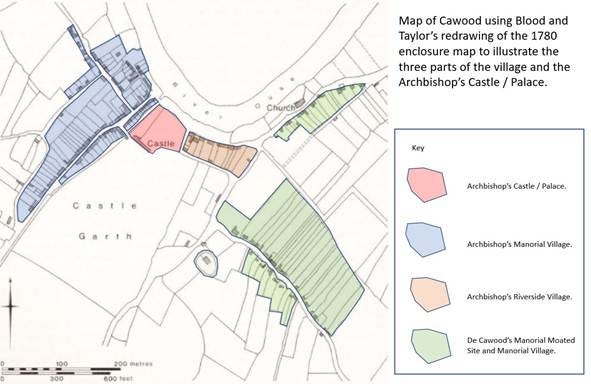
Cawood a village divided between the de Cawoods and the Archbishops
The de Cawoods adopted some of the same language of lordship through their own moated residence.
Yet they never escaped the shadow of their powerful neighbours.
Perhaps that is why Skipwith and Hook are so important.
They show what could happen when ambitious families operated beyond the immediate orbit of such overwhelming authority.
But History Never Stands Still
There is an irony at the heart of these moated landscapes.
The same changes that created opportunities for some families also undermined the world they inhabited.
As the medieval period progressed, traditional feudal relationships weakened. Labour shortages persisted. Tenants gained greater freedom. Economic power shifted in new directions.
The de Hooks declined.
The de Cawoods sought opportunities elsewhere, eventually leaving Yorkshire for a very different world.
Even the successful de Skipwiths discovered that prosperity could not last forever.
The moats remain.
The ambitions that created them do not.
Reading the Landscape Differently
When we look across the moated earthworks at Skipwith, Hook or Cawood today it is easy to see ditches, platforms and ponds. This interpretation emerges not from written documents alone but from moats, building platforms, demolished walls, garden spaces and the changing layouts revealed through excavation.
What we are really seeing are traces of ambition.
These sites were built by families trying to improve their position in a changing world. Some succeeded spectacularly. Others achieved more modest gains. Some never escaped the limitations imposed by more powerful neighbours.
The Black Death devastated medieval England.
Yet the archaeology of the lower Ouse and Derwent valleys suggests a more complicated story than simple decline.
The archaeology suggests that the winners of the Black Death were not necessarily kings or great nobles. In places such as Skipwith and Hook, local families may have used the upheavals of the fourteenth century to consolidate land, increase their status and reshape the landscape around them.
For a time, at least, some people found ways to prosper.
The moated sites of Yorkshire may be among the most visible reminders of those winners and losers.
And of how quickly fortune can change.
No posts
Comments
Nothing yet. Say the first thing.
Sign in to join the conversation.