
In September 1891, Dr James Jerome Morgan appeared in court to give evidence in what would become the last newspaper case of his career. As Assistant Divisional Surgeon to the Marylebone Police, he was no stranger to violence, illness and sudden death. For years he had examined victims, assessed injuries and presented medical evidence before magistrates and coroners.
Yet as he carried out his duties that autumn, another case was quietly unfolding.
The patient was himself.
Somewhere behind the formal newspaper reports, James was beginning to lose his battle with tuberculosis. As a doctor he would have recognised the signs. The persistent cough, the fatigue and the gradual decline were all too familiar. Three months later, on 23 December 1891, he would be dead at the age of forty-three, with his wife Helen at his bedside.
The irony would not have been lost on him. A man who had spent his career explaining death to courts and coroners was now confronting his own.
Today, James Jerome Morgan survives only in scattered records. Yet through those fragments it is possible to glimpse a remarkable life that stretched from British India to the streets of London and placed him at the intersection of medicine, crime and poverty during the final decades of the nineteenth century.
James was born around 1848 in Calcutta, then the capital of British India.
It was an extraordinary place to begin a life. The East India Company had transformed a trading enterprise into an empire, and Calcutta stood at its centre. Government officials, merchants, soldiers and professionals moved constantly between Britain and India. James’ father John was a Customs House Officer at Fort William in Calcutta. The city represented opportunity, ambition and imperial power.
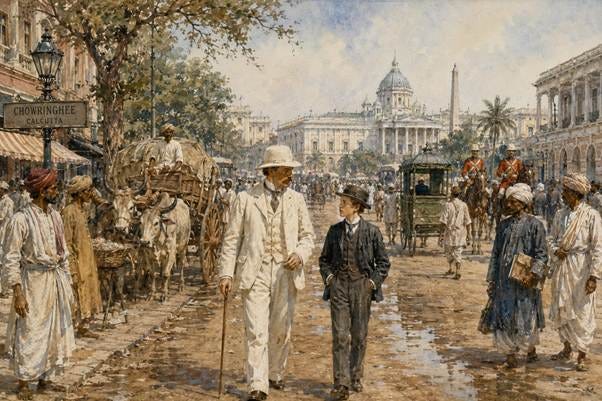
Teenage James walks through Calcutta with his father John circa 1864.
His father died there in 1865 when James was just seventeen years old.
Beyond that, the records become frustratingly silent. We know little of his family circumstances or how he found his way back to Britain. There is no mother’s story to guide us. No family letters survive. Instead, James emerges from the historical record as a young man pursuing one of the most ambitious careers available in Victorian society.
Medicine was changing rapidly.
The nineteenth century witnessed the professionalisation of doctors and surgeons. Qualifications became increasingly important. Scientific approaches to disease were replacing older traditions. Hospitals expanded and medical schools attracted students from across Britain and the Empire.
In 1872 James joined the Royal College of Physicians in Edinburgh. Edinburgh was among the most prestigious centres of medical learning in the world. Later he continued his career in London, joining the Royal College of Surgeons in 1879.
It was during these years as a student and young doctor that another story briefly enters the record.
Somewhere in London, James met a young nurse named Alice Ann Rodwell.
Alice came from a very different background. The daughter of a shoemaker from Hertfordshire, she had found employment as a nurse at the Evelina Hospital for Sick Children in Southwark. Like James, she was part of a new Victorian world in which medicine and nursing were becoming increasingly skilled professions.
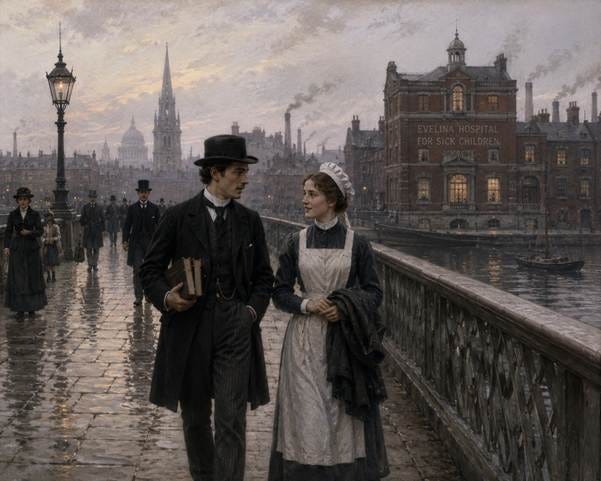
James and Alice meet after work on Southwark Bridge circa 1873.
The records tell us very little about their relationship. We do not know where they met. Perhaps it was through hospital work. Perhaps through friends. Perhaps through lodgings. In 1874 Alice gave birth to a daughter, Lilly Morgan. No father appeared on the birth registration, although James was later named when the child was baptised.
What followed remains uncertain.
Were they engaged? Did they intend to marry? Did James know how events would unfold? The documents do not say.
Like so many Victorian relationships, the story appears only briefly before disappearing from view again.
As James’s professional life gathered momentum, Alice’s circumstances seem to have become more difficult. Lilly was raised largely within her mother’s family while Alice continued working. Alice herself died in 1882 at the age of only thirty-three.
Whatever had once connected their lives belonged to the past.
By then James had become firmly established within London’s medical world.
In July 1882 he married Ellen Harriett Nodes, the daughter of a deceased undertaker. The marriage hints at a more settled phase of life. Both came from occupations that dealt, in different ways, with the realities of sickness and death. Victorian medicine could not avoid mortality; nor could the family of an undertaker.
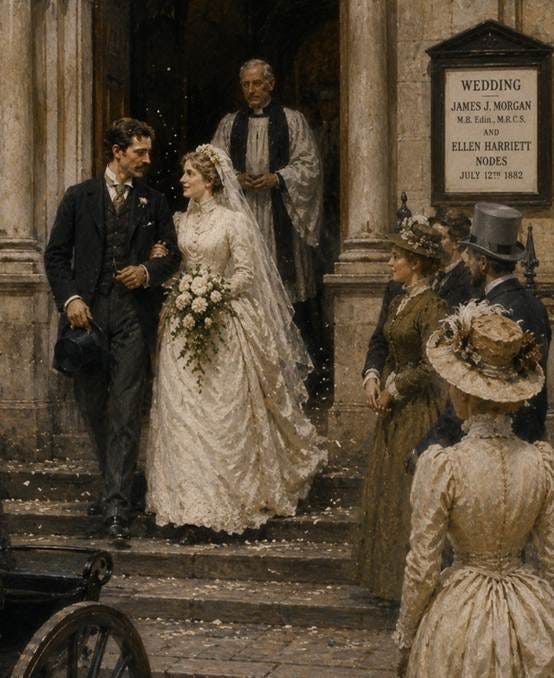
James marries Ellen at St Mary, Bryanston Square, Marylebone. 12th July 1882.
Six years later a daughter, Eileen Constance Mary Morgan, was born.
We know almost nothing about the emotional reality of their marriage. Historical records rarely preserve such details for ordinary families. Yet census returns and professional directories suggest a respectable middle-class household. For the first time, James appears to have achieved the security that had perhaps eluded him as a young man arriving from India.
At the same time his professional responsibilities were growing.
By the mid-1880s he was serving as Assistant Divisional Surgeon to the Marylebone Police.
The title sounds impressive, but what did it mean in practice?
Victorian police surgeons occupied a unique position. They examined assault victims, attended sudden deaths, provided evidence in court and advised detectives. They stood at the boundary between medicine and justice.
A surviving newspaper report from 1885 offers a glimpse of Morgan at work. A violent altercation involving a butcher’s cleaver had left a man seriously injured. Morgan examined the wound and informed the court that it extended to the bone. His professional judgement became part of the evidence upon which the case would be decided.
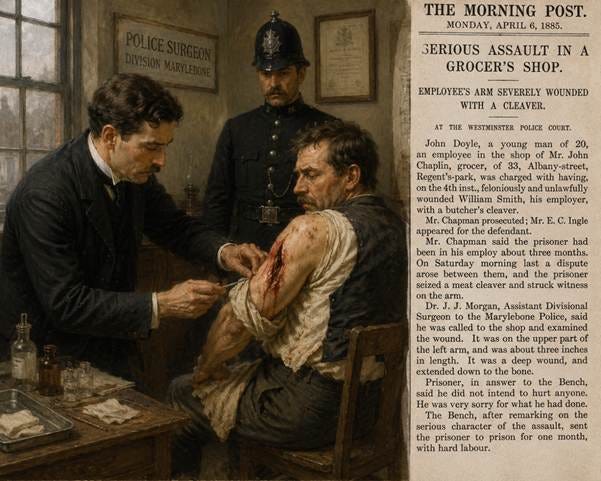
James examines the wound to William Smith’s arm.
Such incidents formed the routine reality of urban life.
London in the late nineteenth century was both the richest city in the world and one of the most unequal. Overcrowding, alcoholism, disease and violence generated a constant stream of work for police officers, doctors and coroners.
It was also the London of Jack the Ripper.
While Morgan was serving as a police surgeon, the Whitechapel murders of 1888 gripped the capital. Newspapers filled their pages with lurid speculation. Medical evidence played a central role in the investigation. Although there is no evidence that Morgan was directly involved, he worked within the same metropolitan policing system and professional community. The debates surrounding forensic medicine, wound interpretation and post-mortem evidence would have been familiar territory.
Yet the sensational crimes that dominate modern memory were only a small part of a police surgeon’s work.
Far more common were the tragedies of ordinary lives: workplace accidents, drunken assaults, neglected illnesses and deaths in lodging houses. These were the cases that filled the courts and inquests where Morgan spent much of his professional life.
Perhaps that is what makes his story so revealing.
James Jerome Morgan was not a famous doctor. He discovered no cure and founded no hospital. Instead, he occupied a position from which he witnessed Victorian society at its most vulnerable. Through his work passed victims and offenders, labourers and servants, the respectable and the destitute.
In the summer of 1891 James Morgan’s health began to fail. Tuberculosis, the great killer of Victorian Britain, slowly took hold. As a doctor he would have understood the significance of the symptoms. For six months the disease progressed until, on 23 December 1891, he died in Marylebone aged just forty-three. His wife Ellen was at his bedside. Their daughter Eileen was only three years old.
From imperial Calcutta to the police courts of London, he had travelled a remarkable distance. Along the way there had been ambition, professional success, a mysterious youthful relationship, marriage, fatherhood and a career spent confronting the consequences of poverty and violence.
His records tell us only fragments.
Yet those fragments illuminate far more than a single life. They reveal a Victorian world in which empire, medicine, policing and family were deeply intertwined—a world that James Jerome Morgan navigated until his untimely death at the close of 1891.
No posts
Comments
Nothing yet. Say the first thing.
Sign in to join the conversation.