
My daughter told me I was dog-maxxing with my pajama choices last night. I’m in Los Angeles visiting her at law school right now, and somewhere between the laundry pile and introducing me to Love Island, she looked me over, delivered her verdict, and then moved on to explaining the nation’s obsession with Trinity and Bryce.
For the record, I was wearing a gray t-shirt that says DOGS ARE PEOPLE TOO with navy pajama pants covered in tiny dogs. Clearly, I’m committed to a theme. (For the Love Island stuff, you’ll have to watch it yourself to understand that particular cultural obsession.)
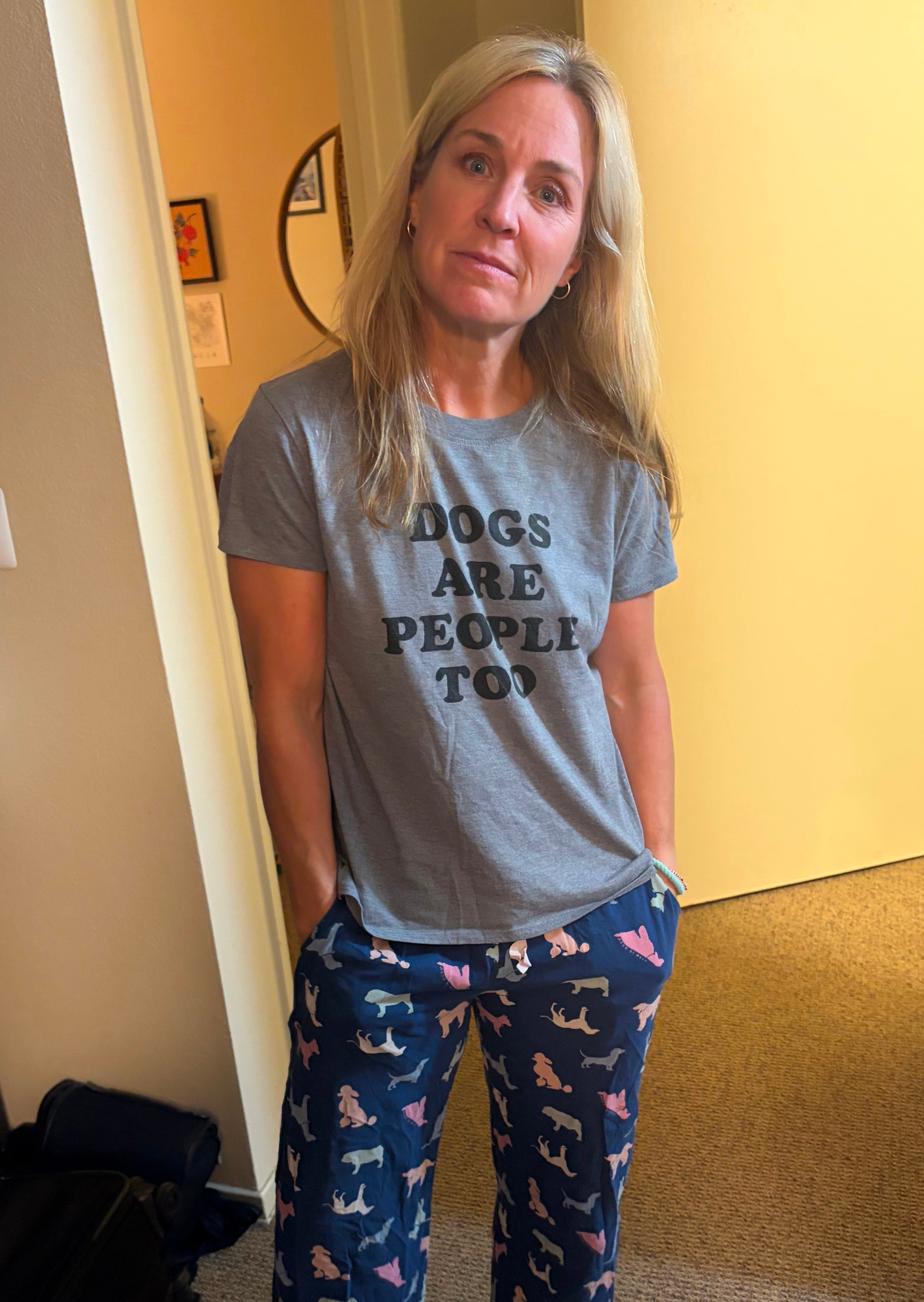
To be clear, she wasn't saying I looked like a dog. She was saying I had committed to a theme, which is what maxxing means: picking a thing and going all the way in. It's one of three phrases that are following me, and everyone else online, around right now. There’s also AI slop and the newest one, “PervPods” — that are the latest “need to know” buzzwords defining our wired world. Or at least helping you understand what the hell your kids are talking about. #servicejournalism
Let’s dive in.
I want to say that you know it when you see it, but sadly, many people don’t. (Hey Mom, Facebook’s filled with it!) At its core, AI slop is low-quality, mass-produced digital content — text, images, audio, and video — generated cheaply by artificial intelligence to game online algorithms and chase engagement. If you've felt like your feed has gotten dumber lately, that's the word for why.
Some of the most popular examples include Shrimp Jesus, the half-man, half-crustacean messiah that colonized Facebook two years ago. (That was the starter version and looks almost charming now.)

More recently, AI slop has taken the shape of a handsome silver-fox podcaster who does not exist. Futurism found a whole crop of them flooding Facebook just last week — distinguished older men filmed mid-monologue, explaining to women everything that’s wrong with men, racking up comments from people who have no idea they’re talking to nobody.

When Futurism ran the pages through Google, the AI Overview described the hosts as real creators, and even after being pressed, insisted that a guy named “Roman Black” was a real person. He isn’t. The machines are now vouching for each other.
It isn’t only images and podcasters, either. Streaming music service Deezer recently said that people upload nearly 90,000 AI-generated music tracks to the service every single day.
Why is there so much AI slop? Because it pays. Generating a thousand images, articles, product descriptions, and glowing fake reviews costs close to nothing now, and the platforms that distribute it all chase engagement, not quality. They reward the moment your thumb stops moving. When a fake driftwood elk out-earns a real photographer, somebody makes ten thousand more elk.
One distinction matters here, because I use these tools every day and I’m not going to pretend otherwise. AI-generated does not automatically mean slop. When I use AI to transcribe an interview, organize research, or wrestle a headline into shape, that’s a tool doing tool things, with a journalist still answering for every word. When somebody publishes 400 interchangeable articles without checking whether a single fact in them holds up, that’s slop — and it’s competing for your attention with work real reporters spent weeks on.
How can I tell when something’s AI slop? Check hands, teeth, jewelry, and any text in the background of a photo- details that AI still gets sloppy. Distrust any image whose only job is to make you feel something instantly, especially outrage or awe. See whether a “news” story names a reporter and a real outlet, and whether anybody else has the story. On product reviews, hunt for specific complaints, because real customers gripe about shipping and sizing while slop gushes. And when a video shows something remarkable that no other camera in the world managed to catch, you have your answer.
The real damage isn’t the fake silver fox dudes
My Nextdoor feed is a war zone right now. Not about crime or parking, but about what’s real. Somebody posts a video, somebody else says it’s AI, a third person calls the local paper a propaganda outlet, and it around it goes. These are neighbors who will believe an anonymous rant with no source before they’ll believe a reporter with a name, an editor, and a phone number. It’s absolutely insane.
It all makes Shrimp Jesus look like child’s play. Slop doesn’t just trick people into believing fake things.
It trains them to disbelieve everything, which is enormously useful to anyone who would rather you not trust the actual news.
Once you’ve been fooled a few times, “that’s probably AI” turns into a way to wave off any inconvenient fact, including the true ones.
The numbers back up what my neighbors are doing. The Reuters Institute’s 2026 Digital News Report found that social media and video networks have, for the first time, overtaken both television and news sites as where people get their news. Pew found that adults under 30 now trust information from national news organizations (51%) at almost exactly the same rate they trust information from social media (50%). Fifty-fifty, between a newsroom and a stranger’s feed.
Meanwhile, the slop keeps spreading. Pew collected a random sample of 10,000 webpages in July and found that one in ten showed signs of being written or substantially edited by AI.
So what can you actually do?
Slow down before you share. The whole business model depends on you reacting in under two seconds, so the pause is the defense.
Check the account, not just the post. A page that posts twelve emotional images an hour isn’t a person.
Use a detector as a gut-check. Pangram is the most accurate one available right now, and its new image detector is free to try. Treat the results as a strong hint, never as proof — these tools always trail the newest AI models by a few months.
Go straight to the source. If a story matters to you, find it on a site with a named reporter and a correction policy. That’s the whole difference.
It started with looksmaxxing, which crawled out of incel message boards in the 2010s to describe men swapping tips on maximizing their “sexual market value.” Looksmaxxing is still the monster of the family at around 300,000 searches a month. For many teenage boys, it starts with skincare and the gym, but doesn’t stop there. Ask a 15-year-old what “bone smashing” is — hitting yourself in the face with objects to sharpen your jawline — and brace yourself for how casually he explains it. Searches hit 1.9 million a day in March. TikTok finally banned them in April.
Then the suffix got loose. Now there’s sleepmaxxing (mouth tape, magnesium, a bedtime routine longer than most flights), fibermaxxing (chia seeds in things chia seeds have no business being in), proteinmaxxing, moneymaxxing, aura-maxxing, and whatever my daughter invented on the spot for a woman standing in front of her in dog jammies. Mentions have nearly doubled since January, per Meltwater, and brands have gleefully piled on.
It’s mostly just harmless slang now, but like so many things stemming from internet culture these days, there’s a darker underbelly here too: the idea that every part of you is a number that could be higher or a trait that could be better.
You’re not sleeping; you’re optimizing your sleep. You’re not having dinner; you’re hitting your protein. You’re not seeing friends; you’re maintaining your social health. It’s exhausting. It’s also how a joke about chia seeds ends up on the same family tree as a kid hitting himself in the face.
For the record, my doggy sleepwear wasn’t optimized for anything. I just love dogs.
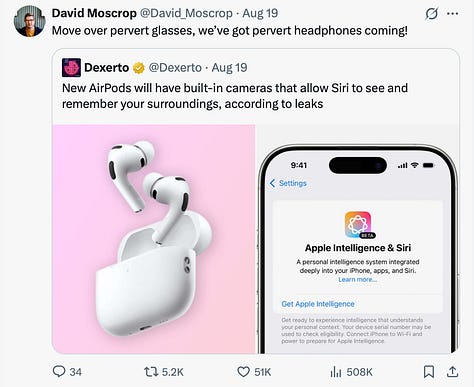

Yes, it means exactly what you think it means, and no, I didn’t coin it. The internet did.
Fellow tech journalist Joanna Stern also wrote a perfect piece about it, which you can find here.
Her short version: “perv glasses” stuck to Meta’s smart glasses because people — mostly men — keep wearing them while hitting on women, sometimes hiding the recording light or the fact that they’re recording at all. (Ew.)
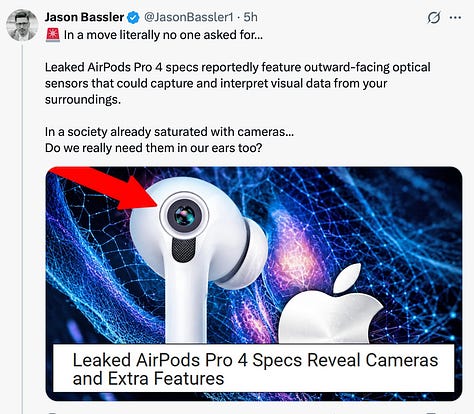
Then this week’s leak of camera-equipped AirPods handed the internet a sequel: PervPods.
The name is funny. The reason it landed so quickly isn’t.
We’re all getting pretty dang tired of being recorded. Go to a gym, an airport, a restaurant, or your kid’s soccer game, and somebody is filming themselves, which means there’s a decent chance they’re filming you, too. You’ve become an extra in a stranger’s content without ever agreeing to be in it. Then there are Flock Safety cameras logging license plates as we drive around town, doorbell cameras catching everyone who trips on a sidewalk, and security cameras just about everywhere else.
Now imagine putting cameras inside something as ordinary and inconspicuous as AirPods.
Before anyone panics, Apple hasn’t announced these things and won’t comment. What we actually have is code Apple apparently left inside a Mac software update last week, which the folks at AppleInsider and MacRumors have been happily tearing apart ever since. Bless them.
So far, the clues point to something much less creepy than the name PervPods suggests. The cameras appear to be tiny — around one megapixel — and designed to capture still images for Siri, not record video for your photo library. The idea is that Siri could see what you’re looking at and answer questions about it without you pulling out your phone. The same code included references to an indicator light, suggesting Apple is at least thinking about how everyone else will know when those cameras are in use.
I’m also less worried about Apple than I am about what happens next. Apple has built privacy into its brand, and putting a secret recording device in millions of ears would be a spectacular way to blow that up.
What worries me are the companies racing to beat Apple to the shelf. Every time Apple signals a new product category, a swarm of manufacturers follows with cheaper versions, and those little details that cost money — privacy protections, security updates, clear data policies, even a visible recording light — can disappear pretty quickly.
That’s how we could wind up with cheap glasses and earbuds made by companies you’ve never heard of, pointed at everyone around us, with no obvious way to know when they’re recording or where whatever they capture winds up.
I spent much of the past year reporting on Flock and talking with people who learned after the fact that cameras in their communities had been recording their movements. They weren’t angry because cameras exist (to be fair, some of them are). They were angry because nobody asked them (and police misuse them to be creeps themselves).
That feels like the lesson worth remembering before we start putting cameras in the next thing we stick on our faces.
Mostly that I’m getting tired of being asked to keep up with technology that is moving faster than the rules around it.
AI can now make a convincing photo of something that never happened, so we have to get better at figuring out what’s real. The internet has turned sleeping, eating, and exercising into things we’re supposed to “maxx.” And the next generation of gadgets may be able to see what we see without anyone standing nearby necessarily realizing there’s a camera involved.
I’m not anti-AI, anti-gadget, or anti-progress. Good grief, I’ve spent a good chunk of my career trying new technology and telling people which parts are actually worth using. But “we can” is not the same thing as “we should,” and convenience is not the only thing worth designing for.
Sometimes “friction” (another buzzword) is useful. Pulling out your phone to take a picture tells the people around you that you’re taking a picture. A recording light gives someone a chance to move away. Asking permission may slow things down by five seconds, but those five seconds belong to the other person, not the technology company.
And maybe that’s the part of our lives we shouldn’t be maxing away.
This is your chance to ask questions, tell me what I’m getting wrong (and right), and what you want me to talk, show, or do more or less of here.
Send me your best slop, too. What’s the strangest fake thing that fooled you, or nearly did? I’m collecting them.
And I’d like to formally announce that I am done maxxing, unless somebody has a truly excellent pajama recommendation. Dogs optional.
I’m an Emmy Award-winning tech journalist and host of Techish with Jennifer Jolly. Reach me at jj@techish.com.
Comments
Nothing yet. Say the first thing.
Sign in to join the conversation.