
0:00
-3:28
It was 50 years ago July 5th, or at least the week right after the Bicentennial, I drove from Washington DC to Boston and met Bill Leavitt at Berklee College of Music. I had just bought a Plymouth van and with my dad’s help (he did most of it) constructed a box in half the back with a trapdoor for instruments. We had chosen to experience the July 4th fireworks at the Annapolis Naval Academy football stadium, as DC was expected to be overflowing.
Certainly, the most bombastic fireworks display I’ve ever witnessed, climaxing with Navy Blue Angels making a single pass at what seemed to be 10 feet above the stadium. (That’s incredibly loud, in case that didn’t occur to you). In the wake of the capitulation in Viet Nam, post-Watergate, Northern Ireland conflict, nuclear testing and Cold War saber rattling, we were laying down the law. Don’t mess with the most violent country in history. The Montreal Olympics started the next week.
I drove up through New York, not thinking it was such a big deal, but a little nervous about the outcome, then was taken over by nostalgic memories of so many drives through Connecticut in my youth (I was, after all, already 30). I forgot how beautiful it was. On the Merritt Parkway, I floated over curves and hills musing about Martin Luther King’s revelatory sermon/speech of his first encounter with this, one of the first “limited access” highways. A student at Boston University, he had missed the exit and had to turn around. The moral being, sometimes you have to endure backward steps to get to where you’re going.
I had collected every guitar instruction book I could find in the 1970’s and had concluded there were two leaders in the guitar technique world, Aaron Shearer who had one system of scales on the guitar and William Leavitt another. Where Shearer’s approach (on classical guitar) was to shift one fret to make scales that were very smooth, Leavitt’s system involved a finger stretch of one extra fret. I could go on with that, but it doesn’t serve the story. There were these two guys.
I concluded that they had each made “cartesian products,” fleshing out all the possibilities of their idea. No one else that I’d found did that. A book by some guitarist or other said, “I play it this way,” good idea, as far as it went. But I decided that I wanted to study with, or at least meet, them both.
Sharing the 4th floor instrument lockers at Eastman School of Music, I’d witnessed what cellists called “stretch position” and I thought I could do that on guitar. So, I did it, though feeling there wasn’t official permission because Andres Segovia’s scale system used neither of these inventions. (I will add here, I met him). I heard Segovia had it in for Aaron Shearer over technique disagreements, and he wouldn’t have even acknowledged Leavitt, as he was playing the evil electric guitar.
Aaron Shearer was close by at Peabody Conservatory in Baltimore. I was told I could audition; I practiced like mad for a week and went and played for him. I don’t think I blew him away, but he found me “interesting.” His advice was, to me in my mid to upper 20s, “It’s late for you to start as a Guitar Major at Peabody, why do you want to do that? I’ll take you on for private lessons, but they will have to fit in our schedules.” I already had a degree from Eastman and a year of graduate work at U of MD. Oh yeah, and study with Segovia minion John Marlow at American University while in the Army Band Jazz Ambassadors, where I wrote a dozen arrangements for the band. The classical guitar and electric guitar for jazz and rock were two different worlds.
And, I was close to broke. OK, private lessons. So, over a couple of years combined with playing in smokey bars, I worked with him. This is classical music, by the way. I had told him about my developing a system of visualizing the fretboard, he said, That’s all well and good, but you’re here to study with me.” I never mentioned it again. His take on my composing work: “All that writing with a pencil can be hard on the fingers.” (It was. At that point composers had a drafting table, straight edge and pencils and erasers, big pieces of paper and graphite on everything).
But at some point I did share with him I was thinking of going to meet Bill Leavitt at Berklee; that I saw myself as a composer as well and interested in pursuing Jazz more than the classical repertoire. To my surprise, he said, “If one of my students were to go on to do well in the Jazz world, I would be very proud.” He had replaced Laurindo Almeidia in the Stan Kenton Band; this was not so foreign a venture. So, in 1976 he wished me well and I went to Boston.
I’m not sure if I had in mind radical change, but life was not fulfilling. And there lurked some feeling about breaking out of my patterns of survival mode, playing in bars, a couple of diversions playing in a pit orchestra, doing local commercials in a Bethesda recording studio. Other bar bands held visions of “making it to Vegas,” or cruise ships, all of which sounded pretty awful to me. I washed my face at every break and suffered through a couple of eye infections from secondhand smoke. You would wash your clothes all the time, but the ones for gigs had no other life. I didn’t play my original songs, and things I was paid to write – commercials – were not something to brag about. I was looking for some sign about direction in life.
Bill Leavitt’s office was full of cigarette smoke, but I was experienced with that. When I told him I was there because I’d discovered both his and Aaron Shearer’s systems and how I had been developing a system too, his response was completely different. “Oh, let’s look at it.” And that was the life changing moment, or maybe also culmination of a couple of years of preparation.
But different as well, he said, “Unfortunately, you can’t just come and study with me. Berklee is on the defensive - students come for a short time and claim to have studied. They’re not making the school look good.” I would have to go full time. I went back to DC and worked every gig I could, afternoon cocktail hours, evening gigs, and some in the recording studio, making all the money I could until the end of ’76. Jimmy Carter got elected, and I started school at Berklee in January 1977.
I hit Boston in a big snowstorm, not the historic “Call-out-the-National-Guard” one of 1978, but it was major, and I had no winter coat. The first day registering, I saw on the bulletin board that Paul Winter had put out a call for auditions to create a new band. I also was told by the Administrator that although I had a college degree, what they would need was my high school diploma – really - so I drove down the partially cleared Southeast Expressway that was only finished the year I’d graduated from Marshfield High School and got a copy of the diploma. They didn’t seem very impressed to see me after 13 years. Then I bought a coat.
I crashed with a friend, came up with bar gigs around Boston, found a place to live. But then, one more big opportunity came about at the recording studio in DC just as I was leaving. Write a soundtrack for a multimedia show “The Arts in America” that the USIA (US Information Agency) was putting together for a World’s Fair in Romania. It took a couple of trips back to DC that spring, small orchestra, no narration in the show, just the music, and pictures of every famous American artist - visual art, theater, architecture, classical music, jazz greats, rock stars - the music followed and changed styles with it all. This done with 6 synchronized slide projectors, on three walls (that’s what they did then). I never got to see the total finished product, but I was told that the crowds in Romania stretched all around the buildings of all the countries to wait to get into the American one, then wait in line to see it again.
Then I landed the gig with Paul Winter, that’s another story. For three years, on and off, in an out, I studied with Bill Leavitt. This was all electric guitar and flat-pick style. Only toward the end of all that time did I show him pieces I’d been composing on classical, finger-style guitar. A few years later he offered me a job there, I think now how different a life I would have had if I’d stayed with that institution.
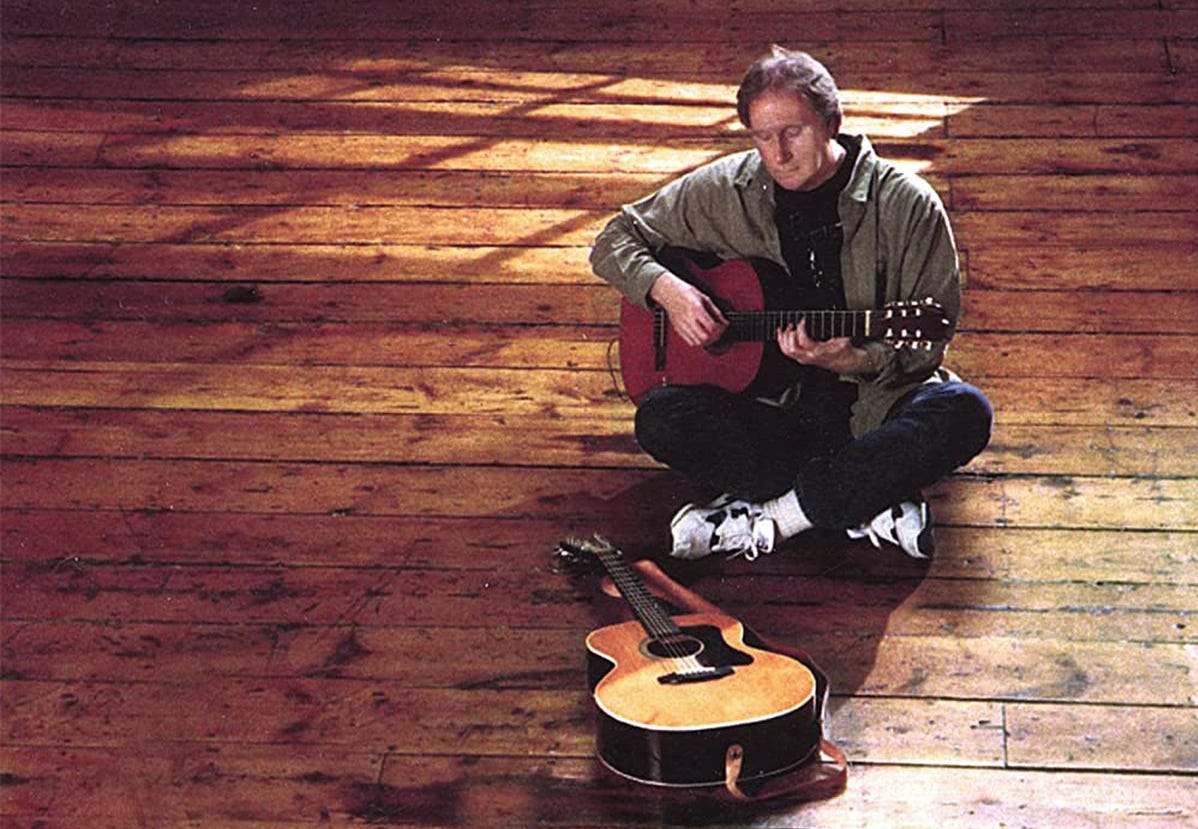
What I haven’t dwelled upon here, is how I almost didn’t do it. And that’s the point; life turns on those decisions, well thought out or not. It was a dream: “I want to know those guys.” I did it. They changed my life. There are all the agenda items of my current work, song lyrics and political involvement and spiritual delving, but I’m a guitar player. Composer too, but guitar player. I don’t know where I would rank in the leagues of students they mentored and influenced, though I guess I wish they could see me now.
There’s a lesson here, be a perpetual learner. I will never get done learning, and I thank all those teachers along the way, and the ones I haven’t met yet. Here’s a song.
Text within this block will maintain its original spacing when published
When I Get This Right              © 2014 Jim Scott,
(From my “Hearts In Another Land” album, available on Bandcamp)
When I get this right, mistakes will get more latitude.
I’ll put more into gratitude, for all that life brings.
When I get this right, forgiveness, the new paradigm
And anger granted no time, in the greater scheme of things.
When I get this right, I’ll know where to find the healing;
I’ll find challenge more appealing, and go the longer way.
When I get this right, I’ll understand the pain of growing
And accept the price of knowing love at last can win the day.
If this is our only life, then time is of the essence.
Time to get to work on our presence - and presentations.
If there’s only this one chance,
We’ll make a stand on this sacred Earth,
And see the holy and the worth of all our relations.
When I get this right - I’ll be student as well as teacher,
A more reluctant preacher, more inclined to offer grace.
When I get this right - I’ll put less into correction
And see the perfection of this fragile human race.
When I get this right.
No posts
Comments
Nothing yet. Say the first thing.
Sign in to join the conversation.