
Dripping water hollows out stone.
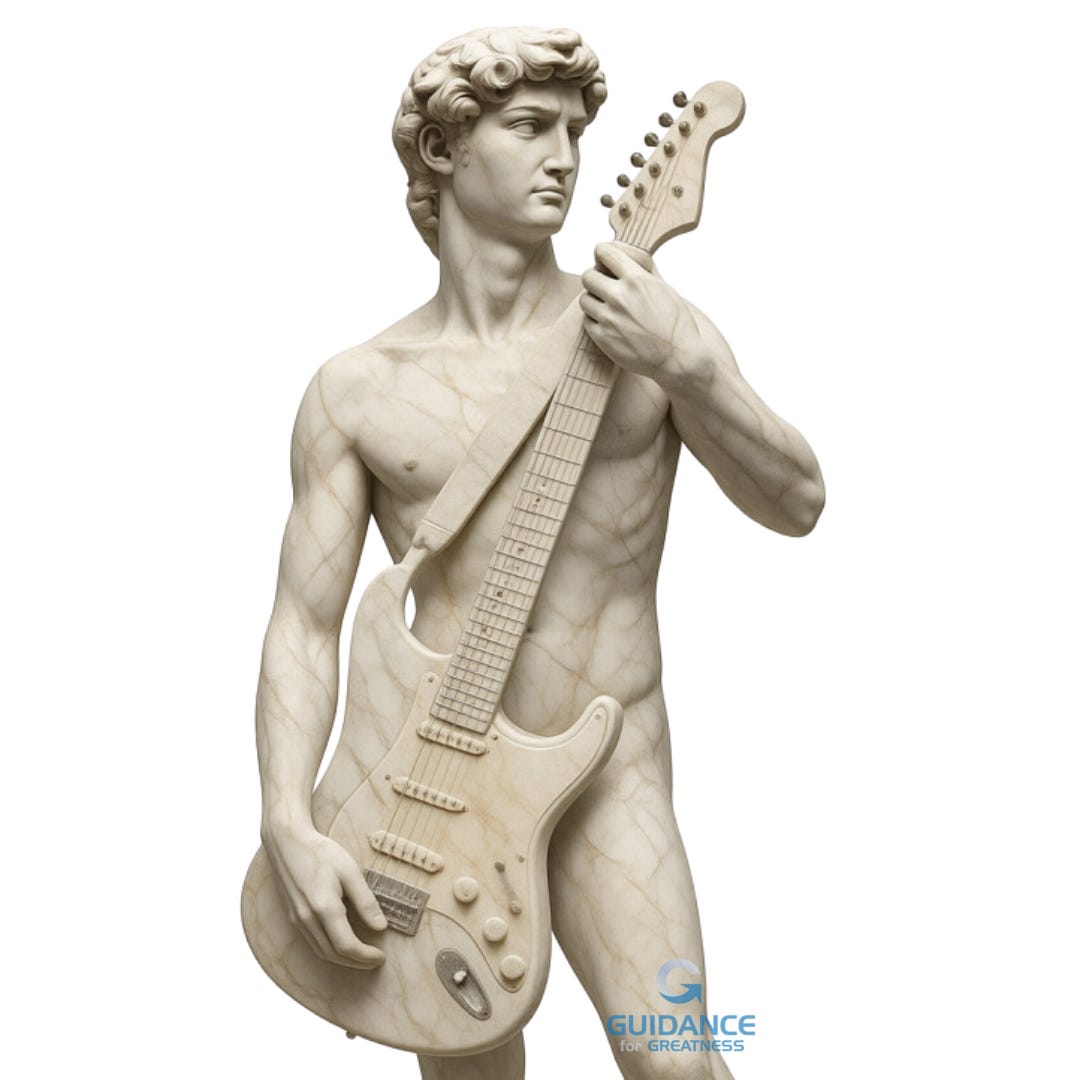
Regular readers and listeners may have noticed that I have a wee fixation on Bob Dylan. I figure, if you could’ve been alive when Shakespeare was alive, why wouldn’t you enjoy his genius as much as possible?
I wouldn’t say I worship Dylan. He has plenty of flaws, and I’m not sure I’d ever want to meet him. As an artist, though, he endlessly fascinates me.
A while back I wrote about seeing a Bruce Springsteen concert and how I realized watching his behavior as a bandleader on stage that the Boss is not much of a boss at all. He’s a leader, through and through. I contrasted his collaborative stage style with Dylan’s, which is more top-down and dictatorial. Dylan is the true boss on stage, and I don’t mean that as a compliment. Even as I write this, his band is experiencing some sort of guitarist shakeup.
At the same time, I find much to admire in Dylan’s approach to his artistry, which offers its own powerful leadership lesson. Dylan’s bold creativity can inspire the leader in all of us.
Dylan, even today at age 85, is restless as an artist—always searching for something else, not just different but better. The most common complaint at his concerts (yes, he’s currently on tour) is that he doesn’t play all the golden oldies and that when he does, they’re unrecognizable. Even Sir Paul McCartney—a precision showman who could probably lip-sync his meticulous live performances to the original recordings—has whined about Dylan’s lack of faithfulness to the familiar.
Sir Paul argues that Dylan is denying his audience what they want. I’d counter that Dylan gives the audience what they need, which is exactly what many of us want. What I don’t want is to pay a fortune to sit in a massive arena, squinting at a miniature figure on a distant stage (or blown up on a jumbotron) who meticulously replicates the same sound that I could simply enjoy on my phone. Dylan’s concerts are more intimate and relentlessly esoteric. Dylan is forever unsettled and unsettling, which I love.
In addition to Dylan, I’m a big fan of jazz, and that has long been the jazz ethos. That musicians are artists whose art is never settled. That performing even old standards is a creative act, each time, every time—a challenge to the audience. That no performance is ever final or definitive.
Dylan shares that ethos. For instance, when he released his Rough and Rowdy Ways album in 2020, his subsequent concert performances more or less adhered to the original recordings for a time. In short order, though, he began to alter the melodies, rhythms, arrangements, and even the words. He’s done this sort of thing for years. Turns out his sacred texts are not so sacred.
For several decades, he also would significantly reshape his set lists every night, playing scores of songs over a given stretch. He has since adopted more static set lists, but even now he might switch things up. Recently he introduced a deep cut from the late sixties that he had never performed in public.
His set lists are such a part of his artistry that there’s a scholarly book on that very topic—the songs Dylan chooses to perform in concert. (Full disclosure, I provided a chapter to that book.)
Moreover, Dylan doesn’t limit himself to music. He draws and paints in addition to creating amazing metal sculptures out of discarded scrap materials—a metaphor for his late songwriting process. He also has waded into filmmaking with mixed results.
Dylan hasn’t always been so creatively productive. During the 1980s, he infamously fell into a fallow period, but he continued to churn out music—some of it regrettable but much of it remarkable and even wonderful.
Still, during much of this period, Dylan seemed adrift, his self-identity unsure. There’s a lesson here for leaders on the importance and power of persevering through self-doubt. Even amidst this muddle, Dylan didn’t fall back on his early hits or tried-and-true formulas but continued to push his artistry until it paid off. He converted restlessness into persistence until he found his depth again. He leaned toward the artist’s and leader’s shared value I call unsettlement. Not mere repetition—Ovid’s water dripping in one spot—but a burst of creative trial and retrial that tests the edges of the acceptable.
One of my favorite Dylan moments was when he performed his reggae-driven song “Jokerman” on David Letterman’s show in 1984. “Jokerman” had proven an instant masterpiece as recorded on the 1983 album Infidels, yet here was Dylan on a television soundstage performing his recent gem, not with his studio band or touring band, not with reliable studio musicians or even Letterman’s deft house band. No, a 42-year-old Dylan brought in a few very young guys, including the rhythm section from a Latino punk band, rehearsed a little, and dragged them before a massive audience to lay down a one-off punk-inflected rendition of this new song.
The performance was explosive even as it was clear from the expressions on their faces that the musicians had no idea why they were there and what might happen next. What did happen next was that Dylan was given a harmonica in the wrong key. After a bit of fumbling around, as chaos threatened, he got the right one from a roadie and went back to performing.
Most musicians go on TV to promote a new album, just about (or actually) miming their way through the studio version. Dylan instead used Letterman’s show to lay bare his fearless artistry on a national scale.
He tried to pull something similar off—doing the unexpected in a high-stakes context—as the de facto U.S. headliner of the internationally broadcast Live Aid concert in 1985, and this time he failed utterly. Imagine a major artist who’s not afraid to fail in front of one of the largest audiences in history.
Dylan is an iconoclast—someone who shatters convention to get at a higher truth. That he’s also an icon—he won a Nobel Prize in Literature, after all—makes his moves uniquely baffling. He’s an icon who smashes icons, including his own iconography. That he’s now in his seventh decade of braving this high-wire act, frankly, blows my mind.
If you follow jazz at all, you might recognize Dylan as a kindred spirit of sorts. For instance, John Coltrane, who reached the pinnacle of his career as Dylan was launching his, started pushing the boundaries of improvised music so hard that critics absurdly suggested he was incapable of playing music “straight” at all.
Partly in response, he released Ballads in 1963, an album of classic tunes his band had never performed before Coltrane walked into the recording session with store-bought sheet music. I don’t know if creating such a conventional album unleashed Coltrane, but afterward he increasingly and fearlessly challenged his listeners until his untimely death in 1967. Even vintage music can sound daring today.
Or take another of my favorites, saxophonist and flautist Henry Threadgill. You may not have heard of him, but he sits atop the jazz world by many measures. Across his decades of composing and performing, Threadgill never stops transforming despite a host of accolades, including a Pulitzer (an honor he shares with Dylan) and an NEA fellowship for lifetime achievement. As with Dylan, I’ve seen Threadgill try only to fail in public and then try again. Such boldness inspires.
So, what can leaders learn from these most creative artists?
The obvious first. Genius improvisers like Coltrane and Threadgill must secure true mastery over their art before they can let loose. Their ability to break boundaries only improves because of the discipline and self-awareness they demonstrate in their creative process.
Dylan comes at it from a much different tradition—folk and blues as well as rock—and his approach is far looser. One would never say his performances are disciplined in the jazz tradition or in Sir Paul’s locked-down approach. Just the opposite.
Instead, Dylan displays his own brand of self-discipline by never resting, never giving up, and rarely repeating. He has toured extensively every year (except during Covid) since 1988—not to replicate past glory or hits, not to fill massive amphitheaters, and not to cater to nostalgia-besotted ex-hippies. This resistance to pandering amply demonstrates his commitment to his creativity.
Boundary-pushing artists like Dylan, Coltrane, and Threadgill take their building seriously but remain willing or even eager to smash their own creations when necessary, when there’s somewhere else to go. They remain unsettled, turning every iteration into something new. That’s the clear lesson for leaders.
I don’t want to suggest that leaders should act like artists. The differences in their processes are vast. The same with the stakes. But leaders can learn from the most productive and innovative artists just the same.
Be self-aware but not self-satisfied. Be disciplined in a way that’s true to yourself. Build wisely. And be willing to take risks, challenge assumptions, smash conventions—even your own—and build anew to get to another level. That fearlessness marks the best artists as well as the greatest leaders, and it requires a sense of self that is at once solid and expendable.
Great leaders enact artistic sensibility by building—and breaking—with bold sincerity, unrelenting integrity, and fearlessness. As Miles Davis purportedly insisted, “Be wrong strong. Otherwise, sit it the fuck out.” Like great artists, great leaders don’t give up, don’t sit back, don’t sit it out. That’s the value that leaders and artists share most—an audacious commitment to unsettlement.
I’m guessing you’re exhausted by the same-old, same-old the leadership advice-industrial complex dishes out.
Want more of something different? Subscribe to my weekly leadership broadside. I guarantee the unexpected. You can pay me or continue to freeload—your call—but even free subscriptions make the internet go round.
Email me at jim@jimsalvucci.com to talk leadership, push back on something I’ve written, or just say hello.
To my paying subscribers, you sustain me, so thanks.
Want still more? Find my book, Greater than Great, on Amazon. Leave a review. Or check out my talk for TEDx Clarkstown.
Intro and outro podcast theme music by LiteSaturation from Pixabay.
Comments
Nothing yet. Say the first thing.
Sign in to join the conversation.