
Reason 1: Litigation to enforce state power to propose a fiscal responsibility amendment is the single solution potentially taking effect soon enough to stave off fiscal calamity.
Here is a new debt crisis chart courtesy of Cato’s Romina Boccia:
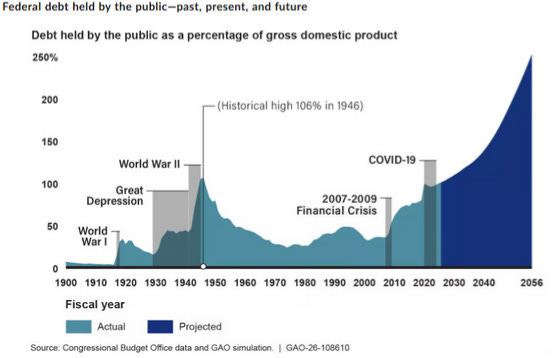
Many leading economists, finance industry heavyweights, and national security experts now routinely and repetitively warn that rapidly rising debt is our nation’s #1 threat and that we have no more than a handful of years to curb it. Back in 1979 during the prior bout of painful inflation, the states recognized this threat and submitted Article V applications in numbers sufficient to trigger Congress’ non-discretionary obligation to call a convention for proposing a fiscal responsibility amendment. Here are the states having applied in sufficient number in 1979 and 2017.
Unfortunately, since 1979, Congress has obstructed and ignored the states’ applications and has failed to call the convention. Since then, Congress has also repeatedly breached its own statutory fiscal restraints—Gramm-Rudman, BEA/PAYGO, the Budget Control Act, and debt-ceiling agreements—with each waived, revised, suspended, or overridden when politically inconvenient.
Recognizing Congress’ longstanding failure to self-cure its debt addiction, House Speaker Mike Johnson in a meeting with FFSF invited state litigation against Congress to enforce Article V. House Budget Committee chair Jodey Arrington confirmed in House testimony that the states have submitted a more than sufficient number of Article V applications to compel Congress to call the convention. Leading constitutional attorneys have reviewed the facts and law involved and give the litigation better than even odds of prevailing at the Supreme Court.
This litigation is the most procedurally-ripe and direct means to address the debt crisis.
Simply filing this litigation will change debt politics. Filing alone will demonstrate to the world financial markets losing confidence in dollar stability that our nation is finally prepared take steps to address the debt crisis. Filing may goad Congress into more responsible action. Filing will raise public awareness of the dormant Article V solution path to address the debt crisis. Worst case, we wind up no worse off than now.
Reason 2: Voters hunger for political leaders with actionable solutions to our nation’s unmet structural challenges, including debt.
Voters already connect national debt to the top issues of inflation, high cost of living, and high interest rates. A new Peter G. Peterson poll finds that:
90% of voters link federal debt to inflation and cost of living;
85% link debt to high interest rates;
83% prefer candidates with plans to address the debt crisis;
72% (79% of independents and 67% of Democrats) would consider supporting a candidate from a political party they do not usually support, if that candidate had a clear plan to address debt.
Voters are primed for the messenger who can articulate these connections, deliver the solution, and emerge a national hero. FFSF knows about one dozen people, mostly state Attorneys General, who have both the inclination and unambiguous legal standing to file the needed Article V litigation, thereby launching the solution process. One brave and patriotic individual has the opportunity right now to take action having extraordinarily high impact.
This act of leadership will not go unnoticed. A leading national media outlet now constantly checks in with FFSF indicating its readiness to provide feature coverage of the litigation announcement.
Reason 3: Defend equal state power to propose amendments.
Even those having doubts about the wisdom of a fiscal responsibility amendment should support this litigation to defend state power to propose amendments addressing other constitutional defects. As noted since 1979, Congress has obstructed and ignored state Article V applications, thereby voiding the bedrock of federalism, equal state power to propose amendments. Without being guaranteed this equal power, the states would not have ratified the U.S. Constitution.
The states must not waive their amending power on any and all subjects. By their inaction and failure to enforce their Article V power, the states are accepting the current intolerable de facto constitutional breach where amending power is retained solely by Congress. A Congressional amending-power monopoly presents an acute conflict-of-interest problem pertaining to amendments limiting Congress’ power, such as term limits or debt limits.
Reason 4: Clarify Article V mechanics.
For those having doubts about litigation win odds, this first impression litigation will provide clarity and guidance about the operation of a high-potency feature of our Constitution not yet, but sorely in need of use. Questions to be addressed, likely by the Supreme Court:
The “political question” doctrine: is Congress’ “shall call” obligation judicially enforceable?
FFSF position: In Powell v. McCormack (1968), the Supreme Court declared that Adam Clayton Powell had the right to be seated in Congress after being elected. The Court was able to interpret the plain text of the Constitution and ruled that Congress had failed to fulfill its ministerial duty to seat a duly elected representative. The simple textual analysis bypassed the need for a political questions analysis. See also Marbury v. Madison (1803), Baker v. Carr (1962), and Zivotofsky v. Clinton (2012).
Do applications age out?
FFSF position: Any debate about the age of convention applications died with the 27th Amendment which was proposed by Congress in 1789 and not ratified until 1992.
Can Congress evade its obligation to call by waiting decades for states to rescind?
FFSF position: The convention for proposing amendments under Article V is an agreement among the states. Once the two-thirds (34 state) threshold is reached, the agreement is consummated. Just like any other contract, “once the bell is rung, the obligations triggered cannot be unrung.” Once the right to meet in convention has vested, any subsequent rescissions are irrelevant. Application counts remained at 34 or more for over two decades, during the years 1979-2004 and 2016-2017.
How similar must application language be to be counted together?
FFSF position: Other than applications requiring specific amendment language or applications containing expiration dates, all applications pertaining to the problem or issue of deficit spending, balanced budgets, or federal fiscal matters must be counted together. Congress may not combine applications pertaining to unrelated subject matter, for example term limits and fiscal limits applications. Congress has no other counting discretion.
Do plenary (no named subject) applications count with single-subject applications?
FFSF position: Yes, consistent with the fundamental legal principle that “the greater includes the lesser.” Plenary applications may be excluded where expressing an intent to remain operative only if a plenary (all subjects) convention is called.
May the states limit convention deliberation to fiscal responsibility?
FFSF position: Amending convention decisions are made on the basis of one-state-one-vote. State legislatures may and a controlling majority will require their delegates to vote to confine convention deliberations to the fiscal responsibility subject matter identified in the majority of relevant state applications.
What role does Congress play in amending conventions?
FFSF position: No roles beyond counting, calling, setting convention date and location, and specifying Mode of Ratification.
Comments
Nothing yet. Say the first thing.
Sign in to join the conversation.