
My prior post covered the top four imperatives for state litigation against Congress to enforce state power to propose a fiscal responsibility amendment:
1. This litigation is the single remedy potentially taking effect soon enough to stave off fiscal calamity.
2. Voters hunger for political leaders with actionable solutions to our nation’s unmet structural challenges, including debt.
3. By its obstruction and inaction on state Article V applications since 1979, Congress has effectively voided equal state power to propose amendments on any needed subject.
4. Regardless of outcome, this litigation will clarify Article V mechanics, resolving some objections to its use by the states.
Imperative Five: State finances will be walloped by the coming fiscal meltdown.
In 1979 the states became sufficiently alarmed about federal fiscal profligacy to have submitted greater than the required number of Article V applications compelling Congress to call a convention for proposing a fiscal responsibility amendment. Since then and as shown in this Pew Charitable Trusts chart, federal grants and aid have increased as a percentage of total state revenues from 25 to 35 percent.
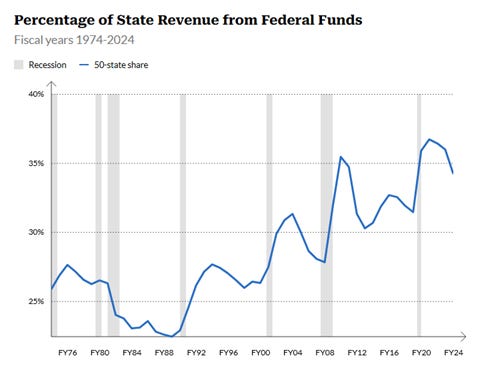
A confidential Trump Administration source tells me that, as soon as late next year, the bond market is expected to convulse on the glut of new and rolled-over federal debt. The resulting interest rate spike could trigger a severe recession and depress federal tax revenues. The combination of increased debt service and reduced revenues would force a choice between more debt monetization, putting more upward pressure on interest rates and inflation or -- more likely given the makeup of the Federal Reserve Board – sudden and sharp cuts to federal spending.
Hinting at first targets for the coming cuts, below is the Treasury Department’s breakdown of current spending. Social Security, Medicare, Interest, and National Defense, comprising 64 percent of spending, will be most protected. Thus, spending reductions will be concentrated on the remaining 36 percent (about $2.5 trillion) of federal spending, of which about $1 trillion is federal grants and aid to the states.
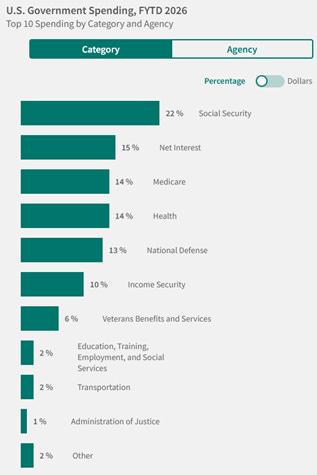
Net, when the meltdown hits, the states will be forced to grapple with a five, ten, or even 15 percent loss of total state General Fund revenues. This means that state leaders should take two actions in preparation and self-defense:
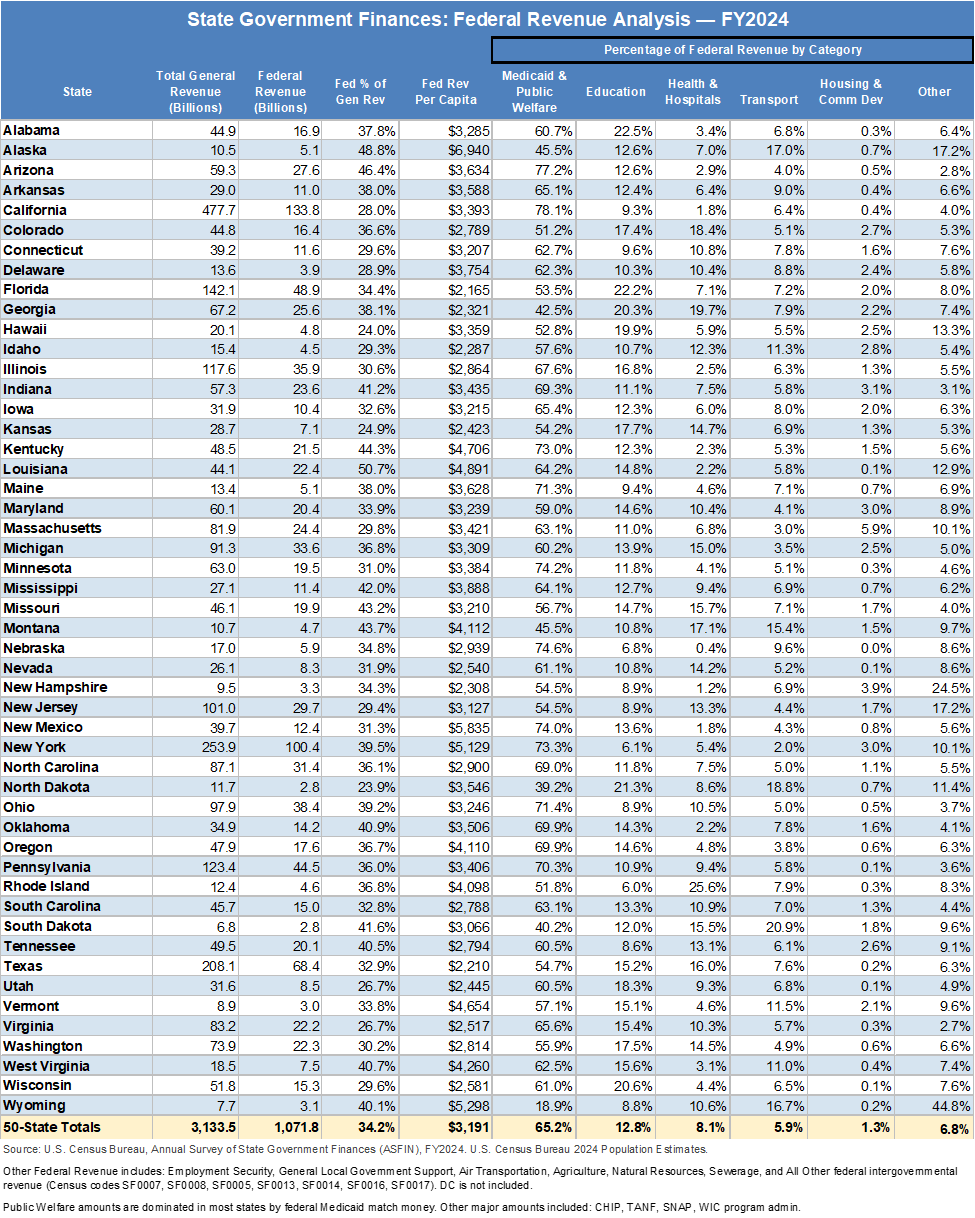
First, prepare a contingency fiscal crisis budget and program plan. Below is the Census Bureau’s most recent Annual Survey of State Government Finances for FY2024 showing the range of state dependency on at-risk federal revenue and the range of revenue allocation by program category. Dependency among the states ranges widely, from Louisiana and Alaska at about 50 percent to North Dakota, Hawaii, and Kansas at about 25 percent and, on a per capita basis, from about $6,900 in Alaska to $2,200 in Florida. On average, nearly two-thirds of this federal money supports the federal share of Medicaid spending.
Hat tip: visit In The Black to learn about its model for states wanting to engage in planning to reduce federal dependency and to restore a culture of fiscal responsibility.
Second, the states must rise up off their hind quarters and assert their proper roles in our system of federalism and shared sovereignty. In self-defense, the states must use all political and constitutional tools available to compel Congress to promptly adopt a binding, multi-year glide path to fiscal sustainability. Compel, because sober observers now recognize that Congress will not budget responsibly until a constitutional amendment mandates it.
Given that Congress is knowingly obstructing and ignoring the states in their decades’ long effort to propose the needed fiscal responsibility amendment, the states must litigate to enforce their power to do so.
Comments
Nothing yet. Say the first thing.
Sign in to join the conversation.