
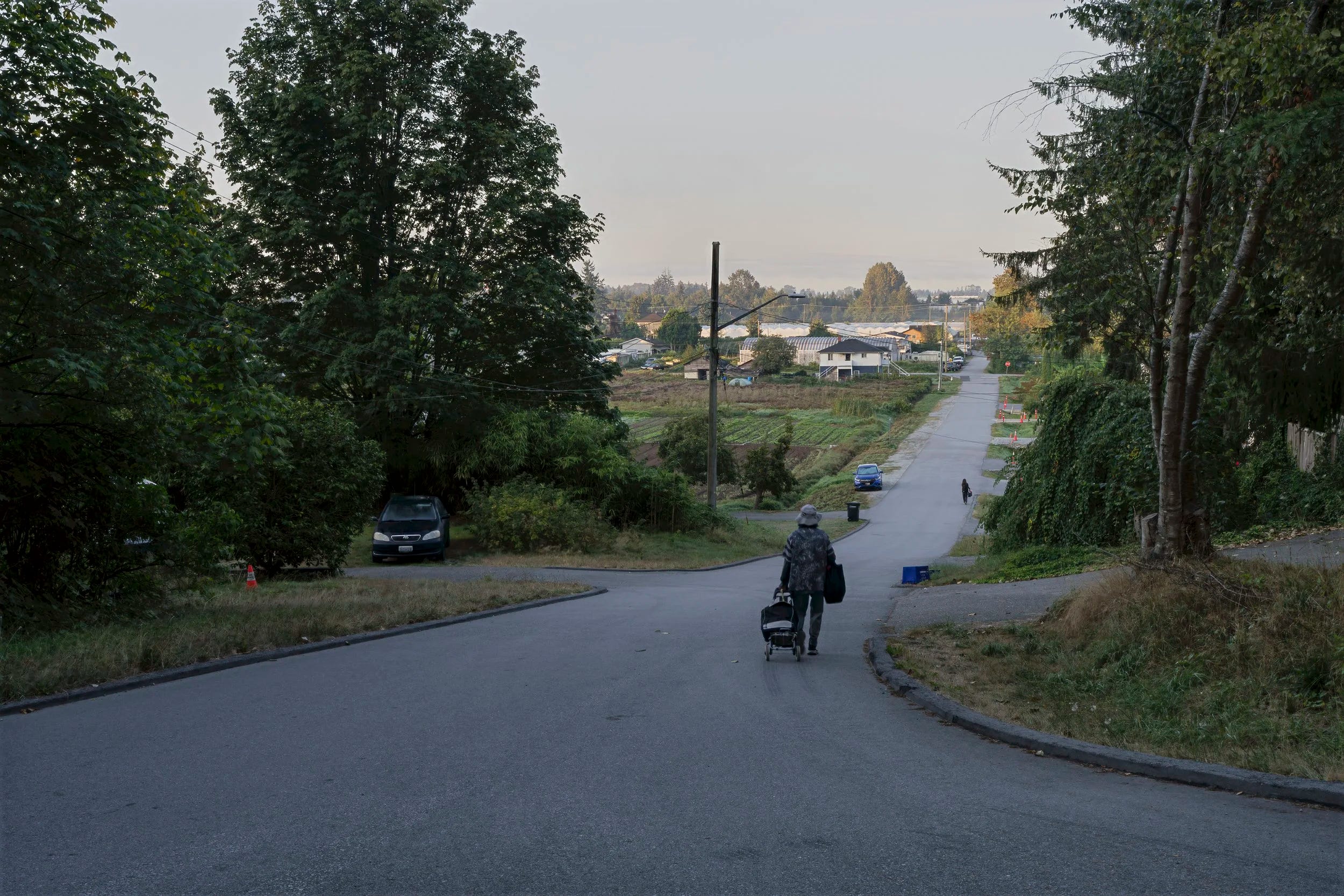
The road comes down off the hill at an angle, and at the bottom of it, though you can’t see it, there is a bus stop. It is early enough that the light is still gray, not gold. It’s the kind of light that comes right after a rain has stopped and the grass is still wet. But the roadways are dry already. A woman walks down the middle of the road, away from the camera, pulling a two-wheeled shopping cart behind her with one hand and carrying a plastic bag in the other. She wears a bucket hat and a patterned jacket against the morning cold and dampness. Somewhere ahead of her, smaller, harder to make out, another figure is walking in the same direction, alone, the same distance apart that seems to hold between most of the people who pass this way. To her left the space opens into farmland, rows of vegetables, small plastic greenhouses further back holding their shape against the haze, the ground that will be boggy underfoot once the sun is fully up and the dampness starts to lift like steam. No one is bent to the soil yet. That comes later, after full light, when the workers arrive, in straw hats with boots against the mud, the same rows she is walking past now standing empty. A telephone pole holds its wires up against the sky. A dark car sits parked near a driveway, another, blue, further down near the field.
She is walking to the bus stop at the bottom of the hill, the way she must walk most mornings, before the day starts for anyone else, and there is nothing in the frame that explains where she has come from or where, exactly, she is going, only that she is going, steadily. The cart’s wheels finding their way over a road that has seen a lot of walking like this.
I seldom take images with people in them. It’s not that I’m afraid, or have some anxiety about taking images of people, although I’ve had several “assertive” encounters with individuals who don’t want to be in a photo. Still, I could show you a good number of my images featuring people. They don’t usually make the final cut to be in a series, likely because there are so few of them that they become noticeable. Distracting. For the most part, I feel the inclusion of a figure in my images, though not in all by any means, often shifts the attention away from the subject of my work, the space: the pathway, the room, the yard. Usually the issues I’m concerned with are about traces, “remains of the day,” that would be lost if I allowed a subject in that would pull the eye away, directing your attention. I want the viewer to feel the space, which means looking at the image from top to bottom, corner to corner. To be a “committed witness.”
The day I took this image, things went against my best-laid plans. There had been the light rain. Drizzle, at one point. In my car, I waited it out, listening to an audiobook. As soon as it stopped, I got my camera and tripod out of the car and set them up. I knew the light would be coming from the left, east, and that shadows would start to appear just after the sun rose. I liked the vantage point, looking down across the fields and houses. “Taking it in.” A vantage point like this, from a slight rise, on a small hill, seeing down a pathway, was a common way to experience the landscape where I grew up in Northwestern Massachusetts and Vermont. So there is a natural attraction for me. A feeling of belonging here.
At the farthest point, looking straight down the road, I see the gardens I do most of my work in right on the horizon. I can feel the emptiness of the garden at this time of day. No one arrives there before full light. I knew that when I stopped here, I could take a respite, wait for the sun here. Maybe catch a different image instead of waiting in the garden. Something more narrative than usual.
After preparing the camera, I stood by the tripod and looked away. At first there was a slow, but steady line of people coming by, one after another. Lots of space in between. Almost everyone walked alone. When they saw the camera aimed down the street, they might move to avoid being in the picture. Switch which side of the street. Sometimes it was that they didn’t want to interfere with my photo. They would signal me, make a little hunch in their back, or slightly nod their heads to ask permission to cross the frame. Can I walk through? I would wave to signal the go-ahead. I was bothered to be bothering them. I’d distracted five or six people in a row, made them anxious. Broke their solitude. So I got a map out of the car and spread it on the hood, and pretended to take notes while holding my remote shutter control in one hand. Things went better once I did that. No one worried about obstructing my view. No one worried about entering my picture unwanted.
At the bottom of the hill is a bus stop. Up and down that road, running through the farmland, are a series of bus stops. Most have old metal or plastic chairs, often green with moss or algae of some sort. The passengers use the chairs to set their bags on. They’re too dirty to sit on, but on other days, while driving through, I’ve seen neighbors come out and wash them.
The passenger I took the photo of, I’ve imagined her day. I feel a little intrusive thinking about her without her knowing. Up before the sun has a chance to rise, walking with her two-wheeled shopping cart to the bus stop. When she gets into town she’ll get coffee at work, not a $5.00 latte at Starbucks. She will return later today, again most likely in the approaching dusk, having missed the day I will enjoy, but feeling, again, that she has done what needs to be done.
The photo becomes about her, about the world we share, and not about the traces. Not about the space. Sometimes I feel the traces are all I can deal with, for the moment. I drive this way every few days, early like this, in the morning before the sun comes up, on my way to take photos at one or another site of a project I’m working on up river. Sometimes I drive by very early, and no one is here. Still, I can feel the emptiness, the people who are missing.
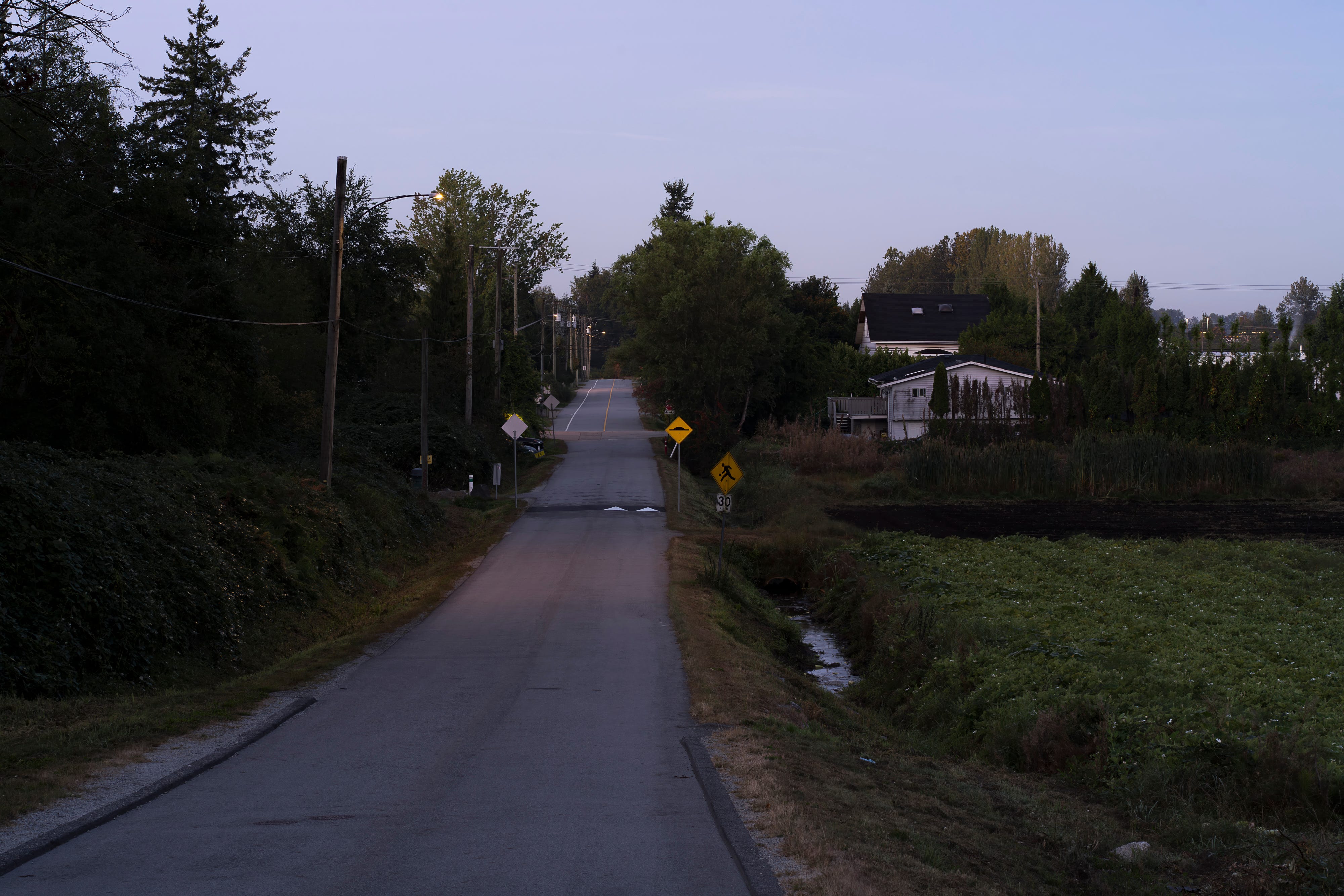
The second photograph holds no one. It’s the parallel road at the back of these fields on the left. Although it’s later, it’s even darker as a hill with fir trees blocks the light the other side of the field enjoys. The terrain is already different, with high points in the road and sudden slight dips. There is a small playground behind the trees to the left with two swings, a sandbox and a plastic slide for toddlers. There is a water fountain there. There is nowhere to park, and the road is too narrow for parking. The grass is always cut, but I have seen no one there. Now the colour of the sky is somewhere between blue and rose. A streetlamp is still lit on the left, working a little past when it’s needed. The road runs straight up a low rise and disappears into trees at the top, the way roads through farmland do, with determination, but without ceremony. On the right, a single house sits behind a hedge of conifers, its windows dark, no one awake inside yet, or no one home. Beside it, a field lies tilled and black, damp-looking, the kind of ground that stays boggy long after the rain has stopped, and beside that, a narrow ditch holds a thin line of standing water. Occasionally there is a heron there, waiting for frogs. A sign warns of a speed bump. Another warns that people sometimes cross here on foot. Nobody is crossing. No car is parked anywhere in the frame, no cart, no bag, no bent back working a row yet. It is the same place, more or less, the same farmland the woman walked by with her two-wheeled cart, but with the one thing that made the first photograph a story taken back out of it. What is left is only the road, the field, the ditch, the dark house, the traces of a place that people pass through every day. People, driving by, have seen me here before with my tripod and camera. They always seem surprised and watch me carefully as they pass.
_______________________
Thanks for looking at my photos and reading my essays. I’d appreciate your help; please take a minute to subscribe, restack the essay, or add it to your recommendations.
No posts
Comments
Nothing yet. Say the first thing.
Sign in to join the conversation.