
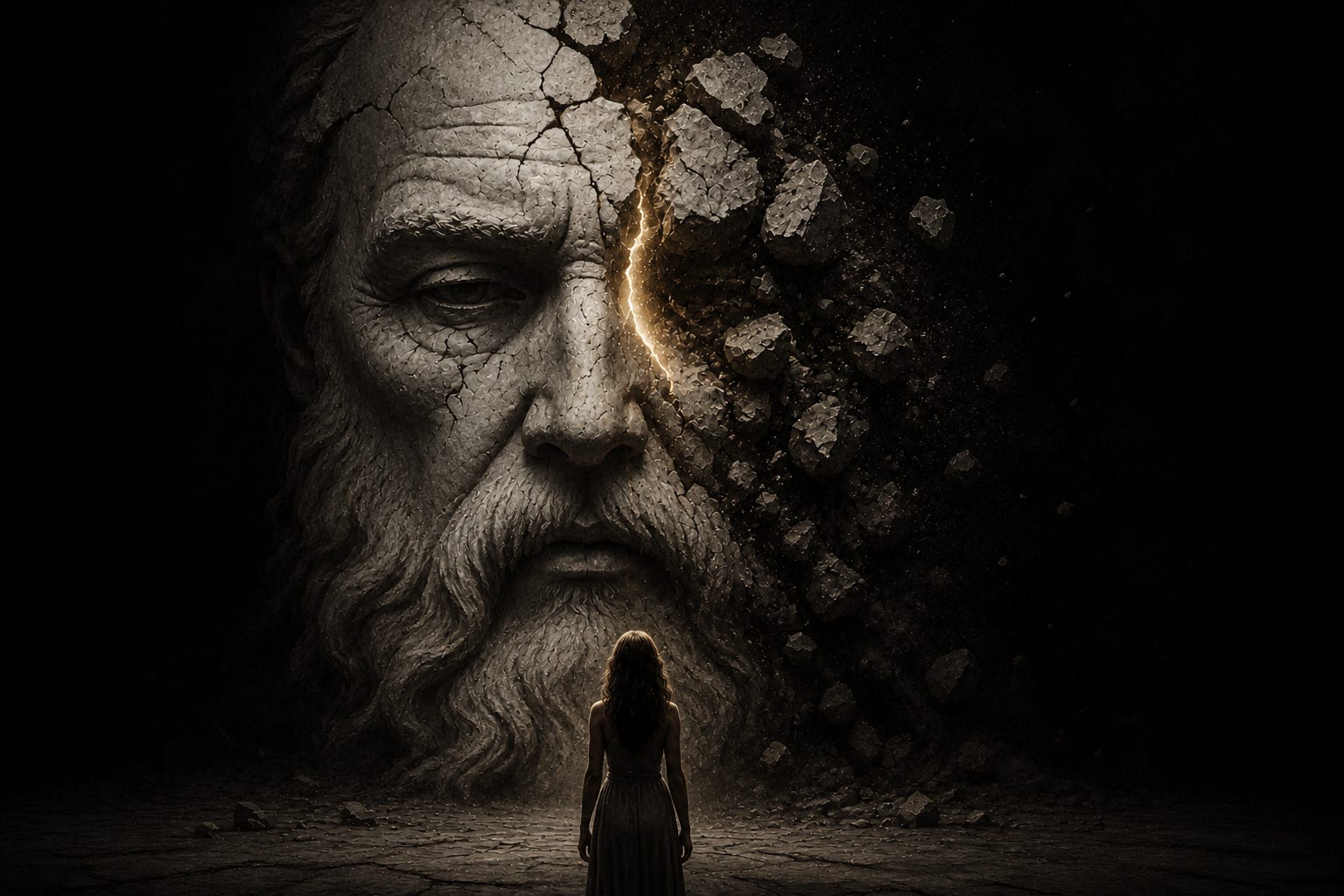
What happens when the God you were taught to worship becomes the greatest obstacle to taking God seriously?
I did not encounter this question as a detached observer of Christianity. I was formed inside its world. I studied theology in seminary, built a ministerial career around Christian belief, preached the biblical story, and helped other people interpret their lives through its categories.
I knew how the parts fit together: God existed above and beyond the universe as its supernatural creator; humanity had become estranged from God through sin; Jesus entered history to repair the breach; salvation restored the relationship; eternal destiny depended upon how one responded to the terms.
For years, this framework possessed the force of reality itself. It named the human problem, explained suffering, organized morality, interpreted history, and offered a final account of what everything meant. To question any part of it placed the whole structure under pressure because the doctrines did not stand independently.
Original sin required atonement. Atonement required a particular interpretation of Jesus. That interpretation required a certain view of Scripture. Scripture required an authorized community of interpreters, even when that community insisted that the text simply spoke for itself. What appeared to be a collection of beliefs functioned as an enclosed interpretive world.
Eventually, that world began to distort more than it disclosed. Its God seemed morally inconsistent with the goodness attributed to him, strangely human despite being described as transcendent, and inseparable from the patriarchal institutions that claimed to represent him. The framework declared an estrangement I could no longer locate in the structure of existence, then offered itself as the exclusive remedy. It made belonging conditional, turned spiritual life into relationship management, and required ancient cosmology to carry forms of authority it could not reasonably bear.
My difficulty extended beyond individual doctrines. The entire theological architecture had become intellectually implausible, morally unstable, and existentially costly. That conclusion did not arrive in a single moment, nor did it leave behind an uncomplicated atheism. The collapse of one conception of God opened a more demanding inquiry: whether traditional Christian theism had mistaken its own image for the mystery to which it was meant to point.
The ten problems that follow are therefore connected. Each reveals a feature of a larger system built around separation, hierarchy, supernatural intervention, and conditional belonging. Together they raise a question more consequential than whether the tradition has gotten some doctrines wrong. They ask whether its dominant construction of God has trained human beings to experience reality, themselves, and one another through a wound that theology itself created.
Because traditional Christian theism overwhelmingly imagines and addresses God as male, I use the pronoun he when describing the deity constructed within that system. The usage reflects the theology under examination rather than my own understanding of ultimate reality.
Traditional Christian theism commonly begins with a categorical division between God and everything that is not divine. The creator is uncreated; the universe is creation. He is self-existent, infinite, and necessary, while everything else is finite, dependent, and contingent. This division was intended to protect divine transcendence. The deity could not be reduced to nature, identified with any object, or contained within the cosmos. Creation depended upon him while he depended upon nothing.
The philosophical seriousness of this account deserves recognition. It safeguards the intuition that ultimate reality exceeds every finite form and resists the temptation to deify nature, nation, ruler, or religious institution. Yet popular Christianity rarely leaves transcendence at that level of subtlety. God becomes a supreme individual located conceptually somewhere beyond the universe: invisible, disembodied, immensely powerful, and equipped with intentions, preferences, emotions, plans, and judgments. However strongly theologians deny that he is one being among other beings, ordinary religious language continually imagines exactly that.
This produces what I call metaphysical exteriority: the assumption that the source and depth of existence stand outside the existence they source and sustain. The divine may be said to be present everywhere, but the governing picture still places him elsewhere. Heaven is above. Revelation arrives from beyond. Meaning is assigned to life from outside life. Human beings look away from the world in order to find the one who supposedly grounds it.
Once metaphysical exteriority becomes the controlling image, reality divides into sacred source and secondary creation. The world can display divine glory, obey its creator, or bear traces of his presence, yet it never fully participates in divinity. Matter becomes spiritually ambiguous. Bodies become lower than souls. Nature becomes scenery, resource, evidence, or stage. The present world is frequently subordinated to another realm imagined as our real home. Even when Christian theology affirms creation as good, its devotional gravity often pulls elsewhere.
The alternative need not be the simplistic claim that every object is God. A richer metaphysical vocabulary includes panentheism, nondual traditions, process thought, the ground of being, sacred naturalism, and forms of Christian mysticism that understand all things as existing within an inexhaustible reality that exceeds them without standing apart from them. These approaches differ substantially, but they refuse to picture transcendence as distance. Ultimate reality can exceed every form while remaining intimate to the being of every form.
That shift changes spiritual orientation. If the word God names the depth, ground, or encompassing mystery of existence, contact with reality does not require escape from the world. Attention becomes spiritually significant. Embodiment is no longer an obstacle to transcendence. Ecological destruction becomes more than the irresponsible use of divine property; it becomes violence within the living whole to which we belong. The sacred ceases to be a distant object of belief and becomes a dimension of participation.
Christian theology has developed many accounts of the human condition, some far more humane than others. The dominant Western narrative nevertheless remains familiar: humanity was created in right relationship with God, fell into sin, became alienated from its creator, and now requires reconciliation. The details vary across traditions. Some emphasize inherited guilt, others inherited corruption, bondage, mortality, or disordered desire. In most versions, a fundamental rupture precedes us. We enter life already implicated in it.
Such a narrative can illuminate genuine features of human experience. We are capable of estrangement from ourselves, one another, the natural world, and the demands of conscience. Human beings inflict harm, rationalize cruelty, betray their values, and participate in systems whose consequences they prefer not to see. Any spirituality that cannot reckon with our capacity for destruction offers sentiment rather than depth.
The theological problem begins when these real forms of estrangement are converted into an ontological verdict. Alienation becomes the deepest truth about the human person. Before an infant has chosen, harmed, understood, or refused anything, the framework has already located that life on the wrong side of a cosmic breach. The person is taught to interpret their existence through inherited spiritual deficit: something essential is missing, corrupted, condemned, or inaccessible until the religious system supplies the remedy.
This structure deserves closer scrutiny because the diagnosis and the cure come from the same institution. Christianity announces that humanity is separated from God, defines the nature of that separation, identifies the event through which it is overcome, and authorizes itself to administer the terms. A system that creates the interpretive wound and monopolizes its treatment acquires extraordinary power. Under its influence, ordinary uncertainty feels like rebellion, bodily desire like corruption, intellectual independence like pride, and departure from the system like departure from reality itself.
The consequences remain even after belief fades. Many people leaving Christianity continue to feel condemned without believing in a condemning God. Their nervous systems retain the threat after their minds reject the doctrine. They may distrust desire, fear their own judgment, or experience autonomy as danger. The theological claim has become an existential posture: I am estranged from the source of life, and my own capacities cannot be trusted to bring me home.
A different starting point would recognize belonging as ontological before it becomes moral, religious, or communal. Violating relationships does not remove us from the web of relationship. Alienation from our own experience does not separate us from the ground of being. Accountability remains necessary because belonging does not confer innocence. It gives accountability somewhere to occur. Repair becomes possible within relationship rather than serving as the price of admission to it.
The difference is profound. Grounded in prior belonging, a person is better able to face harm without collapsing into metaphysical shame. Moral failure calls for truth, restitution, changed behavior, and sometimes consequence. It does not require the belief that one’s essential existence has become repulsive to reality. Traditional Christian theism often confuses moral rupture with ontological exile. Once those are disentangled, human responsibility deepens because it no longer depends upon self-rejection.
Sophisticated Christian theology insists that God transcends biological sex. The divine is spirit, neither anatomically male nor female. Scripture occasionally uses maternal imagery, and theologians point to traditions in which divine wisdom, compassion, or presence carries feminine associations. These qualifications are real. They have not prevented the religious imagination from being organized overwhelmingly around a male deity.
God is Father, Lord, King, Son, Bridegroom, and Judge. The tradition’s definitive incarnation of God is male. The dominant pronoun is he. For much of the tradition’s history, those who interpreted Scripture, defined orthodoxy, presided at altars, governed institutions, and claimed divine authorization were also men. Describing God as metaphorically male does not neutralize the social effects of repeating that metaphor across centuries while concentrating power in male hands.
Religious symbols do more than describe an unseen reality. They distribute legitimacy. When ultimate authority is imagined as male, maleness acquires metaphysical elevation. The hierarchy of heaven becomes available as a template for the hierarchy of earth: God over humanity, Christ over the church, husband over wife, clergy over laity, father over household. Patriarchy can then present itself as participation in cosmic order rather than a historical arrangement serving particular interests.
I call this symbolic authorization: the process by which a religious image lends sacred inevitability to a social structure. No single masculine reference to God causes patriarchy. The mechanism operates cumulatively. Language shapes imagination; imagination establishes what feels natural; what feels natural becomes difficult to identify as political. By the time domination is defended explicitly, the symbol has already trained the community to associate authority, rationality, protection, and divine representation with men.
Expanding divine language is therefore more consequential than adding occasional feminine metaphors to an otherwise masculine system. If God is called Mother while ecclesial authority remains male, reproductive autonomy is controlled by men, women’s testimony is discounted, and gender hierarchy is treated as revelation, the new vocabulary becomes decorative inclusion. The governing distribution of sacred authority remains intact.
An adequate reconstruction must examine the deeper premise that ultimate reality resembles a magnified person at all. The debate over whether God is male often leaves anthropomorphism untouched, as though the solution were a more representative divine individual. Human language will always draw from human experience, and personal metaphors carry genuine relational depth. Trouble begins when metaphor forgets that it is metaphor and returns as cosmic anatomy.
The point reaches beyond gender. Every divine image authorizes a way of organizing human life. A sovereign deity lends legitimacy to authoritarian power. A punitive ruler sanctifies cruelty. A tribal divinity makes exclusion feel righteous. When ultimate reality is imagined as invulnerable perfection, dependency, grief, embodiment, and change appear spiritually inferior. Examining God-language therefore means examining the human order that language protects.
Traditional Christian theism attributes to God a combination of properties that becomes agonizing in the presence of suffering. He is perfectly good, fully powerful, intimately aware of every life, sovereign over history, responsive to prayer, and capable of intervention. Christian communities then tell stories of providence: the tumor disappeared, the accident was avoided, the money arrived, the child came home, the right person called at the right moment. Gratitude turns fortunate circumstance into evidence of divine attention.
The same interpretive system strains when intervention does not come. Another tumor grows. Another child dies. A family prays with equal sincerity and receives no rescue. Genocide unfolds while victims plead for deliverance. Abuse continues inside institutions dedicated to the one who supposedly sees everything. At that point, theology introduces hidden purpose, human freedom, spiritual formation, fallen creation, divine timing, or mystery. Each may address part of the philosophical problem. Collectively, they often protect the doctrine from the evidence rather than helping the sufferer understand what has happened.
The central dissonance lies in selective providence. If the deity can intervene, loves every person, and sometimes alters events in response to prayer, every claimed rescue creates a shadow question about those who were not rescued. The testimony that “God protected me” carries an implication few believers intend: the same protection was available and withheld elsewhere. Appeals to mystery may restrain arrogance, but mystery becomes morally troubling when it preserves praise for divine action in fortunate outcomes while shielding divine inaction from scrutiny in catastrophic ones.
This produces providential asymmetry. God receives agency when events turn out well and exemption when they turn out terribly. Human beings are encouraged to detect divine intention in coincidence, recovery, opportunity, and survival, while apparently meaningless suffering is assigned to causes that leave his goodness untouched. The framework cannot lose. Every outcome confirms it, which also means no possible outcome can test it.
The psychological burden falls heavily on those who suffer. Unanswered prayer can become an investigation of the self. Did I lack faith? Was I asking for the wrong thing? Is he teaching me something? Have I failed to recognize the answer? The believer must often defend divine goodness while absorbing the emotional consequences of divine absence. Grief becomes entangled with theological labor.
Some Christian responses move away from interventionist sovereignty. Process theology limits divine coercive power. Open theism reimagines divine knowledge of the future. Theologies of accompaniment locate God within suffering rather than above it as its controller. Contemplative traditions loosen the association between prayer and outcome. These approaches demonstrate that the problem is not spirituality itself. It arises from a particular package of claims whose elements cannot be held together without severe moral and cognitive strain.
Releasing supernatural intervention does not make suffering easier. It removes a layer of interpretive torment. Prayer becomes attention, lament, alignment, communion, and the gathering of courage rather than an appeal to a cosmic manager. Human action also becomes more urgent. When no invisible agent is presumed to interrupt the consequences of violence, neglect, disease, or ecological collapse, responsibility returns to the human community with greater force.
Christianity contains several ways of interpreting the death of Jesus. The cross has been understood as victory over the powers of evil, revelation of divine love, solidarity with human suffering, exposure of imperial violence, moral example, ransom, sacrifice, substitution, and satisfaction. These accounts should not be collapsed into one. Yet much of Western Christianity has given controlling force to the claim that Jesus died to atone for human sin and satisfy the demands of divine holiness or justice.
Within this logic, forgiveness is not simply given. A moral debt must be paid, punishment borne, honor restored, or divine wrath satisfied. Jesus becomes the acceptable victim whose suffering makes mercy possible. The arrangement is presented as love because God supplies the sacrifice he requires. The believer is asked to see an execution as the necessary mechanism of reconciliation.
The moral difficulty reaches deeper than discomfort with blood imagery. In its retributive forms, atonement theology makes violence part of the character of ultimate reality. God’s justice becomes incapable of forgiveness without punishment, even though human beings are often urged to forgive without exacting equivalent harm. The cross then models a universe in which innocence absorbs the penalty of guilt and suffering acquires redemptive meaning through the higher purpose assigned to it.
These ideas travel into lived experience. People enduring abuse have been encouraged to carry their crosses, forgive prematurely, submit to suffering, or believe that pain will serve a divine purpose. Communities can pursue reconciliation without truth, restitution, safety, or institutional change because the religious imagination has learned to treat forgiveness as the suspension of consequence. None of these distortions follows inevitably from every theology of the cross, but substitutionary frameworks provide them with symbolic resources.
The historical death of Jesus can be interpreted differently. Rome crucified people to display imperial power, terrorize populations, and erase resistance. Seen within that setting, the cross reveals what domination does to bodies. It exposes the alliance of political violence, religious authority, public spectacle, and collective fear. The theological center shifts from a deity requiring violence to a divine presence disclosed in solidarity with its victims and in resistance to the systems that produce them.
Even this interpretation requires care. Suffering does not become sacred merely because someone endures it courageously. Pain can destroy as readily as transform. The human need to make meaning after catastrophe must not become a doctrine that justifies catastrophe in advance. Any account of redemption worthy of the word should oppose the machinery of crucifixion rather than install that machinery within the divine.
Jesus need not be discarded when satisfaction theory is rejected. His life may become more visible once his death is no longer treated primarily as a metaphysical transaction. His table fellowship, boundary crossing, confrontation with religious power, attention to those made socially disposable, and proclamation of a reordered human community recover their own weight. The cross then belongs to the consequences of that life rather than reducing the life to preparation for a sacrificial death.
Modern scientific understanding has revealed a universe of profound relationality. Matter and energy, organisms and environments, bodies and ecosystems, minds and cultures all arise within networks of dependence. No human being exists as a sealed unit. Our bodies are composed of ancient elements, sustained through exchange, formed by evolutionary history, and embedded in a biosphere whose conditions make every breath possible. Philosophy and spiritual traditions have approached this interdependence through different vocabularies, but many converge upon a basic insight: being is participatory.
Traditional Christian theism affirms dependence while preserving separation. Creation exists because God wills and sustains it, yet creator and creation remain ontologically divided. Human beings depend upon him without participating in the divine except through carefully bounded theological categories. The system fears that stronger language of unity will erase difference, collapse the creator into nature, or turn spiritual experience into self-deification.
Those cautions address real risks. Claims that “everything is one” easily become vague enough to mean nothing. Unity language sometimes romanticizes nature, minimizes conflict, or dissolves moral responsibility into cosmic inevitability. Difference is real. A person is not a tree, a river, another person, or the universe in its totality. Participation does not mean interchangeability.
The deeper error is assuming that difference requires separation. A wave is distinguishable from the sea without existing apart from it. A cell has boundaries while belonging entirely to the organism whose life it expresses. Human identity emerges through relation: language, recognition, memory, place, body, ancestry, and shared worlds. The self possesses integrity without possessing independent existence.
I use participatory reality to name this conjunction of distinction and belonging. Everything exists through relationships it did not create and cannot fully control. Spirituality begins here as a disciplined encounter with our implication in what exceeds us. The sacred, under this view, does not need to enter the world from elsewhere. It becomes perceptible through the depth of relation itself.
This account carries ethical consequences. If existence is participatory, harm cannot be confined to isolated individuals. Social arrangements enter bodies. Ecological damage enters food, weather, migration, and grief. Historical violence persists in institutions and inherited opportunity. Compassion ceases to be benevolence extended from one independent self to another; it becomes recognition of a shared reality in which another’s diminishment alters the whole.
Christian theism often possesses resources for this insight, including the language of creation in God, the body of Christ, divine indwelling, and the declaration that all things hold together in the sacred. Its dominant architecture nevertheless pulls toward an external ruler governing discrete subjects. Recovering participatory reality may therefore involve reading parts of Christianity against the metaphysics that later came to control them.
Religious traditions speak through symbol because ultimate concerns exceed literal description. God is shepherd, fire, breath, rock, parent, judge, light, love, and word. Evil becomes serpent, adversary, darkness, bondage, corruption, and empire. Death is sleep, departure, judgment, crossing, return, or passage. Such language can gather layers of experience that propositions cannot contain.
Problems emerge when symbolic language loses awareness of its symbolic character. Metaphor hardens into metaphysics. God becomes a supernatural person, Satan a roaming invisible agent, heaven a destination, hell a chamber of punishment, and judgment a postmortem tribunal. Images originally capable of opening experience become objects that believers are required to affirm.
I call this process symbolic foreclosure. A symbol that could sustain many levels of meaning is closed around one authorized interpretation. The imaginative field contracts. Evil is projected onto a demonic personality rather than examined through trauma, appetite, ideology, group loyalty, institutional incentives, and the human capacity to dehumanize. Heaven directs attention toward another world while questions of how to create inhabitable life in this one lose urgency. Hell turns moral consequence into divine retaliation and supplies sacred justification for imagining some human beings as eternally disposable.
Literalization also changes the psychology of belief. The believer must divide mental energy between ordinary causal understanding and an invisible drama behind events. Temptation becomes satanic attack, coincidence becomes divine signaling, and psychological distress becomes spiritual warfare. The framework often intensifies fear while making evidence less decisive, since the unseen explanation is protected from ordinary methods of examination.
This critique should not be confused with the claim that only scientifically measurable realities are meaningful. Love, dignity, beauty, obligation, identity, and grief cannot be reduced to simple objects of measurement, though each has observable expressions. Human beings inhabit symbolic worlds, and those worlds have consequences. The task is to develop symbolic sobriety: the capacity to receive the depth of a symbol without confusing its imaginative form with a literal description of cosmic machinery.
Under symbolic sobriety, resurrection names the refusal of life to be exhausted by defeat without requiring every reader to settle the physics of an ancient miracle report. Hell exposes the lived realities of alienation, cruelty, and self-consuming hatred without constructing an eternal torture system. Satan personifies the adversarial forces within persons and societies without becoming an invisible explanation for whatever we fear. These interpretations do more than subtract supernatural belief. They restore moral, psychological, and political consequence to symbols that literalism has displaced into another realm.
The mature use of religious language requires holding meaning without demanding false certainty about mechanism. A symbol remains alive because it cannot be exhausted by one account. Once religion insists that the image must be believed as fact, faith becomes an exercise in defending the container at the expense of what it once carried.
The Bible is not a book in the ordinary sense. It is a library produced across centuries by different communities, in different genres, under different historical conditions, reflecting multiple theological perspectives. Its texts contain poetry, myth, law, genealogy, political memory, prophetic protest, wisdom, letters, parable, apocalypse, and competing interpretations of Israel, Jesus, God, history, and human obligation.
Traditional Christian theism often acknowledges this complexity while granting the canon a unified divine authority. In conservative forms, inspiration can approach divine dictation even when dictation is formally denied. The Bible is expected to yield a coherent message, remain free from consequential error, and govern questions its authors could not have imagined. A modern doctrine of Scripture is then projected backward onto ancient writings, and the resulting interpretation is described as biblical faith.
Literalism involves more than reading certain passages literally. It is an authority strategy. By claiming that the text carries God’s final word, interpreters conceal the human judgments required to make the text speak: which passages receive priority, which commands remain binding, which contradictions are harmonized, which historical contexts are decisive, and which translations define the terms. “The Bible says” often disguises a chain of institutional choices.
This creates interpretive concealment. Authority appears to reside entirely in the text while operating through communities that select, frame, teach, and enforce its meaning. Leaders can exercise enormous power without acknowledging themselves as agents of interpretation. Their conclusions acquire divine weight, while disagreement becomes disobedience to God rather than a conflict among human readers.
The problem becomes acute when ancient cosmology and social arrangements are asked to govern modern knowledge. Biblical authors did not possess evolutionary biology, contemporary cosmology, neuroscience, historical-critical method, or current understandings of gender and sexuality. This observation does not make them unintelligent or their work worthless. It locates them within history, where every human voice belongs.
An ancient text may carry wisdom without carrying final jurisdiction over every domain of inquiry. It can preserve memory, reveal moral struggle, expose domination, awaken imagination, and place modern readers in conversation with generations who confronted suffering, power, fidelity, exile, hope, and death. Such authority is dialogical rather than absolute. The text addresses us, and we answer with every form of knowledge, conscience, experience, and accountability available to us.
Once this relationship changes, disagreement with Scripture need not become a contest between human arrogance and divine truth. Some biblical passages deserve resistance. Commands of conquest, structures of enslavement, patriarchal restrictions, and images of eternal violence cannot be made good by assigning them to God. Moral maturity includes the capacity to refuse inherited authority when it demands the diminishment of human beings. A sacred text worthy of continued engagement should be able to survive our honesty about what it contains.
Christian doctrine emerged through long processes of argument, institutional conflict, philosophical borrowing, political pressure, worship, and communal interpretation. The Trinity, incarnation, original sin, atonement, and final judgment were not delivered as a finished system. They developed as communities tried to reconcile texts, experiences, rival teachings, and changing intellectual worlds. Historical development does not automatically invalidate a doctrine. It does undermine the fiction that the complete theological structure lies transparently on the surface of Scripture.
Many believers are nevertheless asked to treat contested and fantastical claims as prerequisites of faith: a primordial fall explaining the human condition, inherited sin, a virgin conception, a metaphysically unique incarnation, one God existing as three persons, bodily resurrection understood as historical mechanism, and everlasting conscious punishment. Some Christians interpret these teachings symbolically or revise them substantially. Others define their literal affirmation as the boundary of belonging.
The issue is not that reality must conform to common sense. Modern knowledge has revealed phenomena far stranger than ordinary intuition anticipates. Nor does lack of verification prove a claim false. The intellectual problem lies in demanding certainty where evidence permits, at most, imaginative possibility or confessional commitment. When assent becomes a moral test, the capacity to believe implausible propositions is mistaken for faithfulness.
This creates credibility coercion: social and spiritual pressure to report belief beyond what one can honestly affirm. The believer learns that doubt threatens salvation, community, family stability, moral identity, or vocational survival. Under those conditions, belief is no longer a free response to perceived truth. It becomes a performance conducted under existential threat.
People adapt in different ways. Some suppress questions. Some divide their minds, using critical reasoning in every area except religion. Some continually reinterpret doctrines while retaining orthodox vocabulary, creating private meanings beneath public affirmations. Others conclude that their inability to believe reveals spiritual failure. The institution rarely counts the cost of making intellectual self-betrayal a condition of belonging.
Doctrine can serve legitimate purposes. It provides a community with language, carries historical memory, disciplines interpretation, and prevents every private intuition from declaring itself ultimate. Shared formulations can make conversation possible across generations. Their proper role changes when they are understood as human constructions attempting to orient communities toward mystery, rather than celestial facts whose denial places a person outside grace.
Theological humility begins by proportioning conviction to evidence and consequence. Claims that condemn, exclude, subordinate, or terrify require more scrutiny, not less, because they are religious. Eternal conscious torment offers the clearest example. A doctrine that imagines infinite punishment for finite human lives, often determined by belief formed under radically unequal conditions, should collapse under its own moral weight. Calling it divine justice does not resolve the contradiction. It reveals how thoroughly the image of God can override conscience.
Evangelical Christianity often presents faith as a personal relationship with God rather than a religion. The phrase promises intimacy over institution, lived encounter over empty ritual, and love over legalism. For many people it has named experiences of comfort, guidance, moral transformation, and profound interior companionship. Those experiences should not be dismissed simply because their interpretation can be questioned.
Yet the relationship begins under unusual conditions. God cannot be seen, heard in an ordinary reciprocal manner, or known apart from interpretation. One party is perfect, omniscient, and ultimately authoritative; the other is fallen, limited, and instructed to distrust their own understanding. The religious community supplies the accepted signs of God’s presence, the expected forms of communication, and the criteria for determining whether one is in right relationship.
This arrangement places a remarkable burden on the believer. They must pray consistently, detect guidance, interpret silence, confess adequately, surrender completely, maintain faith, resist temptation, discern God’s will, and monitor whether competing desires arise from ego, evil, trauma, or divine leading. When the relationship feels absent, responsibility tends to flow downward. God has not failed to communicate; the person has failed to listen.
I call this sacred relationship labor: the continual effort required to sustain, interpret, and verify a relationship whose other participant remains inaccessible except through contested signs. The labor becomes especially intense because the stakes encompass meaning, identity, community, moral worth, and eternal destiny. Ordinary fluctuations in emotion become spiritually charged. Dryness may feel like abandonment, ambivalence like betrayal, and independent desire like resistance to God.
The language of relationship also obscures the transactional structure beneath it. Christianity proclaims grace as a free gift while surrounding that gift with conditions of reception, evidence, perseverance, obedience, and doctrinal fidelity. Believers are told they cannot earn divine love, then given an extensive account of how a life should look if that love has truly been received. The transaction moves from purchase to proof.
For those formed within this system, self-trust becomes morally dangerous. Their deepest perceptions are vulnerable to being labeled deception, their bodies treated as sources of temptation, and their moral objections dismissed as pride. The safest course is to transfer interpretive authority to Scripture, clergy, community, or an internalized divine voice shaped by all three. The personal relationship thereby becomes the most intimate location of institutional power.
Spiritual life need not disappear when this transaction ends. Contemplation, gratitude, reverence, ethical commitment, wonder, ritual, and experiences of communion remain available without constructing an invisible authority whose approval must be continually secured. The person can relate to the mystery of existence through participation rather than negotiation. The burden of making God present gives way to the recognition that no life could stand outside the reality the word God seeks to name.
Taken individually, these ten problems can look like familiar disputes about doctrine. Viewed together, they reveal a more comprehensive structure. Traditional Christian theism organizes reality through a series of divisions: God and universe, sacred and secular, creator and creature, heaven and earth, saved and lost, spirit and body, orthodoxy and error, divine authority and human judgment. Each distinction carries some legitimate insight. Collectively, they are often converted into separations and arranged hierarchically.
At the center stands a God imagined as self-sufficient, sovereign, invulnerable, and above the world. Spiritual maturity then becomes movement upward and away: away from bodily desire, dependence, ambiguity, finitude, and the ordinary conditions of creaturely life. Human beings are taught to seek resemblance to a divine ideal constructed through exemption from the realities that make us human.
I call this larger system the architecture of separation. It is theological because it describes God, psychological because it shapes the self, social because it distributes authority, and political because it legitimizes hierarchy. Its power comes from the way these dimensions reinforce one another. A God above creation supports leaders above communities. A humanity unable to trust itself supports institutions that interpret on its behalf. A salvation administered through authorized beliefs turns belonging into compliance. A future heaven can reduce the moral urgency of the present world.
The architecture does not control every Christian life in the same way. Christianity contains internal resistance: mystics who experienced union, prophets who opposed sacred power, liberationists who read salvation politically, contemplatives who found God within, and communities whose practices exceed their doctrines. Countless believers inhabit traditional language with generosity and intellectual freedom. A fair critique must acknowledge that people often become more humane than the systems that form them.
That acknowledgement does not remove the need to examine the structure. A theology should be evaluated by more than the private goodness of its adherents or the beauty of its highest expressions. We must also ask what forms of domination it can authorize, what kinds of fear it repeatedly generates, whose authority it elevates, what intellectual compromises it demands, and how it teaches a person to inhabit their own humanity.
The deepest effect of separation theology may be existential estrangement: the learned experience of being outside the source of one’s own life. A person becomes dependent upon an external system to mediate reality, authorize identity, interpret conscience, and grant belonging. Even love arrives from elsewhere and must be received correctly. The self does not stand within reality as a participant; it stands before reality as an applicant.
Religious deconstruction often begins by challenging doctrines but reaches its true depth when this posture becomes visible. The person discovers that leaving a belief system does not automatically end the experience of separation. The external God may disappear while the internal structure remains: distrust of self, fear of uncertainty, dependence upon authoritative answers, and the sense that belonging must be earned. Reconstruction therefore involves more than acquiring better ideas. It requires learning to inhabit existence without asking permission to belong to it.
Traditional theism often controls the debate by defining the available options. Either a supreme personal being exists or God does not exist. Either Christianity’s supernatural claims are true or reality is spiritually empty. Either one accepts divine revelation or reduces life to matter and mechanism. Many people leave religion while carrying these alternatives with them, becoming atheists in relation to the only God they were taught was possible.
The binary is intellectually impoverished. The word God has carried radically different meanings across traditions and eras: personal creator, ultimate concern, ground of being, unconditioned reality, infinite depth, process, love, consciousness, emptiness, the sacred whole, and the name given to what exceeds every name. These meanings cannot be blended without losing their differences. Their variety demonstrates that rejecting one conception does not settle the entire metaphysical question.
Sources within the tradition resist theological uniformity. Biblical texts offer royal, parental, maternal, legal, cosmic, intimate, anthropomorphic, and apophatic images. God walks in a garden, speaks from a storm, burns in a bush, dwells in darkness, fills heaven and earth, appears in the stranger, and remains beyond every human representation. Later theologians described the divine as being itself rather than a being, while mystical traditions approached it through unknowing, union, and the surrender of images.
The dominance of supernatural personal theism has caused many readers to treat these alternatives as poetic supplements to the real God, who still resembles an infinite mind governing the cosmos. Reversing that hierarchy changes the field. Personal language can become one symbolic register among others, valuable for intimacy and moral address without functioning as a literal portrait of ultimate reality.
None of this proves that reality is divine, conscious, purposive, benevolent, or worthy of the name God. Intellectual honesty leaves those questions open. It also refuses to let inherited theology decide in advance what counts as a serious answer. Mystery should not become a refuge for claims that cannot withstand examination, but neither should the limits of one religious framework be mistaken for the limits of reality.
The more fruitful distinction lies between God as an explanatory object and God as a depth dimension of existence. The first competes with scientific accounts by functioning as an invisible cause within the same field of explanation. The second concerns the character, intelligibility, value, and inexhaustibility of being itself. Science investigates how worlds develop without exhausting what it means that anything exists, that consciousness participates in reality, or that human beings experience obligation, beauty, terror, and wonder within it.
Atheism deserves recognition as more than a transitional stage between traditional belief and reconstructed spirituality. For many people, it represents the most intellectually honest response to the available evidence and the theological claims they have encountered. An atheist may experience wonder, moral obligation, reverence, belonging, and existential depth without interpreting any of them as evidence of divinity. Nothing in this argument requires ultimate reality to be called God or the depth of existence to be understood as sacred. The freedom to reconstruct spiritual language must include the freedom to leave that language behind entirely.
Religious deconstruction does not obligate anyone to construct another theology. Reconstruction may involve recovering spiritual language, or it may mean building a life without God, metaphysical commitments, or religious identity. Its deeper work involves recovering agency, self-trust, belonging, ethical orientation, and the ability to live meaningfully after the interpretive system that once organized reality has fallen away. An atheist who has built a coherent and fully inhabited life after religion has not failed to reconstruct. They have reconstructed on different ground.
Existential health does not depend upon reaching a particular metaphysical conclusion. It concerns how well we inhabit uncertainty, remain in contact with reality, exercise self-authorship, sustain meaningful relationships, face mortality, and participate honestly in our lives. These capacities are available to atheists, theists, agnostics, humanists, mystics, and those who claim no identity at all. Existential health is measured by whether a framework enlarges our capacity for reality without demanding the surrender of intellectual honesty or personal authority.
Calling the depth of existence God therefore remains optional. For some, the word carries irreplaceable resonance. For others, it is too burdened by domination, trauma, and implausible claims to remain useful. No vocabulary should become the price of spiritual or existential seriousness. Every person must remain free to investigate ultimate reality without surrendering authority to an institution that claims to have named it finally.
The collapse of traditional Christian theism is often experienced first as subtraction. God disappears from the sky. Prayer loses its recipient. Scripture loses final authority. The story that organized suffering, morality, identity, death, and hope no longer holds. Even an oppressive framework can leave a genuine absence when it falls because it once carried the weight of an entire world.
Rushing to replace that world repeats the old demand for certainty. Some people need to remain within metaphysical orphanhood long enough to discover which parts of spiritual life were encounters with reality and which were products of interpretive containment. Within that open space, wonder survives without supernatural explanation. Ethical seriousness often deepens after divine surveillance ends. Ritual continues as a way of inhabiting time, while contemplation becomes more honest when released from the need to produce messages from elsewhere.
The sacred, as I understand it now, does not name a separate supernatural domain. It names a quality of encounter in which reality exceeds our use of it. A person becomes more than a role they perform for us. A forest becomes more than timber. A body becomes more than an instrument of productivity. Grief reveals the irreplaceable value of what has been lost. Mortality makes a finite life worthy of attention rather than merely a prelude to another one.
This understanding offers no guarantee that the universe is arranged for our benefit. It does not promise intervention, final explanation, cosmic justice, or personal immortality. Its spiritual force comes from fuller contact with existence rather than protection from its volatility. Reverence becomes possible without certainty because value does not depend upon permanence, and belonging does not depend upon exemption from death.
Traditional theism trained many of us to look beyond life for the source of life’s significance. The reconstruction I am describing turns attention back toward participation: toward bodies, relationships, communities, ecosystems, moral consequence, and the mystery present in the fact that anything exists at all. Transcendence no longer means escape from finitude. It names the way finite existence continually exceeds our concepts, control, and possession.
I no longer believe human beings begin in separation from the ground of their existence. Alienation, destructiveness, dissociation, and disorientation remain part of the human condition. We betray ourselves and one another. We require accountability, repair, practices of discernment, and communities capable of telling the truth. None of these requires ontological exile as its foundation. Our failures occur inside belonging, and the work of becoming human takes place there as well.
The God I could no longer believe in stood outside the universe, governed through selective intervention, authorized patriarchal power, demanded a sacrificial death, spoke with finality through an ancient text, and made relationship contingent upon correct belief. Letting go of that God did not settle every question. It cleared the ground on which the questions could finally become honest.
What remains is neither the certainty I once possessed nor an empty world stripped of depth. It is a reality in which everything belongs before anyone explains why, a mystery no institution can own, and a human life returned to the responsibility of participation. The end of traditional theism may feel like the disappearance of God. From another vantage, it is the moment a theological image stops standing between us and the sacred.
📄 What Comes After Deconstruction? Existential Health and the Work of Building a Life Beyond Religion
If this article gave you language for questions you have carried beyond traditional religion, consider becoming a paid subscriber ($50 annually).
Your support makes it possible for me to continue producing substantial, independent work on religious deconstruction, existential health, non-religious spirituality, and the reconstruction of a life beyond inherited certainty. It also supports the larger effort to develop new frameworks for meaning, belonging, self-trust, and spiritual depth without requiring anyone to surrender their intellectual honesty or personal authority.
Paid subscribers receive full access to my writing and complimentary annual membership in the Center for Non-Religious Spirituality, including its gatherings, workshops, groups, and ongoing community life.
This work exists because readers choose to sustain it. If you believe these conversations deserve a serious and enduring place in our culture, I invite you to become a paid subscriber.
Comments
Nothing yet. Say the first thing.
Sign in to join the conversation.