

Kennedy and Israel - Rolf Kvalvik digs into 2025 declassified Kennedy assassination documents revealing that four words were systematically redacted across four release cycles before finally seeing daylight. The four words were “the Israeli Intelligence Service,” suggesting that there’s someone powerful that kept the link with Israel in the dark the first three times. Apparently, CIA counterintelligence chief James Angleton met with Mossad reps up to five times weekly and personally controlled Oswald surveillance files, yet lied about any pre-assassination knowledge. Kennedy had issued ultimatums to stop Israel’s nuclear weapons program, and his successor LBJ abandoned that fight immediately, with Israel completing its first nuclear bomb by 1966. Most striking revelation is that Angleton removed Oswald from federal watchlists six weeks before Dallas.
Red and Blue Families - Benjamin L. Mabry lays out two distinct family models. The “Blue” model is a partnership optimized for shared career projects and the “Red” model is a kinship embedded in extended community. As you might expect the distinction isn’t black and white nor cleanly split along political lines as the names would suggest. The main insight is that each breaks down through completely different failure modes. Poverty devastates Blue families by destroying the partnership's economic foundation, while vice like alcoholism ravages Red families because it violates communal resource-sharing obligations. Regardless, both types of families are now being undermined by worker mobility and suburbanization, making it hard to make either approach work.
Childhood Freedom - Johann Kurtz documents a reversal. In 1971, roughly 80% of British seven-year-olds traveled to school independently, but by 1990 that figure collapsed to 9% despite violent crime falling by half. Unsupervised childhood now requires expensive real estate, religious community membership, and/or wealth to privately recreate every social function. He cites Robert Sampson's Chicago research showing how neighbors' willingness to intervene predicted safety far better than poverty levels, showing that the current situation of childhood freedom being a luxury good need not be the case. The fiat dependence on government, unfortunately, incentivizes not caring very much about neighbors or neighborhoods, and children are left paying the price.
Young Women Aren't Converting - Madeleine makes the refreshingly honest case that young women aren't joining conservative Christianity at the same rate as men because the lifestyle costs are dramatically front-loaded. Before getting a husband, they must abandon social signaling, restructure career plans, and sever secular friendship circles. Men converting primarily sacrifice premarital sex while women sacrifice visible social status, career mobility, and access to secular support networks. She paraphrases the rich young ruler from Matthew 19 to frame women's hesitation as entirely rational cost-benefit analysis. Yet like the rich young ruler, there are long term consequences to such short term thinking, which unfortunately prevails to the fiat educated.
Benefits of Forgetting - Luke Burgis recounts discovering at age 39 that his father's undiagnosed Alzheimer's had progressed so far that he failed to recognize his wife's catastrophic health decline. The crisis only surfaced because a parish priest noticed the family had stopped attending Mass, illustrating the difference between “thin” communities that reward conformity and “thick” communities that notice when someone goes missing. His father's remaining memories center entirely on deep relationships while resentments have evaporated, to quote: “It's not all bad being me, because there are a lot of things that are not worth remembering.” Even in things we think of as tragic, there are trade-offs.

Atomiq Level - I was on this podcast on Substack Live a while back, but it’s now on YouTube. We talked mostly about Bitcoin as money and as freedom technology.
Origin Seoul - I will be in Seoul, Korea for this event on July 18th. There’s a gathering of Christian Bitcoiners followed by a more general one afterward. Sign up and come on by if you’re in town then!


Transaction Privacy - A comprehensive Delving Bitcoin thread mapping out where Bitcoin privacy actually stands right now. The short summary is that it's mostly happening in wallets and L2s and not at the protocol level. The discussion covers CoinJoin (including WabiSabi and Wasabi's “Pay in CoinJoin” feature), Silent Payments, PayJoin, CoinSwap, and even PathCoin for offline transfers. There's real disagreement about how effective any of these are. Critics point to scaling challenges in CoinJoin and custodian-visible patterns in Silent Payments. The main observation is that privacy has shifted from a protocol-level concern to a wallet-level one, with Nostr-based CoinJoin coordination (joinstr) being one of the more interesting new directions.
BIP110 Fork Simulator - An interactive educational tool that walks you through how the BIP110 softfork may play out, from miner signaling through potential chain splits. The simulator’s three-part learning path (Activation, Forking, Simulator) makes the abstract mechanics of softfork disagreement concrete and visual. It’s not a bad first-order approximation of what would happen, but relying on this as truth is a bit naive as the hash power splits are likely to change and not stay static as the simulator assumes. It’s also hard to model how miners are going to optimize on what they perceive will happen. In other words, it’s a dynamic system and dynamic systems are notoriously hard to predict.
Bedrock - Brink grantee Niklas Gogge built a custom hypervisor from scratch in Rust that creates a determinism boundary for fuzz testing. This means you can run the exact same test scenario with identical results every time. The most technically impressive part is achieving near-zero instruction “skid,” or overshot past target instruction count, using Intel’s performance monitoring features for precise timer interrupt injection. The engineering around creating what is essentially deterministic states around something as random as fuzz testing is indeed pretty cool and a good way to find and fix bugs that would normally not surface.

Async Payments - LDK's async payments protocol attempts to solve one of Lightning's most annoying UX problems. You can't receive payments when your node is offline. The system works by having the sender's LSP hold an HTLC with an extended timeout while an onion message notifies the recipient, who provides the release secret when they come back online. The key design insight is that no funds are locked up across the network during the wait. Only the sender's intended payment is encumbered, which avoids the liquidity waste of alternative approaches like long-CLTV spontaneous payments. The main concern is that the recipient has to come back online to complete the payment, and in the meantime, the routes can go stale. There’s a protocol for finding an alternative route, but it’s a pretty frustrating UX to send asynchronously and have no finality like you do onchain.
ZapBox - This is a hardware project that turns ESP32 microcontrollers and LilyGo boards into physical Bitcoin Lightning payment devices which they call “switches.” These are devices that switch Lightning payments into some good or service. The idea is that any maker with basic electronics skills can build a physical device that accepts or triggers Lightning payments. Think vending machines, door locks, tip jars, or any real-world object that should be able to interact with the Lightning Network. The ESP32 costs a few dollars, making this one of the lowest-cost Lightning hardware entry points available.
Bitcoin Karoo - Sarah Joubert left her career as an investment specialist at Standard Bank after recognizing traditional finance was failing ordinary South Africans through high fees and poor returns. She and her husband founded Bitcoin Karoo in the small town of De Rust, building a grassroots Bitcoin circular economy that combines tennis lessons with instruction on Bitcoin, budgeting, and Austrian economics. Their model focuses on expanding merchant adoption among spaza shops (informal convenience stores) and introducing the Fedimint protocol for privacy-conscious transactions.

Blockstream Part 2 - In something of a response to the Blockstream article from last week, BitMexResearch took a look and concludes that while the original article is worth reading and raises legitimate questions about the BMN’s financial health and the 20% yield promise, it goes too far in linking mining note problems to the BSTR public listing. According to the author, the mining note situation “deserves further investigation,” but the article is “too aggressive” in its conclusions. The association with the convict Chris Cook is what makes me question the situation, and while I think the first article is perhaps drawing too many conclusions, this article reads a little too much as an exoneration.
Dilution as a Service - (Non-Paywall) Craig Coben at the Financial Times coins this devastating phrase to describe Strategy's perpetual share issuance model. The argument is that MSTR shareholders are being slowly diluted to fund Saylor's Bitcoin accumulation, with each new offering benefiting existing Bitcoin holdings at the expense of new equity investors. It's a structural critique that Bitcoiners need to take seriously rather than dismiss as FUD, especially given the recent Bitcoin treasury company drops. The question isn't whether Bitcoin is good, but whether this particular vehicle is fair to its shareholders given the leverage being employed.
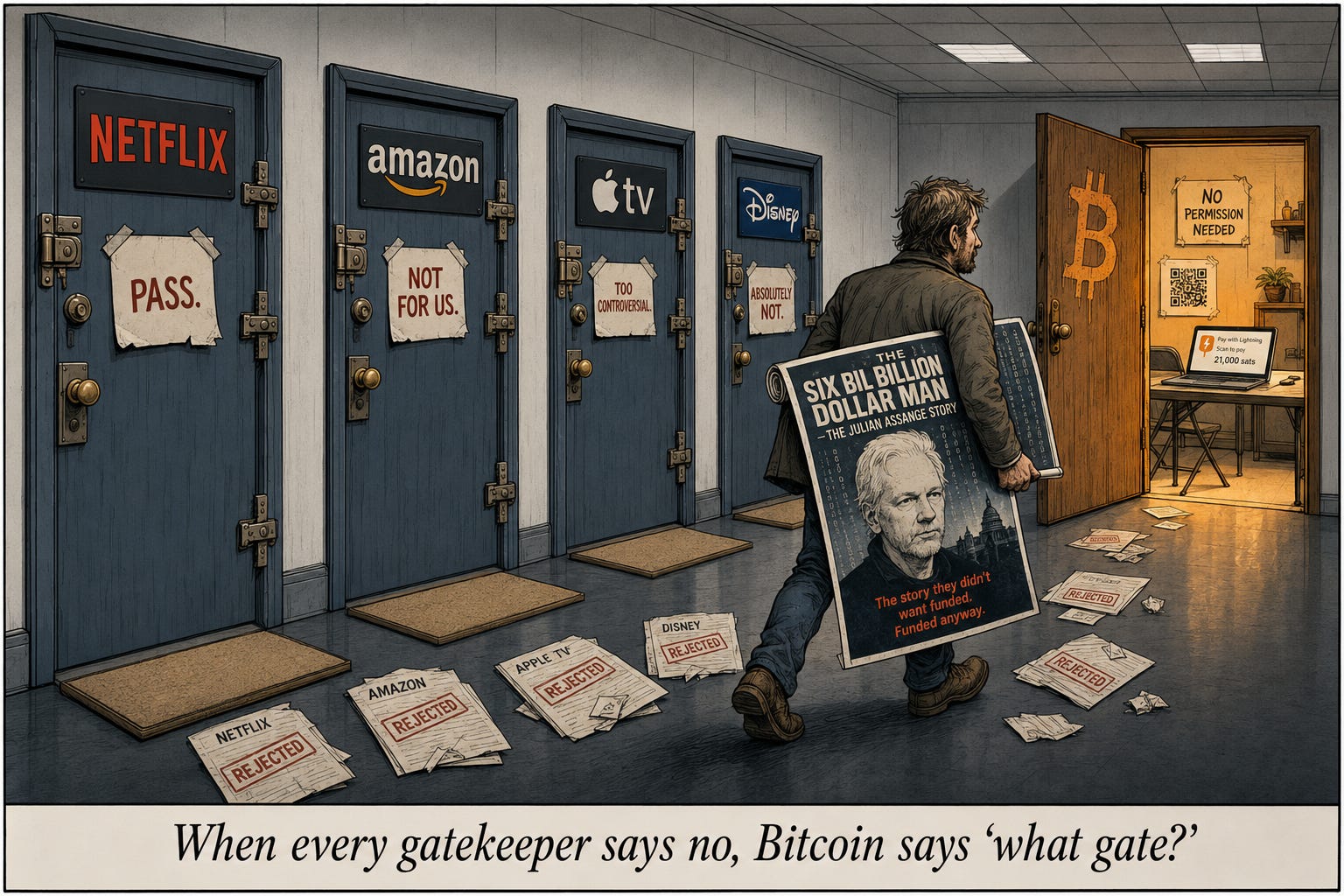
The Six Billion Dollar Man - Forbes reports on this Julian Assange documentary that no major streaming platform would distribute. The filmmakers have turned to Bitcoin-based funding and distribution instead. It’s a case study in why censorship-resistant money matters, particularly with respect to traditional gatekeepers. When every traditional distribution channel says no, Bitcoin provides an alternative that doesn’t require anyone’s permission. The appropriateness of an Assange film, about a man persecuted for publishing uncomfortable truths, finding its financial lifeline in the technology WikiLeaks helped popularize is almost too perfect.
Hal Wallet - A new Bitcoin wallet with a minimalist aesthetic built on CSS rather than the usual bloated UI frameworks.
MSTR Lawsuit - There’s a shareholder class action lawsuit examining whether executives made misleading statements about the Bitcoin treasury strategy.
Noah Doe Demasking? - “Noah Doe” is a claimant trying to gain legal ownership of ~3.8M of Patoshi Bitcoin. Oral arguments are scheduled where the judge will decide whether Doe can remain anonymous.
Jobs in Bitcoin - It’s hard out there, especially in a bear market. Go mine fiat instead.
Fiat delenda est.
No posts
Comments
Nothing yet. Say the first thing.
Sign in to join the conversation.