

Autonomous Cars and Real Estate - I got a Tesla with Full Self Driving a few months ago, and I’m still amazed more people haven’t switched. This is an article about how such cars will be changing commercial real estate, though I suspect the long-term changes will be much bigger. The article makes the very insightful point that almost every retail store is essentially a last-mile problem solved with cars and autonomous cars will change the equation significantly. As the article states, a single automated warehouse could replace ten conventional grocery stores. I personally think autonomous vehicles, including self-driving cars and delivery drones, will change more things than AI will.
Quebec Nationalism - Peter Frost examines the resurgence of Quebec nationalism, thanks to mass immigration that added 430,000 newcomers from 2022-2024. This is proportionally equivalent to dropping 3.3 million people into France over three years. Canada's GDP per capita has unsurprisingly declined 2.5% below pre-pandemic levels despite population growth, proving more bodies doesn't mean more prosperity. The Parti Québécois is expected to win October elections, whose goal is independence. Given that 25% of the Canadian Armed Forces are French-Canadian, there would be obvious complications if Ottawa tried to hold Quebec by force. Of course, if Quebec were able to gain independence, Alberta would not be far behind, and a world of smaller states would seem then inevitable.
Failed Democracies - Frank Wright shows how nearly every European country had democracies which collapsed during the interwar period. From the Weimar Republic to Greece, democracies had a terrible reputation until after WWII. The contrast between what we consider governance now and what pre-1914 governance was is striking. Before 1914, governance was so minimal that “an Englishman could hardly notice the state.” What we call democracy now has brought massive bureaucratic expansion in step with the monetary expansion. We place too much emphasis on the form of government and not enough on the character of the people, which unfortunately gets deeply corrupted under fiat money.
Saving LA - Spencer Pratt frames his failed LA mayoral bid as losing a battle but not the war, pivoting to a “new media empire” to expose city fraud. Despite the very sketchy vote counting that seems to have been designed to exclude him specifically, he’s not done fighting. As he points out, his campaign forced officials into at least some visible reform in the beleaguered city. Pratt is also promising some bombshell recordings from city officials to expose corruption. Every single party governance predictably results in this and under fiat money, the corruption is essentially unbounded. And we can see this in the population statistics, which given the weather of the place should be increasing, yet continues declining.
Knockrup.com - Aella (I refuse to link to this person) launched this rather dystopian website to connect wealthy men who want genetic offspring with women willing to bear children for compensation. It features embryo selection technology, offering up to 10 additional IQ points, incentivizing IVF even among women who could conceive naturally. For me, this is an indication of just how bad dating has gotten that both men and women want such a dystopian alternative. Yet this website is sadly the logical next step of seeing partners and children as commodities to be optimized rather than as people.

Servant Leadership Podcast - I posted this podcast already, but this is a Korean dubbed translation of the entire podcast, which is a fascinating new type of content. I know enough Korean to know that it’s at least not terrible and given I’ll be in Seoul in a month (see next item), it’s content like this that brings people in different cultures together.
Origin Seoul - I will be in Seoul, Korea for this event on July 18th. There’s a gathering of Christian Bitcoiners followed by a more general one afterward. Sign up and come on by if you’re in town then!
Hanging Contest - Fun little fitness contest at BTC Prague. I was as surprised at who won.

Joinstr on Floresta - Floresta Wallet adds coordinator-less CoinJoin functionality. The Bitcoin wallet is using Utreexo and Nostr to coordinate the CoinJoin. The joinstr protocol lets users construct collaborative transactions (PSBTs) peer-to-peer via Nostr relays and Tor, eliminating the single point of failure and surveillance that plagues existing CoinJoin implementations. Privacy on Bitcoin desperately needs more implementations of decentralized CoinJoin, and the combination of Nostr coordination with Utreexo-based verification is a genuinely novel approach.
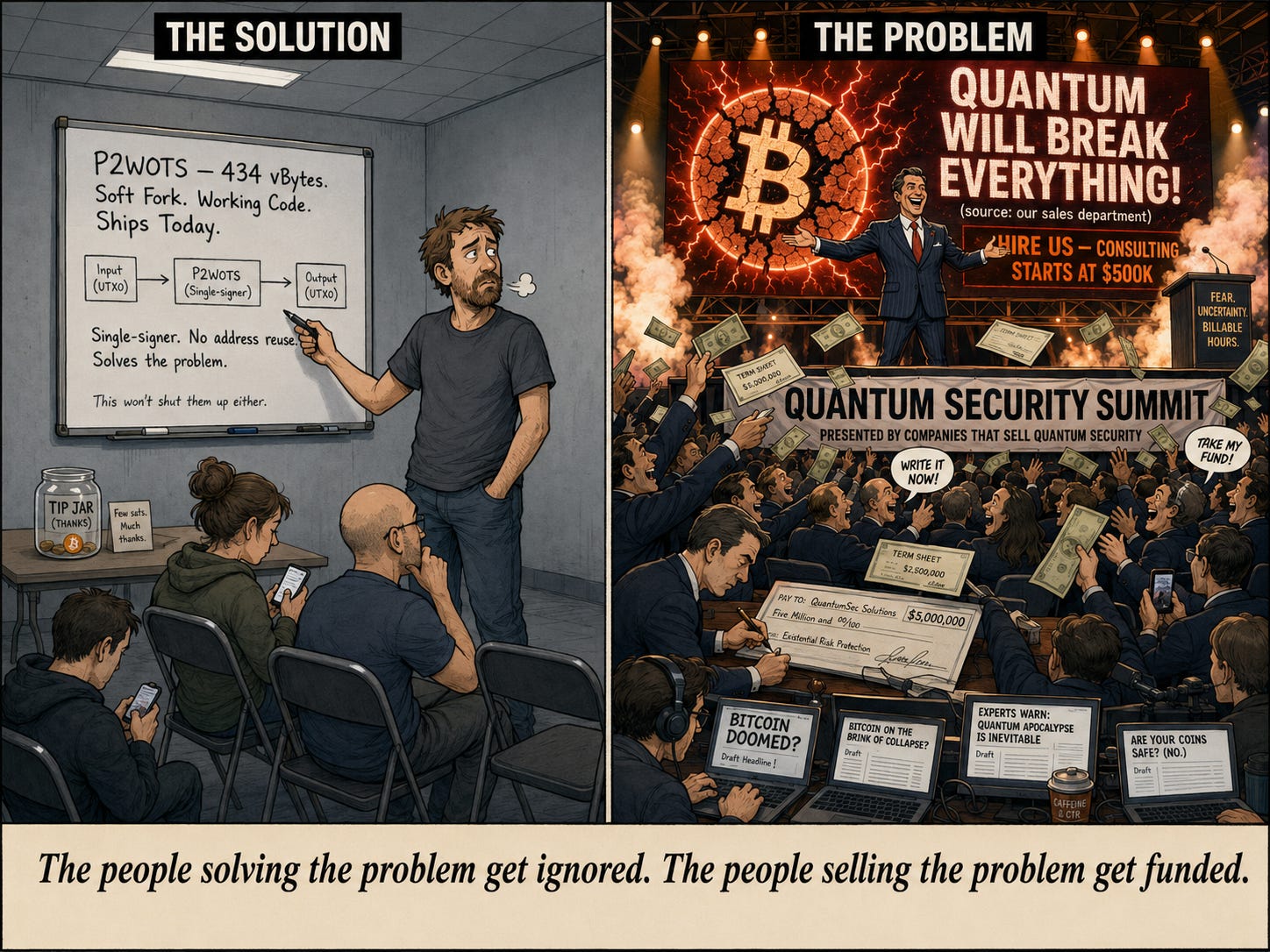
P2WOTS - Post-Quantum UTXO Winternitz Signatures is a proposal which introduces a new witness version 3 output type using Winternitz One-Time Signatures. The signature is implementable as a soft fork at just 434 virtual bytes per signature. The design uses a Merkle Key Tree providing 64 signing attempts per address and anchors signatures to TXIDs to prevent reuse attacks. The clever part is working within Bitcoin's UTXO model rather than trying to bolt on account-based quantum resistance. Limitations include single-signer only, which means no multisig, CPFP-only fee bumping which means no RBF, and no address reuse. I don’t think quantum computing actually threatens Bitcoin, but having a concrete, minimal soft-fork proposal should shut up some of the quantum FUDsters. Of course, it won’t, but that’s another whole discussion.
Accountable Computing - Antoine Riard proposes using Bitcoin smart contracts and zero-knowledge proofs to create a trustless marketplace where AI agents only get paid when they deliver verifiably correct solutions. The system encodes problems in Taproot annex data, locks rewards in smart contracts, and uses ZK proofs to verify solutions without revealing the computation. Users publish problems with collateral; agents scan the blockchain for opportunities, generate proofs, and unlock rewards. It is an application of Bitcoin's programmability to the principal-agent problem that plagues AI services. You should not have to trust that an AI gave you the right answer when you can verify it cryptographically. Whether the complexity is worth it for current AI use cases is debatable, but the framework is intellectually serious.
Zero-Timestamp Gossip - A vulnerability in LND before v0.20.1 allowed an attacker to crash any LND node by broadcasting a validly signed channel_update or node_announcement with a timestamp of zero, causing a nil map panic that terminated the daemon entirely. The bug was discovered through fuzzing the gossip state machine, and exploitation was cheap. An attacker could create a synthetic funding transaction to a 2-of-2 P2WSH output and broadcast zero-timestamp announcements without even running a real node. BOLT 7 required timestamps greater than zero but never explicitly defined rejection behavior, which is the kind of spec ambiguity that creates implementation bugs. The fix was simply to reject zero-timestamp messages at parse time.
Interactive Lightning Tutorial - This guide walks through Lightning Network mechanics with visual balance sliders, clickable channel simulators, and a routing puzzle where users build payment paths through misaligned liquidity. It covers payment channels, HTLC security guarantees, and the routing problem of finding viable paths when channel balance distributions are hidden. The author makes the important point that Bitcoin's seven transactions per second is not a flaw but a feature and that the base layer is slow on purpose to preserve decentralization and security for the settlement layer beneath faster systems.
Tollbooth - Tollbooth implements a discriminating approach to API monetization using Lightning, where users pre-fund balances and tools debit per call. The pricing is currently 1 sat for reads, 5 for writes, and 10 for heavy operations. Authentication uses Nostr keypairs instead of emails or passwords, and failed API calls automatically roll back credits so users never pay for errors. The system includes a constraint engine supporting free trials, happy-hour discounts, and loyalty incentives, plus a governance model with transparent trust chains. The reference implementation wraps the free Open-Meteo weather API to demonstrate the pattern..

The Merge - Hodlonaut's third installment in his investigation of Bitcoin Core governance is a meticulous forensic account of how OP_RETURN size limits were removed despite significant community opposition. He traces four pull requests from 2023-2025, showing how a documentation change was used to reframe the debate, how Luke Dashjr's CVE-designated vulnerability fix was closed during a single afternoon purge of 14 PRs at a CoreDev meeting, and how Paradigm-funded developers and Chaincode Labs employees formed a coordinated institutional bloc. The most damning detail is that inscription fees that were supposed to provide essential long-term miner revenue collapsed to under $10,000 daily, representing less than 0.08% of total miner revenue over 18 months. Whether you agree with Hodlonaut or not, this is essential reading for anyone who cares about how Bitcoin governance actually works.
Satoshi Nakamoto's Full History - The Satoshi Times launched an interactive, searchable timeline documenting over 1,000 events from Satoshi Nakamoto's public history, including forum posts, mailing list conversations, code commits, block production records, and over 60 previously unknown emails with Nicholas Bohm. The deep-zoom interface lets you navigate from multi-year overviews down to individual hours, revealing patterns like Satoshi's mysterious disappearance from late July to late August 2009. All timestamps are standardized to UTC for consistency. It is the most comprehensive single resource for studying Bitcoin's creator, and the fact that a pseudonymous person’s entire digital footprint can be reconstructed this thoroughly is both fascinating and a little unsettling.
Sponsor Money and Education - Daniella documents the financial incentives that distort Bitcoin education. Individual sponsorships from one Bitcoin company exceeded $480,000 over 18 months, referral programs pay up to $450 per converted lead, and one major YouTuber disclosed $35 million in lifetime ad earnings. Meanwhile, her own 56-hour tutorial video generated just 80 euros in value-for-value zaps. The piece argues that corporate-backed creators crowd out integrity-driven educators through a compounding cycle where bigger audiences attract sponsors, which fund more content, which builds bigger audiences. The Nostr angle is interesting too. She notes that pre-selected default follow lists on onboarding effectively pick winners before users even understand the platform.
Crypto Tax - Illinois imposes a transaction-based tax on digital assets of 0.2%.
Blockstream Questions - Hard to know how much of this points to anything unethical, but there are some uncomfortable questions.
Darknet Diaries - The rise and fall of Mt. Gox is told here.
Bisq Post-Mortem - Bisq's report on the May 2026 security vulnerability that cost traders 11.59 BTC
Removing RBF Signaling - This mailing list post argues that explicit BIP 125 opt-in signalling via sequence numbers has become redundant.
Fiat delenda est.
No posts
Comments
Nothing yet. Say the first thing.
Sign in to join the conversation.