
“First they ignore you. Then they laugh at you. Then they fight you. Then you win.” — David Vélez, Co-founder and CEO (2021)
Nubank is one of the greatest stories of resilience and validation I have ever witnessed in financial markets, from several different angles.
The company went public at the very end of the 2021/2022 bull market window, heavily criticized for its extremely high valuation - which was even higher than that of some of Brazil’s incumbent banks - despite having never generated a single drop of profit in its history.
I followed the company’s roadshow while I was still on the buyside, and most of the asset managers following the story were hedge funds interested in shorting the stock as soon as it started trading.
Add to that the fact that the bank distributed “BDRs” - Brazilian Depositary Receipts, basically equity securities that replicate the performance of the original shares listed on NASDAQ - to millions of customers already in its base at the time of the offering, bringing a massive number of retail investors into the stock at a terrible moment for the market.
What followed was an almost -70% drawdown in the stock and almost two years of complete disbelief and lack of interest from the market.
Until that started to change...
What followed from there was an extraordinary +318% performance from the 2022 low, compared with +97% for the S&P 500 and +54% for the Ibovespa, Brazil’s main stock market index.
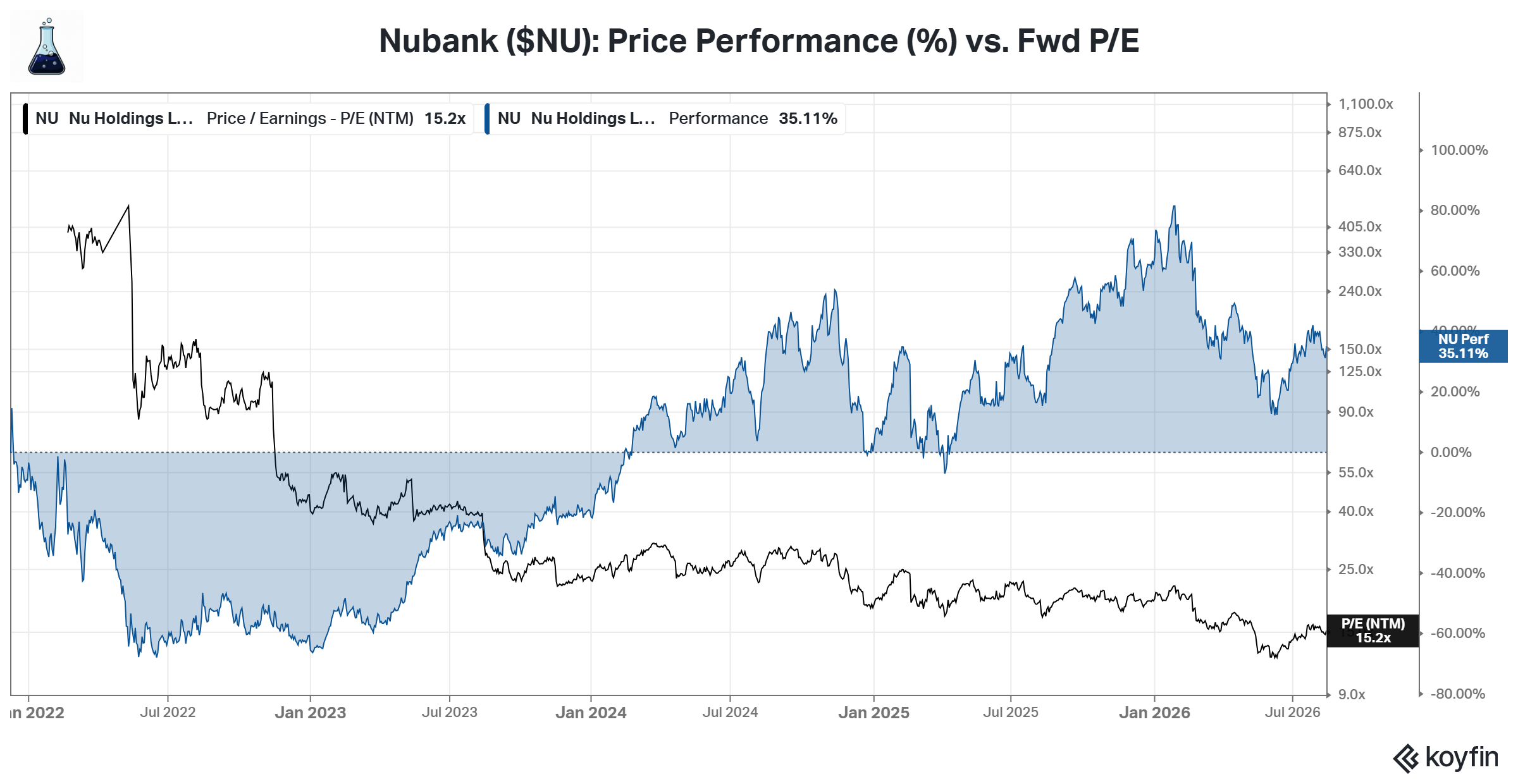
The P/E multiple, which once traded at levels that would scare away almost any value investor, has fallen to just 15x. Compare that with the stock’s performance, and you get a sense of how much earnings had to grow just to sustain the shares at these levels.
Despite the slowdown over the past 1-2 years, the company continues to grow EPS at +20-25% per year with 30% ROE (the highest among LatAm banks), while further strengthening its leadership position across the markets in which it operates.
So, is Nubank ($NU) now one of the best opportunities in the market, especially considering how little attention investors are still paying to LatAm?
Nubank was founded on May 6, 2013, in a small house in the Brooklin neighborhood of São Paulo, Brazil, by David Vélez, Cristina Junqueira, and Edward Wible.
David Vélez, the company’s current CEO and original mastermind, is Colombian and built his career across investment banking and venture capital, with stints at Goldman Sachs and Morgan Stanley. He later moved to Brazil to work at General Atlantic before joining Sequoia Capital’s Latin American operations.
After 3-4 years in Brazil, Sequoia ultimately decided to shut down its local office. The firm concluded that LatAm’s tech ecosystem was still too underdeveloped to support investments at the scale it was looking for, citing a limited engineering talent pool, a lack of compelling business ideas, and the absence of a mature startup infrastructure.
But where Sequoia saw reasons to leave, David Vélez saw opportunity. The same lack of competition and innovation that made Brazil unattractive to the venture firm convinced him that the market was ripe for someone willing to build from scratch. For Vélez, Sequoia’s retreat became the catalyst to pursue his long-standing ambition of starting a company of his own.
The idea for Nubank came from a somewhat traumatic experience he had while trying to open a bank account in Brazil.
"I was shocked by the bureaucracy, the long lines, the poor service, and the high fees." — David Vélez, Co-founder and CEO
Prospective customers were processed behind bulletproof glass, forced to hand over stacks of documents, and often left waiting for months. Brazil’s banking system was one of the most concentrated - and most profitable - in the world. Five institutions - Itaú, Bradesco, Banco do Brasil, Caixa, and Santander - controlled ~80% of the system’s assets and charged some of the highest spreads and fees on the planet.
A massive profit pool combined with a terrible user experience.
And don’t think there were no barriers to entry protecting these incumbents. In fact, there were plenty: (i) regulation, (ii) the extensive brick-and-mortar branch networks that reinforced the traditional banking experience and made digital disruption harder, (iii) consumer trust, among many others.
And yet, they decided to move forward with the idea.
Vélez teamed up with Cristina Junqueira, a Brazilian who had run credit cards at Itaú and understood the incumbent playbook from the inside, and Edward Wible, an American engineer who would build the technology.
The first investment round came precisely from Sequoia - and, interestingly, we even have some readers who work there here at Jimmy’s Journal - together with Kaszek. $2M dollars to launch the first product in September 2014: a no-fee, purple Mastercard managed entirely through a smartphone app, offered by invitation only.
There were no branches, paperwork, cross-selling of loans or insurance, or annual fees. Just a little purple card - the “roxinho,” as Brazilians still call it today, which literally means “little purple one” - that you could control directly from your phone, with transparency toward the customer as one of its main pillars.
The name Nubank was itself meant to reflect the company’s philosophy. In Portuguese, the word “nu” means “naked,” evoking the ideas of transparency, simplicity, and a lack of judgment - principles the founders wanted to embed into the customer experience from the very beginning.
At the same time, Nubank also sounds similar to “new bank,” reinforcing what the company was trying to build: a fundamentally new way of relating to customers and, ultimately, a challenge to Brazil’s outdated incumbent banking system.
Early adopters loved the product so much that they started recommending it to friends and family through the best marketing channel possible: word of mouth.
Demand became so strong that Nubank eventually ran into capacity constraints. The company simply could not onboard customers fast enough and had to create a waiting list for new users.
That scarcity ended up creating a huge sense of exclusivity around the product, while keeping customer acquisition costs close to zero.

This article is exclusive to paid members of Jimmy’s Journal.
If you’re reading through the Android or iOS app and want to avoid platform fees, click here to upgrade directly.
What followed was a true David-vs-Goliath story…
The incumbent banks were racing to make up for lost time, closing unproductive physical branches and investing heavily in technology, trying to improve the online experience of their legacy, often unintuitive apps.
Nubank - the David in this case - kept stacking new revenue streams on top of its platform and customer relationships, adding digital accounts, personal loans, investments, and insurance, while positioning itself not only as the most technology-driven player in the industry, but also as its low-cost provider.
This has significant implications for the competitive dynamics going forward, which we’ll explore in the next sections.
Comments
Nothing yet. Say the first thing.
Sign in to join the conversation.