
Hi, Investor! 👋🏼
One lesson I’ve learned - and continue to learn every day - from the market in 2026 is that great opportunities aren’t created only by fear.
Sometimes, they are created by distraction…
To paraphrase Warren Buffett’s famous line for today’s market:
“Be greedy when others are… distracted.”
AI has absorbed an extraordinary amount of capital and attention, pushing investors toward the same group of companies and narratives. Meanwhile, several high-quality businesses have been left behind, with competitive advantages arguably stronger than ever, simply because the market has found something more exciting to focus on.
In today’s article, we look at five long-term compounders trading near historically low multiples that may deserve a closer look.
P.S.: If you invest in high-quality businesses and have a 5-10 year investment horizon, I think you’re going to love some of these opportunities.

S&P Global ($SPGI) is a diversified provider of benchmarks, data, analytics, and workflow tools across global capital markets, energy and commodities, and the automotive industry.
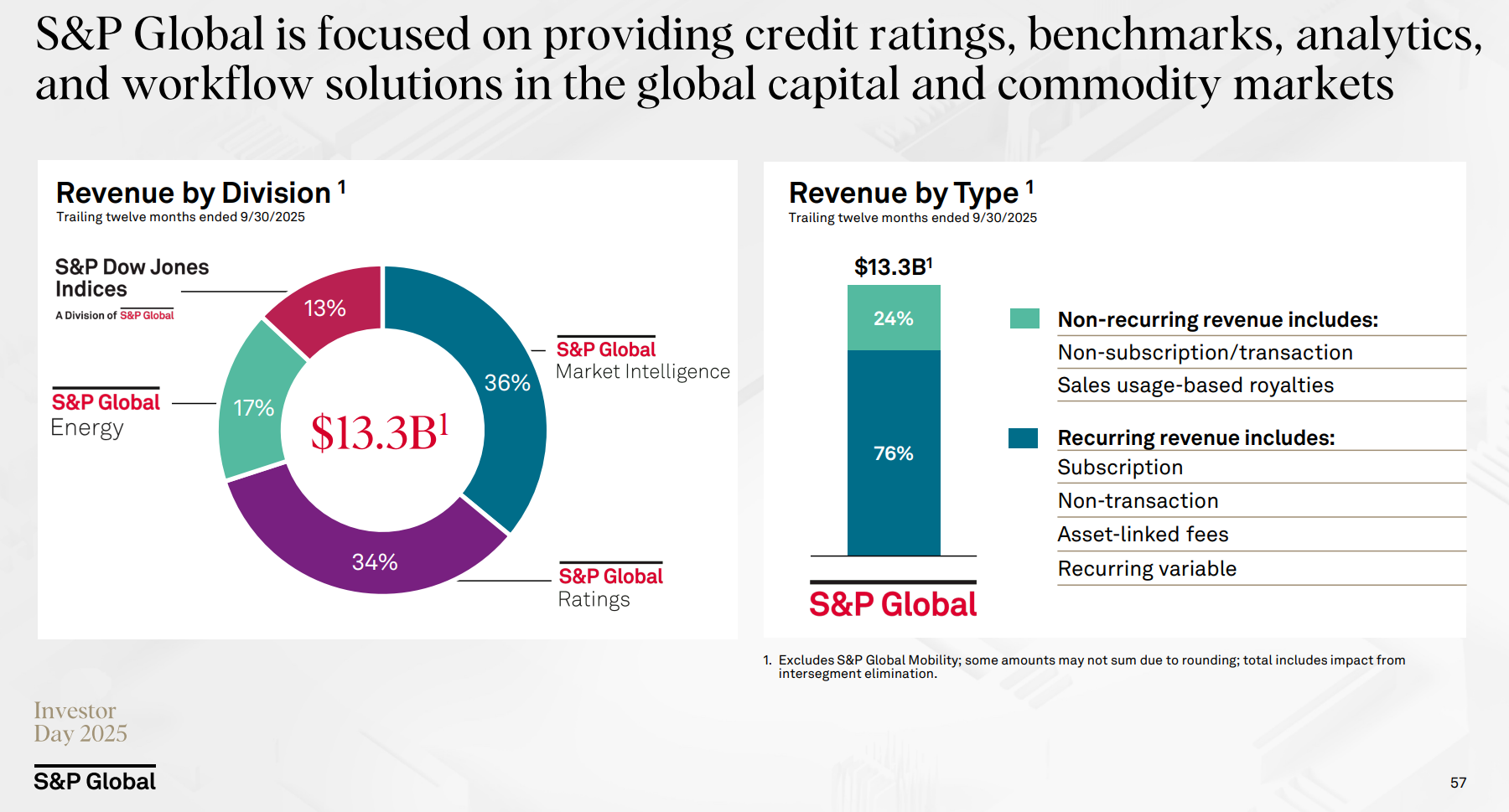
Following the sale of its Mobility business a few months ago, the company is now organized around four main segments, most of them deeply embedded in the infrastructure of global financial markets across both equity and debt: (i) Ratings, (ii) Indices, (iii) Market Intelligence, and (iv) Energy.
Ratings is the company’s largest source of operating profit and one of its most valuable franchises. S&P Global controls ~40% of the global credit ratings market, operating in what’s effectively a duopoly with Moody’s. The segment generated $1.3B in revenue in Q2 2026, accounting for ~34% of the company’s total revenue.
The segment’s revenue is composed of (i) issuer-paid fees and (ii) recurring surveillance revenue, which allows S&P Global to capture the upside during periods of strong debt issuance while also providing a meaningful revenue floor during weaker environments.
Indices is the highest margin business in the company, running at ~70% EBIT. It licenses the S&P 500 and thousands of other benchmarks/ETFs, earning asset-linked fees and derivatives royalties. In practice, it operates like a toll booth on passive investing, making the business highly scalable and very resilient.
Market Intelligence is the largest division by revenue and the lowest-margin segment, at ~33%. It sells Capital IQ Pro, Compustat, SNL, and related data and workflow tools primarily through subscription-based contracts.
Energy, formerly Commodity Insights, houses Platts and its price assessments, benchmarks, data, and analytics across global energy and commodity markets.
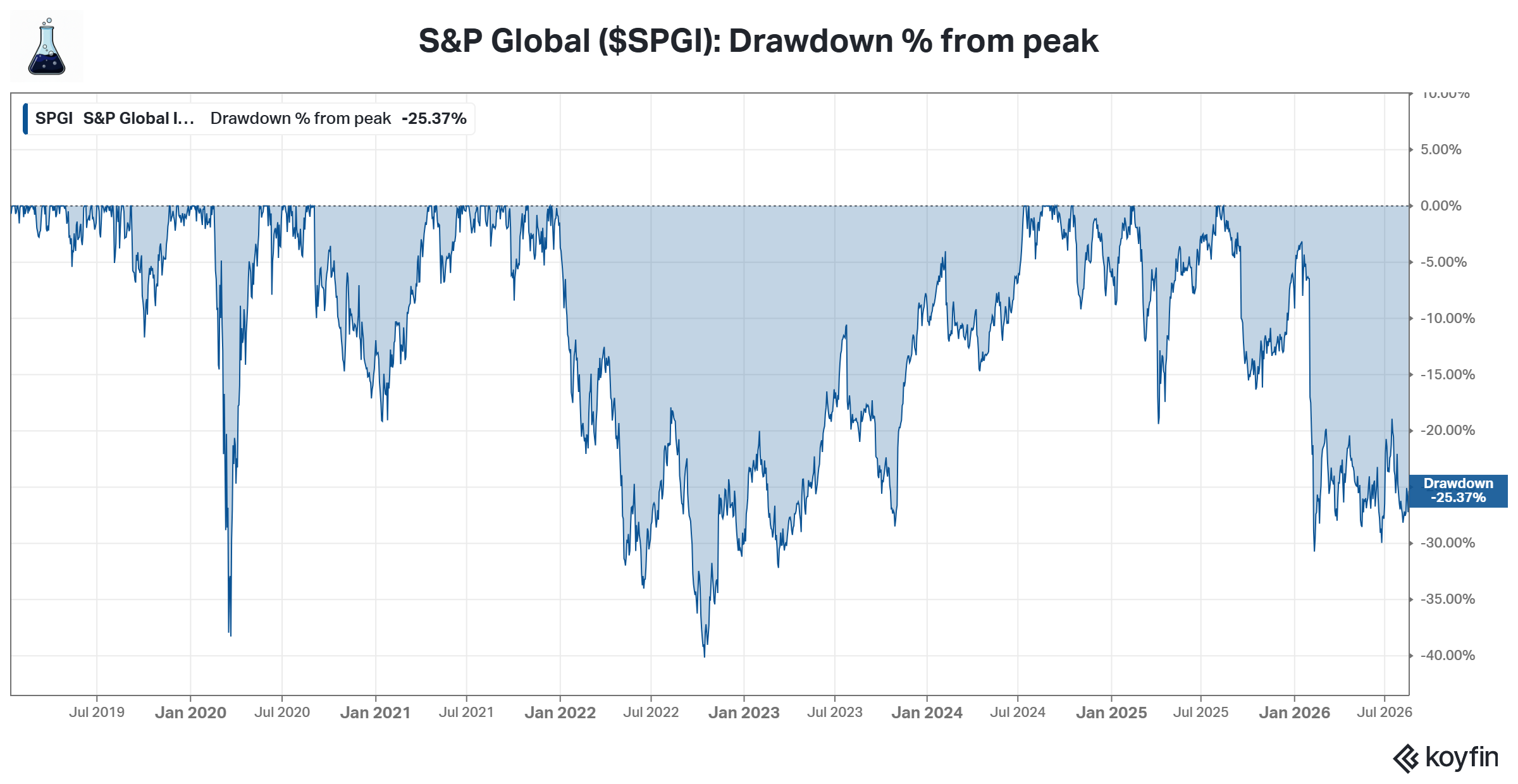
The company is currently in a ~25% drawdown from its recent ATH, a relatively rare occurrence in its history, driven by three main factors - only one of which we believe is structural.
First is the AI narrative. Information-services multiples compressed throughout 2026 on concerns that LLMs could erode the value of proprietary data and analytics. S&P Global was swept into that trade primarily through Market Intelligence, which represents ~35% of total revenue.
Second, the company cut its 2026 EPS guidance by ~10% in Q1, from a range of $19.40-$19.65 to $17.50-$17.75, largely reflecting the sale of the Mobility segment.
Third, some parts of the business have shown slightly greater weakness. Energy grew only +3% y/y in Q2, as the Iran conflict disrupted contract renewals and trading volumes. Market Intelligence grew +6% y/y, as larger clients stretched renewal cycles, partly due to discussions around AI and intellectual-property terms.
$SPGI is currently trading at ~22-23x P/E, vs. a historical average closer to 28x, implying a discount of ~20%.
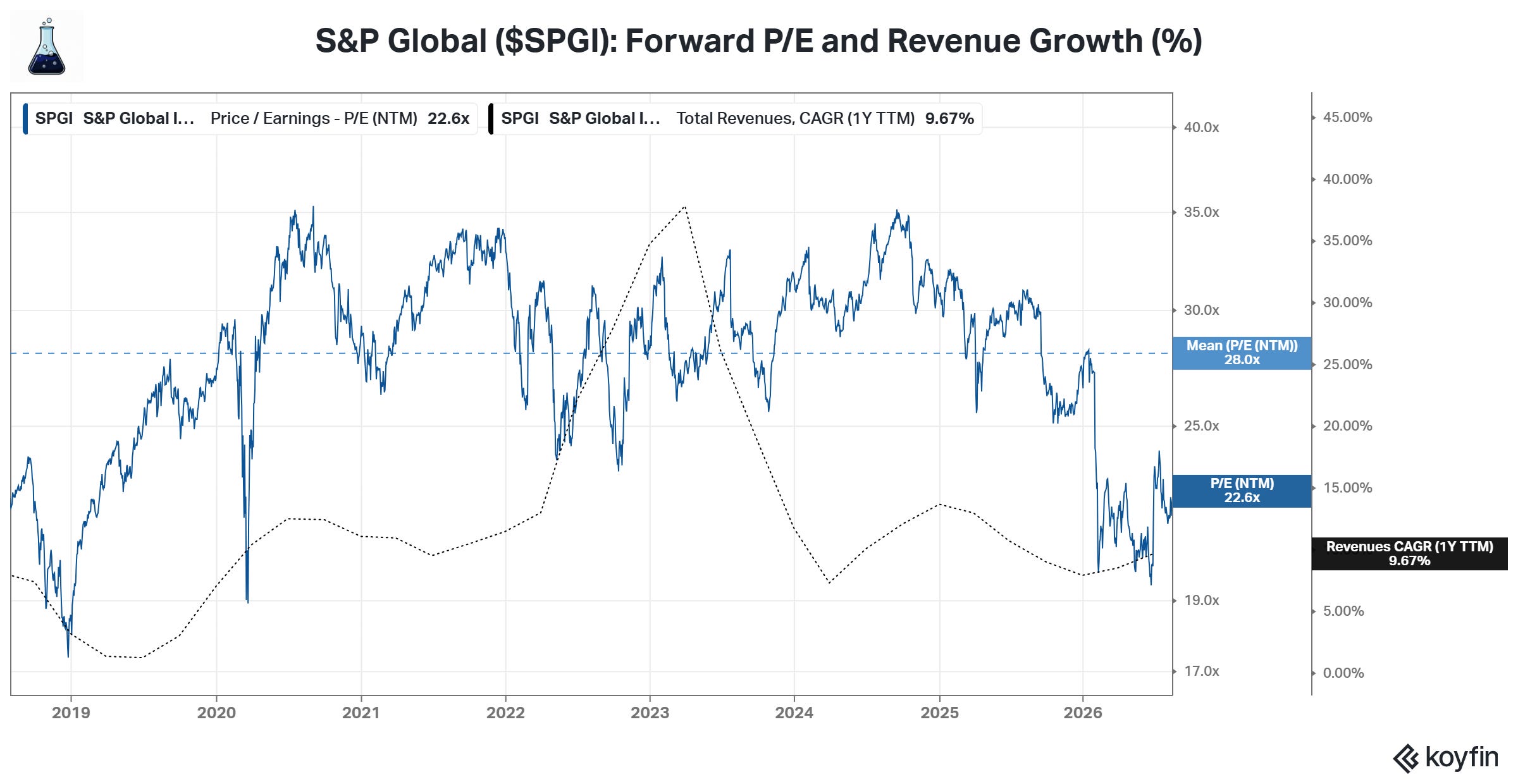
Management is still guiding to +6-8% y/y organic revenue growth, continued margin expansion, and > $7B of buybacks in 2026 (~5% of market cap).
The core misread, in my view, is that the market is applying a Market Intelligence disruption discount to the entire company. Ratings and Indices generated 67% of total EBIT in Q2, with margins in the 65-70% range, and face very little credible AI substitution risk.
Even within Market Intelligence, the threat appears much smaller than the discount currently being applied. Only about 12% of the segment’s revenue comes from relatively undifferentiated data. Products such as Compustat, SNL, and Capital IQ are deeply embedded in client workflows and often tied to compliance and regulatory processes, creating switching costs that extend well beyond the value of the raw data itself.
The bolt-on acquisitions completed in July, such as datacenterHawk and Agusto & Co., also point to continued reinvestment in data-intensive verticals and emerging-market growth.
And even with some deceleration in Energy and Market Intelligence, the two strongest franchises within the business continue to grow at a very healthy pace: Ratings was up +17% y/y, while Indices grew +20% y/y, marking its 13th consecutive record quarter.
Found this content valuable? Share it with your network! Help others discover these insights by sharing the newsletter. Your support makes all the difference!
Equifax ($EFX) is a global data, technology, and analytics company operating through three main segments: (i) Workforce Solutions, (ii) US Information Solutions (USIS), and (iii) International.
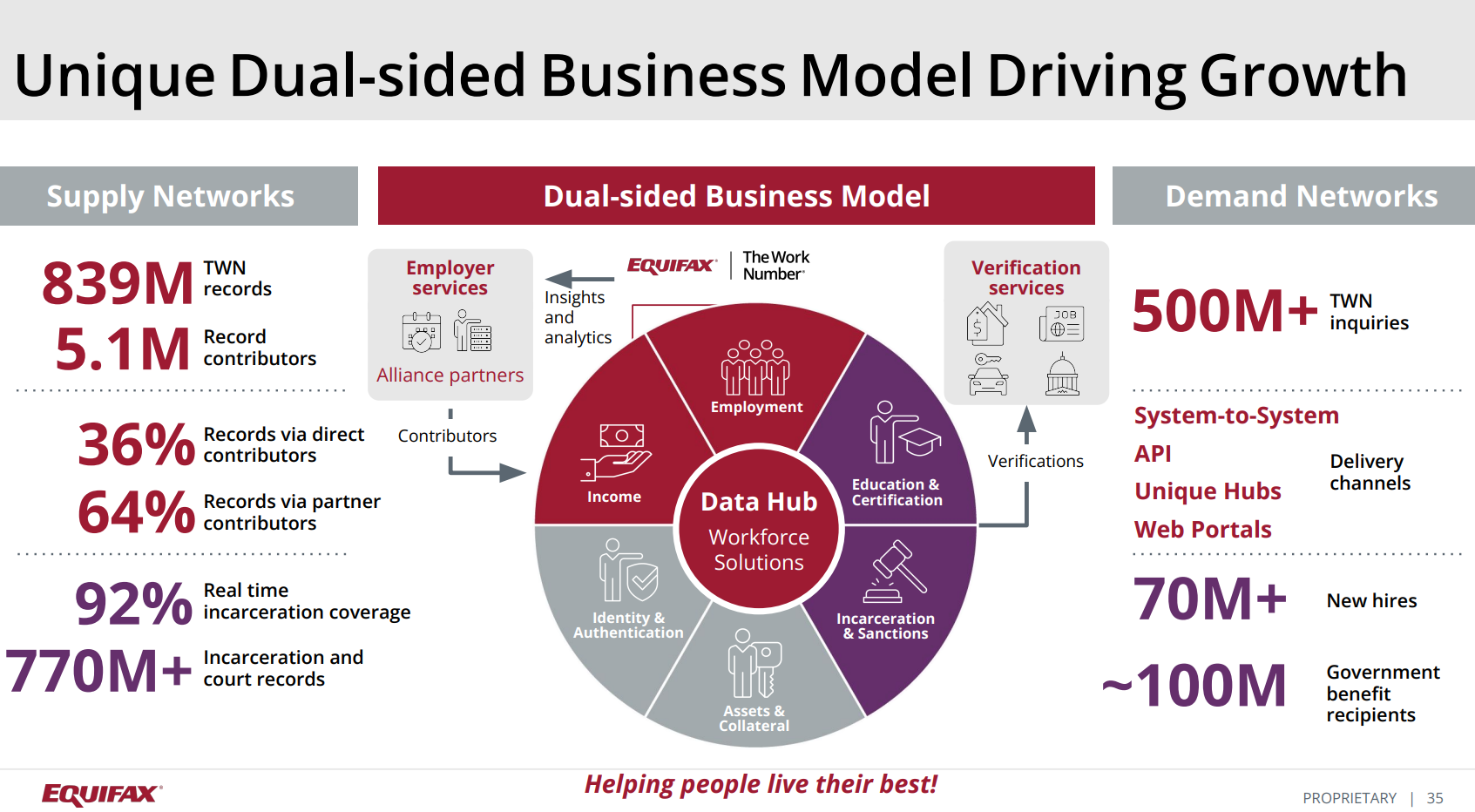
Workforce Solutions is the crown jewel and the highest margin business in the company, operating at an Adj. EBITDA above ~52%. Its core asset is The Work Number, a proprietary database of income and employment records contributed directly by employers every pay period. The database now contains more than 210M active records covering over 100M unique individuals.
This is an especially valuable dataset because competitors cannot easily replicate it: the information is fed directly by payroll systems instead of scraped, estimated, or modeled. Lenders, employers, and government agencies pay Equifax to verify income and employment against the database, while each new verification product creates additional monetization opportunities on top of the same underlying data infrastructure.
USIS is Equifax’s traditional credit bureau business, providing consumer and commercial credit data, mortgage origination information, and identity and fraud solutions to US lenders. It’s more cyclical than Workforce Solutions because a meaningful portion of revenue is tied to mortgage activity and broader lending volumes, while operating margins sit in the low-20’s range.
International extends the credit bureau model across Canada, LatAm, Europe, and APAC. The segment grows at a mid-single-digit rate and carries lower margins than the US businesses.
Equifax ($EFX) is currently in a drawdown of ~40% from its ATH, driven by two main factors.
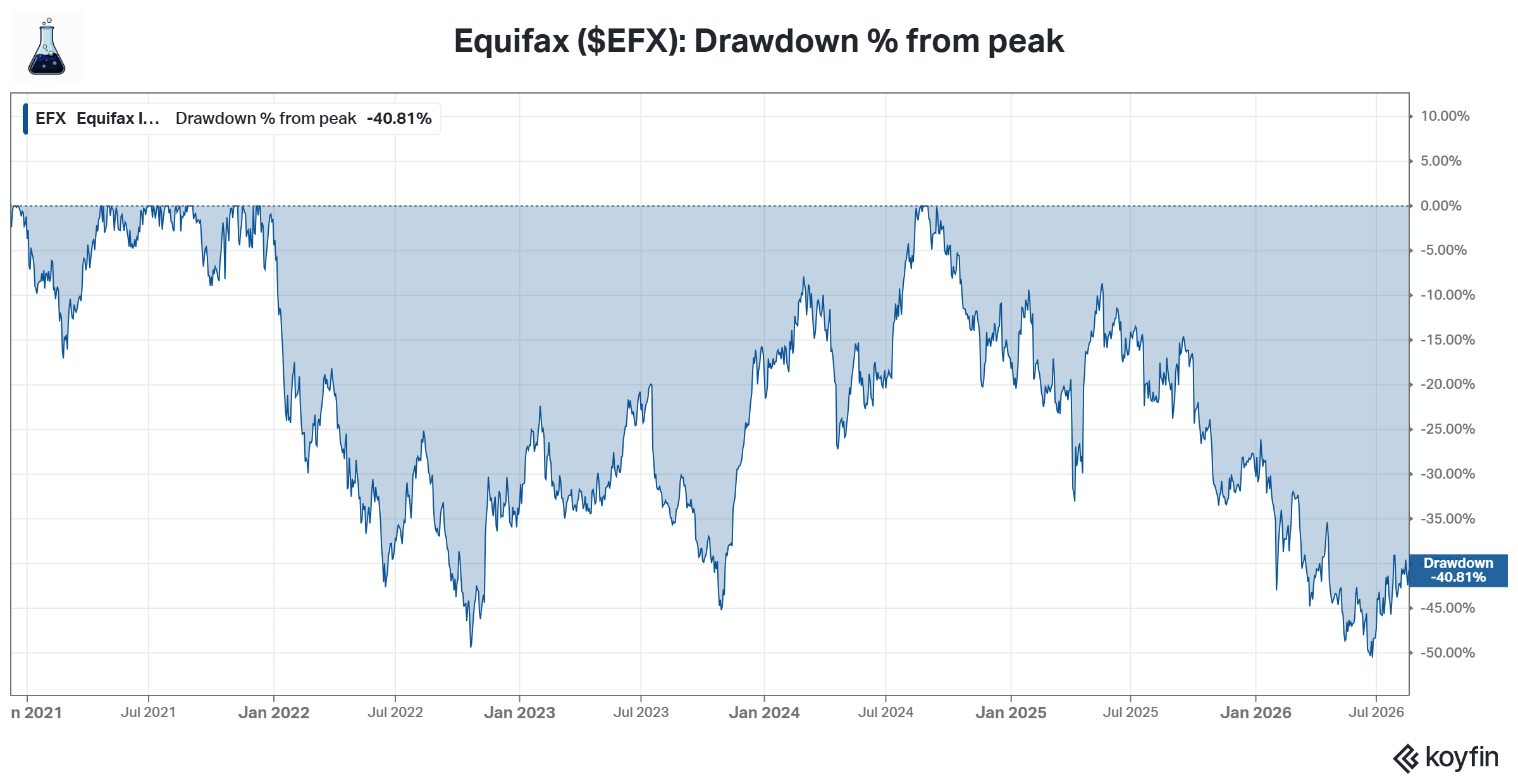
The first is that, much like S&P Global, Equifax has been caught in the broader de-rating of data and analytics companies on AI-disruption fears.
The second - and likely more relevant from here - is the company’s exposure to US mortgage and lending activity. A meaningful portion of Equifax’s revenue is tied to transaction volumes in those markets, and mortgage activity has remained near generational lows as interest rates stayed higher for longer.
Equifax ($EFX) is currently trading at ~20x fwd P/E, also about 20% below its 10Y average of ~25x.
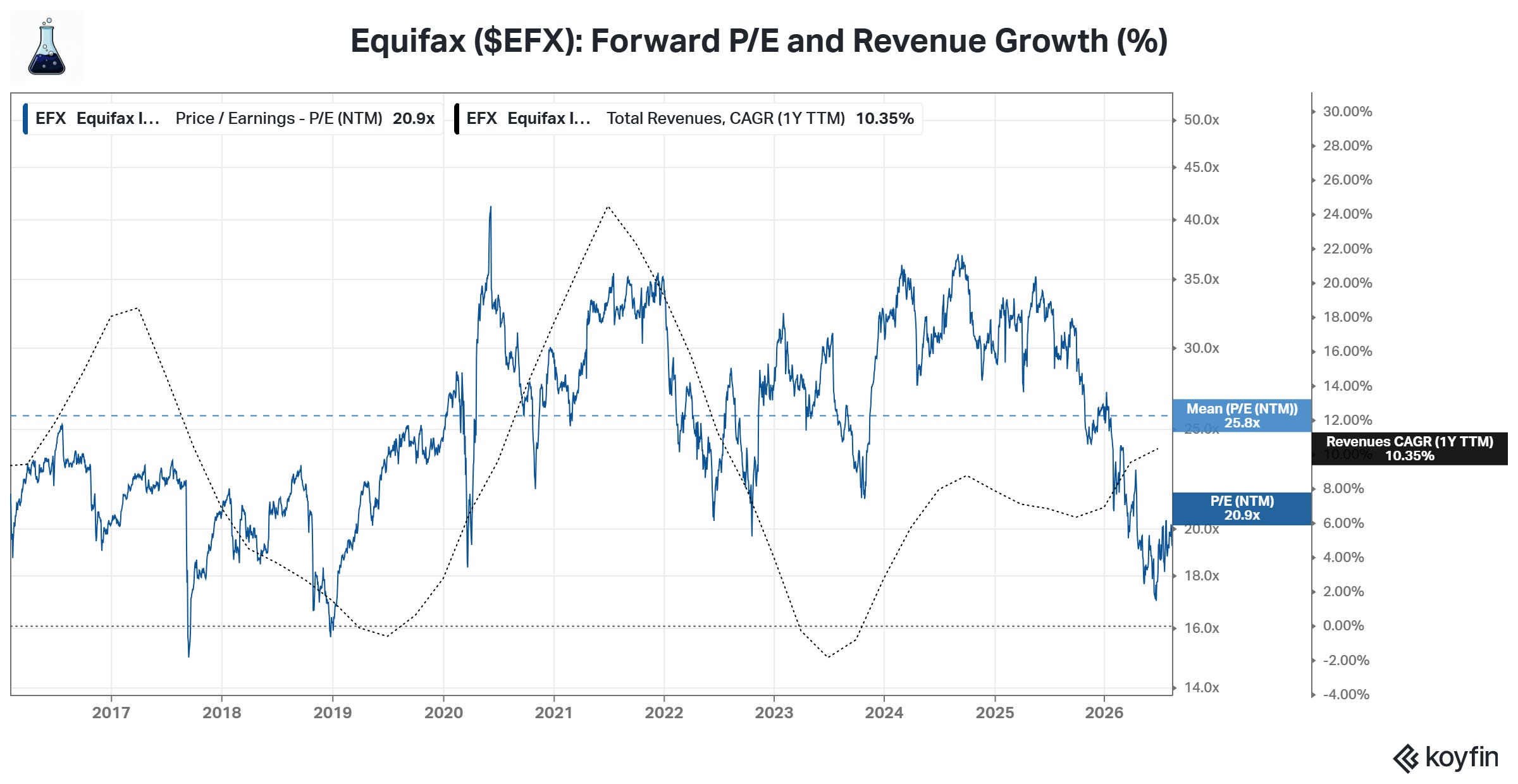
The company’s FY2026 guidance calls for $6.75B in revenue, up +11% y/y, with its new-product Vitality Index running at +16% y/y.
Our main disagreement with the market at this point is that Equifax may actually prove to be one of the bigger beneficiaries of AI - mainly because the value of a decisioning model is ultimately capped by the data it can access, and Equifax owns that data.
AI is also helping on the cost side. Management doubled its AI-driven cost-reduction target to $150M and is embedding AI across product development, which is already showing up in margin expansion at Workforce Solutions and a faster pace of new-product launches.
Mortgages are always a very difficult factor to predict, especially given their sensitivity to the Fed rate cycle. The fact is that interest rates remain elevated relative to most of the past decade - and the Iran conflict certainly doesn’t help - while mortgage originations also remain at depressed levels. The asymmetry looks favorable to us at this point.
Found this content valuable? Share it with your network! Help others discover these insights by sharing the newsletter. Your support makes all the difference!
Intercontinental Exchange ($ICE) is a global financial infrastructure and technology company that operates digital networks, marketplaces, and clearing houses. The company reports its results across three main segments: (i) Exchanges, (ii) Fixed Income & Data Services, and (iii) Mortgage Technology.
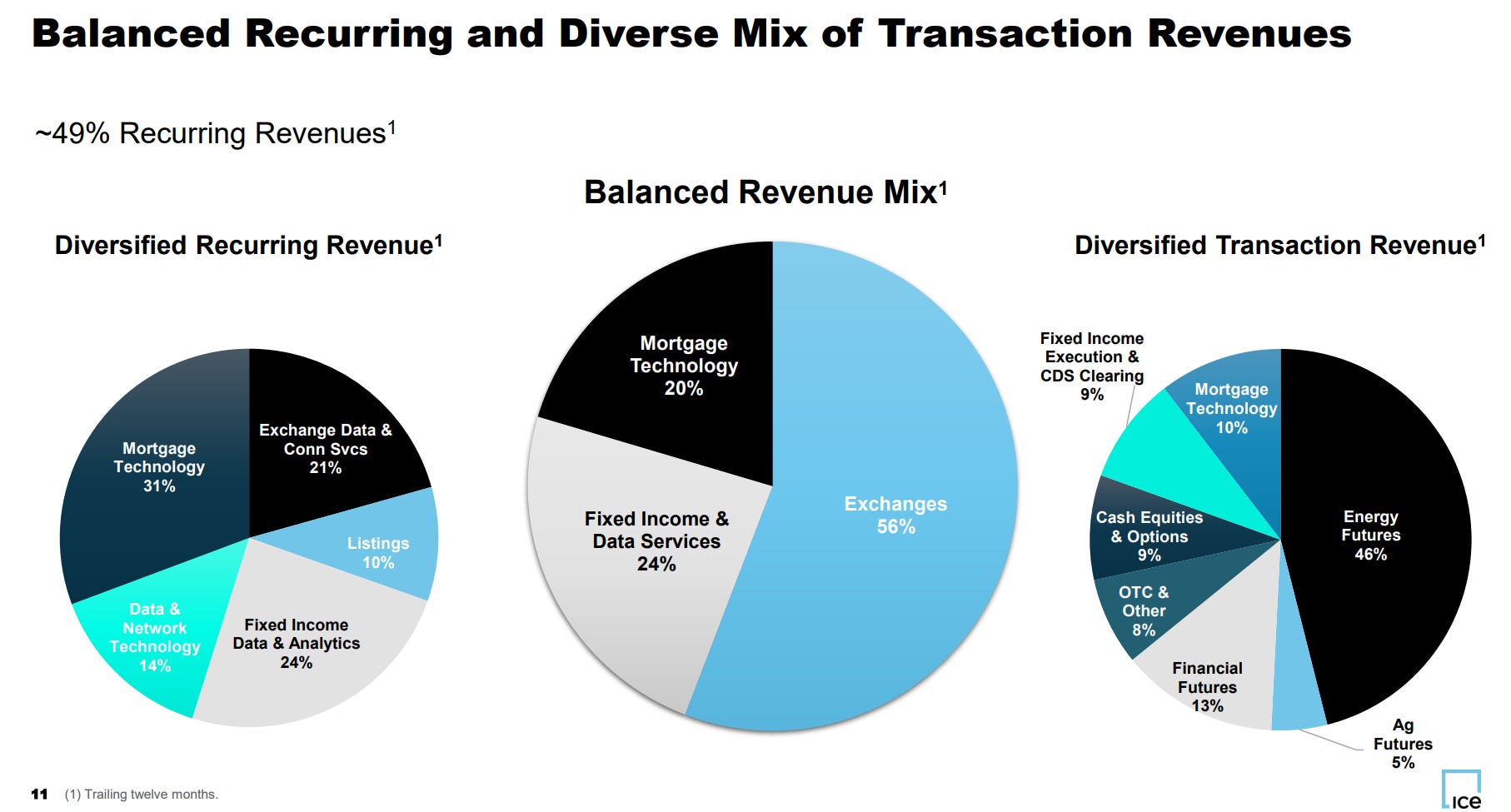
Exchanges is the most important segment of the business - and, in my view, the crown jewel of the company given its deeper moat relative to the other divisions. It accounted for ~56% of total revenue in Q2 and also carries the highest operating margin, at ~75%.
Among the company’s most important assets are (i) ICE Brent, the reference price for almost 3/4 of internationally traded oil, alongside natural gas, agricultural, and financial futures, and (ii) the New York Stock Exchange (NYSE), with a leading position across cash equities, options, and corporate listings.
Of the $1.4B in revenue reported in Q2, ~30% is recurring but grows relatively slowly, mostly from fees and interest income, while the remaining 70% is transaction-based, which grew +10% y/y.
Fixed Income & Data Services accounts for ~24% of total revenue and is the most recurring segment of the business, although it carries a lower operating margin of ~45%.
The segment is basically built around CDS clearing, fixed-income pricing and reference data, and the ICE index franchise, which ended the quarter with a record $922B in ETF AUM.
Mortgage Technology represents for the remaining ~20% of total revenue and is the most volatile of the three segments. It’s also the lowest margin, with an operating margin of just 43% in Q2.
The segment is closely tied to US mortgage origination volumes through Encompass and ICE’s servicing platform, and performance has remained depressed as higher-for-longer interest rates continue to weigh on mortgage activity.
Intercontinental Exchange ($ICE) is an exceptionally stable business and rarely experiences drawdowns of this magnitude under normal market conditions.
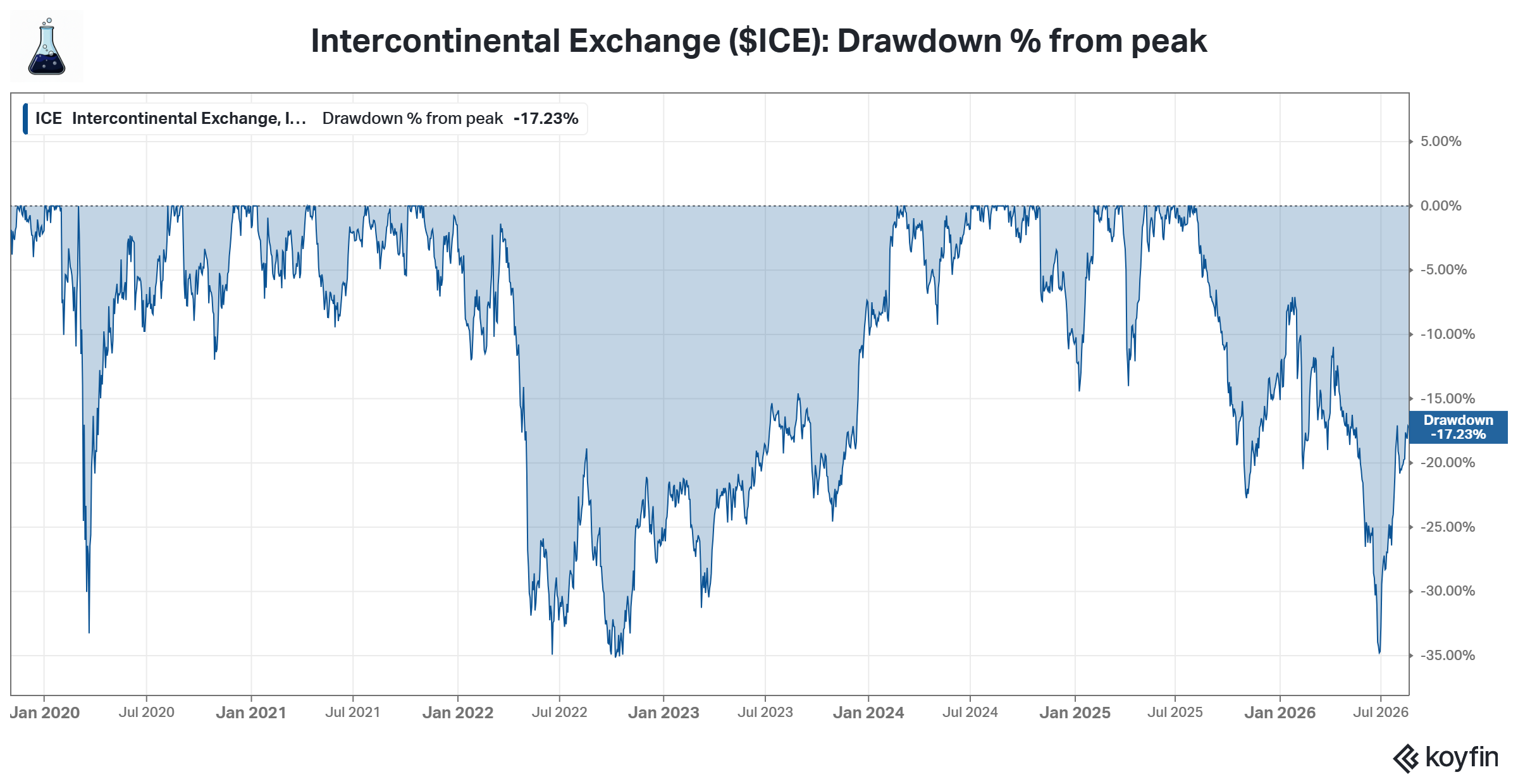
Speaking of which, we first pitched $ICE in our private subscriber chat on June 5, when the stock was already down -25% from its ATH. It eventually reached a drawdown of around -35%, making the opportunity even more attractive.
If you’d like access to our private discussions and investment ideas, click the link below.
Unlike the companies discussed above, ICE’s drawdown was driven almost entirely by a single event.
The selloff began at the end of May 2026, when the CFTC approved Bitcoin perpetual futures and published a framework for listing perpetual contracts in the United States. Exchange stocks sold off broadly on the view that perpetuals - which have generated enormous trading volumes in offshore crypto markets - could eventually expand into traditional asset classes and divert retail-heavy trading activity away from incumbent exchanges.
Intercontinental Exchange ($ICE) is currently trading at 19x fwd P/E, about a ~10% discount to its historical average of ~21.5x, despite being a better and more diversified business today than it was in the past.
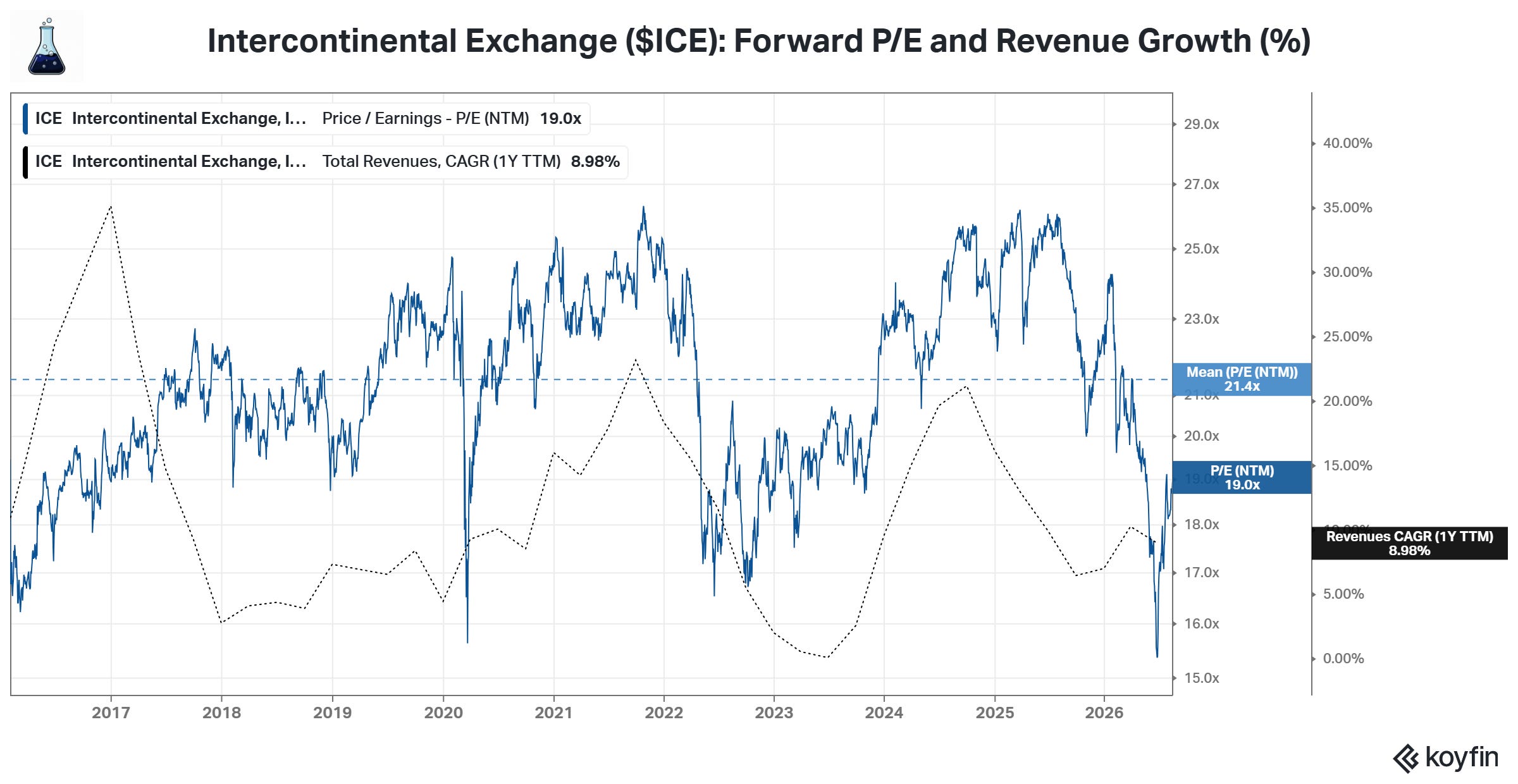
My disagreement with the market is concentrated almost entirely on the perceived threat from perpetuals. ICE’s derivatives volumes are primarily institutional risk-transfer activity: an energy major hedging Brent exposure, a bank managing interest-rate risk, or a trader rolling natural gas futures against physical delivery. None of those use cases is meaningfully addressed by a retail-oriented crypto perpetual.
In addition, CEO Jeff Sprecher has a strong capital-allocation track record and continues to diversify the company into faster-growing areas. Beyond ICE’s meaningful stake in Polymarket, the company also took a strategic minority stake in OKX in March 2026, one of the world’s largest crypto-derivatives platforms with more than 120M customers.
In May, the two companies launched perpetual oil futures referenced to ICE’s Brent and WTI benchmarks, the first commodity product to come out of the partnership (notably, a perpetual contract still needs a reference price - and ICE owns the reference price for most of the world’s oil).
We saved the smaller-cap - and therefore less consensus - names for last, behind the paywall.
Our #2 pick has a market cap of ~$15B, while #1 is worth less than $4B.
If you want access to these investment ideas - and much more - click the link below and upgrade your subscription today.
With that, let’s move on to our Top 2...
Comments
Nothing yet. Say the first thing.
Sign in to join the conversation.