
We ask the University of North Carolina to authorize a genuinely independent investigation of its coronavirus research and release the evidence needed to resolve the questions surrounding it.
Dear Chancellor Roberts:
On July 30, 2026, discussing an investigation into UNC’s football program, you articulated an admirable standard for institutional leadership:
“If something has gone wrong, we want to know about it. If something needs to be fixed, we will be sure to fix it.”
We respectfully ask you to apply that standard to the unresolved questions surrounding coronavirus research conducted at UNC–Chapel Hill, the safety and oversight of that work, and its possible relevance to the emergence of COVID-19.
We are not asking you—or anyone signing this letter—to accept a particular origin theory. Nor are we asserting that UNC or any UNC researcher caused the pandemic. We are asking UNC to obtain and test the evidence through a genuinely independent, technically competent investigation.
UNC was not peripheral to the research now under scrutiny. Dr. Ralph Baric’s laboratory was internationally recognized for assembling and modifying coronaviruses and collaborated with EcoHealth Alliance and scientists at the Wuhan Institute of Virology. This publicly funded work included research involving potentially dangerous pathogens.
The 2018 DEFUSE proposal described plans to introduce novel cleavage sites into SARS-related coronaviruses. DARPA declined the proposal, but legitimate questions remain about whether any proposed work was pursued through other programs, laboratories, or funding sources. Jim Haslam has also advanced a disputed and unproven—but specific and testable—hypothesis concerning UNC-linked research and the movement of coronavirus materials and technology between American and Chinese laboratories.
The relevant evidence includes laboratory notebooks, freezer inventories, virus sequences, grant files, biosafety and incident reports, transfer agreements, shipping records, and communications. UNC has resisted public-records requests and withheld thousands of potentially relevant documents. Disagreement with a hypothesis is not a substitute for examining records that could confirm or refute it.
Were research risks properly evaluated? Were laboratory incidents fully documented and reported? Were federal agencies given complete and accurate information? What did UNC’s leadership know, and how did the University respond when questions about COVID-19’s origin arose?
These are questions of scientific integrity, public accountability, and continuing public safety. An investigation should not target individuals or manufacture a predetermined conclusion. It should establish the facts, correct any failures, and strengthen safeguards for potentially dangerous research.
We therefore respectfully ask you to:
Appoint an independent panel whose members have no conflicts involving UNC or the research under examination.
Give the panel full access to relevant laboratory records, grants, communications, biosafety documentation, inventories, transfer records, and personnel.
Include outside expertise in virology, biosafety, federal grants, research integrity, public records, and digital forensics.
Direct the immediate preservation of all potentially relevant physical and electronic records.
Release records that can lawfully be made public and provide a clear explanation for any material withheld.
Require the panel to publish its findings, supporting evidence, and recommendations.
We make this request because great public institutions protect their reputations by confronting difficult questions honestly. If the concerns are unfounded, an independent investigation can establish that and strengthen confidence in UNC. If mistakes or safety failures occurred, Carolina should identify and correct them.
Football received an investigation because you said UNC should find out what went wrong and fix it. Questions surrounding publicly funded coronavirus research deserve at least the same commitment. North Carolinians—and people worldwide affected by the pandemic—deserve the evidence, answers, and accountability that a credible independent investigation can provide.
Respectfully,
George A. Howard
Jim HaslamAnd the undersigned
George Howard created a great website. No special credentials are required, and you can sign anonymously, but we need more signatures to present to the UNC chancellor.
I alone signed the radical letter below.
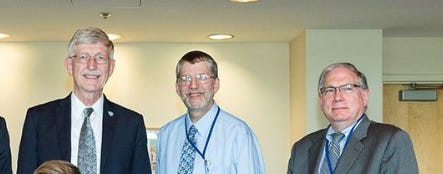
Your predecessor, Larry Tabak, knows me. Two years ago, he sat at your desk and debated my evidence with his deputy, Mike Lauer.
I asked them: Why does this Old World virus love New World lab animals?
In 2014, Tom Frieden of the CDC and Francis Collins asked Tony Fauci: What are you doing at Rocky Mountain Lab?
Fauci replied: CMV-based wildlife vaccination—i.e., self-spreading vaccines.
In other words, Atlanta CDC & NIH Building 1 were in the dark about Fauci’s risky research.
1st problem: RML sucks at reverse genetics.
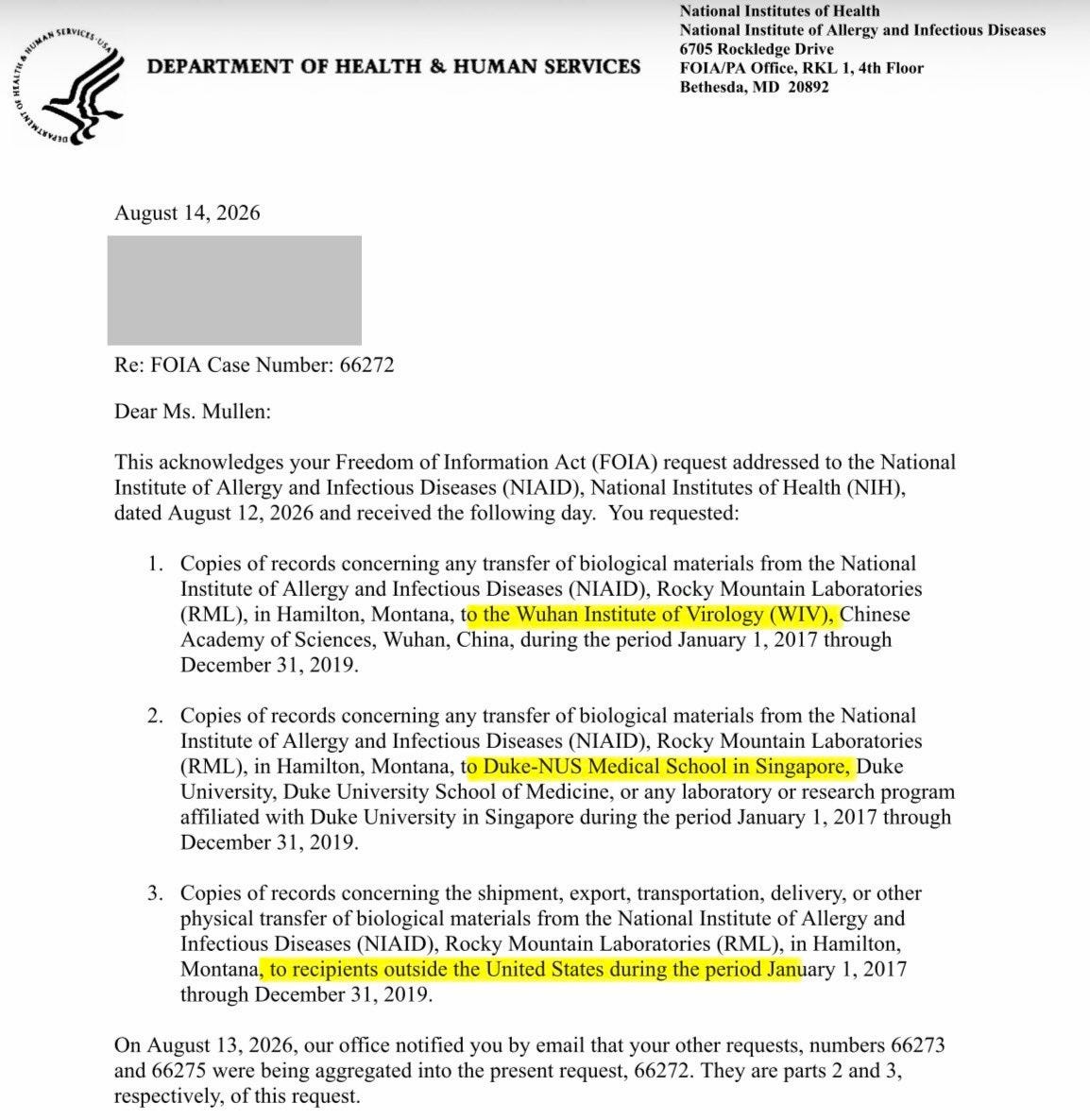
So Ralph Baric sent genomes to RML from 2014–19. They were addressed to Heinz Feldmann. According to 2019 NIAID docs, the genome Baric sent to Feldmann was HKU3r-CoVs.
2nd problem: no live bats at RML.
In 2012, CDC started an Egyptian fruit bat colony in Atlanta. NIAID was jealous. So in 2016, Fauci’s office (i.e., Hugh Auchincloss) offered Vincent Munster early tenure if he set up a live-bat lab at RML.
Munster fought the RML bureaucracy by outsourcing the breeding of Egyptian fruit bats to Colorado State University.
This logistical quirk led to the smoking-gun email.
3rd problem: no Chinese horseshoe bats in Montana.
In 2018, Munster and Baric published their intent to test their chimera, with a furin cleavage site, in Chinese bats.
Fauci later rectified that logistical problem by starting a Chinese bat-breeding facility at RML. But at the time, those bats were only available at Wuhan BSL4, via NIAID contractor Danielle Anderson.
Dani’s live-bat experiment is now called SARS-CoV-2.
How do I know?
RML passaged Baric’s genome in five lab animals, exclusive to RML. They created a transmissible and airborne agent that would spread like a virus, immunizing bats.
But now we are the bats.
How do we know?
In April 2020, CSU sent Munster an incriminating email stating his Egyptian fruit bat colony is the SARS2 reservoir host.
How should you know?
The CDC bat lab confirmed to me that their Egyptian fruit bats are a “non-natural host” for SARS2. This is what you call the Second Scientific Revolution, since the results were replicated at the CDC, which you use to run.
How do you know it’s a self-spreading vaccine?
Immune evasion—which you were the first to prove with antibody testing. Self-spreading vaccines create an incentive to evade the mammalian immune response, so the vector will keep spreading and shedding.
That vaccine vector (CMV, CoV, etc.) is secondary to the transmission models. Four of five are directly tied to pre-pandemic vaccine research: deer, deer mice, EFB, hamsters.
I asked your predecessor, Tabak, to prove me wrong.
They can’t because COVID was a contagious bat vaccine developed at RML.
But now you can prove me right.
Release Munster and Feldmann’s 2019 lab records.
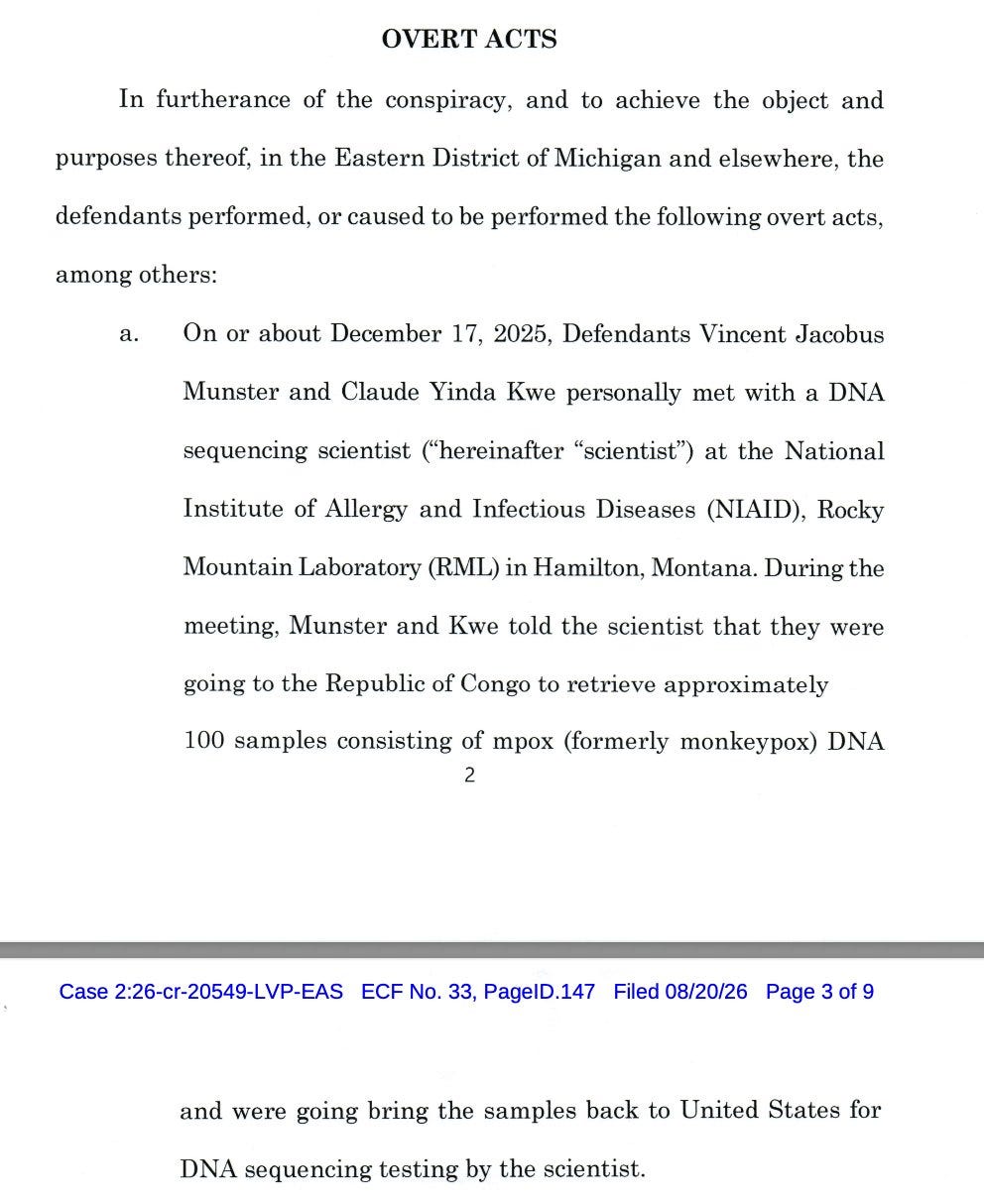
Munster is set to appear in Detroit court on Wednesday, August 26, for his preliminary hearing. The new indictment claims that, prior to leaving for Africa, he met with a “DNA sequencing scientist” at RML and discussed their plan to bring back mpox viruses.
“Greetings. THIS IS NOT A DRILL.”
So began, in bold, a November 13, 2025 email from Marshall Bloom, associate director for scientific management at Rocky Mountain Laboratories.
What followed was a seven-paragraph note to a number of Bloom’s colleagues at the National Institutes of Health, the federal agency that operates the cutting-edge and high-security laboratory in Hamilton, alerting them to a concerning situation: an animal caretaker had, that morning, “sustained a bite” from a monkey infected with Congo-Crimean Hemorrhagic Fever, a rare but serious virus that’s related to Ebola.
“The bite,” Bloom wrote, “penetrated” numerous layers of gloves worn by the caretaker and “cracked the individual’s nail, drawing blood.”
“The bite was judged to present a high/moderate risk of exposure and expert consensus was to transport the injured worker by ambulance to the Care and Isolation Unit at Providence St. Patrick Hospital (PSPH) in Missoula,” Bloom added. “Once admitted, the person will be under the care of the PSPH red team. Upon discharge, (Occupational Medical Service) will assume responsibility for the outpatient management.”
But that is not what happened, according to an NIH report released last week.
Soon after the patient arrived at the Missoula hospital, the report says, “St. Patrick Hospital notified RML staff that they would not have the capacity to care for the patient beyond 3 days due to staffing and space constraints.”
That was news to Rocky Mountain Laboratories leadership, the report says, “as this constraint was not previously conveyed to RML prior to this incident.”
“The RML emergency response plans have been based on the premise that any exposed individuals would be kept in the (Care and Isolation Unit) for the period of either quarantine (remain free of infection) or isolation (develop confirmed illness),” the NIH report found.
Rather than remaining at St. Patrick Hospital for the duration of their isolation and treatment, the bitten RML animal caretaker was sent from St. Patrick after three days to Providence Sacred Heart Hospital in Spokane, Washington, which is a Level 1 Regional Emerging Special Pathogen Treatment Center.
An after-action report included in the NIH report called the transfer of the patient to the Spokane facility the “‘best worst option’ due to proximity of exposure and having a trained transport team in place.”
As the patient showed no symptoms of the fever, took antiviral medications and showed no signs of infection, including in tests, officials decided to release the patient after 12 days, instead of after the 14-day incubation period associated with Congo-Crimean Hemorrhagic Fever, the NIH report says.
The report cites the high cost of caring for the patient as a reason for their early discharge.
https://ravallirepublic.com/news/local/article_9622b89c-7aef-4964-88b4-c4c0ed89a73c.html
A group of scientists from the U.S. Public Health Service’s Rocky Mountain Laboratory in Hamilton, Montana, published an article in 1949 in the American Journal of Hygiene documenting how six employees of a local laundry facility became infected with Q fever by handling the lab’s soiled coveralls, towels, and other items that needed washing. Three of them were seriously sickened with symptoms that included coughing blood and battling fevers and pneumonia.
— Pandora’s Gamble: Lab Leaks, Pandemics, and a World at Risk by Alison Young
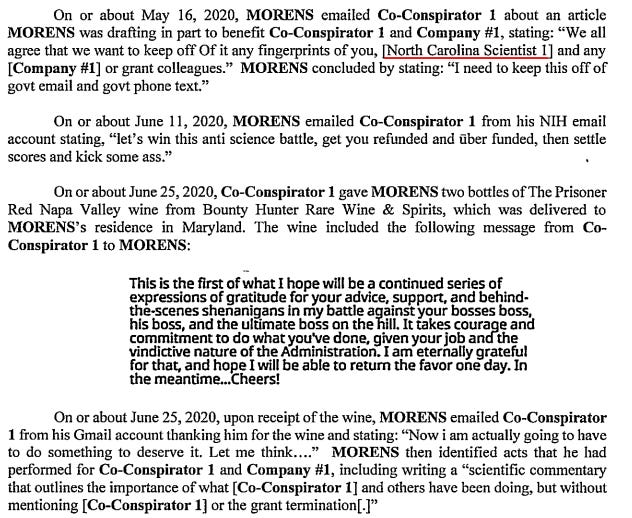
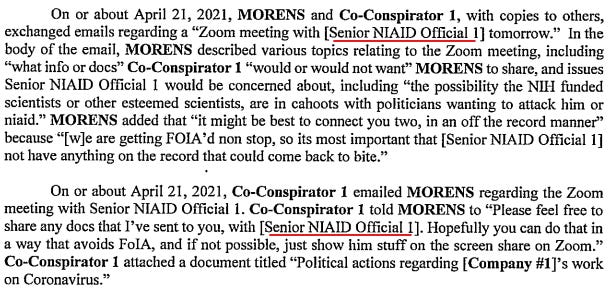
The government documents refer to Baric and Fauci as a “North Carolina Scientist” and a “Senior NIAID official.” Peter Daszak of EcoHealth (Company #1) is Co-Conspirator 1, and Gerald Keusch of Boston University (on the CREID grant) is Co-Conspirator 2.
https://storage.courtlistener.com/recap/gov.uscourts.mdd.603873/gov.uscourts.mdd.603873.36.1.pdf
I open my book with Peter Miller’s $100,000 in debate winnings.
The lab leak narrative you have heard is incorrect. A $100,000 bet was lost because, until now, there was no biological evidence of a Wuhan lab leak. SARS-CoV-2 does not infect humanized mice or Chinese bats but transmits well in American lab bats. Instead of debating the lab leak, we will focus on ‘what’ leaked. Lab leaks happen daily but only infect the technician. We will explore the origin of the virus and expose its creators. SARS-CoV-2 was designed to spread; contagion was a feature, not a bug, until the animal vaccine jumped species at the Wuhan Institute of Virology.
Miller doubled down and won again!

Peter Miller@tgof137
@zhihuachen Scott outdid me, I only bet 150k this time (I am up 250k if you add that to the Rootclaim bet). A bet is a tax on bullshit. Lab leakers are determined to keep spreading bullshit, so maybe I’ll just keep getting richer.
12:31 PM · Aug 20, 2026 · 1.5K Views
3 Replies · 2 Reposts · 86 Likes
I have a weird relationship with the zoonati, which means people who argue for natural origins.
They are easily running circles around the mainstream lab leak narrative, for reasons like this.
Alina Chan’s new lab leak article in The New York Times called Ralph Baric and Ian Lipkin: Leading virologists who rang the alarm
All of this was done outside high containment, two rungs short of the sort of precautions reserved for the deadliest pathogens. Leading virologists rang the alarm, saying that the level of safety was inadequate for a new virus potentially capable of infecting people through the air.
Ironically, Chan was referencing MERS research, and Baric used a MERS-like sequence for the SARS2 furin cleavage site. And as a reminder, Baric “attacked” Kristian Andersen for ringing the alarm on SARS2 being engineered.
Alina linked to Baric and Lipkin’s 2025 New York Times article calling for more regulation on China’s BSL2 research. Neither Baric nor Lipkin ever disclosed their plans to test a bat vaccine in China’s BSL4.
The US needs gain-of-function research to fight future pandemics
Instead of losing our world leadership in gain-of-function research, we should be honoring and supporting scientists who are committed to safety and are doing the work needed to ensure that we are not caught flat-footed when the next threat emerges, whatever its source: nature, lab leak or nefarious design.
Jeffrey Sachs’ answer: because SARS2 was created at UNC, then tested on Chinese bats in Wuhan. Prove otherwise by opening the UNC records.
The Anthony S. Fauci M.D. Legal Defense Fund was established to help cover the legal representation and associated administrative costs for Dr. Fauci. Your contributions directly support these defense efforts and ensure comprehensive legal support during ongoing inquiries and proceedings.
I contributed by ordering Fauci a copy of my book. It should be delivered to his D.C. area house next week, in time for Munster’s hearing.
No posts
Comments
Nothing yet. Say the first thing.
Sign in to join the conversation.