
https://chapelboro.com/town-square/viewpoints-if-its-science-then-release-the-evidence
Jean Bolduc’s recent Chapelboro column, “It’s Science,” dismisses the Senate investigation into Dr. Anthony Fauci as a “ridiculous political exercise” centered on a “favorite conspiracy topic.”
We attended the July 29 hearing, and our statement was accepted by the chairman for the record. We have also spent years examining scientific publications, federal grants, research proposals, congressional testimony, internal communications, and other records on the origin of COVID-19.
Based on that evidence, we believe UNC, Duke, and their affiliated researchers and administrators bear substantial responsibility for the research enterprise's failures and the concealment that contributed to the COVID-19 catastrophe.
That conclusion remains disputed, but it is not an internet fantasy. It is an evidence-based hypothesis that should be tested according to the scientific method.
Jim Haslam has developed a specific hypothesis in his book, “COVID-19: Mystery Solved: It leaked from a Wuhan lab, but it’s not Chinese junk,” concerning the research pathway that led to SARS-CoV-2 and the roles played by UNC, Duke, and their federally funded collaborators. We believe the public record strongly supports it. But like any legitimate scientific hypothesis, it must remain open to confirmation, refutation, or revision as additional evidence becomes available.
The central problem is that UNC and other institutions possess important evidence that has not been made available for independent examination.
That evidence is not limited to scientific data and laboratory records. The public also needs to know what UNC’s institutional chain of command knew, when officials knew it, what researchers told them, what warnings or concerns were raised, what decisions were made, and who approved or continued the work.
An institution cannot dismiss a hypothesis as unsupported while withholding the evidence needed to test it. Nor can it cite uncertainty as a defense when its own secrecy helps perpetuate that uncertainty.
In 2026, Jeffrey Sachs and Haslam provided evidence that Ralph Baric of UNC created SARS-CoV-2. Baric was asked for input, but he didn’t provide any. Baric has now provided two days of sworn testimony, but has yet to provide an alibi. If UNC believes Haslam’s hypothesis is wrong, it should release the relevant records and allow the evidence to demonstrate that. If the records support the hypothesis, the public has a right to know.
That is how science and institutional accountability are supposed to work.
A False Choice
Bolduc describes the alternatives as natural emergence or a virus “created in a lab and deliberately unleashed on the world.”
That is not the serious research-related origin hypothesis.
The principal question is whether SARS-CoV-2 emerged from coronavirus collection and experimentation, followed by an accidental infection, or from a laboratory-associated release. Deliberate release is not required. A biological-weapons program is not required. The virus need not have been created entirely from scratch.
By substituting the most sensational imaginable scenario for the actual hypothesis, Bolduc makes the evidence easier to dismiss without examining it.
She also invokes Fauci’s statement that two possibilities need not be equally probable. That proposition is true. But probability is a conclusion drawn from evidence, not a substitute for examining it.
The evidence includes years of American-supported research involving dangerous bat coronaviruses; proposals to modify such viruses at a feature that later distinguished SARS-CoV-2; collaborations among American and Chinese researchers; biosafety concerns; missing or withheld records; and early private discussions among leading scientists that were substantially more open to laboratory involvement than their later public statements suggested.
The record also includes the work of UNC coronavirus researcher Ralph Baric, whose laboratory developed advanced methods for constructing and manipulating coronaviruses and collaborated with researchers connected to the Wuhan Institute of Virology.
That makes UNC’s role a legitimate subject for scientific and congressional investigation, not a partisan distraction.
Missing Evidence Is Not Scientific Resolution
Bolduc cites the World Health Organization’s assessment that zoonotic emergence is more likely. She omits that the WHO has also said the origin remains unresolved and that it lacked important laboratory, biosafety, and personnel records needed to properly evaluate a research-related incident.
In 2025, Sachs and Haslam submitted a letter to the WHO Scientific Advisory Group for the Origins of Novel Pathogens (or SAGO). Citing peer-reviewed evidence, the letter concludes COVID was a bat vaccine developed by Baric’s team. A year later, Nature covered that debate.
A conclusion reached without access to critical evidence is not the final word of science. It is an assessment constrained by missing information. UNC is a public university. Its research was substantially supported by public funds. The consequences of the work under examination were potentially global. The university should not demand public confidence while denying independent access to records needed to determine what occurred.
The necessary inquiry must reach beyond individual researchers. It should examine the entire institutional chain of command. What did laboratory leadership report to department chairs, deans, university counsel, research administrators, biosafety officials, senior university executives and the Board of Trustees? What did those officials know about the nature and risks of the work? When did they know it? What concerns were raised internally? What assurances were given to federal agencies, elected officials and the public? Were any records withheld, narrowed, reclassified or routed through legal channels after questions about COVID-19’s origin intensified?
These are not peripheral questions. They are central to determining whether UNC acted responsibly before the pandemic and candidly afterward. A great scientific institution should welcome the testing of serious allegations. It should not ask the public to accept the conclusions of the same institution whose conduct is being examined.
That approach is inconsistent with both the scientific method and the dignity and integrity expected of the University of North Carolina.
The Hearing Raised Document-Based Questions
Bolduc portrays the Fauci hearing as political theater. But the inquiry concerned federally supported research, preservation or destruction of government records, possible inconsistencies in official testimony, and efforts to shape public understanding of COVID-19’s origin.
Those are document-based questions. Disagreeing with Senator Paul does not make the documents disappear.
Fauci had the constitutional right to invoke the Fifth Amendment. Exercising that right is not proof of guilt. But it does not answer the questions.
The Constitution protects his choice to remain silent. It does not require Congress, journalists, or the public to treat that silence as vindication.
Nor should Chapel Hill assume that the unanswered questions stop in Washington. They extend directly to UNC’s leadership structure and institutional response.
The public deserves more than scientific papers selected for release and statements drafted by communications offices. It deserves contemporaneous emails, meeting records, safety reports, grant communications, legal reviews, internal warnings, and testimony from those responsible for oversight.
Chapel Hill’s Public-Safety Double Standard
Most troubling is what Bolduc leaves out entirely: the local public-safety implications. Chapel Hill has a long history of intense concern over traffic, tree removal, housing density, commercial projects, industrial facilities, cell towers, road construction, fracking, PFAS, Pfiesteria, the Shearon Harris nuclear plant, and other environmental risks. Some of those concerns are legitimate. But their potential consequences are limited to the region. A development project may increase traffic, noise, or emissions, or alter a neighborhood. A laboratory accident involving a pandemic-capable respiratory pathogen could kill millions, close schools and businesses, destroy livelihoods, overwhelm hospitals and destabilize the world.
Extreme virology is the most environmentally dangerous research imaginable, even more dangerous than handling nuclear weapons. Relative to many far less consequential activities, high-risk virology at UNC is lightly regulated: oversight is fragmented, heavily dependent on institutional self-policing, and lacks the external permitting, public disclosure, independent review, and community participation routinely required for ordinary environmental hazards.
Last week, UNC placed football general manager Michael Lombardi on leave and opened an investigation after a human-resources complaint. Yet its leaders have shown little comparable curiosity about worldwide questions over whether their research contributed to COVID-19. That contrast looks less like scientific caution than willful ignorance.
We believe the scientific and documentary evidence points back to the coronavirus research enterprise in which UNC and Duke participated. We believe those institutions bear responsibility for enabling dangerous work and failing to provide a full and candid account of their knowledge and conduct.
The Baric laboratory remains an extraordinary public-safety concern. Institutional prestige is not a biosafety system. Scientific accomplishment is not immunity from oversight. Chapel Hill residents should demand answers.
What potentially pandemic-capable viruses are presently being created, altered, or tested at UNC? Who independently determines whether those experiments are necessary? What accidents, exposures, or containment failures have occurred? What information is provided to local emergency responders?
Above all, what did the leadership of UNC know, when did it know it, and what did it do with that knowledge? Bolduc titled her column “It’s Science.” On that point, we agree.
Science means developing hypotheses, testing them against evidence, confronting contradictory facts and revising conclusions when the record requires it. Haslam has developed a hypothesis. UNC and Duke should produce the evidence needed to test it.
That means more than laboratory data. It means releasing the institutional record necessary to reconstruct decisions, warnings, approvals, and responsibility from the laboratory bench to the highest levels of university leadership.
If the UNC records disprove Haslam’s analysis, release them and allow them to do so. If they confirm or strengthen it, the public has a right to know. Dismissing a hypothesis while withholding the evidence necessary to test it is not science. It is institutional self-protection.
After millions of deaths, silence and deference are no longer acceptable. It is science. Release the evidence. Establish who knew what and when. Test the hypothesis.
George A. Howard ‘89 is a Raleigh businessman, former United States Senate staff member and co-author of peer-reviewed scientific research. He attended the July 29 Senate hearing concerning Dr. Anthony Fauci.
Jim Haslam is an independent researcher and author who has assembled an extensive documentary record concerning coronavirus research, the origin of COVID-19 and the government’s response. He also attended the hearing.
https://www.commondreams.org/opinion/fauci-fifth-amendment-covid-origin
Baric himself was involved in the genesis of Proximal Origin, since he was on the February 1 call, in secret. His presence was disclosed to no one, he cannot explain how he got there, and at least two participants did not know he was there. Baric did not mention the DEFUSE proposal on the call, and has since claimed to have forgotten about it.
https://worksinprogress.co/issue/why-we-should-vaccinate-wild-animals/
It's telling that 3 of 5 animal models for SARS2 (Egyptian fruit bats, deer & deer mice) are listed in this self-spreading vaccine article.
But defense doesn’t have to be adversarial. Around 60 percent of infectious diseases are zoonotic in origin, meaning they are transmitted from animals to humans, and the majority of them originate from wildlife rather than livestock or pets. Ebola came from fruit bats; HIV from chimpanzees; SARS from horseshoe bats and civets; Lyme disease lurks in deer and mice. In theory, preventing disease at its source in wild populations could protect people better than simply reacting to spillovers when they occur.
NIH director Jay Bhattacharya is to visit RML today, in an email released by Paul D. Thacker. This will be his second visit in the past year.
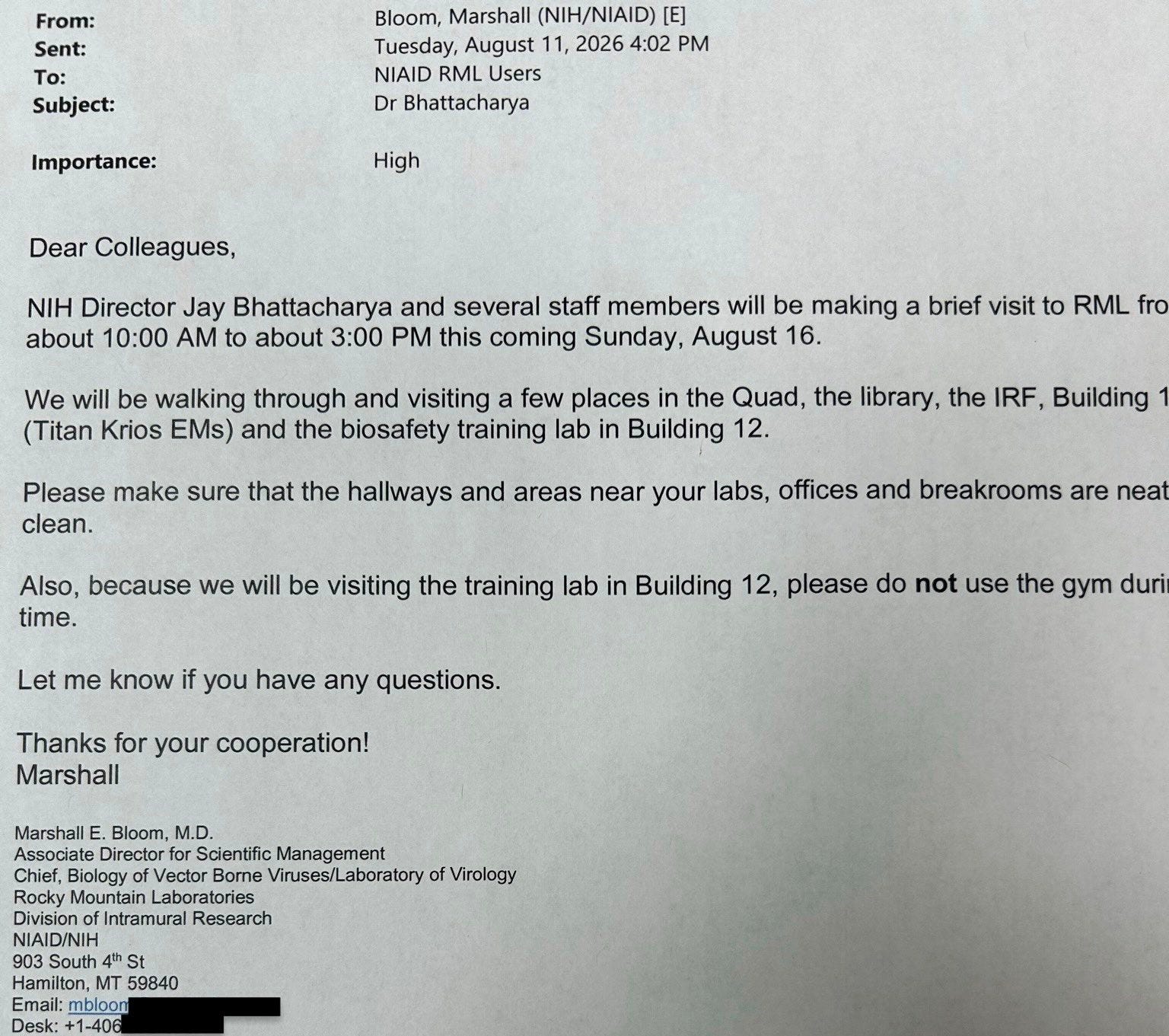
Jay should ask to see the Chinese bat breeding facility. Fauci built it with COVID relief funds so he wouldn’t have to test his bat vaccines in Wuhan.
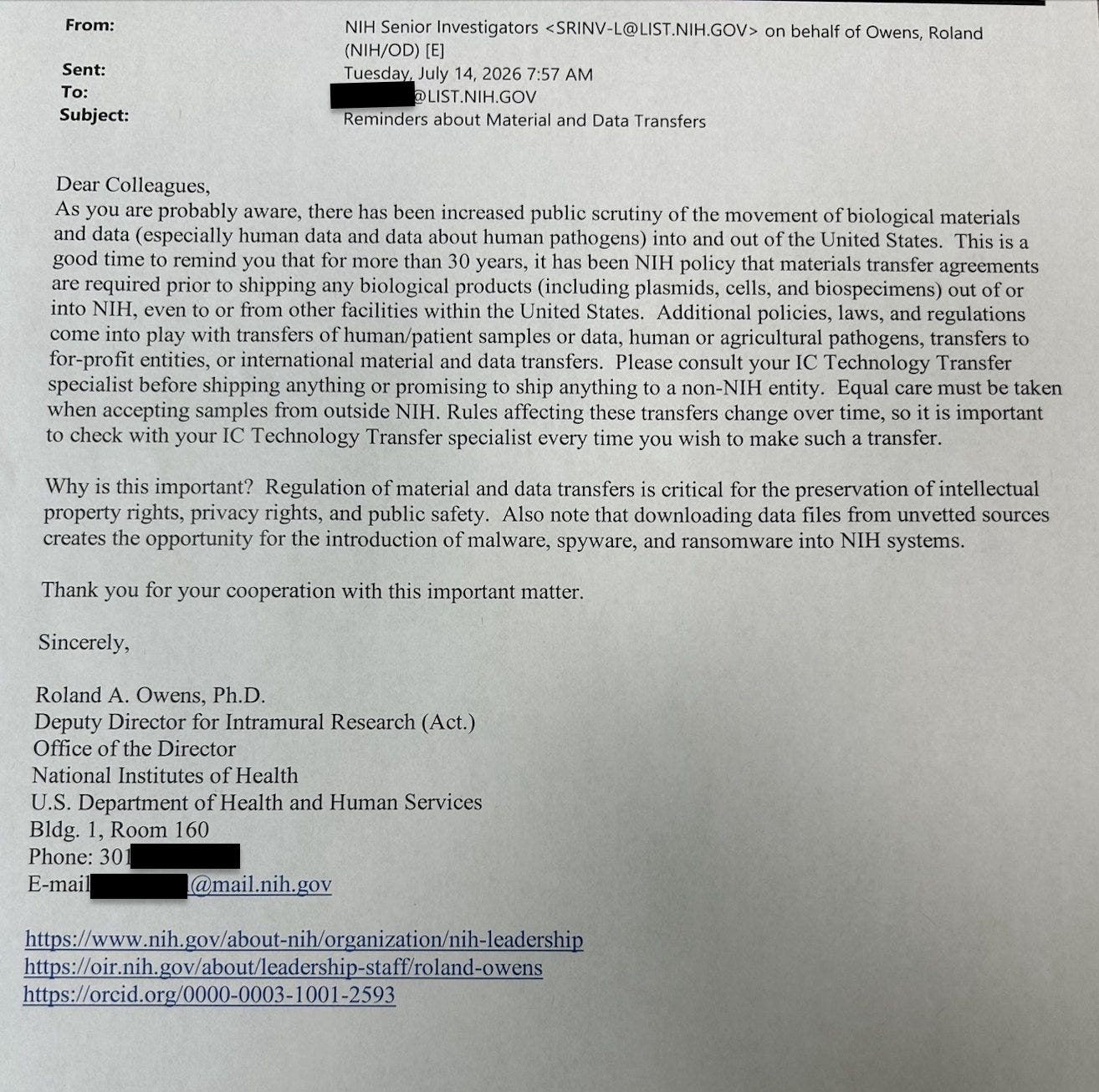
After Vincent Munster’s arrest went public in June 2026, the NIH circulated a memo, also leaked by Paul D. Thacker source, which shows the transfer (MTAs) of biological material across borders.
Kristian Andersen offers a perfect summary of the current lab leak debate: COVID was made in America by Baric and Fauci, who made $$$ from vaccines, and they covered it up.
Steven Quay, a pharma executive known for his books making the case that COVID came from a Chinese lab, is on the verge of getting Fauci’s old job.
https://www.politico.com/news/2026/08/04/steven-quay-anthony-fauci-niaid-covid-lab-leak-01024080
Quay contends Baric is innocent, but told me he would look into Rocky Mountain Lab.
Like Quay, David Relman is a Stanford professor with close ties to Baric.
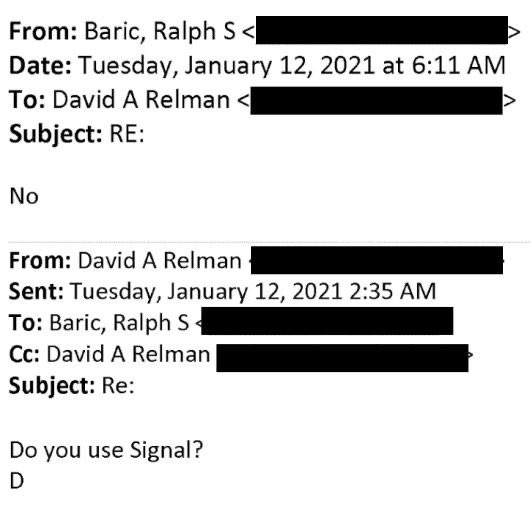
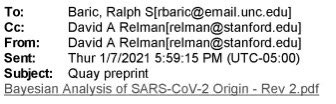
Relman leaked Steven Quay’s lab leak paper to Baric before their State Department meeting. Quay said Baric bullied him during that January 2021 red team meeting. Baric obviously didn’t disclose his DEFUSE plans.
Relman previously claimed DEFUSE did not “move the needle a lot.” He has never discussed it or given an hour-long presentation on DEFUSE. He’s only continued to implicate Shi’s BSL2.
“They were essentially playing Russian roulette with the virus that the world’s expert [Ralph Baric] had labelled poised for human emergence,” David Relman, a microbiologist at Stanford, said. “It’s the willingness to manipulate them without due concern.”
I’ve never interacted with Relman, but I made sure he knows about me and bat vaccine theory, so I assume this recent Guardian article was directed at us.
First, everyone who insists that they know how Covid began should back off, accept ongoing uncertainty and display a bit more humility. Second, we need an objective and transparent forensic investigation of Covid origins with broad international engagement and proper authorities and accountability.
https://www.theguardian.com/commentisfree/2026/aug/15/covid-19-origins
Relman clearly wants to confine the lab leak debate to China’s role. He was an early proponent of the Mojiang mineshaft theory. He is Richard Ebright without a Twitter feed. Relman was all in on the lab leak theory, delivering hour-long presentations from his Stanford University office. He even discussed the WIV Master Thesis, a short-lived conspiracy since Shi uploaded RaTG13 to NIH databases in 2018. He also discussed the missing WIV database, which is irrelevant after Shi re-uploaded RaTG13 on Jan 24, 2020, which led Baric to call for Shi’s arrest.
In May 2021, Relman invited Baric to sign the Science letter calling for a lab leak investigation into Shi’s BSL2. Baric gladly played Relman and signed it, making lab leakers fall in love with Baric. Then DEFUSE leaked, and both Relman and Baric went radio silent.
Every evening, 1,000,000 Mexican free-tailed bats emerge from an abandoned train tunnel in the Texas Hill Country. COVID also inoculates this species of bats, since Baric used them as “proxies” for his SARS2 bat vaccine. But no transmission with Baric’s bats, unlike Munster’s Egyptian fruit bats, which transmit SARS2.
No posts
Comments
Nothing yet. Say the first thing.
Sign in to join the conversation.