
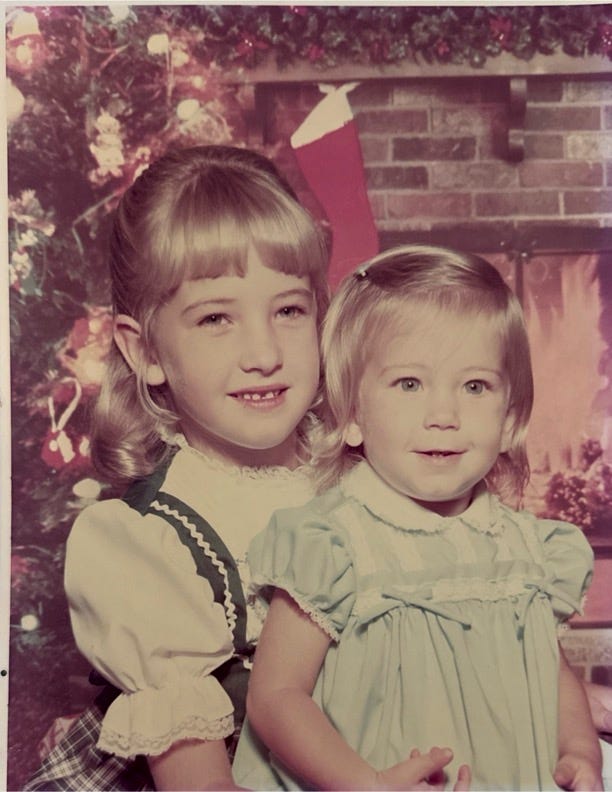
When I was 7 and my younger sister was 2, she used to bite me. Yes, she was a biter. And, on one occasion, my mom must have gotten particularly frustrated by this pattern of behaviors and told me to “just bite her back, Jill!” I remember being completely mortified by this idea, refusing to bite my rabid little sister back. So, my mom took Joni’s chubby little arm and bit her back, showing her just how it made me feel to get bitten. Well, what I remember about that moment was that my sister just sat there staring at my mom and me, with her dry, saucer shaped blue eyes, and promptly stood up and trotted away, completely unfazed. Lesson learned?
The lesson to take from that is while you can begin to teach empathy to a two year old, real developmental sophistication around taking another person’s perspective does emerge until the age of 5. And, trying to teach a toddler not to bite by biting them back is akin to saying “do as I say, not as I do”. But, let’s face it, this was in the early 80’s and my parents were highly influenced by James Dobson’s “Dare to Discipline” (1970) and “Focus on the Family” (1977), which supported high structure, pro-spanking, and conservative religious values. There was room, too, for Dr. Spock, who started with authoritarian ideas in the 1940’s, “Baby and Child Care”, and then softened in the 70’s and 80’s to include advice showing affection and trusting parental instincts. Still, the backdrop of the parenting in the early 80’s and throughout my childhood was a more authoritarian style. So, the “bite her back” advice was logical for my mom. I don’t blame her. She was doing what her own parents taught her, what the experts at the time were teaching, and she was trusting her instincts.
Fast forward to where we are now, and I’m left to scratch my head a bit. I’ll admit that as a Gen X parent, I tried to parent from a more “relational” approach. I strived to be authoritative overall with a heavy dollop of open communication and affection. I did spank each of my kiddos once a piece, but both were toddlers and each were in response to behaviors that could’ve resulted in them being squashed by oncoming traffic. I put away the paddle, didn’t use the “do as I say, not as I do” mentality, left behind any trace of “children should be seen and not heard”, and definitely did NOT expect my kids to be latch-key kids like my entire generation. I felt incredibly progressive and, quite frankly, maybe even a bit too relational and permissive. Was I giving my kids too many choices? Were they allowed to speak their minds more than they should? Why did their opinions matter so much when we were discussing chores, rewards, goals, and logical consequences? But that was how my husband and I decided to parent over the last 20 years, and it seemed to work for us.
Now I work with parents who seem afraid to set boundaries. Over the past 25 years of private practice, I have seen the parenting trends shifting away from the helicopter and gentle parenting fads back to a more “balanced” space. Or, more accurately stated, I am seeing parents in my office asking permission to parent using some tools they learned from their parents, some from their pediatricians, some from the preschool teachers, and some from parenting books. These parents are also admitting to me that they feel burnt out by the pressure to avoid the word “no”, and to explain everything to their screaming toddler, put their lives on hold while they raise their kids, and mortgage their houses so little Johnny can pursue his dream of being a professional baseball player at age seven. These confessions happen behind the safety of my sound-proof office, where the moms and dads often express guilt and fear that making this shift from pure child focus to a more “balanced” approach will mean their kids will feel neglected. Neglected?! Not to worry, I will not be calling child protective services because these parents have decided to raise children who feel completely loved for who they are AND know that they are not the center of the universe.
As it turns out, my clinical observations are not far off from a trend. A peer-reviewed study found a third of self-identified “gentle parents” reported burnout and uncertainty. Parents who had adopted this approach focused on validating their child’s feelings, remaining calm during their child’s meltdowns above all else, and helping their child regulate. On the surface this all sounds good. But the struggle is that many parents and some influencers of this approach, took it to the extreme and discouraged limit setting, the use of “no”, any form of time-outs or setting boundaries and especially the use of consequences, whether they were logical or natural. This form of extreme gentle parenting has left many parents exhausted, burnt out and saddled with certain kids (those who have especially intense temperaments), wildly out of control.
So, shall we swing back to the 1970’s authoritarian mode of “just bite her back!”? Well, obviously not. But, I am encouraging parents to integrate (my favorite word when I coach parents), what they know about their own parenting history, their personalities, what their values are and what they know about their kiddo to develop an approach that works for them. We can go back to the gold standard of Erik Erikson’s stages of psychosocial development and Jean Piaget’s stages of cognitive development to understand where the child is developmentally first. Then, with that as the backdrop, pull together the components that makes the most sense for the parent and child. Every child needs to feel safe, loved and understood. And every parent needs to feel respected, supported and encouraged while they do the best they can with the tools they have. There isn’t one approach for every child, so a parent might find a good approach with one kiddo, and then need to scrap that for the next. Guess what? That’s okay. Raising children should be something that we are all trying to do together, accepting that we will make mistakes, and trusting that kids are resilient. After all, many of us GenX adults did bite our siblings back, walked home from school alone as latch-key kids, were babysat by Oprah and Scooby-dooh and ate boxed mac n cheese for many dinners, and we are known as the independent, pragmatic, and adaptable generation. So maybe throwing in more “no’s”, and “because I say so’s” into our current parenting vernacular wouldn’t be such a bad thing.
You’ve got this!
No posts
Comments
Nothing yet. Say the first thing.
Sign in to join the conversation.