
Drafts are beautiful. This is the conclusion I’ve come to after spending the summer intensively working on this book. I sent the full manuscript to my editor on August 15th, two days ago.
This summer, I’ve been deep in it, and enjoying the sustained focus the final stages of a project require. It’s one of my favorite parts of writing: the late stages when ideas and sentences begin to crystallize.
As I worked through my draft, my thoughts drifted back to a small piece I cut from my post on Picasso from April 2025. It was all about Picasso’s writing and how he edited his work.
I can’t say that my drafts are as beautiful as Picasso’s, but his literary work—and the gorgeous messiness of it—returned to my mind companionably as I worked on my own writing. Here is another short notation—this time on Picasso as a poet.

In April of 1935, in the midst of a contentious divorce, Picasso turned his energies to poetry. He brought the same rebellious creativity to his writing as he did to his art, and, of course, his manuscripts are visually vibrant.
Poetry had been a feature of Picasso’s life for a long time. As a young man, he surrounded himself with poets like Max Jacob and Guillaume Apollinaire. One of Picasso’s first patrons was none other than Gertrude Stein. Above his studio at Bateau-Lavoir in Paris, where he painted “Les Demoiselles d’Avignon,” he chalked the words “Rendez-vous des poètes.”1
But it wasn’t until 1935 that he began writing in earnest. In fact, he supposedly told a friend that he would be remembered as a poet rather than a painter.
“Picasso, Pablo Ruiz―Spanish poet who dabbled in painting, drawing and sculpture.”2
As you might expect, his manuscripts are gorgeous!
Picasso flouted the rules of grammar with as much aplomb as he did the rules of painting. In particular, he hated punctuation. Most of his poems do not contain a single punctuation mark. As he told a friend,
I would prefer to invent a grammar of my own.
Here is one of Picasso’s punctuation-less poems. It begins irresistibly:
sur le dos de l’immense tranche de melon ardent
(on the back of the immense slice of burning melon)
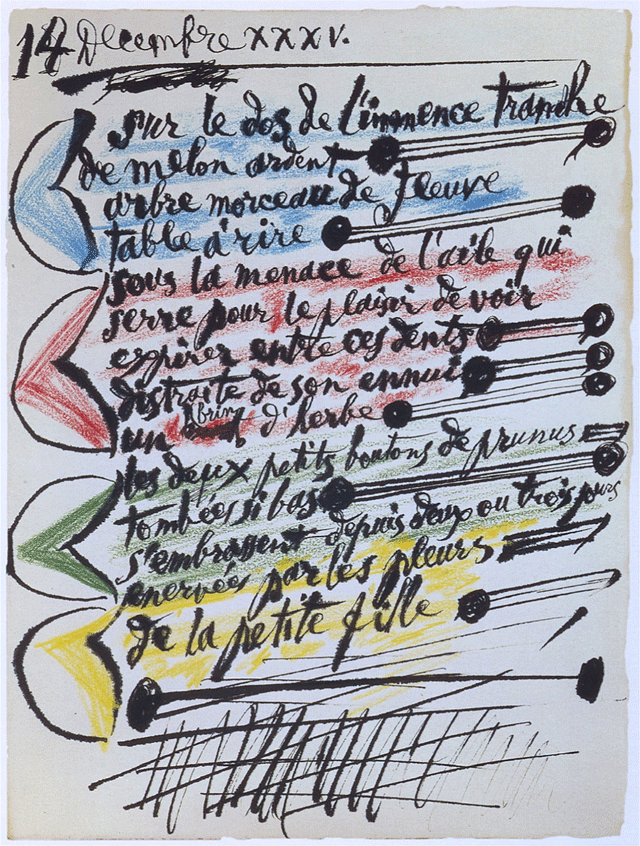
Notice the dots and dashes at the end of each line—is this invented punctuation? Or simply design?
I can only describe the following image as the draft of a visual artist. He did not leave his aesthetic sensibilities behind when he turned to language.
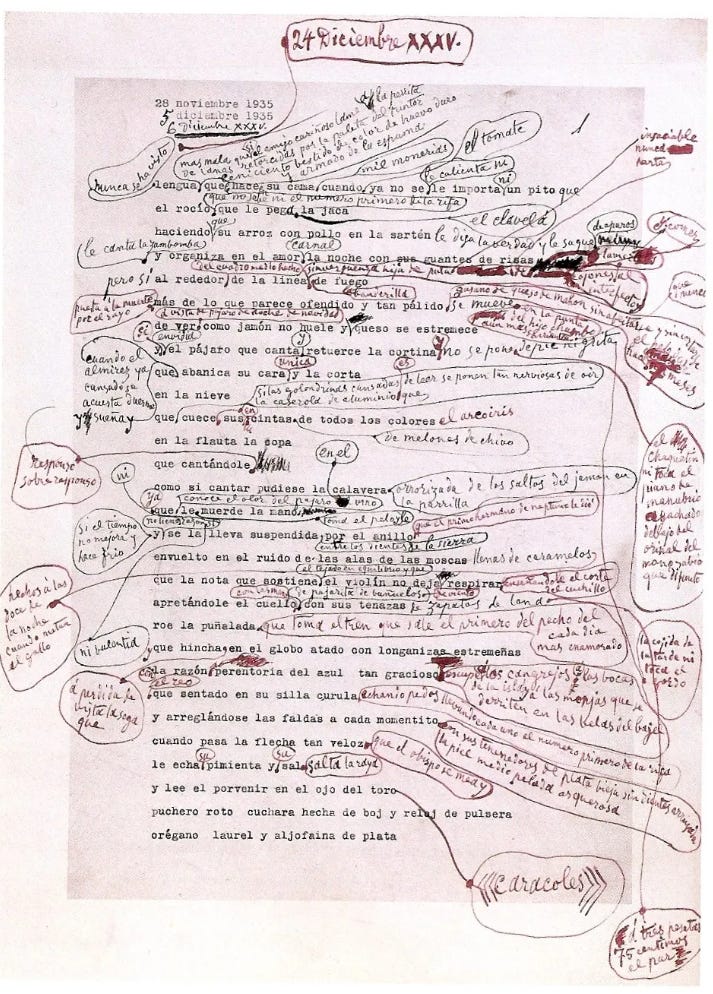
Here, we find Picasso having a conversation with his own draft. Evocative words dot the margins
el arcoiris (the rainbow)
ni valentía (not even courage)
responso sobre responso (a requiem upon a requiem)
The draft arranges words without punctuation. How liberating that must have felt!
I’ve been thinking a lot about punctuation as I finished the draft—a necessary final consideration. That subtle undercurrent of anxiety over the em dash—my favorite punctuation mark. The relentless shuffling of commas.
Perhaps that is what I love so much about drafts—the messiness, but also the possibility—and the way they inhabit a universe of their own where you make the rules, at least temporarily. In a draft, you can dispense with punctuation if you want. Rest assured: my manuscript is fully punctuated.
I can’t wait to be able to share my book with you…in approximately a year!
Yours in note-taking,

Richardson, John. A Life of Picasso Volume I: 1881-1906. Random House, 2013.
Picasso, Pablo. The Burial of the Count of Orgaz & Other Poems. Exact Change, 2004.
Comments
Nothing yet. Say the first thing.
Sign in to join the conversation.