
The last matrix sorted your roadmap. This adds one more filter: narrative fit
Ship everything and you just overwhelm your customers
Write your product’s story for the year first, then make every release earn a place in it
Someone has to own the narrative thread. That’s the PM’s job
Hey folks,
After the last newsletter on prioritization, a product leader wrote about a problem that I’ve now seen surface several times. His team’s shipping had gotten so fast and cheap that they could push something new almost every week. But their customers started to drown in all that output.
What his team did about it was the interesting part. Instead of announcing every release, they started deciding on purpose which moments were actually worth telling customers about. They called them launch moments, and they built their prioritization around them.
Their story points to a secondary prioritization conversation. The learning/reversibility matrix helps you decide what’s worth building. The next thing you have to figure out is what’s worth telling a story about.
I want to be careful here, because there’s a thin line and it’s easy to land on the wrong side of it. Deciding what to announce sounds like product marketing, and honestly, some of it is.
Most teams already have the pieces. You know your OKRs, you know who you’re serving. What’s usually missing is a simple story for where the product is going this year — not a roadmap, a story. We’re taking the product from where it is now to somewhere specific, and then somewhere past that. That arc is worth writing down.
If you write down the beginning, middle and end of your product’s story arc for the next 6-12 months first, it turns into another filter for the work. It does the same job as learning value and reversibility, just on a different axis. For any feature on the table you can ask whether shipping it actually moves you along that arc, and if it does, how you’d tell that part of the story. It’s Jeff Bezos’s idea of writing the press release before you build, except here the story isn’t the marketing, it’s the thing forcing real prioritization decisions.
Let’s say you build a project management tool and your story for the year is getting from where teams track their tasks to where they plan their whole quarter. That’s the arc for the year.
Now the feature requests come in and they’re all reasonable. You’re being asked to build a faster mobile app, smarter notifications and a slicker way to assign tasks. They’re cheap to build, so why not just build them? It turns out though that those features keep the product where it already is, just smoother. So, none of them are a chapter in the story. Small improvements like these don’t get a launch moment, a campaign nor an email to your whole customer base.
Then there’s a hard feature you’ve validated. You want to build goal-setting that rolls task progress up into a quarterly view. Your discovery work says users want it, but it’s expensive, slow to build and it touches half the product. Weighed on effort alone, it loses to the pile of quick wins every time. That’s exactly how the important, hard things get perpetually pushed down the backlog.
But this feature is important. It’s going to be the most important part of moving from “track your tasks” to “plan your quarter.” This is the chapter of the story that you promised. The story helps support the judgment call you need to make to build the harder thing. It’s this feature that will earn the spotlight when it ships.
The story doesn’t decide what you’re allowed to build. It helps anchor what’s important about your product right now and where you are going. Telling that story both internally and to the market keeps your team and organization focused and your customers’ heads above water.
Write the story before you build. The story sets the target; the work has to earn its place in it.
The product manager owns the narrative. Someone has to keep asking whether the story still makes sense and whether each release still fits it.
Let the story change when it should. If the narrative stops being true, rewrite it, don’t force releases into an arc that no longer makes sense.
I’ll be digging further into these ideas in each of them.
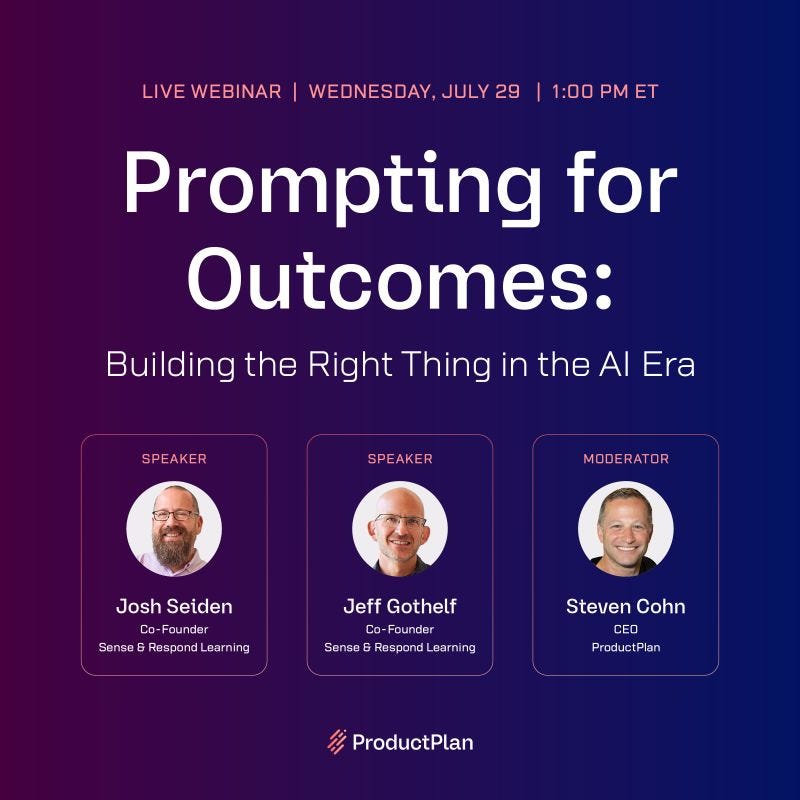
Next week: I’m joining ProductPlan for Prompting for Outcomes: Building the Right Thing in the AI Era.
AI can make it much easier to generate ideas, prototypes and features. It can’t tell you which customer behavior is worth changing or whether the thing you built deserves to exist in the first place.
Register for free here.
In September: Josh and I will host our monthly Sense & Respond Learning webinar: What Does Product Management Look Like in 2027?
If building gets cheaper and faster each year, what happens to the role of the product manager? We’ll share where we think the work is headed, which fundamentals still matter and what product leaders should be preparing their teams for now.
Register for free here.
Can’t make it live? Register anyway and we’ll send you the recording.
If this is the kind of thinking your team needs to get sharper at, specifically deciding what’s worth building, not just building faster, this is where we teach it.
with Rich Visotcky | 💬 English
August 11, 18, 25 & September 1
📍Live online (Zoom)
Register here
with Mihai Olaru & Florin Manolescu | 💬 Romanian
September 14, 18, 21 & 25
📍Live online (Zoom)
Register here
with Rich Visotcky | 💬 English
August 20 & 27
📍 Live Online
Register here
with Mihai Olaru & Florin Manolescu | 💬 Romanian
September 11
📍 Live Online
Register here
View all upcoming workshops.
Interested in working together? Please reach out.
In case you need it, here's a description of what I do.
Comments
Nothing yet. Say the first thing.
Sign in to join the conversation.