
Perspective is probably one of the most useful drawing techniques I’ve ever learned. I actually can’t remember exactly when I learned it. I imagine it was sometime in art class, but it’s one of those things that has stayed with me for years.
I’ve always loved architecture and interiors, so learning perspective was kind of a must. I studied interior design before eventually moving into product design, and I remember constantly drawing rooms, furniture, buildings, and floor plans. Perspective became something I used so often that eventually I stopped thinking much about the rules behind it.
Now that I’ve started carrying a sketchbook around again, I’ve been thinking about it a lot more.
When I sit down to draw a space, one of the first things I look for is where everything is going.
⋆。°✩
This is how I like to think about perspective: all roads lead somewhere.
Look at the lines around you. The edge of the ceiling, the floor, a table, a window, a row of buildings. Some of those lines might actually be parallel, but from where you’re sitting they look like they’re slowly getting closer together.
Keep following them and eventually they lead somewhere.
That somewhere is your vanishing point.
I find this much easier to think about than trying to remember a bunch of perspective rules while I’m drawing. I’ll pick one obvious line in the room and ask myself, where is this going? Then I look for another line moving in the same direction.
It becomes a little puzzle.
Once I figure that out, I have something to build the rest of the drawing around.
The other thing I look for is the horizon line, which is basically your eye level.
I used to hear “horizon line” and immediately think of an actual horizon, which makes sense when you’re drawing a landscape but feels a little strange when you’re sitting inside a café.
Really, I just think about where my eyes are.
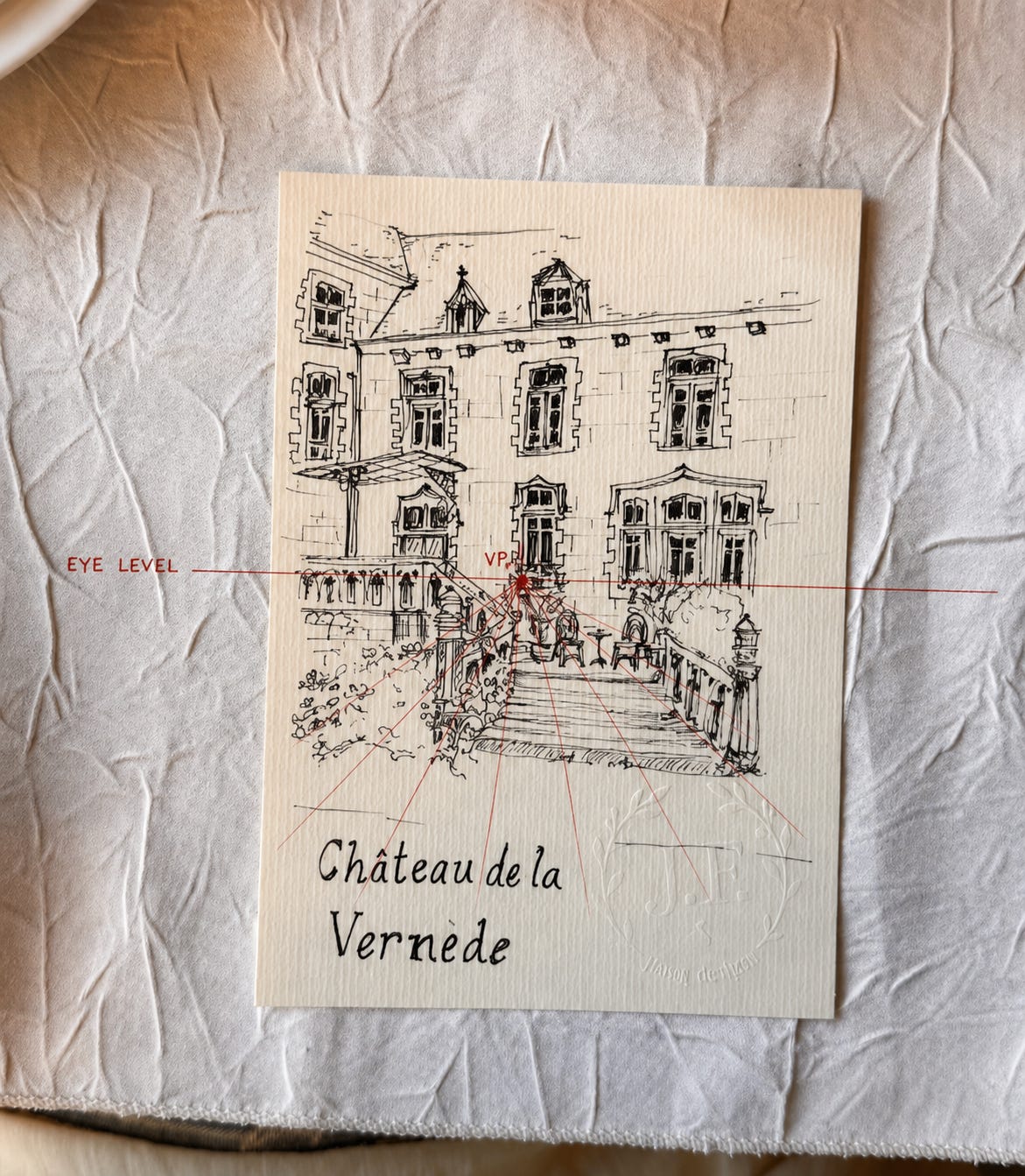
If I’m sitting down, my eye level comes down with me. If I stand up, it moves up. Everything I’m looking at is being seen in relation to that point of view.
You don’t have to actually draw a horizon line across every page. Most of the time I don’t. I just like having a rough idea of where it would be.
From there, you can start figuring out what kind of perspective you’re looking at.
One-point perspective has one vanishing point.
The easiest example I can think of is looking straight down a hallway. The hallway gets smaller and smaller in the distance and everything seems to lead toward the same place.
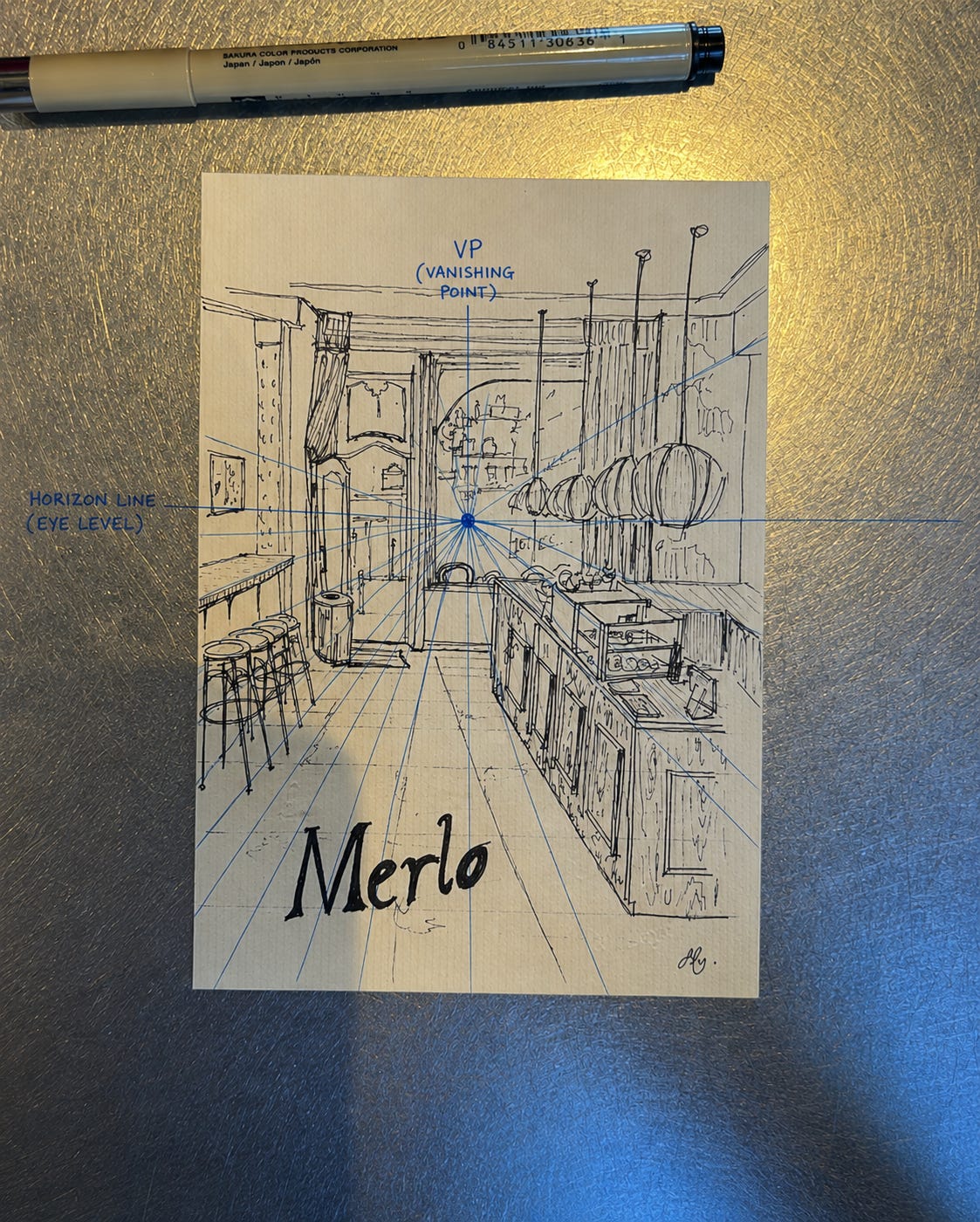
You’ll also see this when you’re looking directly toward one wall of a room. The wall in front of you stays fairly straight while the floor, ceiling, and walls beside you move toward the vanishing point.
This is probably the easiest type to spot once you start looking for it.
Two-point perspective is the one I probably use the most.
Instead of looking straight at something, you’re looking at it from an angle. Think about standing in front of the corner of a room or building. One side goes in one direction and the other side goes in another.
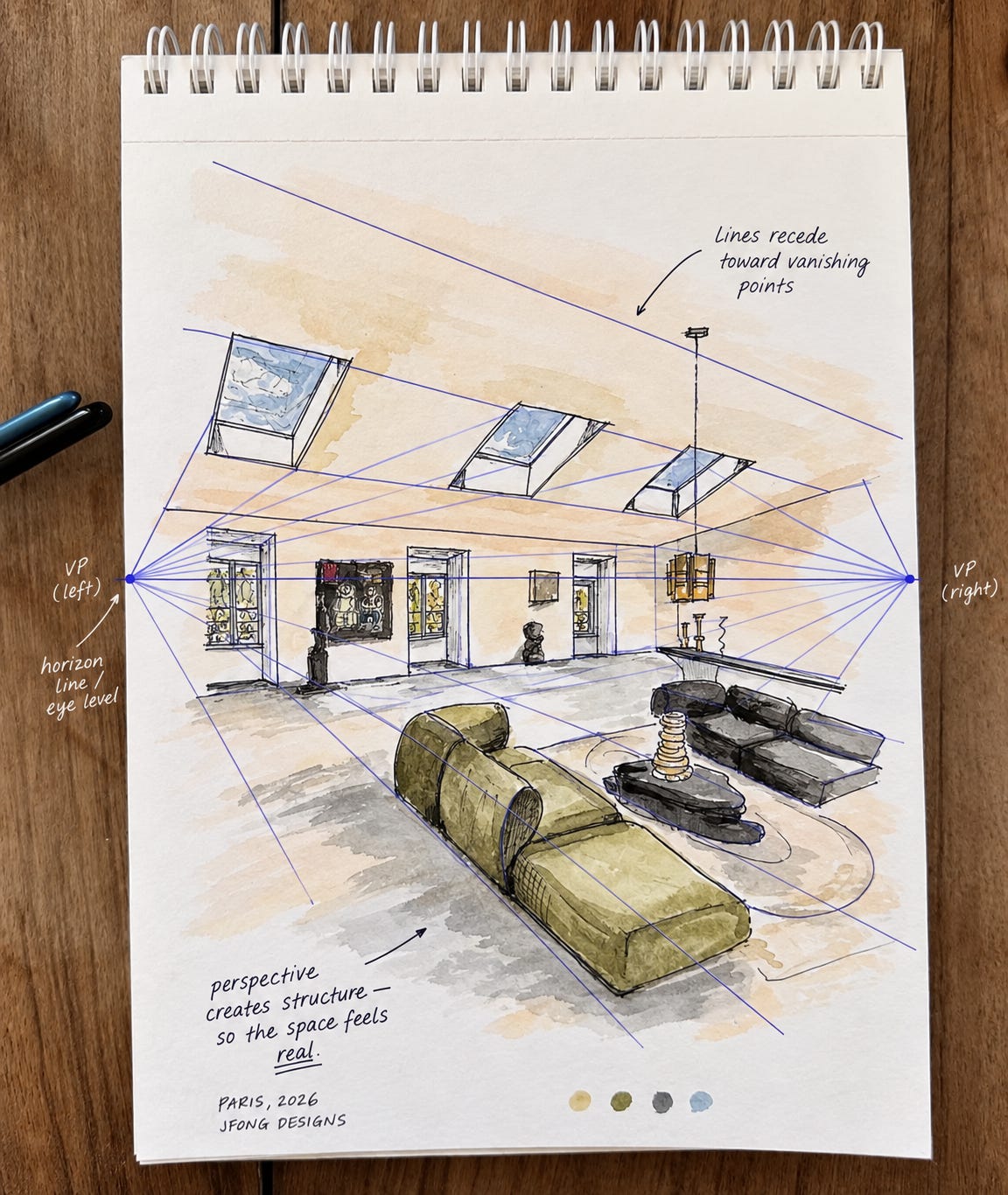
Now you have two vanishing points.
I see this constantly when I’m drawing interiors because I’m rarely sitting perfectly centered in front of a wall. I’m usually tucked into a corner somewhere, looking across the room.
This is where the idea of all roads lead somewhere really helps me. I look at one set of lines and figure out which direction they’re travelling, then do the same with the other side.
Once I know that, the room starts making a lot more sense.
Then there’s three-point perspective.
This adds another vanishing point for the vertical direction and becomes much more obvious when you’re looking really far up or down.
The easiest example is standing underneath a tall building and looking up. The building feels like it’s getting narrower as it reaches the sky. The same thing happens in reverse when you’re somewhere high up looking down.
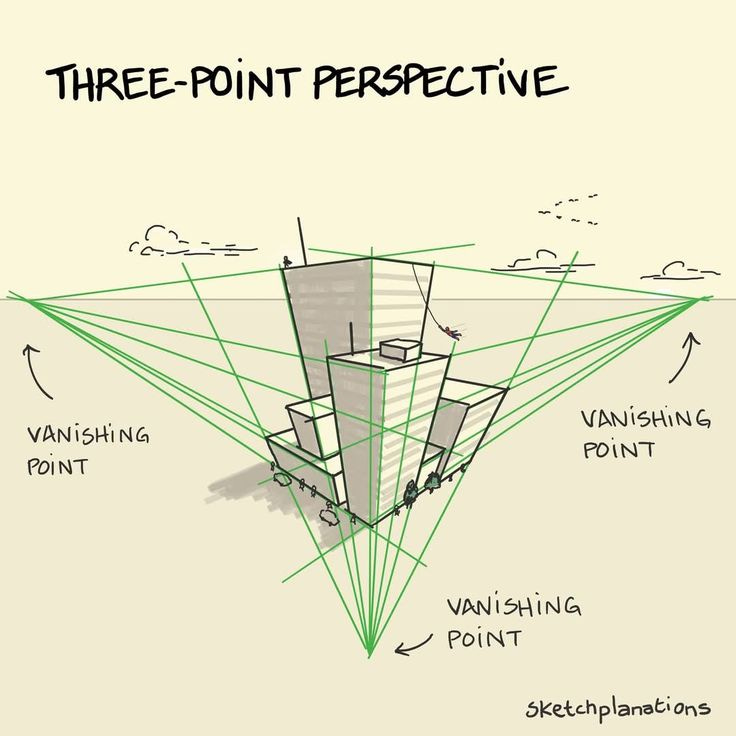
I don’t use this one nearly as much in my everyday sketches, but I think it’s useful to understand why those really dramatic views of buildings look the way they do.
There are four-, five-, and even six-point perspective systems too, but I’m not going to pretend those are part of my everyday sketching practice. For what I draw, one-, two-, and three-point perspective are the ones I actually care about.
When I’m actually sitting somewhere drawing, I’m not plotting everything perfectly or pulling out a ruler.
I usually start by looking for the biggest shapes.
Where does the ceiling meet the wall? Where does the floor start? What’s closest to me? What’s sitting behind it? Which lines seem to be heading in the same direction?
I map those out really lightly first.
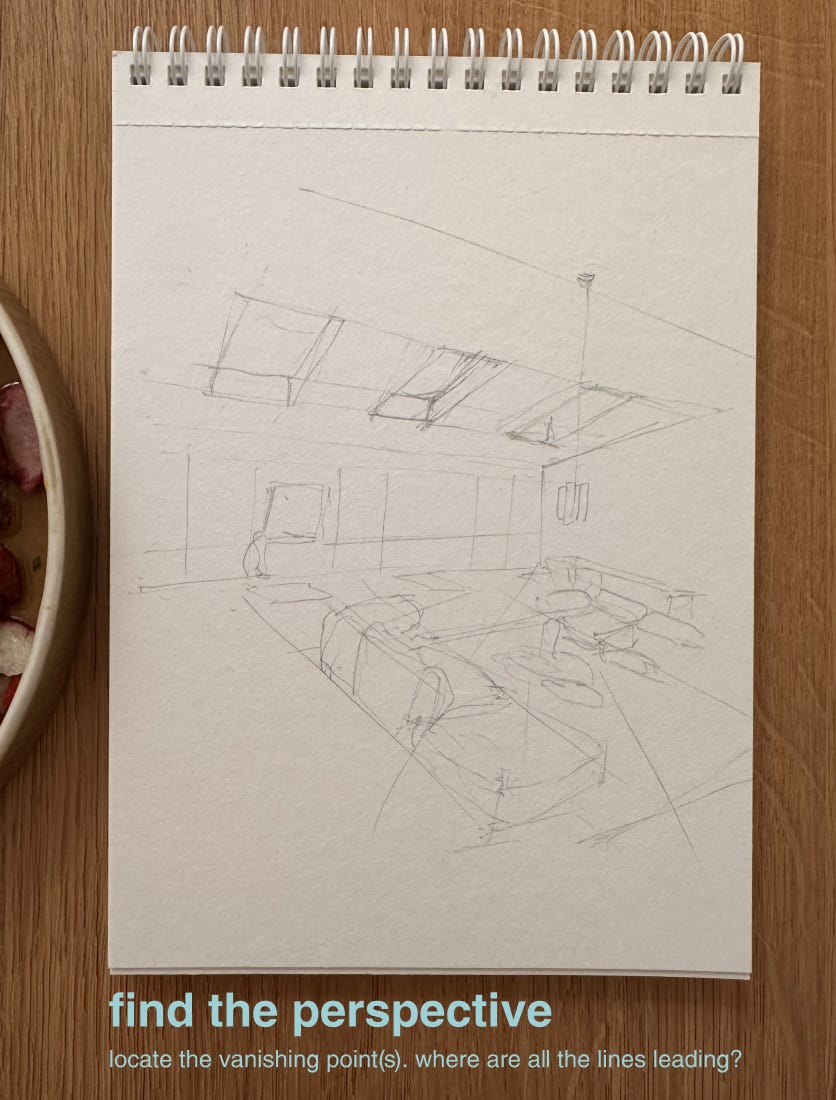
Then I start working from front to back so I know what overlaps and what doesn’t. Once I feel good about the basic structure, I can start going back in with darker lines and adding all the little details.
This is the part I have to remind myself of because I always want to jump into the details too early.
I love drawing the chair, the lamp, the stack of books, the tiny things sitting on a table. But if the perspective of the room is completely off, getting those little things right isn’t going to save it.
So I try to get the big things right first.
Then I can have fun.
I think this is especially important for the kind of drawing I’m doing now.
I’m not creating technical architectural drawings. I’m documenting places in my sketchbook.
My lines are not perfectly straight. Sometimes my vanishing points probably don’t line up exactly. I change proportions. I leave things out. I make things bigger because I like them.
That’s part of why I enjoy sketching.
For me, understanding perspective isn’t about making everything technically perfect. It gives me enough structure to understand what I’m looking at, and then I can decide what I want to do with it.
I think that’s why it has remained one of the most useful things I’ve learned.
It didn’t just teach me how to draw a room. It changed how I look at one.
I notice lines, shapes, proportions, shadows, what overlaps, what feels close and what feels far away. The more I sketch, the more I notice myself doing this without thinking about it.
And maybe that’s my favourite part about learning to draw again. I’m not only getting better at putting things onto paper.
I’m getting better at looking at them.
Until next time,
Janice
No posts
Comments
Nothing yet. Say the first thing.
Sign in to join the conversation.