
One year ago, on February 25, 2024, Aaron Bushnell set himself on fire outside the Israeli embassy in Washington, D.C., live-streaming his final statement. “I will no longer be complicit in genocide,” he said before igniting himself. His last words were: “Free Palestine.”
He was not the first to set himself on fire in protest.
In 2006, Chicago resident Malachi Ritscher made a chilling declaration in his final statement: "If I am required to pay for your barbaric war, I choose not to live in your world." Then, he set himself on fire in protest.
Spanning nearly two decades, these political suicides lay bare an ongoing and unresolved struggle against systemic brutality, spotlighting the persistent injustices that drive individuals to such extreme actions. In the relentless march of history, acts of profound sacrifice compel the world to confront its own indifference. These self-immolations cut through the noise, demanding attention and action, yet leaving us to question if the world truly listens and responds.
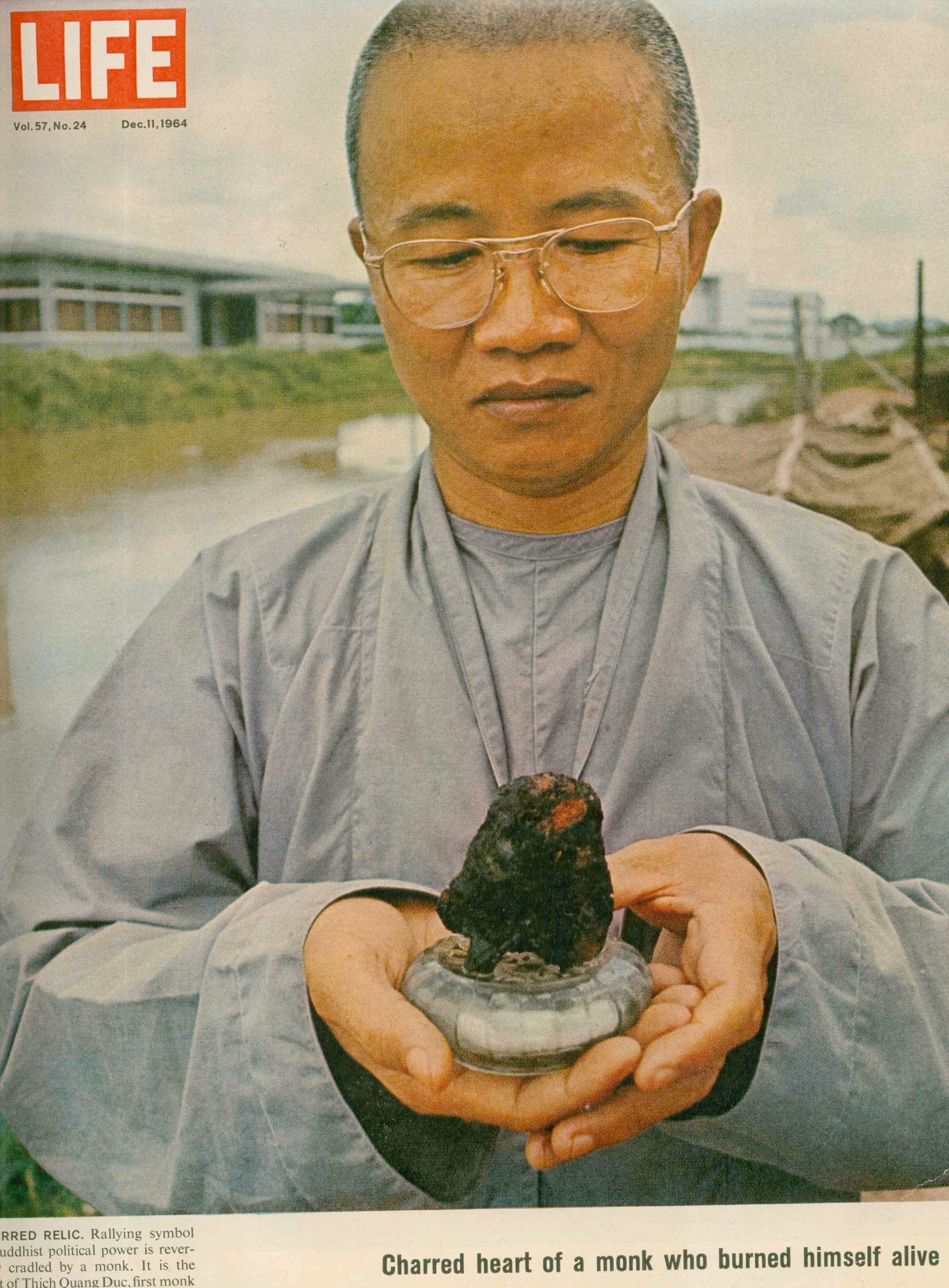
One of the most striking acts of self-immolation in modern history was carried out by Buddhist monk Thích Quảng Đức, who set himself ablaze on the streets of Saigon on June 11, 1963. His protest was against the brutal persecution of Buddhists by the US-backed South Vietnamese government. The image of his burning body, seated in meditation amidst the flames, shocked the world and ignited a firestorm of political dissent. His action inspired five more Buddhist monks to follow his example with politically motivated suicides by fire.
Thích Quảng Đức’s protest became an iconic and haunting symbol of the war, and effectively brought global attention to the corruption, abuses, and brutality of the American-backed Diệm regime. The now infamous photograph of “The Burning Monk” sent shockwaves throughout the world. “No news picture in history,” John F. Kennedy once said, “has generated so much emotion around the world as that one.”
The U.S. government viewed South Vietnam's autocratic leader Ngô Đình Diệm as a crucial defense against Communism. Consequently, they provided his military regime with funding, armaments, and training. This support enabled Diệm to suppress the Buddhist monks. However, Historian Seth Jacobs believes that Quảng Đức’s immolation had "reduced America's Diệm experiment to ashes" and that "no amount of pleading could retrieve Diệm's reputation." Shortly after Thích Quảng Đức’s death, the US turned on their alliance. Five months after his death, Diệm was overthrown in a US-backed coup and executed. Two years later, over 60,000 U.S. troops were deployed to Vietnam, initiating a conflict that resulted in some 3 million deaths.
The ripple effects of Quảng Đức’s protest extended beyond Vietnam. Inspired by the powerful impact of his protest, the first American political self-immolation occurred in March 1965 in Detroit. Eighty-two-year-old peace activist Alice Herz set herself on fire to oppose US military action in Vietnam, “the arms race, and a president using his high office to wipe out small nations.” Her protest didn't stop the war nor the arms race; instead, it highlighted the worsening conflict, which only escalated further with time.
Several more self-immolations followed. An anti-war activist named Norman Morrison set himself on fire below Secretary of Defense Robert McNamara's Pentagon office. Morrison took his daughter Emily, then one year of age, to the Pentagon, and either set her down or handed her off to someone in the crowd before setting himself ablaze. Morrison's wife Anne later recalled that Emily “was a powerful symbol of the children we were killing with our bombs and napalmDiệmwho didn't have parents to hold them in their arms."
One week after Morrison, 22-year-old Roger Allen LaPorte set himself on fire in front of the United Nations building in New York City to protest the United States' involvement in the war. When asked in the hospital why he had burned himself, LaPorte calmly replied, "I'm against war, all wars. I did this as a religious action." He died the next day.
Since 1965, thirty-eight people in the US have self-immolated for political reasons, driven by various injustices. In 1972, civil rights organizer and former military veteran Willie B. Phillips self-immolated in Atlanta to highlight violence towards African Americans. In April 2018, pioneering human rights lawyer David Buckel emailed a statement to media outlets decrying humanity’s passivity in the face of pollution and climate change, then walked to nearby Prospect Park in Brooklyn and set himself on fire, hoping his death would galvanize mass action.
Similarly, in 2022, climate activist Wynn Alan Bruce, a 50-year-old climate protester from Colorado, self-immolated outside the Supreme Court on Earth Day. Kritee Kanko, a friend of Bruce, wrote that his action was "not suicide" but rather "a deeply fearless act of compassion to bring attention to climate crisis."
Just a month before I wrote this text, Maxwell Crosby Azzarello self-immolated in New York City, outside the courthouse where jurors were being chosen for the New York state criminal trial of former US President Donald Trump. In Azzarello’s manifesto, he wrote, "This extreme act of protest is to draw attention to an urgent and important discovery: We are victims of a totalitarian con, and our own government (along with many of their allies) is about to hit us with an apocalyptic fascist world coup.” “The Democrat vs. Republican division has been entirely manufactured,” he added.
Azzarello was unfairly maligned in the press as a conspiracy theorist with mental health issues, despite the absence of evidence to support these claims. His friends lamented the media's portrayal, calling it a "really inaccurate depiction of him." A former colleague described Azzarello as "highly intelligent, thoroughly dedicated, funny, and kind."
This trope, sadly, is all too common. It's perhaps an understandable reaction, as it is wildly unsettling to contemplate how someone could endure the pain and brutality of such an act. Yet, this reductionist narrative not only dishonors the complexity of the individual but also obscures the thoughtful political statements these acts are intended to convey. By focusing solely on mental health, we fail to recognize the deliberate and calculated nature of these sacrifices. This evasion prevents us from addressing the underlying societal and systemic issues that contribute to their protest.
Furthermore, we must consider who benefits most from the narrative of mental illness; dismissing political self-immolation only serves the comfort of those unwilling to confront harsh realities and the interests of those in power who seek to obscure them. This is precisely how regimes and political systems discredit self-immolators: by labeling them as psychologically disturbed.
In contrast, placing one’s body in danger is a fundamental aspect of protest and a powerful means of asserting agency. Commonly, people place their bodies at risk as a means of rebellion through actions such as sit-ins and occupations, marches and rallies in hostile environments, crossing dangerous borders, climbing or hanging from structures, blocking traffic, exposing themselves to environmental extremes, or engaging in hunger strikes. By risking their bodies, protesters bridge the gap between abstract ideas and tangible reality, transforming their convictions into physical acts. The body becomes a poignant symbol of resistance and commitment.
This willingness to endure physical danger underscores the urgency and importance of their message, demonstrating that the issue at hand is significant enough to warrant personal sacrifice. Moreover, this act of placing their bodies on the line often comes from a place of sheer necessity—when all other options have been exhausted, the only resources that remain are their literal skin and bones. This desperation emphasizes not only the critical nature of their cause but also their determination to make their voices heard against overwhelming odds.
In contrast, it is a deeply ingrained norm, celebrated and valorized, to place one's body at risk in service to the state and the ruling class. When soldiers deploy into conflict zones, their sacrifice is glorified; their willingness to endure the horrors of war is seen as the pinnacle of honor. Workers in hazardous jobs, who risk life and limb to keep the wheels of industry turning, are praised for their rugged determination. These acts of bodily risk are sanctified because they serve the interests of power, upholding the structures that benefit the ruling class.
But when bodies are placed on the line to challenge these very structures, to protest systemic oppression and demand justice, the narrative shifts dramatically. Suddenly, the same act of risking one’s body is pathologized, dismissed as the irrational behavior of the unhinged. This stark contrast exposes a profound hypocrisy: the state and the elite only celebrate sacrifice when it perpetuates their control. When the body is used as a tool of resistance, it is no longer noble but condemned and marginalized. This reveals the uncomfortable truth that our society venerates sacrifice only when it maintains the status quo, not when it threatens to upend it.
Even in the most notorious cases of self-immolation, the results are often ambiguous and complex. Thích Quảng Đức's infamous act of self-immolation in 1963 drew international attention and contributed to the overthrow of the autocratic leader who was oppressing Buddhist monks. However, it did not prevent the looming horrors of the Vietnam War, which continued to devastate the region. Similarly, when Tunisian street vendor Mohamed Bouazizi set himself on fire in 2011 to protest poor economic conditions and political corruption, his sacrifice ignited widespread demonstrations that led to the ousting of Tunisia's long-time President Zine al-Abidine Ben Ali. This act of despair sparked the Arab Spring, a wave of protests across the Arab world. Yet, despite these powerful moments of change, the region remains engulfed in turmoil, and many of the underlying issues persist.
Following Aaron Bushnell’s death, countless comments expressed sentiments like, "Such a tragic waste," and "what did that accomplish?," implying that his protest was ultimately futile. This perception was echoed when local resident Warren Beishir reacted to environmentalist David Buckel’s self-immolation in Prospect Park by saying, "How do you do that to yourself? It’s a terrible way to go, and I don’t want to think about it after today." Such remarks reveal a discomfort with confronting the urgency that has driven individuals to such extreme acts of protest, often leading to a dismissal of the very issues they sought to highlight.
For those directly impacted by these issues, such as the people in Palestine or Vietnam, extreme protests hold deep significance. These sacrifices are powerful expressions of solidarity and commitment from individuals who lack power and resources, yet find a way to vehemently assert the value of the lives of those they are defending. Beyond mere symbolism, the protest embodies a shared struggle and an urgent plea for justice and recognition. In a world that often turns a blind eye to their suffering, such sacrifices force global attention, demanding acknowledgment of their humanity and the imperative to address their plight.
Although largely forgotten in the US, Herz’s act of solidarity with Vietnamese monks achieved, in part, what she intended. In Hanoi, crowds gathered to observe a moment of silent prayer upon learning of her death. Poets crafted songs and recitations honoring her unwavering dedication to pacifism, children were taught about Herz in school, and a street in Hanoi was named in her memory. A month after Aaron Bushnell’s death, Abdul Karim Sidr, the mayor of Jericho in the occupied West Bank, unveiled a new street sign bearing Bushnell’s name.
In Fear and Trembling, Danish theologian and philosopher Søren Kierkegaard delves into the existential aspects of faith, sacrifice, and the human condition through the biblical story of Abraham and Isaac. He questions the unfathomable and harrowing ordeal of being commanded by God to sacrifice one's own son, highlighting the sheer madness and heart-wrenching terror such an act would entail.
"Infinite resignation is the last stage before faith,” wrote Kierkegaard, “for only in infinite resignation does an individual become conscious of his eternal validity, and only then can one speak of grasping existence by virtue of faith.” In essence, true faith demands significant personal sacrifice and a deep acceptance of loss, which leads to the realization of one’s true self. However, unlike the biblical narrative, self-immolation does not stem from a divine command but from the unbearable weight of a moral imperative. Their faith is not in an abstract deity but in humanity itself—a raw, searing belief in our potential for justice and change. This is a faith forged in the crucible of despair, a blazing testament to their conviction in our collective conscience.
Lebanese-Palestinian poet May Ziadeh wrote, "The most important revolution is the one that takes place in our own consciousness. To see the world as it truly is, to understand our place in it, is to begin to change it." Self-immolation acts are a furious rejection of societal apathy, a blistering cry to awaken us from our indifference. We must consider that these actions of self-sacrifice may not be intended to directly change the power structures perpetuating these injustices, but rather profound declarations demanding recognition and action. They compel us to confront societal failures and acknowledge the nonnegotiable value of every life. Each act is a visceral, unignorable call to rekindle our humanity and stand against the injustices driving individuals to such extreme measures. Their flames remind us of the fierce urgency of justice and the unyielding truth that our collective inaction is intolerable.
In response to those who question what actions like Aaron Bushnell’s death "accomplished," the true measure of these sacrifices is not for those who made them to determine but for us to decide. It is incumbent upon us to honor their memories by taking tangible actions to combat the injustices they protested against. We must organize, educate, and mobilize to create meaningful change. The power of their sacrifice calls us to awaken from complacency, to challenge systemic oppression, and to build a world where such desperate acts are no longer necessary. The impact of their sacrifices rests on our shoulders—our response and commitment to justice will define their true significance.
This essay was originally published in Lumpen Magazine, Issue 142: Democrazy (August 18, 2024). The opening sentence has been updated to mark the anniversary of Aaron Bushnell’s death.
No posts
Comments
Nothing yet. Say the first thing.
Sign in to join the conversation.