
On International Women’s Day, Polish activists moved the fight for abortion from the margins to the center of power.1 In a country where abortion is nearly inaccessible, they opened Abotak—Poland’s first abortion support center—directly across from parliament.
Its location is no coincidence. Abotak is not just a space—it is a provocation. It exists to make abortion undeniable and ungovernable in a country where lawmakers have spent decades attempting to legislate it out of existence. “We are taking over part of the most important street in Warsaw to remind politicians every day that we exist, that abortion is a reality,” said Natalia Broniarczyk, one of Abotak’s founders and an activist with the Abortion Dream Team.2
The name itself is a declaration: Abotak, merging the Polish words for “abortion” (aborcja) and “yes” (tak), serves as both a practical title and a political statement, directly challenging stigma and fear. But its purpose is more than symbolic. Abotak provides a space where people can take abortion pills with support, access vital information, and receive care denied to them by the government. It is an alternative system of reproductive access, built outside the law but grounded in reality.
For decades, abortion in Poland has been driven into secrecy—restricted, criminalized, and isolated. Now, activists are refusing to remain on the defensive. Abotak marks a turning point—where the fight is about reclaiming power, creating infrastructure, and ensuring abortion happens on the movement’s terms, not the state’s.
This is not a plea for rights. It is an assertion that abortion is already happening—and no law will stop it.
Abotak does not provide abortions in the clinical sense, but it functions as something more politically significant: a materialization of counter-power where people can take abortion pills, access information denied by the state, and construct alternative systems of care. Its founders articulate an explicitly dual strategy—providing immediate support while simultaneously exposing the systemic failures of a political class that promises rights it never intends to deliver. "Politicians failed to keep their word on abortion—we did it for them," reads a statement on the Abotak website, simultaneously indictment and declaration of autonomous action.3
By establishing a visible, physical infrastructure, Abotak makes abortion impossible to relegate to the political margins. It transforms what the state attempts to abstract and criminalize into a tangible site of collective power.
The center functions as both territorial occupation and ideological confrontation, forcing lawmakers to contend with a reality they attempt to legislate out of existence. It is material proof that abortion continues regardless of prohibition, that it always has, and that neither the state nor the church can successfully suppress it.
Despite Poland's intensified abortion ban—a restriction strategically tightened in 2020 when the government-controlled Constitutional Tribunal eliminated the exception for fetal anomalies—the activists behind Abotak operate in the contradictions of Poland's legal apparatus.4
The law criminalizes those who facilitate abortions while not explicitly penalizing individuals who terminate their own pregnancies.5 Exploiting this contradiction, Abotak refrains from distributing abortion pills directly; instead, it constructs networks of information, support, and solidarity. Those seeking care bring their own medication, typically acquired through transnational activist networks like Abortion Without Borders, which helps facilitate tens of thousands of abortions annually—a significant parallel system of care that defies state prohibition.6
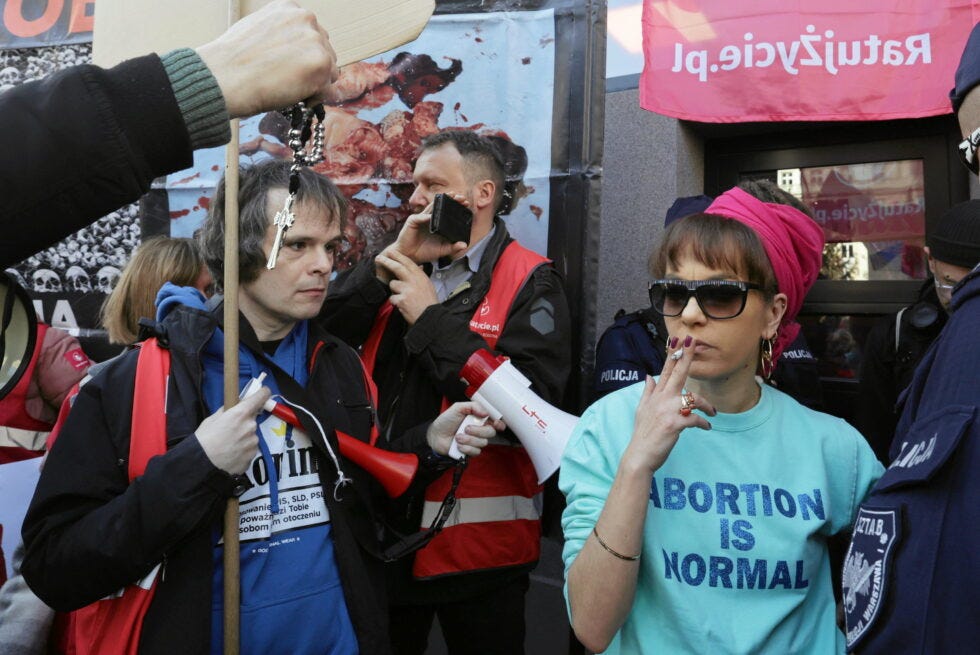
The reactionary response was immediate and predictable. Anti-abortion demonstrators mobilized outside, deploying familiar political spectacle with signs declaring "baby killers" that serve not to prevent abortion but to reinforce its stigma. Some engaged in performative displays of red paint across the sidewalk, while others broadcast recordings of crying babies—attempts at emotional manipulation that expose the movement’s refusal to acknowledge abortion for what it is—a common medical procedure undergone by roughly 25% of women globally.7

Inside, activists occupied the space with calculated political aesthetics: a red lip-shaped couch serving as visual disruption of conservative reproductive politics, pastel shirts declaring "Abortion is Normal," and red velvet curtains leading to private spaces designed specifically to counter both state surveillance and medical institutionalization. These design elements constitute both symbolic and practical rejection of the regulatory apparatus Poland has constructed around reproductive healthcare.
Poland’s systematic assault on reproductive autonomy must be understood as a decades-long political project, engineered through the Catholic Church’s institutional capture of state power. Before the collapse of the communist regime in 1989, abortion was not only legal but readily accessible as standard healthcare.8 However, during Poland’s transition to capitalism and parliamentary democracy, the Catholic Church strategically leveraged its ideological influence to restructure the emerging state in line with its reproductive politics. By 1993, this counter-revolutionary process had achieved a near-total restriction on abortion, permitting it only in exceptional circumstances—constraints that have continued to tighten as the state actively criminalizes reproductive rights activism.
The 2023 conviction of Justyna Wydrzyńska, a member of the Abortion Dream Team, marks a significant escalation in this repression, making her the first person in Europe criminalized specifically for facilitating access to abortion pills. Her supposed crime? Sending medication to a woman trapped in domestic violence—a concrete act of feminist solidarity that the Polish judicial system deliberately recast as criminal.9
Her sentencing to eight months of community service sparked international outrage. In February 2024, an appeals court annulled her conviction, but rather than dismissing the case, it ordered a retrial—subjecting her to continued legal persecution. The UN’s independent expert on sexual and reproductive rights has called for Poland to acquit her entirely, yet the state persists in its prosecution. This ongoing case demonstrates the state’s determination to criminalize abortion solidarity, using legal machinery not just as punishment but as a process designed to exhaust and intimidate.
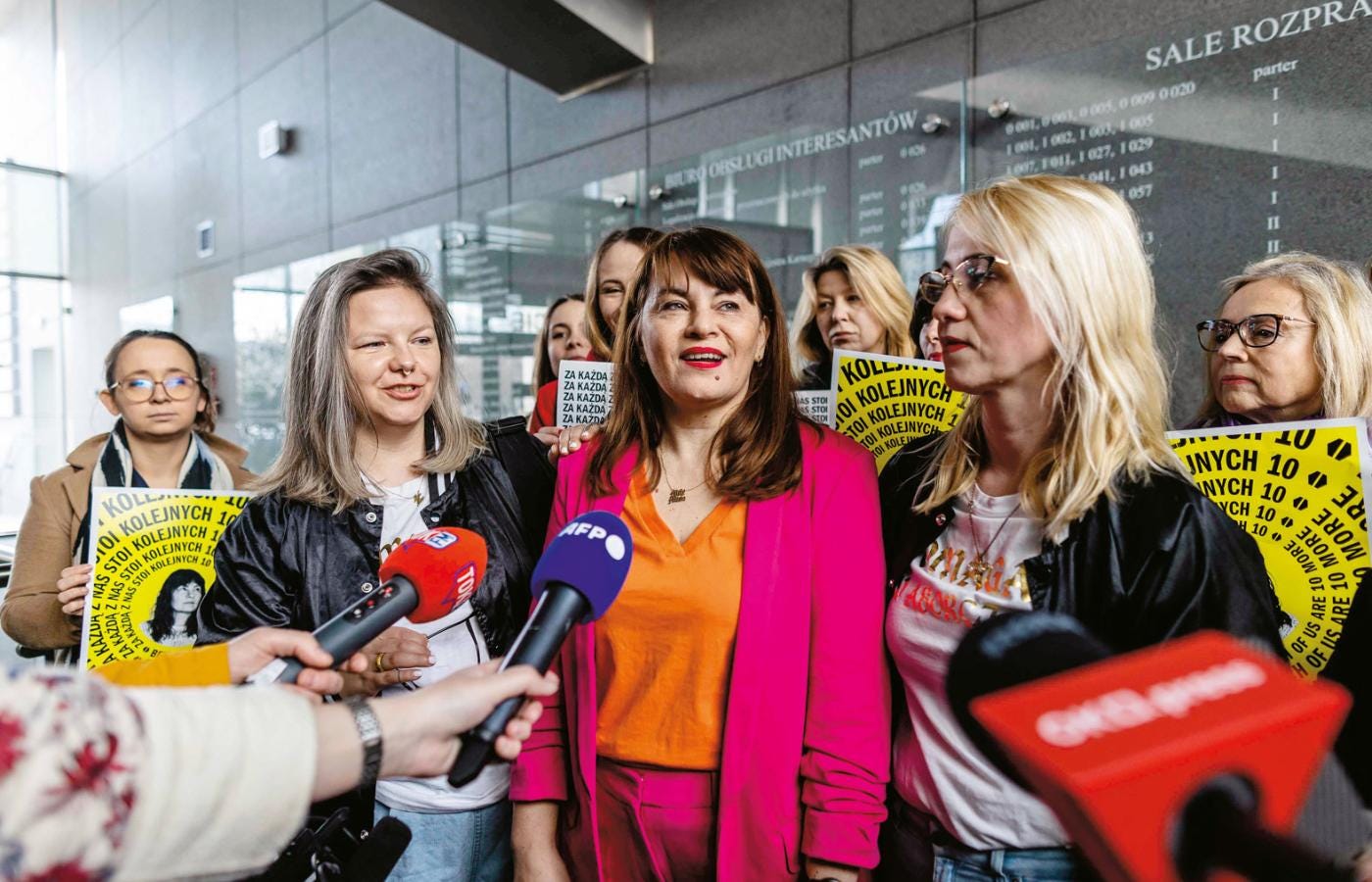
Wydrzyńska’s case reveals the strategic logic of Poland’s abortion regulation: while the state technically does not criminalize individuals who terminate their own pregnancies, it imposes prison sentences of up to three years on anyone providing material assistance. This creates a calculated form of reproductive isolation. Conservative legal organizations like Ordo Iuris—operating as non-governmental enforcers of church doctrine—have systematically lobbied for increased criminalization, developing prosecutorial frameworks specifically designed to target abortion networks and even those who distribute information about abortion access.10
The strategic alignment between Poland's reproductive regime and post-Roe America reveals the transnational character of contemporary anti-abortion politics. Since the termination of Roe v. Wade in 2022, American conservative forces have systematically implemented tactics refined through decades of Polish experimentation: weaponizing legal ambiguity to target abortion providers, expanding state surveillance capabilities, criminalizing information dissemination about abortion medication, and deputizing citizens as reproductive vigilantes through privatized enforcement mechanisms.11
Just as Polish religious conservatives have developed prosecutorial frameworks targeting anyone providing abortion support, American groups like Alliance Defending Freedom have crafted model legislation enabling similar criminalization.12 The same legal strategies that led to Wydrzyńska's prosecution in Poland are already being deployed across restrictive U.S. states, with laws designed to isolate and frighten those seeking abortions by criminalizing anyone who helps them.
But if American anti-abortion forces are learning from Poland, so too must abortion rights advocates. The Abortion Dream Team's boldness in creating Abotak demonstrates that waiting for political solutions is insufficient. Their direct action approach—creating visible, autonomous spaces for abortion access and information—offers a powerful template for resistance in post-Roe America. Just as Polish activists have built robust networks that bypass legal restrictions, similar infrastructure is emerging across restricted U.S. states. The lesson is clear: when governments criminalize essential healthcare, effective resistance requires building parallel systems of access and care.
Yet Poland simultaneously demonstrates the limitations of state power and the efficacy of counter-organization. The underground abortion networks operated by the Abortion Dream Team and others throughout Poland have not merely survived state repression; they have developed increasingly sophisticated infrastructures of resistance. Polish activists have constructed parallel systems that function entirely outside state regulation, creating autonomous mechanisms for abortion access that operate with or without legal sanction.
The electoral victory of Donald Tusk's centrist coalition in 2023 revealed the fundamental limitations of electoral politics in addressing reproductive autonomy. Despite campaign promises to legalize abortion up to 12 weeks, Tusk quickly retreated once in power, citing insufficient parliamentary support for substantive reform. Instead of substantive legislative reform, his government issued only symbolic adjustments, relying on vague administrative guidelines instructing doctors and prosecutors to "take women's side" when interpreting existing restrictions—technocratic gestures that preserve the fundamental architecture of reproductive control.
The abortion movement has responded by abandoning the politics of permission.
Abotak's establishment represents a decisive tactical evolution in Poland's reproductive struggle—signaling a movement's transition from underground networks and private assistance to visible, public creation of autonomous spaces.13 This shift abandons the limitations of reform politics in favor of constructing immediate, concrete alternatives to government restrictions. It represents a complete rejection of legal reform efforts in favor of a revolutionary claim to reproductive autonomy that operates entirely outside government oversight.
In constructing spaces of collective power, the movement creates actual freedom rather than theoretical rights. In a country determined to restrict reproductive autonomy, activists have developed working systems of care and support that operate regardless of legal status. As Poland demonstrates, the government may declare what is allowed, but organized resistance determines what is possible. The central question is no longer whether restrictive abortion laws can stop abortion (they cannot) but rather who will control reproductive access: lawmakers or organized communities. In Poland, as across the globe, the message is clear: reproductive freedom is not theirs to grant—it is already ours.
Dissent Index is a curated series on HELLRAISERS that examines pivotal movements, activists, and events in the history of resistance. Each installment profiles a different form of dissent, revealing how organized challenges to power have shaped societal change and continue to inspire contemporary struggles.
The opening of Abotak on International Women's Day (March 8, 2025) was strategically significant. Established to commemorate women's labor and voting rights struggles, International Women's Day has evolved into a global day of recognition for women's social, economic, and political achievements. In Poland, the date carries particular resonance after the massive Women's Strike protests against abortion restrictions began in 2016, with the red lightning bolt symbol becoming an emblem of reproductive rights resistance. By launching on this symbolic date, the Abortion Dream Team deliberately connected Abotak to this larger history of feminist struggle, framing abortion access as fundamentally intertwined with women's political and economic liberation.
Agnieszka Rakoczy, "Polish Activists Open Country's First Abortion Centre Despite Near-Total Ban," The Guardian, March 7, 2025.
The Abortion Dream Team is a Polish collective founded in 2016 by activists. The group provides abortion information and practical support while working to destigmatize abortion through education and public campaigns. Known for their bold messaging and direct-action approach, they explicitly embrace self-managed abortion and frame abortion access as a fundamental right.
Abortion Without Borders is a European network established in 2019 that provides information, funding, logistical support, and practical assistance to people in Poland seeking abortions. The coalition includes organizations from six countries: Abortion Dream Team and Kobiety w Sieci (Poland), Abortion Network Amsterdam (Netherlands), Abortion Support Network (UK), Ciocia Basia (Germany), Ciocia Wienia (Austria), and Women Help Women (global).
See also Weronika Strzyżyńska, "More Than 30,000 Polish Women Sought Illegal or Foreign Abortions Since Law Change Last Year," The Guardian, October 22, 2021.
On the weaponization of legal ambiguity to target abortion providers, see Tanya Albert Henry, “Ambiguous Anti-Abortion Laws Are Putting Patients at Risk,” American Medical Association, September 16, 2022.
For state surveillance and criminalization of abortion information, see Jolynn Dellinger and Stephanie Pell, “Bodies of Evidence: The Criminalization of Abortion and Surveillance of Women in a Post-Dobbs World,” Duke Journal of Constitutional Law & Public Policy 19, no. 1 (2024): 1–108.
On deputizing private citizens as enforcers of abortion bans, see Emma Bowman, “As States Ban Abortion, the Texas Bounty Law Offers a Way to Survive Legal Challenges,” NPR, July 11, 2022.
No posts
Comments
Nothing yet. Say the first thing.
Sign in to join the conversation.