
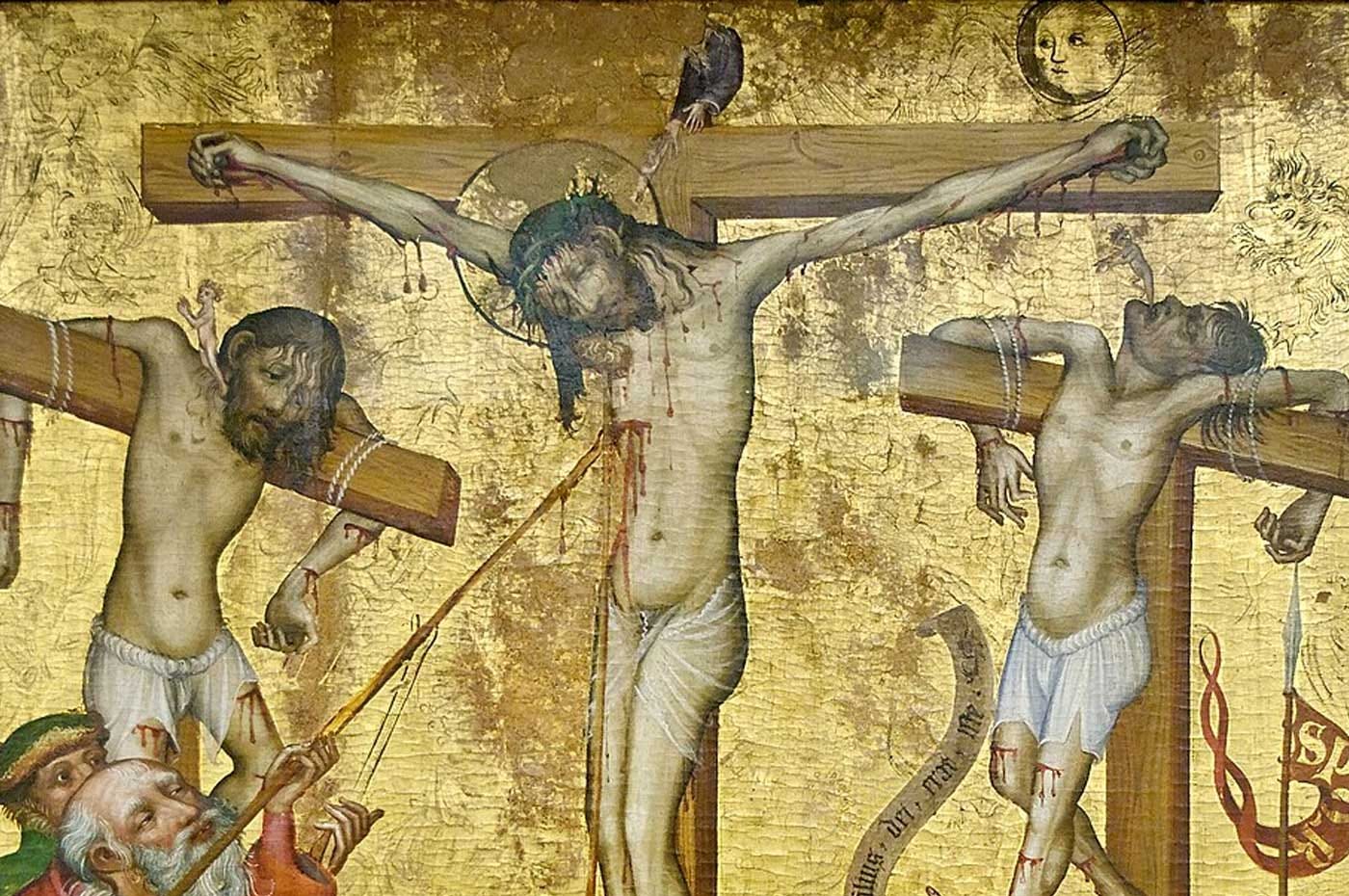
A couple of days ago while wandering a museum on a weekend trip to Italy, my partner’s sister asked me a question, and I think my answer caught her off guard.
“What did you think of the Passion of the Christ?” she asked as we pretended to be interested in painting after painting of Jesus’s crucifixion. We were really there to see only one thing—the big naked man—David (but then again that’s often true of my outings). “I never saw it,” I replied.
I think it shocked her that this now middle-aged millennial, who literally writes a blog called The Jesus Movement, and who has studied at two different seminaries (a story for another day), hadn’t seen the defining Jesus movie of our teenage years.
That’s because I had no interest then—or now—in seeing a horrifically violent film whose sole purpose was to shock and scare us into accepting Christianity’s most horrifically violent lie about Jesus: that God executed his own “Son” to take the punishment for sins.
If you grew up in or around U.S. American Protestantism, you know this story by heart.1 Jesus, when he was brutally murdered on the cross, took our punishment for sin—if we “believe” in him. Otherwise, we’re the ones who will get that punishment—eternally—in hell. This is called penal substitutionary atonement in fancy theological terms.
Except there are several, very big problems with this proposition that most people have probably never thought about. The simple statement, “Jesus died for our sins on the cross,” makes several huge assumptions. First and foremost: the assumption that God requires punishment for our sins. Says who?
Most of the Hebrew Bible is written as a warning to ancient Jews as a whole. Following God’s rules—as with much of ancient religion—was a shared activity. And so was the reckoning: success or failure, reward or punishment, fell on the people together. Continued observance of the Torah meant God’s favor and the continued existence of Jewish kingdoms; failure meant demise.2
The God of the Old Testament punishes people for transgressing the law—but that punishment is almost always collective. In Joshua, after a man named Achan violated a divine command by stealing forbidden spoils of war, the Israelite army was defeated in battle, and thirty-six men died for one man’s theft.3 The individual, one-man-dies-for-billions-of-individual-sins transaction that “Jesus died for your sins” assumes isn’t the kind of justice the Hebrew Bible portrays.
Christians will likely point to other passages as proof—several from Paul’s authentic letters, and the story of Adam and Eve in Genesis.4 But just as they could point to verses demonstrating God’s requirement for punishment, so too could I point to passages—including words from Jesus’s own mouth—that characterize God as a loving parent:
“The Lord is merciful and gracious, slow to anger and abounding in steadfast love… As a father has compassion for his children, so the Lord has compassion for those who [are in awe of] him.” - Psalm 103:8,13.
“When Israel was a child, I loved him, and out of Egypt I called my son… How can I give you up, Ephraim? How can I hand you over, O Israel? My heart recoils within me; my compassion grows warm and tender. I will not execute my fierce anger; I will not again destroy Ephraim, for I am God and no mortal, the Holy One in your midst, and I will not come in wrath.” - Hosea 11:1,8-9.
“Instead, love your enemies, do good, and lend, expecting nothing in return. Your reward will be great, and you will be children of the Most High, for he himself is kind to the ungrateful and the wicked. Be merciful, just as your Father is merciful.” - Luke 6:35-36.5
If we believe Jesus’s words here, would a merciful parent require punishment if one didn’t capitulate to a demand? If I receive mercy only after capitulating, is that really mercy, especially divine mercy?
The Bible is full of contradictions, and we are all forced to make decisions about what to believe and why. If you believe Jesus took your punishment for sin on the cross, you’re making a very big assumption about God—one based on a very specific reading of certain passages, not the obvious outcome of a plain-text reading of the whole book.
Conservative Christians treat penal substitutionary atonement as the only logical conclusion of reading the Bible. It isn’t—and the first thousand years of Christian history prove it.
The Bible narrates Jesus’s execution and asserts that humanity is somehow reconnected to God through it. It never actually explains, however, why we were disconnected to begin with, or how the reconnection works. Christian thinkers have spent two thousand years arguing over the answer (for an in-depth explanation, see my essay, “A Brief Look at Five Views on The Atonement of Christ”), and for the first thousand of those years, the dominant theory wasn’t substitution at all. It was ransom: the idea that Christ’s death was a payment to Satan to spring humanity from captivity. Strange as that sounds now, it was mainstream, defended by towering theologians like Gregory of Nyssa.
It took until roughly 1097 for an English monk, Anselm of Canterbury, to introduce the version most Christians now assume is the original one: the medieval idea that sin offends God’s honor, and only a God-man can restore it. It took five hundred years—during the Reformation, with Calvin specifically—for that idea to curdle into what we now call penal substitution: not honor restored, but punishment absorbed. The term “penal substitutionary atonement” wasn’t even coined until the nineteenth century.
The doctrine conservative Christians insist is the whole point of Christianity took eighteen centuries to arrive at its current form. Jesus was already ash and rumor by the time anyone had the specific idea now being sold to eight-year-olds in vacation Bible school.
Historical accident doesn’t explain why penal substitution, of all the available theories, became the one American evangelicalism built its entire identity around. The Italian theorist Antonio Gramsci’s idea of cultural hegemony explains it better: dominant classes rarely rule chiefly through force.6 They rule by making their preferred order feel like common sense—like the only way things could possibly be.
Penal substitution is common sense for a hierarchical, punishment-based society. It teaches that justice requires someone to suffer, that mercy only arrives after a debt has been extracted in blood, that submission to an all-powerful authority is the price of belonging. That is not a message that threatens power. It’s a training manual for obedience.
Compare it to what actually got Jesus killed. Rome crucified people publicly, slowly, and humiliatingly for one reason: to make an example out of anyone who threatened imperial order. It was state terror staged as spectacle, aimed at the crowd as much as at the man on the cross.
Mel Gibson’s two hours of unbroken torture is not a departure from that logic. It’s the same logic, replayed as devotional content. A theology that requires suffering to be extravagant in order to mean anything was always going to produce a movie like The Passion of the Christ eventually. The violence isn’t a filmmaking choice. It’s propaganda for a violent—and submission-driven—theology.
The New Testament scholar Marcus Borg, after decades studying this material, called the whole framework bad theology and bad history. The language of payment and appeasement doesn’t show up until later, and it was just one of many ideas that make their way into New Testament writings.7
Paul picks it up, and centuries later, rich white men in feudal Europe systematize it so the working class couldn’t imagine it any other way.
None of this means the cross doesn’t matter. It means it matters for a different reason than the one you were taught. I refuse to believe that Jesus was executed so God’s ledger could balance. He was executed because a radical Jewish peasant preaching a spiritual revival with debt forgiveness and a reversal of the social order was, correctly, read by Rome as dangerous. Originally, following him was never supposed to be a matter of believing the right theory about why he died. It was supposed to be a matter of doing what got him killed in the first place—and doing it anyway.
That’s the whole difference between the religion of Jesus and the religion about Jesus, compressed into one lie. The religion about Jesus asks you to accept a transaction. The religion of Jesus asks you to accept a mission.
Standing in that museum, looking at Michelangelo’s David—a man carved not in agony but in the moment just before the fight, calm, undefeated, entirely his own—I understood something about why I’d never wanted to sit through two hours of a different man being torn apart on-screen for my benefit. I already knew how it would end. I just didn’t believe it represented the angry God I spent so much of my life trying to run away from.
Consider becoming a paid supporter of The Jesus Movement, to help keep our work free, online, forever.
I qualify because I don’t want to speak about traditions with which I am unfamiliar. Also, I say Protestantism, because officially, the Roman Catholic Church embraces a similar—though substantially different view of atonement. Still, I argue many Western Catholics probably don’t know that, and have been infected by the dominant Protestant view.
Historians call this the Deuteronomistic framework: the editorial lens applied to Joshua through 2 Kings, where the nation's collective fidelity or infidelity determines its national fate. See Deuteronomy 28 for the covenant's collective blessings and curses, and Exodus 20:5, where judgment falls across generations rather than on individuals. For a full treatment, see John J. Collins, Introduction to the Hebrew Bible, 4th ed. (Minneapolis: Fortress Press, 2018).
The idea that Adam's sin left humanity guilty and awaiting punishment—"original sin"—is a doctrine developed by Augustine in the fourth and fifth centuries, built partly on a mistranslation of Romans 5:12 in the Latin text he used, which rendered Paul's Greek as "in whom all sinned" rather than "because all sinned." Judaism has no equivalent doctrine: in Jewish reading, Genesis 3 explains mortality and exile from Eden, not inherited guilt requiring payment.
I also got to visit the grave of Gramsci on this trip to Italy. He’s buried in the non-Catholic cemetery on the southern side of Rome, near Keats and Shelley.
Comments
Nothing yet. Say the first thing.
Sign in to join the conversation.