
I remember the first time I read the Sermon on the Mount on my own. Twenty-some years ago, I was a high school senior, standing in the middle of a suburban bookstore in North Central West Virginia. Encouraged by my evangelical friends to learn more about Jesus Christ, I picked up a blue and orange colored copy of an NIV Teen Study Bible and started to thumb my way through.
When I reached the orange-colored words of Jesus in Matthew 5—“Blessed are the poor...”—two profound feelings swept over me. The first was relief. This stuff made serious sense to a 17-year-old trying to find a spiritual and ethical lodestar in the world of George W. Bush, a lying government, two genocidal wars, and a state that overwhelmingly supported all three. “Blessed are the meek...” I could see the appeal in such words immediately.
But that moment of understanding was soon followed by a sense of confusion. Was I reading the right book? Is this like, the “official” thing? Because most of the Christians I knew were definitely not turning the other cheek. They were not loving their enemies. They were more concerned with policing women’s bodies and who I was personally attracted to (I gave off more than a little gay vibe1) than rejecting the evils of greed.
As I’ve grown older, I’ve come more to understand the reasons why. The first is that most of these people practice the religion ABOUT Jesus—which is far more concerned with policing beliefs and action—than the religion OF Jesus—a radical way of living and spirituality focused almost exclusively on love and justice.
The second is that Jesus laid out a blunt set of rules for ethical action that almost no Christian—despite what they may say—follows completely. This list is by no means exhaustive, but here are seven of them.2
In the opening days of our latest war in the Middle East (more accurately called Southwest Asia), a group of evangelical pastors prayed over our pedophile-protector-in-chief right in the Oval Office. Putting aside for a moment the church’s historic connection to child sex crimes cover-ups, none of these esteemed Christian leaders offered a prayer for the hundreds—if not thousands—of Iranians about to die.
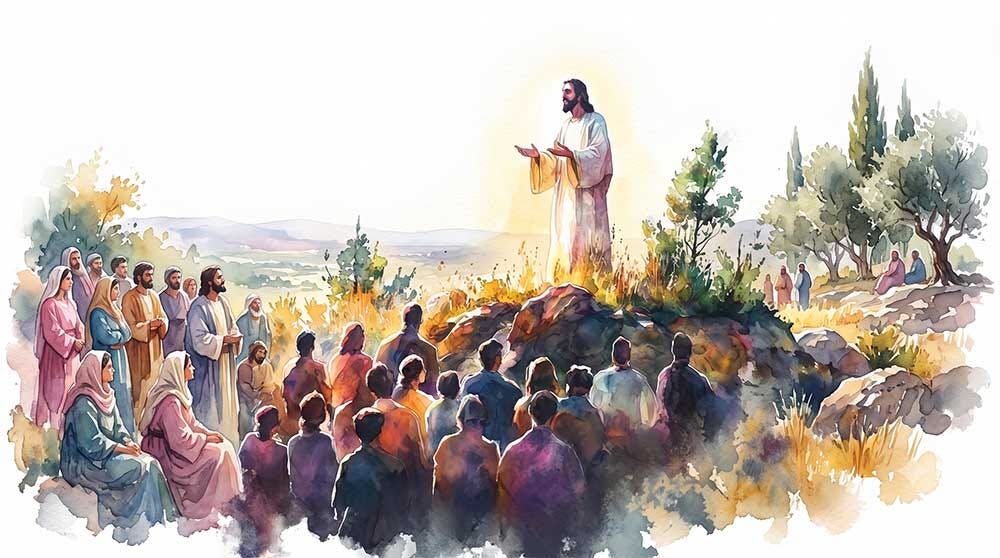
This is just a small example of how many Christians ignore an ethical commandment at the core of Jesus’s ministry—you must love your enemy. In the Sermon on the Mount, Jesus put it plainly:
“You have heard that it was said, ‘You shall love your neighbor and hate your enemy.’ But I say to you: Love your enemies and pray for those who persecute you.” (Matthew 5:43-44)
Imagine if those leaders had actually taken those words seriously, and implored Trump and the U.S. military to love their enemies and lay down their weapons? It would never happen (if partly because war is big business, the “defense” industry is a major donor to both parties). The truth is modern American Christians have never taken it seriously.
At the time I first read those words in the aisle of that Books-A-Million, in the long shadow of 9/11, exactly no one was offering a prayer for al Qaeda, the Taliban, or Saddam Hussein.
Yet—this commandment was likely as hard for Jesus’s original audience to hear as it is for us today. He was preaching to an occupied people, living under a foreign army with the legal right to kill them at will. Yet Jesus was telling them to love that army. He not only said it—but commanded it—and you’d be hard-pressed to find many Christians today who truly commit to this commandment of love.3
If rule number one is hard to follow, then rule number two—the first’s practical application—is impossible. Because nearly no one in American Christianity actually does it.
“You have heard that it was said, ‘An eye for an eye and a tooth for a
tooth.’ But I say to you: Do not resist an evildoer. But if anyone strikes you on the right cheek, turn the other also.” (Matthew 5:38-39)
Again, recall the days after 9/11. At no point, at least to the best of my recollection, did any major Christian leader preach “turning the other cheek.” (If anybody remembers otherwise, please drop it in the comments!) At exactly the moment it would have been most difficult—and precisely the moment it was most needed—the leaders of American Christianity turned their backs on the commandment of Jesus, their supposed God.
I say “most needed” because their dereliction of duty helped pave the way for two unnecessary wars that killed hundreds of thousands of innocent people. What would have happened if Billy Graham—who was still alive, and a much-vaunted counselor to presidents—had preached turning the other cheek?
Sadly, we will never know.
This one is so hard only a select few actually take it seriously. Throughout the Gospels, Jesus rails against the corrupting influence of wealth. In the Sermon on the Mount, he says,
“Do not store up for yourselves treasures on earth, where moth and rust consume and where thieves break in and steal, but store up for yourselves treasures in heaven, where neither moth nor rust consumes and where thieves do not break in and steal. For where your treasure is, there your heart will be also… No one can serve two masters, for a slave will either hate the one and love the other or be devoted to the one and despise the other. You cannot serve God and wealth.” (Matthew 6:19-21, 24)
This is really just the tip of the iceberg when it comes to Jesus and wealth. For example, although modern Christians are quick to point to John 3:16 when asked how to achieve eternal life, the Jesus of the Synoptic Gospels has a much different answer. Consider this passage in Luke, which appears also in Matthew and Mark. To this Jesus, the path to the Kingdom of God is not from merely believing in him:
A certain ruler asked him, “Good Teacher, what must I do to inherit eternal life?” Jesus said to him, “Why do you call me good? No one is good but God alone. You know the commandments: ‘You shall not commit adultery. You shall not murder. You shall not steal. You shall not bear false witness. Honor your father and mother.’” He replied, “I have kept all these since my youth.” When Jesus heard this, he said to him, “There is still one thing lacking. Sell all that you own and distribute the money to the poor, and you will have treasure in heaven; then come, follow me.” But when he heard this, he became sad, for he was very rich. Jesus looked at him and said, “How hard it is for those who have wealth to enter the kingdom of God! Indeed, it is easier for a camel to go through the eye of a needle than for someone who is rich to enter the kingdom of God.” (Luke 18: 18-25)4
The message—although obscured by millennia of theological backflips and propaganda by wealthy religious leaders—is clear: you cannot be rich and follow Jesus.
For sure this is bad news for megachurch pastors like Joel Osteen who have $10 million mansions—but it’s also bad for almost everyone who will read this essay today. If you make more than $40,000 a year, you’re in the top three to five percent of wage earners globally.5 That means you’re richer than 8 billion people—and under Jesus’s strict criteria, probably not headed for eternal life.
This one might seem small—but Jesus doesn’t mince words—and almost nobody follows it. Back to the Sermon on the Mount:
“Again, you have heard that it was said to those of ancient times, ‘You shall not swear falsely, but carry out the vows you have made to the Lord.’ But I say to you: Do not swear at all, either by heaven, for it is the throne of God, or by the earth, for it is his footstool, or by Jerusalem, for it is the city of the great King. And do not swear by your head, for you cannot make one hair white or black. Let your word be ‘Yes, Yes’ or ‘No, No’; anything more than this comes from the evil one.” (Matthew 5:33-37)
This may seem antiquated, but when you think about it, our society still takes oaths incredibly seriously. You have to take an oath before testifying in court, and breaking it can get you sent to jail. And if you work for the government, you’ll likely also have to take some oath declaring your loyalty to the Constitution. (Not that it matters that much these days.) But arguably our most Christian president ever—Jimmy Carter—took an oath of office. No one can imagine him standing on the dais of the Capitol and declaring, “This is from the evil one—let my word be yes,” rather than taking the oath of office.
This one—much like the others—is followed by absolutely no one. Nobody, if we’re honest, has ever made it through life without judging someone else. Jesus calls it out plainly:
“Do not judge, so that you may not be judged. For the judgment you
give will be the judgment you get, and the measure you give will be the measure you get.” (Matthew 7: 1-2)
He doesn't leave it there. Two verses later, in the same breath:
"Why do you see the speck in your neighbor's eye, but do not notice the log in your own eye?... You hypocrite, first take the log out of your own eye, and then you will see clearly to take the speck out of your neighbor's eye" (Matthew 7:3-5)
This isn't a stray one-liner. Jesus spends the whole passage building the case that self-righteous judgment is itself the disqualifying sin.
It's not a one-off idea in the sermon, either. A few verses earlier, Jesus glosses the Lord's Prayer's line about forgiving debts with a warning: if you don't forgive others, neither will you be forgiven (6:14-15). The measure you give is the measure you get shows up twice in three chapters. It's a structural principle of Jesus's ethics—and a requirement for entry into the Kingdom.
Beyond being nearly impossible to follow—we constantly make judgments, good and bad, about other human beings—this line has profound theological consequences. If taken literally, it’s a much higher bar than the one set by Paul, whose own gospel promises salvation through faith regardless of works. You would have to be impeccably perfect or excruciatingly forgiving. Either way, nobody does it.
Jesus also lays a near-complete prohibition on divorce in the Sermon on the Mount:
“It was also said, ‘Whoever divorces his wife, let him give her a certificate of divorce.’ But I say to you that anyone who divorces his wife, except on the ground of sexual immorality, causes her to commit adultery, and whoever marries a divorced woman commits adultery.” (Matthew 5:31-32)
This is part of the reason why the Roman Catholic Church forbids divorce (also, annulments are a cash cow6).
There is some speculation that Jesus may have offered this restriction on behalf of women who had very few legal rights—because men could leave women and take everything they had. This, however, is conjecture and debated. Regardless, the logic behind the rule is irrelevant, and according to Jesus, very rarely is divorce allowed.
I don’t think most Christians today take these rules seriously. That’s thanks in no small part to Paul and Martin Luther, who both claimed entry into the Kingdom of God is based on belief in the resurrection, not any specific action you took. (You can read more about my disdain for Paul here).
When confronted with this, most Christians lean on ambitious theological workarounds trying to justify why Jesus’s rules—especially around judgments, wealth, and divorce—don’t really apply. But Jesus himself was very clear about what would happen if you didn’t follow his rules:
“Whoever breaks one of the least of these commandments and teaches others to do the same will be called least in the kingdom of heaven, but whoever does them and teaches them will be called great in the kingdom of heaven. For I tell you, unless your righteousness exceeds that of the scribes and Pharisees, you will never enter the kingdom of heaven.” (Matthew 5:19-20)
The most common response is: Jesus didn’t really mean that. He was speaking ironically, he knew nobody could be that just (except himself). Still—if you believe in eternal punishment for those denied access into a next-life Kingdom of God, that’s a pretty big risk to take. Consider what Jesus says just a few chapters later:
“Not everyone who says to me, ‘Lord, Lord,’ will enter the kingdom of heaven, but only the one who does the will of my Father in heaven. On that day many will say to me, ‘Lord, Lord, did we not prophesy in your name, and cast out demons in your name, and do many mighty works in your name?’ Then I will declare to them, ‘I never knew you; go away from me, you who behave lawlessly.’” (Matthew 7:21-23)
Again, in contrast to Paul and Luther, Jesus sets the bar pretty damn high.7 And if you’re living your entire life for the next one, would it not be better to not judge, not get a divorce, and give all your money to the poor, just to be sure? Gambling it all on being on a jury or judging your neighbor for not cutting their lawn is a hell of a risk.8 The stakes seem too high to logic your way out of rules you don’t like.
Because the truth is, Jesus did set the bar incredibly high. Anybody who commands his followers not to take oaths or to renounce wealth seems not to have wanted a mass-market movement—ask any leftist organizer how hard it is to recruit wealthy people to support your anti-capitalist cause.
Not to mention, despite what conservative Christians want you to believe, the Bible is full of contradictions—around theology but also ethics. Some of these are clear here: the Jesus of the Synoptic Gospels is directly at odds with the Johannine Jesus and Paul when it comes to requirements of salvation. One is quite clear that moral living is required and not everyone will be saved—the other is the exact opposite.
This is further complicated by the fact that we don’t really know what’s authentically Jesus. Readers of The Jesus Movement will know that those of us who want to follow the historical Jesus are faced with a dizzying debate over nearly every passage on its authenticity. Are we actually prohibited from divorce except in cases of adultery? Bad news if you believe the Jesus Seminar—they actually think that exception to the rule was a later addition, and Jesus’s prohibition on divorce was total.
So what are we to do? The truth is that every single one of us views the words and teachings through our own religious framework—a thesis, if you will, by which we judge what they mean for our lives.
Most Protestants’ framework, as pointed out above, is built around Paul and Luther. To them, the reconciling work of Jesus’s crucifixion renders moot (to varying degrees) the rules of Jesus before his execution and resurrection. This doesn’t mean Protestants think anyone is free to sin or break these commandments outright; in their framework, the commandments function more as guidelines for living than as absolute requirements.
For many Progressive Christians and those of us who have left Christianity or the church behind, we must find a different framework. And the key, I believe, is in what Jesus himself said was the most important thing: the Greatest Commandment.
The Gospel of Matthew tells it this way:
When the Pharisees heard that he had silenced the Sadducees, they gathered together, and one of them, an expert in the law, asked him a question to test him. “Teacher, which commandment in the law is the greatest?” He said to him, “‘You shall love the Lord your God with all your heart and with all your soul and with all your mind.’ This is the greatest and first commandment. And a second is like it: ‘You shall love your neighbor as yourself.’ On these two commandments hang all the Law and the Prophets.” (Matthew 22:34-40)
The Greatest Commandment appears in all three Synoptic Gospels, but only in Matthew does Jesus add that last corollary about all the other commandments emanating from this one.
But here in black and white, and plain language, Jesus is telling us what is absolutely most important: loving God and loving others. Everything else—belief in the resurrection, going to church, the promise of eternal life—comes second to that.
What happens when we place the Greatest Commandment as our lens through which to see the ethical commandments of Jesus? First, we see an ancient man speaking to an ancient audience, who had no special powers to lift his thinking beyond the times of his age. He experienced but could not name the evils of empire, debt bondage, and extreme wealth concentration, and knew nothing of what would be required to keep a modern, democratic justice system running.
Thus, his other, lesser commandments must answer the questions, does this help me love God or others better? Would following that commandment today force me to break the Greatest Commandment?
Take, for example, his antiquated prohibition of divorce. Should a mother of two whose husband is mentally abusive—but has never cheated—stay with him? The better question is, if she stays anyway because Jesus forbade divorce, is she actually living out the Greatest Commandment? Is it an act of love for God or others? I would argue exactly the opposite.
We know through scientific studies just how damaging abusive relationships can be on not just the victim but the children. Staying in such a toxic situation because a man—divine or not, 2,000 years ago—said you should, is a clear violation of the Greatest Commandment.
The abuse example is really a test case for something bigger: the Greatest Commandment doesn’t let you off the hook of the seven rules above, but it also doesn’t let a rule become an excuse to cause harm in love’s name. That’s the actual discipline the religion of Jesus asks for—not picking which commandments are convenient to keep, but running every single one, in every situation, through one question: does this serve love, or does it just look like obedience?
That’s a harder religion to practice than the one sold in most American churches on a given Sunday. It comes with no doctrine that settles the matter in advance, no clean rule you can point to and say “I followed it, so I’m covered.” It comes with the daily, unglamorous work of holding every choice—who to forgive, what to do with money, when to walk away from a marriage, when to keep a promise—up against a single, unforgiving measure. Most of American Christianity spent two thousand years building elaborate ways not to ask that question. I’d rather ask it.
Consider becoming a paid supporter of The Jesus Movement, to help keep our work free, online, forever.
I proudly re-enacted Madonna’s video-ending dance from “Vogue” at the bus stop my sophomore year.
Before you come at me in the comments, I want to say that there are groups of Christians who do take these commandments seriously and vigorously try to keep them, most notably Catholic religious orders and Quakers. The algorithm does not reward nuance, however, so the more accurate headline, “7 Rules From Jesus That (Most) (or Conservative) Christians Absolutely REFUSE to Follow” would get buried and nobody would read this. So please read what might sound absolute with a grain of salt. My favorite Christians are those—liberal or conservative—who refuse to see Jesus’s ethical commandments as optional. The religion OF Jesus and ABOUT Jesus are not exclusives; many practice both.
Again, this is not to discredit the great tradition of Christian pacifism. I would argue though that they are an absolute minority in this history of the religion.
cf. Mark 10:17-22, Matthew 19:16-22.
This figure is derived from World Inequality Database and World Bank global income percentiles (adjusted for PPP/cost of living). While $40,000 USD historically represented the global top one percent, recent global wage growth and inflation place an individual earner at this threshold within the top three to five percent globally.
To be fair, Catholic sources say this is not true, and that annulments are actually a fiscal loss for the church. But it wouldn’t be the first time Rome has offered a heavenly escape route for an earthly price (see the Reformation).
I’m here all week ladies and gentlemen!
Comments
Nothing yet. Say the first thing.
Sign in to join the conversation.