
A quick logistics update: I paused billing for paying subscribers again. I’m a bit pre-occupied with the primary elections here in Massachusetts which will happen on September 1. I’m helping Patrick Roath to win the congressional seat for my district, MA-08. The incumbent, Stephen Lynch, has been the district’s representative for 25 years – more than enough, I think.

There are so many wondrous, extraordinary, baffling creatures on this Earth! I recently came across another one I knew very little about. I had heard the name but that was about it, so I wanted to find out what they looked like. Meet the tapirs!
These large mammals look like anteaters, or some say they look like pigs, but actually they’re relatives of horses and rhinoceroses. That’s because they belong to one of the three families of perissodactyla (from ancient Greek περισσός, perissós ‘odd’ and δάκτυλος, dáktylos ‘finger, toe’) – animals with hooves that have an odd number of toes on their hind feet. Horses, donkeys, and zebras belong to one family, rhinoceroses make up another one, and then there are the tapirs. Animals with hooves with an even number of toes are called artiodactyla (from ancient Greek ἄρτιος ártios ‘even’ and δάκτυλος dáktylos ‘finger, toe’). There are about 270 species belonging to this group, such as cows, goats, and sheep; also camels, giraffes, deer, and antelopes. Even some marine mammals belong to this group, whales, porpoises, and dolphins, because they had a terrestrial ancestor who gradually transitioned from land to sea some 49 million years ago.
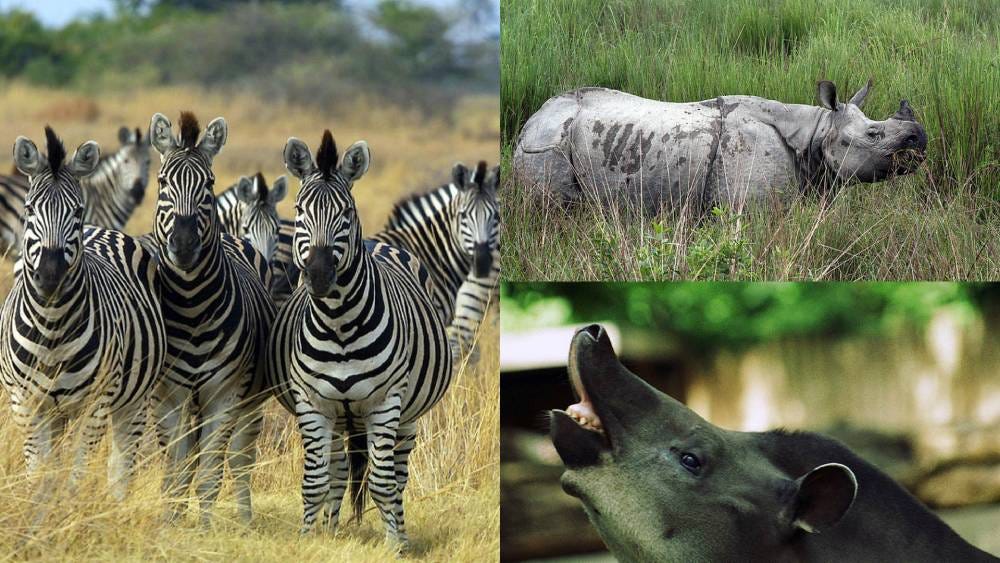
I hope you find such facts equally fascinating. While I quickly forget the scientific names, I hope I will remember that there are two orders of hooved mammals, and that whales once lived on land…
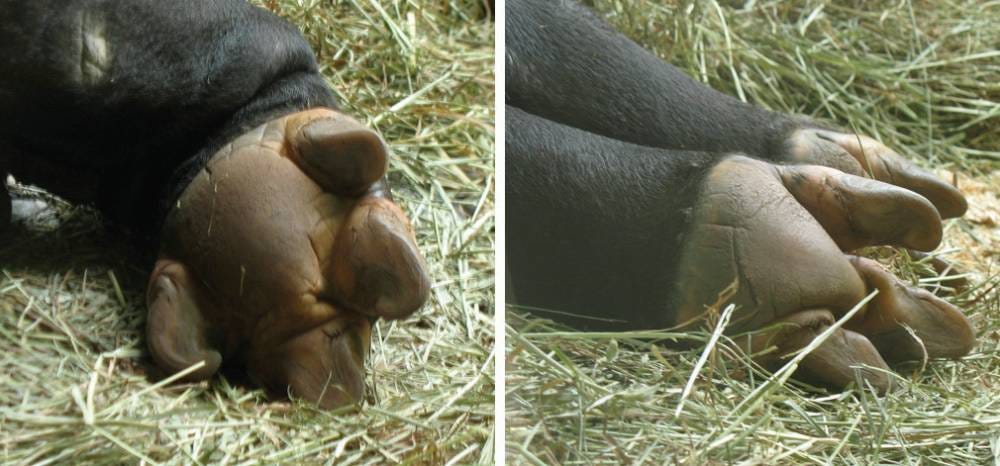
Tapirs have four toes on the front, and three on their hind feet, which helps to distribute their weight on soft forest soils and gives them more stability on muddy slopes. Like all other ungulates (large mammals with hooves) they eat only plants: berries, fruit, leaves, shrubs, grasses. They play an important ecological role as seed dispersers and are nicknamed “Gardeners of the Forest” by indigenous communities because they often swallow whole fruits and then eliminate the seeds far away from the original plant.
There are altogether four tapir species, three live in the Americas (the South American tapir, the Mountain or Andean tapir, and the Baird’s or Central American tapir) and one lives in Southeast Asia, the Malayan or Asian tapir. That’s the one with quite distinct markings, look at the picture below: the animal seems to be wearing an almost-white swimming trunk! They actually love the water and are good swimmers and divers. Often, they walk along the bottom of a river, just like hippos. They even can stay under water for several minutes!
A tapir is well-equipped for lengthy times under water because of their peculiar nose. It looks like the cross between a trunk and a snout, is highly flexible, and can move in all directions. It’s prehensile, meaning it can grip or grasp things, just like elephants with their trunks: pluck fruit and put it directly into their mouth, for example. Under water, it becomes a convenient snorkel. The different tapir species have different nose lengths: Malayan tapirs, who live in parts of Thailand, Malaysia, and Indonesia, have the longest snout and also are the largest of all tapirs. An animal can be up to 8 feet long and stands more than 3 feet tall; females are generally bigger than males. The Southamerican, also called the Brazilian tapir, has the shortest nose but nevertheless loves to swim, as you can see below! It helps them to cool down and protects them from biting insects.
There used to be tapirs in what is now Europe, but they became extinct approximately 2.6 million years ago. And some ancestors of the current tapirs, such as the Miotapirus, lived in North America some 20 million years ago… It’s rather sobering when you consider that Homo Sapiens showed up “only” 300,000 years ago. According to Wikipedia some 4,500 million years have gone by since the Earth was formed. I thought that human-caused extinctions of other living beings and negative human influences on ecosystems started with the Industrial Revolution, mainly in the 19th century. But scientific research has shown that humans caused serious environmental damage for more than 10,000 years. If you want to learn more, here is a great article from The Guardian.
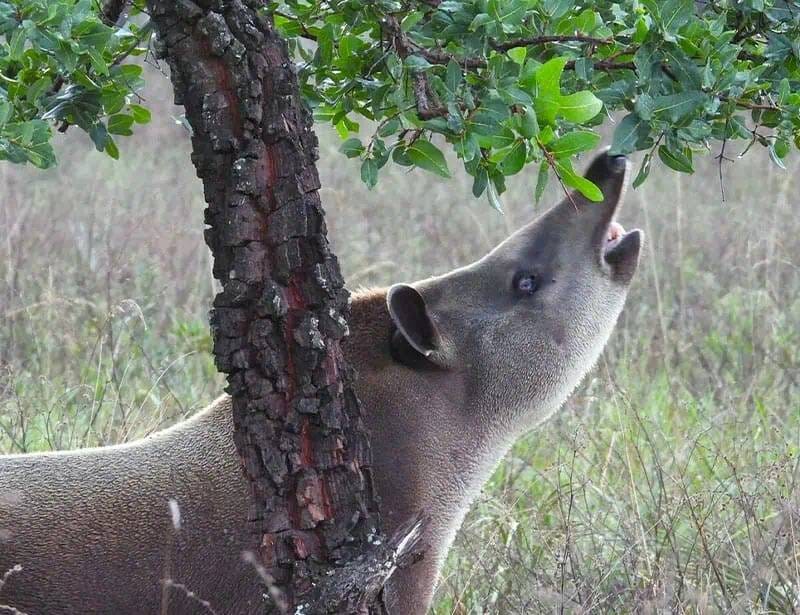
Of course, all four tapir species are seriously threatened. Although they lasted for millions of years, humans have brought tapirs to the brink of extinction. The population of the Brazilian (aka Southamerican) tapir has decreased considerably because of habitat loss; nearly half of the Cerrado and Atlantic Forest eco-regions have been lost due to conversion to cattle ranching and agriculture. The most threatened species is the Andean (or Mountain) tapir. Besides losing their habitat the animals are being hunted for their meat and hides, and they have even more bad luck: parts of them are being used for folk remedies and love potions. There may be only 2,500 individuals left in the wild – but this number hasn’t been updated since 2014 and may be woefully incorrect.
The IUCN (International Union for Conservation of Nature)’s Red List classifies the South American tapir as vulnerable and the other three species as endangered. Again – these numbers are from 2014. While the IUCN website states that the Red List gets updated at least twice a year, I frequently came across listings that were over ten years old. I sent them an email and even got a friendly answer which informed me that they try to reassess species every five to ten years, but they rely on volunteers and may be behind. Which makes the list unreliable, unfortunately.
Mexico is planning to open a Tapir Sanctuary in Yucatán by the end of the year, the Santuario del Tapir. They’re expecting three individuals of the Baird’s or Central American tapir species, one male and two females who come from Guatemala. At the sanctuary they will have the space and protection to breed, and will eventually be released into the wild. There’s enough space to house four breeding pairs.
And there is the Baird’s Tapir Survival Alliance, a team of conservationists from Mexico, Guatemala, Belize, Honduras, Nicaragua, Costa Rica, and Panama who work with local initiatives to protect and save the animals. Similar efforts are underway to rescue the Malayan tapir by declaring the Sungai Dusun Wildlife Reserve in Malaysia a sanctuary for animals who have come in conflict with humans. Having lost their homes because of heavy deforestation due to palm oil production, the animals wander into plantations and urban areas where they are at an enormous risk of injury or death from human retaliation, vehicle collisions, poaching, and accidental snare trapping. The Reserve is managed by Malaysia’s Department of Wildlife and National Parks and implements conservation measures such as breeding, husbandry, and rehabilitation programs.
Let’s hope all four tapir species will last another few million years. As much as humanity is to blame for the devastating destruction of nature everywhere, it always gives me hope when I learn of the many humans who deeply care for the more-than-human world.
Comments
Nothing yet. Say the first thing.
Sign in to join the conversation.